
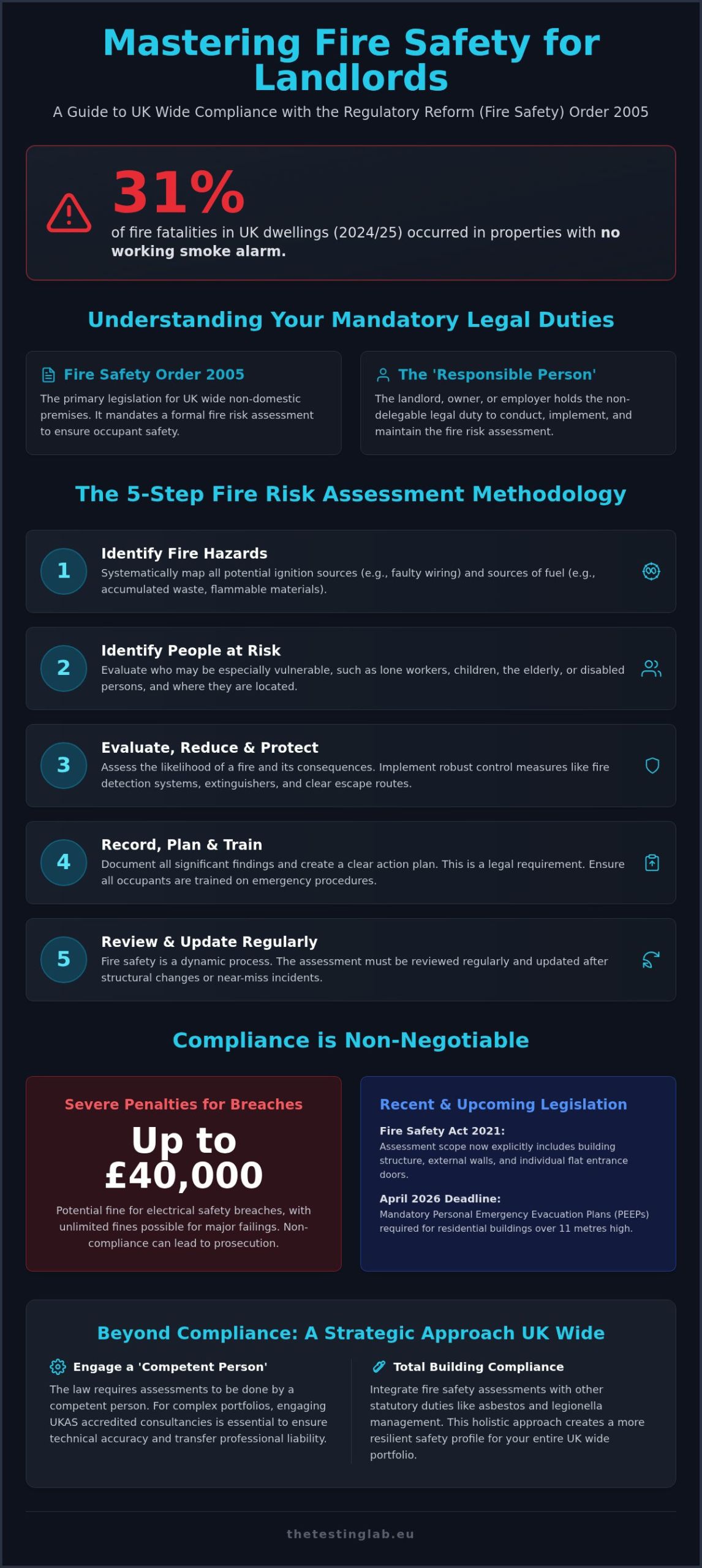
Did you know that 31% of fire fatalities in UK dwellings during 2024/25 occurred in properties without a single working smoke alarm? It’s natural to feel overwhelmed by the Regulatory Reform (Fire Safety) Order 2005 and the 2026 requirements for Residential Personal Emergency Evacuation Plans. You want to protect your tenants, but the fear of legal liability or a £40,000 fine for safety breaches is a heavy burden. Securing a technically sound fire risk assessment for landlords is the essential first step toward removing that professional weight from your shoulders.
This guide helps you master safety legislation with an engineering mindset. We’ll provide a clear roadmap to reduce hazards and ensure your premises meet every stringent UK standard. By following this methodology, you’ll gain a precise action plan for full compliance and peace of mind. We deliver these essential assessments UK wide to ensure your buildings remain secure and legally robust.
Key Takeaways
- Understand your mandatory duties under the Regulatory Reform (Fire Safety) Order 2005 and the professional responsibility held by the ‘Responsible Person’.
- Master the systematic 5-step methodology to conduct a comprehensive fire risk assessment for landlords across your UK wide property portfolio.
- Learn how to transform documented findings into a dynamic emergency plan that ensures full legal compliance and maximum occupant safety.
- Discover the benefits of a strategic partnership that integrates fire safety with asbestos and legionella management for total building compliance.
UK Fire Safety Legislation: The Regulatory Reform (Fire Safety) Order 2005
The Regulatory Reform (Fire Safety) Order 2005 stands as the primary legislation governing fire safety for UK wide commercial and multi-occupancy premises. It shifts the burden of safety from the fire service to the “Responsible Person,” typically the employer, owner, or landlord. This individual holds a non-delegable legal duty to ensure a rigorous fire risk assessment is conducted. For those managing residential portfolios, securing a valid fire risk assessment for landlords isn’t just a best practice; it’s a statutory requirement to prevent catastrophic failure and avoid severe civil penalties.
Recent legislative updates, specifically the Fire Safety Act 2021, have expanded these duties. The Act clarifies that for multi-occupied residential buildings, the assessment must now explicitly include the structure, external walls, and individual flat entrance doors. Precision in identifying these hazards is vital. A lack of methodological rigour can lead to legal non-compliance, leaving the Responsible Person vulnerable to prosecution or significant fines, which can reach unlimited amounts for gas safety failures or up to £40,000 for electrical breaches.
The Definition of a Competent Person in Fire Safety
The law requires that the assessment be carried out by a “competent person.” While owners of simple, low-risk premises might attempt a self-assessment, complex structures demand a higher level of technical expertise. A competent person must possess sufficient training and experience to evaluate intricate building systems. UK wide operations benefit significantly from engaging UKAS accredited consultancies. These strategic partners, like those offering integrated asbestos consultancy, provide a tier of risk mitigation that solo assessors can’t match. They apply an engineering mindset to ensure every structural risk is documented with scientific accuracy, taking the professional responsibility off the landlord’s shoulders.
The 5 Essential Steps of a Comprehensive Fire Risk Assessment
Executing a precise evaluation requires a methodological framework. Following the official 5-step fire safety risk assessment checklist ensures that no critical hazard is overlooked. This systematic approach is the backbone of a valid fire risk assessment for landlords, providing a clear audit trail for UK wide compliance and ensuring every property meets its legal obligations.
Methodology: From Hazard Identification to Risk Reduction
The process begins with identifying fire hazards. This involves mapping potential ignition sources, such as faulty wiring or heating equipment, and combustible fuel sources like paper, waste, or structural materials. Simultaneously, the assessor must identify people at risk, which is a critical component of a thorough fire risk assessment for landlords managing HMOs or high-rise blocks where evacuation routes may be complex.
Evaluation is the core of risk mitigation. You must assess the likelihood of a fire and the potential consequences, then implement measures to eliminate or reduce these risks. Step four involves recording your findings with precision; this is a legal requirement for buildings with five or more employees or those requiring a licence. Finally, establishing a rigorous review schedule ensures the plan remains dynamic. It’s vital to update the assessment after structural changes, near-miss incidents, or when new regulations like the April 2026 Residential Personal Emergency Evacuation Plans (RPEEPs) take effect for buildings over 11 metres.
A comprehensive assessment culminates in a clear action plan. This includes designing logical fire escape routes and installing high-visibility signage to guide occupants safely. Effective fire safety management is a continuous process of quality control, not a one-time event. If you require expert guidance on these technical requirements, you can consult with our specialist team to ensure your documentation meets the highest UK standards.
Beyond Compliance: Strategic Fire Safety Management UK Wide
Effective fire safety is more than a tick-box exercise; it’s a critical component of a total building compliance strategy. For national property managers, integrating a fire risk assessment for landlords with other statutory duties like asbestos consultancy creates a more resilient safety profile. This holistic approach ensures that structural risks aren’t viewed in isolation but as part of a managed ecosystem. It allows for a more sophisticated understanding of how building materials and fire protection systems interact over time.
UK wide businesses gain significant operational efficiency by working with a single strategic partner. Managing legionella risk assessments, fire safety, and material testing through one point of contact reduces administrative friction. It also allows for deeper technical analysis. For example, lab-backed inspections of fire doors and compartmentation provide certainty that visual checks alone can’t offer. At The Testing Lab PLC, we act as an extension of your team, taking the burden of professional responsibility off your shoulders through UKAS accredited precision.
Integrating Building Safety for National Operations
A unified approach to asbestos and legionella surveying streamlines compliance for UK wide property portfolios. Instead of managing disparate contractors, landlords receive consistent, high-quality data across all sites. Our status as an independent, UKAS accredited laboratory means every material analysis and fire risk assessment for landlords is grounded in scientific fact. This level of methodological accuracy is essential for verifying building material safety and maintaining the long-term integrity of complex facilities. By centralising these critical functions, you ensure that your safety protocols are always current, robust, and legally defensible.
Secure Your Property with Integrated Safety Compliance
Managing a property portfolio requires more than just meeting basic legal standards; it demands a proactive, engineering-led approach to risk. By following the statutory five-step framework and staying ahead of the Fire Safety Act 2021, you protect both your tenants and your professional reputation. A robust fire risk assessment for landlords is most effective when integrated into a broader building safety strategy. This includes managing complex risks like asbestos and legionella through a single strategic partner.
As a UKAS accredited independent laboratory with national UK wide coverage, we provide the technical precision needed for total peace of mind. We take the professional responsibility off your shoulders so you can focus on your core operations. Request a quote for professional fire risk assessment and building compliance today. Ensuring safety is a continuous journey, and we’re here to guide you every step of the way.
Frequently Asked Questions
What is a Fire Risk Assessment and is it legally required UK wide?
A fire risk assessment is a systematic evaluation of your premises to identify potential fire hazards and at-risk individuals. It’s a legal requirement UK wide under the Regulatory Reform (Fire Safety) Order 2005 for nearly all non-domestic properties. For those managing residential blocks, a fire risk assessment for landlords is mandatory to ensure communal areas and structural fire protection meet every safety standard.
Who is the ‘Responsible Person’ for fire safety in a commercial building?
The ‘Responsible Person’ is the individual or entity in control of the premises, such as an employer, building owner, or landlord. They hold the non-delegable legal duty to ensure fire safety measures are implemented and maintained. In complex or multi-tenanted buildings, several parties may share this role, requiring a coordinated approach to ensure the entire facility remains compliant with UK wide safety legislation.
How often should a professional fire risk assessment be reviewed?
While the law doesn’t define a specific expiry date, your assessment must be reviewed regularly to stay valid. Professional consensus recommends an annual review or an immediate update if the building undergoes structural changes, occupancy shifts, or near-miss incidents. A dynamic fire risk assessment for landlords ensures that safety protocols evolve alongside the building, maintaining a rigorous action plan for occupant protection at all times.
What are the penalties for non-compliance with fire safety regulations in the UK?
Penalties for fire safety failures are severe and can include unlimited fines or custodial sentences of up to two years. Local fire authorities can issue enforcement notices that can halt business operations until hazards are rectified. With civil penalties for related safety breaches reaching up to £40,000, maintaining a methodologically sound risk management strategy is essential for protecting your assets and ensuring full legal compliance.
Can I perform my own fire risk assessment or do I need a professional?
You can conduct your own assessment if you possess the training and experience to be deemed a “competent person.” However, for complex structures, the technical requirements for compartmentation and material analysis are often beyond the scope of a layperson. Engaging a UKAS accredited strategic partner ensures your assessment is backed by laboratory-grade precision, effectively removing the burden of professional responsibility from your shoulders.

Article by
P J F Thomas
CEO and Founder of TTL plc.
Disclaimer
Items declared are AI generated but do reflect our services. Please get in contact if you have any questions.