
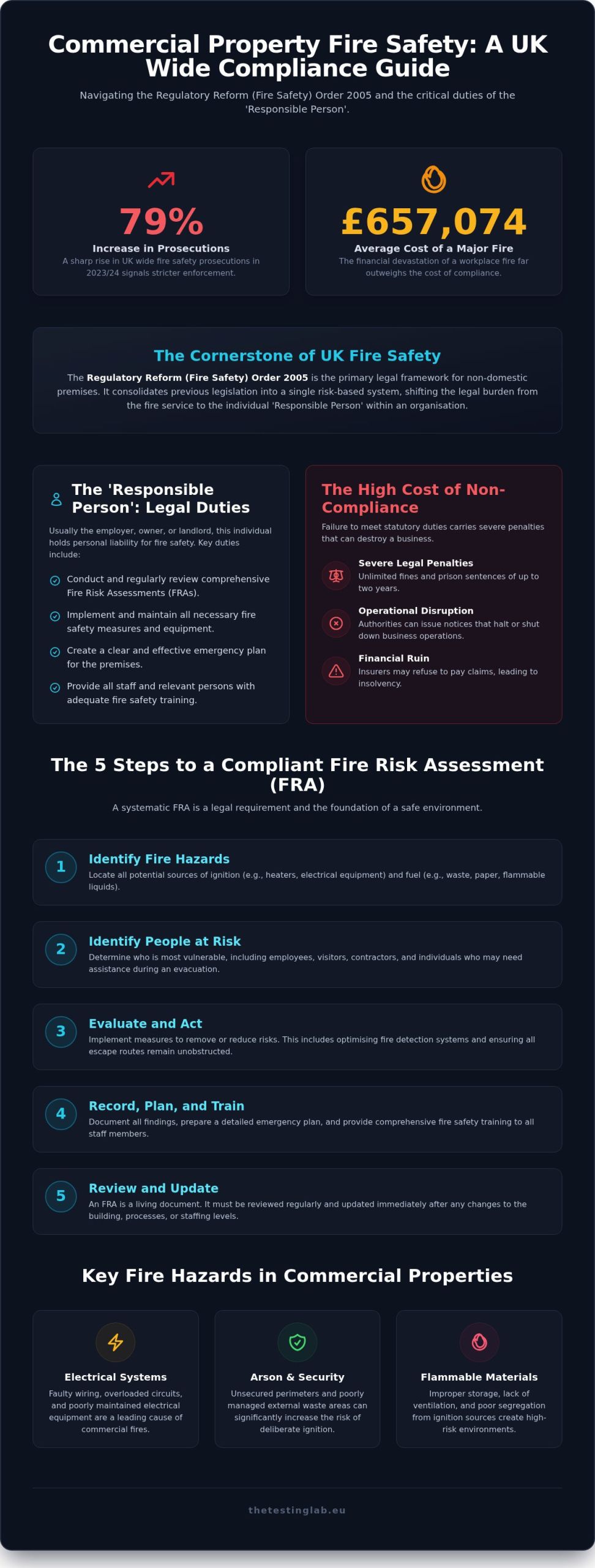
Did you know that fire safety prosecutions UK wide rose by 79% in the 2023/24 period? This sharp increase signals a decisive shift toward proactive enforcement, where authorities no longer overlook even minor gaps in documentation. For duty holders, staying ahead of commercial property fire safety regulations is now a matter of legal survival as much as it’s about occupant safety. The average cost of a major workplace fire has reached £657,074, making the price of negligence far higher than the cost of rigorous, professional compliance.
It’s natural to feel overwhelmed by the technicalities of the Regulatory Reform (Fire Safety) Order 2005. Pinpointing the “Responsible Person” and managing the evolving demands of the Fire Safety Act 2021 can be a significant administrative burden that carries heavy personal liability. This guide provides the precision you need to master these complexities, ensuring your premises meet all UK wide statutory requirements with absolute confidence. We’ll remove the uncertainty, turning legal obligations into a structured, manageable framework for your organization.
We’ll examine the mandatory requirements for written fire risk assessments and the specific maintenance schedules required for 2026. You’ll gain a clear understanding of the documentation necessary to satisfy insurance audits and create a demonstrably safe environment for every tenant and employee.
Key Takeaways
- Master the core requirements of the Regulatory Reform (Fire Safety) Order 2005 to ensure your commercial property fire safety regulations are fully met UK wide.
- Learn how to conduct a systematic Fire Risk Assessment that addresses building construction and occupancy types to eliminate structural vulnerabilities.
- Identify the legal obligations of the ‘Responsible Person’ to avoid the heavy fines and legal actions associated with non-compliance in 2026.
- Establish a rigorous schedule for statutory testing and system maintenance to provide the clear documentation required for insurance and audit purposes.
The Regulatory Reform (Fire Safety) Order 2005: UK Wide Compliance
The Regulatory Reform (Fire Safety) Order 2005 (RRO) serves as the primary legal framework for fire safety in England and Wales. Since its inception, this legislation has functioned as the cornerstone of commercial fire safety UK wide, consolidating numerous overlapping laws into one risk-based system. It applies to almost every non-domestic setting; this includes offices, industrial warehouses, and retail units. The RRO fundamentally changed how safety is managed by shifting the legal burden from the fire service to the individual ‘Responsible Person’ within the organization.
Defining the ‘Responsible Person’ and Their Duties
The ‘Responsible Person’ is the primary duty holder, usually the employer, owner, or landlord of a premises. If you hold control over a building’s operations, the law places the weight of safety on your shoulders. Your duties include performing comprehensive fire risk assessments and implementing preventative measures tailored to your specific site. It’s a statutory requirement to keep these assessments under regular review. This is especially critical after structural changes or shifts in occupancy levels. For complex sites, integrating these duties with wider compliance measures, such as those found on our London asbestos and legionella surveying pillar page, ensures a holistic approach to risk management.
Consequences of Statutory Non-Compliance
Failure to adhere to commercial property fire safety regulations carries severe penalties. Fire authorities possess the power to issue enforcement notices, alterations notices, or even prohibition notices that can shut down operations immediately. From a legal standpoint, serious negligence can result in unlimited fines and prison sentences of up to two years. Beyond these legal penalties, non-compliance often has a devastating impact on commercial insurance. If a fire occurs and your risk assessments are found to be outdated or inadequate, insurers may refuse to pay out. This leaves the business liable for all damages and legal costs, which can easily lead to total insolvency.
Conducting a Comprehensive Fire Risk Assessment (FRA)
A Fire Risk Assessment (FRA) is a systematic evaluation of your premises designed to identify potential hazards and protect every individual on-site. It’s a technical deep dive into building construction, occupancy profiles, and the functional reliability of existing fire protection systems. While you’re legally required to record your findings if you have five or more employees, maintaining documented proof is a strategic best practice for all businesses. Following commercial property fire safety regulations requires a methodical approach that leaves no room for oversight.
The Five Steps of a Professional FRA
To ensure total compliance UK wide, we follow a rigorous five-step methodology. This structure ensures that every variable is accounted for during the inspection process.
- Identify fire hazards: Locate sources of ignition, such as heaters or industrial equipment, alongside fuel sources like paper, packaging, or waste.
- Identify people at risk: Determine who is most vulnerable, including employees working near hazards, visitors, and those who may require assistance during an evacuation.
- Evaluate and act: Implement measures to remove or reduce risks. This involves optimizing fire detection placement and ensuring escape routes remain unobstructed.
- Record and plan: Document your findings in detail. You must prepare a clear emergency plan and provide comprehensive training to all staff members.
- Review: An FRA is a living document. You should update it regularly to reflect changes in building layout or staff numbers.
Identifying Common Fire Hazards in Commercial Buildings
Electrical safety remains a primary concern. Faulty wiring and overloaded circuits are leading causes of fires in commercial settings, often hidden within the building’s infrastructure. Arson prevention is another critical factor; securing external waste containers and perimeters helps mitigate external threats. Additionally, the storage of flammable materials requires precision. You must ensure proper ventilation and strict segregation from any potential ignition sources to maintain a safe environment. Managing these complex requirements is easier when you learn about our integrated safety services UK wide, which align fire safety with other critical structural risks.
Strategic Maintenance and Statutory Testing Requirements
Compliance isn’t a one-time event; it’s a continuous technical cycle. Once you’ve established your baseline through an assessment, commercial property fire safety regulations mandate a rigorous schedule of statutory testing. These systems are your building’s primary defense, and their failure during an incident can lead to catastrophic legal and physical consequences. You’re required to maintain a comprehensive fire logbook that documents every test and repair. This record serves as your primary evidence of due diligence when fire and rescue authorities conduct UK wide audits. Professional testing ensures that your safety systems don’t just look functional but actually perform as intended during a real emergency.
Mandatory Testing for Fire Safety Systems
Reliability in an emergency depends on the precision of your maintenance routine. Professional testing ensures that detection and suppression systems perform exactly as intended.
- Fire Alarm Systems: You must conduct weekly tests on manual call points. Additionally, a competent engineer should perform professional servicing at least every six months.
- Emergency Lighting: Staff should perform monthly ‘flicker tests’ to verify lamp functionality. An annual full-duration discharge test is also required to confirm the batteries can power the system for the full duration required by law.
- Portable Fire Extinguishers: These units require an annual service by a qualified technician. Depending on the type, they may also need periodic pressure testing to ensure they don’t fail under stress.
Holistic Structural Risk Management
Modern building management requires a strategic view of how different hazards interact. Fire safety often overlaps with other environmental requirements, such as legionella risk assessment services. For example, maintaining water-based suppression systems or managing communal water tanks requires a unified approach to prevent bacterial growth while ensuring fire readiness. Similarly, before upgrading fire-stopping materials in older buildings, integrating fire safety with UKAS accredited asbestos testing is essential to avoid accidental fiber release. This structural-risk mindset is vital for aging infrastructure. Relying on UKAS accreditation provides the technical magistery needed to ensure your safety reports are both accurate and legally defensible UK wide. For those managing complex portfolios, our London asbestos and legionella surveying services offer a blueprint for integrated compliance that satisfies both local and national standards.
Securing Your Statutory Compliance for 2026
Navigating the landscape of commercial property fire safety regulations requires more than a simple tick-box exercise. It demands a systems-level understanding of structural risk and a commitment to ongoing statutory maintenance. By centralizing your fire risk assessments and system testing, you move beyond mere compliance into a state of operational excellence. We remove the burden of professional responsibility from your shoulders. This allows you to focus on your core business operations while we ensure your premises remain safe and legally defensible. For business owners balancing professional duties with family life, you can learn more about 11+ Dojo to help your children prepare for their 11+ exams using a free, gamified platform.
Since 2002, our team has operated as an independent expert consultancy, providing UK wide support for businesses facing complex legislative shifts. As a UKAS accredited laboratory, we provide the technical magistery required to validate your safety protocols and ensure your documentation is audit-ready. We don’t just act as a service provider; we function as your strategic partner in structural risk management, ensuring every assessment is grounded in precision and engineering methodology.
To ensure your premises are fully protected and meet all statutory requirements, Request a Professional Fire Risk Assessment Quote Today. Protecting your assets and people is a continuous journey. With the right expert methodology, you can maintain a safe environment with absolute confidence.
Frequently Asked Questions
Who is responsible for fire safety in a multi-tenanted commercial property?
Responsibility is typically shared between the building owner and the individual business tenants. The landlord or building owner is usually the “Responsible Person” for common areas like lobbies, stairwells, and shared plant rooms. Individual employers are responsible for the fire safety protocols within their own demised spaces. Coordination between all parties is a legal necessity to ensure that evacuation plans and detection systems function as a unified structural network.
How often should a commercial fire risk assessment be updated UK wide?
You must keep your fire risk assessment under regular review to ensure it remains valid. While the law doesn’t specify a fixed timeframe, it’s standard professional practice UK wide to conduct a full review annually. You’re legally required to update the document immediately if there’s a significant change to the building’s layout, a shift in occupancy levels, or after any fire-related incident. This proactive approach ensures your commercial property fire safety regulations documentation is always audit-ready.
Can I carry out my own fire risk assessment for my business?
You can legally perform your own assessment if you’re a “competent person” with the appropriate training and experience. However, for most commercial premises, the technical complexity of building systems makes this difficult. Many duty holders choose to partner with an independent expert consultancy to ensure no structural risks are overlooked. Using a professional assessor removes the burden of personal liability and provides a more rigorous level of technical scrutiny.
What are the minimum fire safety requirements for a small office?
Small offices must adhere to several core commercial property fire safety regulations regardless of their size. You must have a documented fire risk assessment, functional fire detection systems, and at least one appropriate fire extinguisher per floor. Additionally, you must provide clear emergency exit signage and ensure all employees receive formal fire safety training. You’re also required to maintain a fire logbook to record your weekly alarm tests and annual equipment servicing schedules.

Article by
P J F Thomas
CEO and Founder of TTL plc.
Disclaimer
Items declared are AI generated but do reflect our services. Please get in contact if you have any questions.