Can you truly identify a microscopic health hazard simply by glancing at a textured surface? The dangerous myth that visual inspection is sufficient for identifying asbestos in ceiling tiles what to do often leads to either costly overreactions or, more critically, hazardous exposure. If you’ve discovered damaged tiles in a building constructed before 2000, your concern for occupant safety and legal liability is entirely justified.
We understand that navigating the Control of Asbestos Regulations 2012 can feel like a burden, especially with the Health and Safety Executive tightening compliance standards following the January 2026 consultation. This article provides a precise, professional roadmap to help you manage these risks across your UK wide portfolio. You’ll learn the exact safety protocols to follow, the legal necessity of UKAS accredited laboratory analysis, and how to establish a robust digital management plan. By following a structured approach to professional surveying and testing, you can shift from a state of uncertainty to one of documented safety and total regulatory compliance.
Key Takeaways
- Understand the technical reasons why Asbestos Insulation Board (AIB) was used for fireproofing and why visual identification alone is insufficient for safety.
- Learn the essential immediate protocol regarding asbestos in ceiling tiles what to do, including why stopping work and isolating the area is critical to prevent fibre migration.
- Gain clarity on your legal “duty to manage” under the Control of Asbestos Regulations 2012 to ensure compliance across your UK wide property portfolio.
- Discover how UKAS accredited laboratory analysis and professional surveys provide the definitive data required for safe management or refurbishment.
- Establish a clear path to professional certification through air clearance and consultancy, removing the burden of risk from your operational team.
Identifying Asbestos in Ceiling Tiles: Types and Health Risks
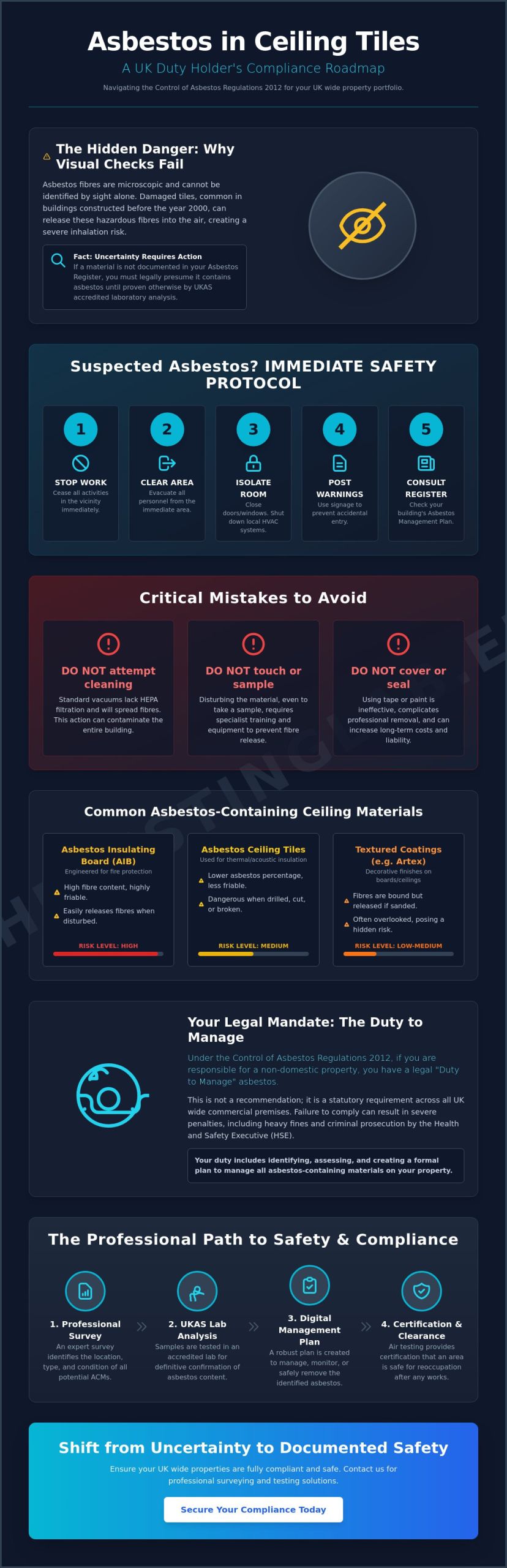
Identifying asbestos-containing materials (ACMs) within suspended ceiling systems requires more than a visual assessment. Historically, manufacturers integrated asbestos into ceiling products to achieve high performance in fireproofing, thermal insulation, and acoustic dampening. For a comprehensive Asbestos overview, it’s clear why these minerals were favoured across the construction industry until the UK wide ban in 1999. Consequently, any building constructed or refurbished before 2000 is statistically likely to contain asbestos. If you’re managing such a property, knowing about asbestos in ceiling tiles what to do begins with understanding the material’s physical nature. The fibres are microscopic and invisible to the naked eye. When tiles are damaged or degraded, these fibres become airborne, creating a severe inhalation hazard for occupants.
Common Types of Asbestos-Containing Ceiling Materials
Ceiling systems often hide different grades of ACMs, each requiring a specific management approach. While standard drop-in tiles might contain lower percentages of asbestos, Asbestos Insulation Board (AIB) represents a significantly higher risk profile. AIB was engineered for structural fire protection and contains a higher concentration of fibres, making it far more hazardous if disturbed. Additionally, textured coatings like Artex were frequently applied to ceiling boards, often concealing asbestos within the decorative finish itself. Distinguishing between modern mineral fibre tiles and older asbestos versions is impossible without professional asbestos surveying and laboratory analysis.
The Risks of Disturbance and Fibre Release
The danger level of these materials depends heavily on their friability. Friable materials, such as older AIB, can be crumbled by hand pressure, releasing millions of fibres into the breathing zone instantly. Even materials considered non-friable become dangerous during routine maintenance. Simple actions like drilling for new light fittings or pulling data cables through a ceiling void can release enough dust to exceed the UK statutory control limit. When considering asbestos in ceiling tiles what to do, the priority is always preventing fibre release at the source. You must respect the latent period, which is the duration between the initial fibre inhalation and the clinical diagnosis of related diseases, often lasting twenty years or more. Just as the building industry demands high-grade safety tools, the healthcare sector requires precision supplies to manage these long-term health outcomes; you can visit IMT Medical Devices to learn more about the specialized equipment supporting modern medical procedures.
What to Do if You Suspect Asbestos: Immediate Safety Protocols
Discovery of a suspicious material requires an immediate cessation of all activity. If you suspect asbestos in ceiling tiles what to do begins with stopping work and clearing the area of all personnel. Every movement near a damaged tile can disturb microscopic fibres, leading to widespread contamination. Once the area is clear, isolate the room by closing doors and windows. You should also deactivate any local ventilation or air conditioning systems to prevent air currents from carrying dust to other parts of the building. Under the Control of Asbestos Regulations 2012 (CAR 2012), you’ve a legal obligation to mark these areas with clear warning signage to prevent accidental entry.
In commercial environments, your first point of reference is the existing Asbestos Register. This document should contain the findings of your previous management surveys. If the specific material isn’t documented or its status is “presumed,” you must treat it as a high-risk ACM until professional analysis confirms otherwise. Failure to follow these steps can lead to significant health risks and severe legal liabilities across your UK wide operations.
The ‘What Not to Do’ Checklist for Property Owners
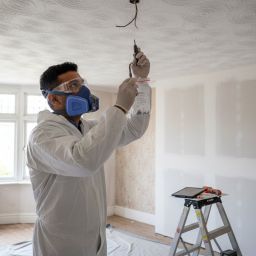
Avoid the common mistake of attempting a “quick clean.” Standard industrial vacuums lack the HEPA filtration required to trap asbestos, meaning they’ll simply exhaust fibres back into the breathing zone. Don’t attempt to “wet down” the material or take samples yourself without specific training and high-grade respiratory protective equipment (RPE). Finally, don’t cover damaged tiles with duct tape or paint. These methods are ineffective and complicate the eventual professional removal process, often increasing your long-term costs.
Understanding Duty Holder Responsibilities (CAR 2012)
The “Duty to Manage” is a statutory requirement for those in control of non-domestic premises UK wide. It isn’t just a safety recommendation; it’s a legal mandate to identify, assess, and manage asbestos risks. HSE enforcement is strict, and non-compliance often results in heavy fines or criminal prosecution. Adhering to the UK guidance on asbestos surveys ensures you meet the required competency standards. Transitioning from suspicion to certainty requires UKAS accredited asbestos testing, which serves as your primary evidence of compliance. Our team acts as your strategic partner, taking the technical weight of these responsibilities off your shoulders through precise consultancy.
Professional UKAS Accredited Testing and Management Solutions
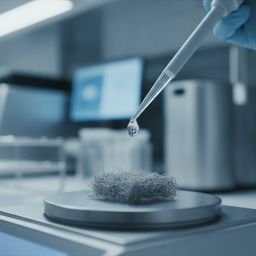
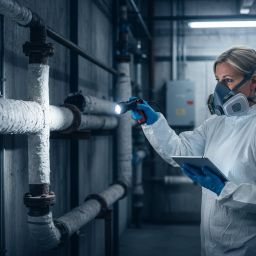
Bulk sample analysis in a UKAS accredited laboratory is the only method to confirm the presence of asbestos fibres with technical certainty. While some online retailers suggest DIY test kits, these lack the legal standing required for commercial compliance or property transactions UK wide. A qualified analyst uses Polarised Light Microscopy (PLM) to identify specific mineral types, such as Chrysotile or Amosite. This data is essential when determining asbestos in ceiling tiles what to do, as it dictates whether future work falls under licensed, non-licensed, or Notifiable Non-Licensed Work (NNLW) categories.
Professional surveys are categorised based on the building’s current state and future intent. A Management Survey is standard for normal occupation to ensure the safety of daily users. Conversely, a Refurbishment and Demolition (R&D) Survey is a statutory requirement before any intrusive works begin. This intrusive approach identifies ACMs hidden within the building fabric that a standard inspection might miss. Following the UK Health and Safety Executive guidance ensures these surveys form the foundation of your legal safety file.
The Value of Independent Asbestos Consultancy
Appointing an independent partner like The Testing Lab PLC ensures an unbiased assessment of your property. Using a removal contractor for your initial testing often creates a conflict of interest that can lead to unnecessary remediation costs. Our asbestos consultancy services focus on providing objective data and strategic management plans. For organisations managing multiple properties, our pillar page for London and UK wide surveying provides a centralised framework for achieving multi-site compliance without operational friction.
Creating an Asbestos Management Plan
Securing Your Property Through Professional Compliance
Managing asbestos in ceiling tiles what to do requires a shift from reactive fear to methodical, data-driven management. You now understand that visual identification is impossible and that the legal “duty to manage” under CAR 2012 is a non-negotiable statutory requirement for all pre-2000 buildings. By implementing immediate isolation protocols and moving toward professional analysis, you protect both your building’s occupants and your legal standing.
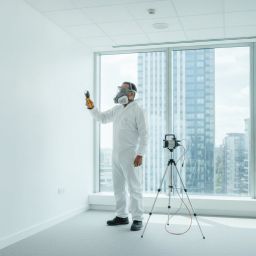
Our team serves as a strategic partner across your UK wide portfolio, providing the technical expertise needed to navigate complex 2026 HSE compliance standards. As an independent UK wide consultancy, we offer unbiased insights backed by our UKAS Accredited Laboratory. Whether you require expert 4-stage clearance testing after a removal project or a comprehensive management survey, we take the burden of professional responsibility off your shoulders. Request a UKAS Accredited Asbestos Survey or Sample Test Today to ensure your property remains safe, compliant, and fully documented. Taking these precise steps today ensures long-term operational excellence and peace of mind for the future.
Frequently Asked Questions
What do asbestos ceiling tiles look like?
Asbestos-containing ceiling tiles often look identical to modern mineral fibre versions, typically featuring pinhole, fissured, or “popcorn” textures. They’re generally grey or white, but decades of paint can easily mask the original material. Because the hazardous fibres are microscopic and invisible to the naked eye, you can’t rely on visual cues alone. Professional analysis is the only technically sound way to confirm the presence of ACMs in your UK wide property portfolio.
Can I test for asbestos in ceiling tiles myself?
You shouldn’t attempt to take samples yourself. Disturbing a tile to snap off a piece can release millions of fibres into the air, creating an immediate inhalation risk without industrial-grade respiratory protective equipment (RPE). Additionally, DIY sampling lacks the “chain of custody” required for legal compliance in commercial settings. For a result that stands up to HSE scrutiny, a UKAS accredited surveyor must collect the sample under controlled conditions.
Is it safe to leave asbestos ceiling tiles in place if they are not damaged?
It’s perfectly safe to leave asbestos tiles in situ if they’re in good condition and won’t be disturbed by maintenance or renovation. The law doesn’t require immediate removal of all ACMs; instead, it mandates a “duty to manage” them. If you’re unsure about asbestos in ceiling tiles what to do, the best approach is to document them in your asbestos register and conduct annual re-inspections to ensure they haven’t started to degrade.
How much does it cost to have a ceiling tile tested for asbestos in the UK?
Testing costs vary depending on whether you need a single bulk sample analysis or a full management survey for a large premises. While laboratory analysis itself is a standard technical process, the total fee reflects the surveyor’s expertise, travel, and the documentation required for legal compliance. We recommend a professional consultation to get an accurate quote based on the specific size and age of your building.
How long does asbestos testing take in a UKAS accredited lab?
Standard turnaround for sample analysis is typically 24 to 48 hours once the material reaches the laboratory. This timeframe allows analysts to use polarised light microscopy to identify the specific mineral types present. Some facilities offer expedited same-day services for emergency situations. Receiving a fast, accurate certificate of analysis is vital for keeping your construction or maintenance projects on schedule without compromising safety.
What happens if I accidentally break an asbestos ceiling tile?
If a tile breaks, you must stop work immediately and evacuate the room to prevent further fibre disturbance. Seal the area by closing all doors and windows, and turn off any air conditioning or ventilation systems that could spread dust. You’ll need to contact a specialist for air clearance testing and potentially a professional clean-up. Don’t attempt to vacuum the debris yourself, as standard household or industrial vacuums will simply exhaust the fibres back into the room.

Article by
P J F Thomas
CEO and Founder of TTL plc.
Disclaimer
Items declared are AI generated but do reflect our services. Please get in contact if you have any questions.