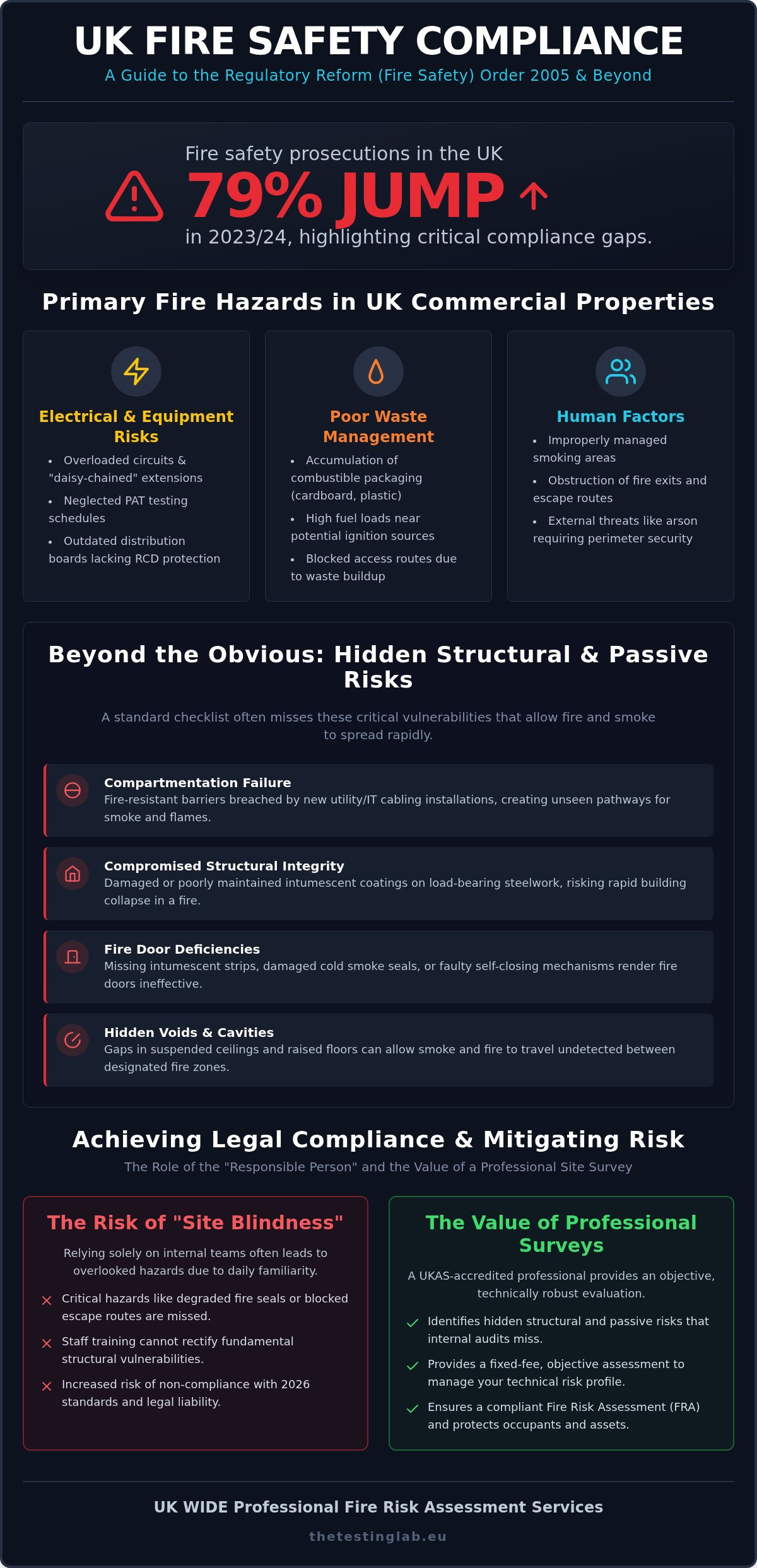
Fire safety prosecutions in the UK jumped by 79% in 2023/24, making it essential to maintain a robust fire risk assessment checklist UK to avoid massive legal liabilities. You likely feel the pressure of maintaining a safe environment while wrestling with the complexities of the Regulatory Reform (Fire Safety) Order 2005. It’s common to worry about heavy fines or hidden structural risks that aren’t immediately obvious during a standard walk-through.
Our guide helps you master compliance and identify critical hazards across your premises. You’ll gain a clear understanding of your legal obligations under 2026 standards and learn how to evaluate both daily ignition sources and passive protection systems. We preview essential steps for a UK wide safety strategy and explain when to instruct a UKAS-accredited professional to manage your technical risk profile.
Key Takeaways
- Identify why electrical faults and poor waste management remain the primary drivers of fire risk in commercial properties UK wide.
- Discover how to detect hidden structural vulnerabilities, including compromised compartmentation and damaged intumescent coatings on steelwork.
- Utilise our comprehensive fire risk assessment checklist UK to ensure your business adheres to the latest 2026 compliance standards and the Regulatory Reform (Fire Safety) Order 2005.
- Understand the legal duties of the “Responsible Person” and the value of a professional site survey in eliminating dangerous “site blindness.”
Identifying the Most Frequent Fire Hazards in UK Workplaces
Electrical faults are the primary driver of commercial fires UK wide. These often stem from overloaded circuits or neglected maintenance schedules. Integrating these technical checks into your fire risk assessment checklist UK is a legal necessity under the Regulatory Reform (Fire Safety) Order 2005. It’s vital to treat these as preventable technical failures rather than mere accidents.
Poor waste management also creates significant danger. Combustible packaging, like cardboard or plastic wrap, frequently accumulates near ignition sources in warehouses or retail backrooms. This creates high-risk zones that can accelerate a minor spark into a major blaze within minutes. Clear protocols for waste removal are essential for maintaining a safe building environment and reducing fuel load.
Human error remains a persistent variable. Improper smoking area management and the obstruction of designated fire exits are common findings during our site surveys. Additionally, arson poses a credible threat. It requires robust perimeter security and strict management of external combustible materials to protect the building envelope from external ignition sources.
Electrical and Equipment Risks
In high-density office environments, “daisy-chaining” extension leads is a frequent but dangerous practice. It places excessive load on a single wall socket, leading to overheating and potential ignition. This behavior often bypasses standard circuit protection, creating a hidden fire path through floor voids or furniture.
Every portable appliance UK wide must undergo regular PAT testing to satisfy statutory safety obligations and ensure electrical integrity.
Outdated distribution boards represent a deeper structural risk. These systems often lack modern RCD protection, making regular EICR reports essential for identifying hidden degradation. For businesses managing complex portfolios, including those seeking nationwide specialist surveying services, these technical evaluations form the backbone of a compliant safety strategy. Regular inspections prevent catastrophic infrastructure failure and ensure long-term operational continuity.
Structural and Passive Fire Safety Risks: Beyond the Basics
While a basic 5-step checklist covers immediate ignition sources, a comprehensive fire risk assessment checklist UK must also account for “passive” elements that prevent fire spread. Compartmentation failure is a critical risk. It occurs when fire-resistant barriers are breached by new utility or IT cabling installations, leaving gaps that smoke and flames exploit. These breaches are often hidden behind walls or above ceilings, making them invisible during a casual inspection. You can find general guidance on the 5-step fire risk assessment checklist provided by the government, but complex commercial structures require much deeper technical scrutiny.
Structural integrity depends on the condition of load-bearing elements. Compromised structural steel can lead to rapid building collapse if intumescent coatings are damaged or poorly maintained. Similarly, fire door deficiencies remain a persistent issue UK wide. We frequently find missing intumescent strips or faulty self-closing mechanisms that render the door useless during an emergency. Voids in suspended ceilings and raised floors also allow smoke to travel undetected between fire zones, bypassing safety barriers entirely.
The Role of Compartmentation Surveys
Professional surveys identify these weak zones in a building’s infrastructure that a generic fire risk assessment checklist UK might overlook. Our engineering-led approach ensures that every penetration and joint is evaluated for compliance. This level of detail is vital for protecting both occupant safety and the building’s long-term asset value. For organizations managing complex portfolios, integrating these checks with other technical requirements, such as specialist surveying in London, provides a holistic view of operational risk. Identifying these hidden vulnerabilities before an incident occurs is the only way to ensure true structural resilience.
Mitigation and Legal Compliance: Your Professional Fire Risk Assessment
Legal compliance in 2026 isn’t just about satisfying an inspector; it’s about shifting the burden of technical liability. The Regulatory Reform (Fire Safety) Order 2005 mandates that every UK business appoints a “Responsible Person” to maintain a valid FRA. While staff training is a useful tool, it cannot rectify the fundamental structural vulnerabilities identified in previous sections. Relying solely on internal staff often leads to “site blindness,” where daily familiarity causes teams to overlook critical hazards like degraded fire seals or blocked escape routes.
A professional site survey provides an objective, fixed-fee evaluation that internal audits frequently miss. These regular reviews are legally essential UK wide, particularly following structural alterations or significant changes in building occupancy. Utilizing UKAS accredited testing ensures that every material and structural assessment meets the highest national safety standards. This methodical approach provides the “Responsible Person” with the technological confidence needed to manage complex infrastructure safely.
Steps to a Compliant Fire Risk Assessment
The professional process begins with a comprehensive site visit, where our experts evaluate every inch of your premises against a rigorous fire risk assessment checklist UK. This leads to the delivery of a final accredited report that details every finding with precision. To ensure your business remains fully compliant, you should request a quote for a fire risk assessment today. We provide a clear action plan with prioritized remedial works, allowing you to address the most critical risks first. This structured roadmap transforms complex legal duties into manageable operational tasks, ensuring your premises meet all UK wide safety requirements.
Securing Your Infrastructure Against Future Fire Risks
Compliance in 2026 requires a shift from superficial checks to deep technical analysis. Managing daily ignition sources is only half the battle. You must ensure that structural compartmentation and passive protection systems remain uncompromised to truly protect your assets and personnel. Utilizing a professional fire risk assessment checklist UK ensures you don’t miss hidden vulnerabilities that internal teams might overlook due to site blindness. It’s about building a resilient safety culture based on engineering precision rather than guesswork.
As a UKAS Accredited Laboratory, we act as your strategic partner to take the technical burden off your shoulders. We provide independent and impartial professional surveyors and offer fixed-fee site survey charges UK wide. Ensure your building is safe and compliant with a professional Fire Risk Assessment from The Testing Lab PLC. We’re ready to help you secure your premises with confidence and methodological excellence.
Frequently Asked Questions
What are the 5 most common fire hazards in a UK commercial building?
The five most frequent hazards found in commercial buildings include electrical equipment failure, accumulation of combustible waste, human negligence like blocked exits, arson, and structural compartmentation breaches. To address external threats like arson, many organizations partner with security experts such as AlphaLVC to implement robust perimeter defenses. Identifying these critical points is a fundamental step in any fire risk assessment checklist UK. Maintaining strict protocols for waste removal and electrical testing helps mitigate these risks and ensures building safety for all occupants.
Who is legally responsible for fire safety in a UK workplace?
Legal responsibility for fire safety rests with the designated “Responsible Person” as defined by the Regulatory Reform (Fire Safety) Order 2005. This individual is usually the employer, building owner, or premises manager. They carry the burden of ensuring that fire safety duties are met UK wide. Non-compliance can result in severe legal penalties, including unlimited fines and potential custodial sentences for serious breaches.
How often should a professional fire risk assessment be reviewed?
You should review your fire risk assessment regularly to ensure the safety measures remain effective. While an annual review is standard best practice, a reassessment is mandatory if you make significant structural changes or alter the building’s occupancy levels. Keeping these records updated is a core legal requirement. It ensures that your safety strategy evolves alongside your operational environment and physical infrastructure.
Can I perform my own fire risk assessment or do I need a professional?
While the law allows a “competent person” to conduct an assessment, professional surveys are often necessary for complex commercial environments. Internal staff often suffer from “site blindness,” potentially missing hidden structural risks or technical non-compliance. Instructing a UKAS accredited professional provides an objective, fixed-fee evaluation. This methodical approach ensures that your fire risk assessment checklist UK covers all mandatory safety and structural requirements.

Article by
P J F Thomas
CEO and Founder of TTL plc.
Disclaimer
Items declared are AI generated but do reflect our services. Please get in contact if you have any questions.