Relying on the vague “regular review” clause in UK fire safety law is a gamble that could cost you your insurance coverage or lead to unlimited fines. It’s understandable if you feel uncertain about your legal standing. The Regulatory Reform (Fire Safety) Order 2005 purposefully avoids a one size fits all expiration date. This ambiguity often leaves responsible persons wondering exactly how often should a fire risk assessment be reviewed to remain compliant and protect their occupants.
We understand that you need precision rather than guesswork to manage your professional liability. This article provides a definitive breakdown of the annual review industry standard and the specific trigger events, such as structural changes or new legislation, that necessitate an immediate update. You’ll gain a clear roadmap for UK wide compliance, ensuring your safety documentation remains a living, legally defensible asset. Whether you are managing complex sites or require a professional partner for surveying and risk management, we’ll help you transition from uncertainty to methodological control. From the nuances of the Building Safety Act to practical checklists, we’ve outlined everything you need to maintain operational excellence and safety.
Key Takeaways
- Understand the legal framework of the Regulatory Reform (Fire Safety) Order 2005 and how Article 9 defines your accountability as a Responsible Person.
- Establish a clear schedule for how often should a fire risk assessment be reviewed to align with modern safety standards and high-risk building requirements.
- Identify the critical trigger events, such as structural modifications or changes in building use, that necessitate an immediate re-assessment to maintain UK wide compliance.
- Recognize the legal requirement for a “competent person” and how professional oversight mitigates the risks of site blindness and insurance invalidation.
- Learn how to integrate your fire safety obligations into a broader, precision-led strategy for risk management and surveying.
Understanding the Legal Requirements for Fire Risk Assessment Reviews
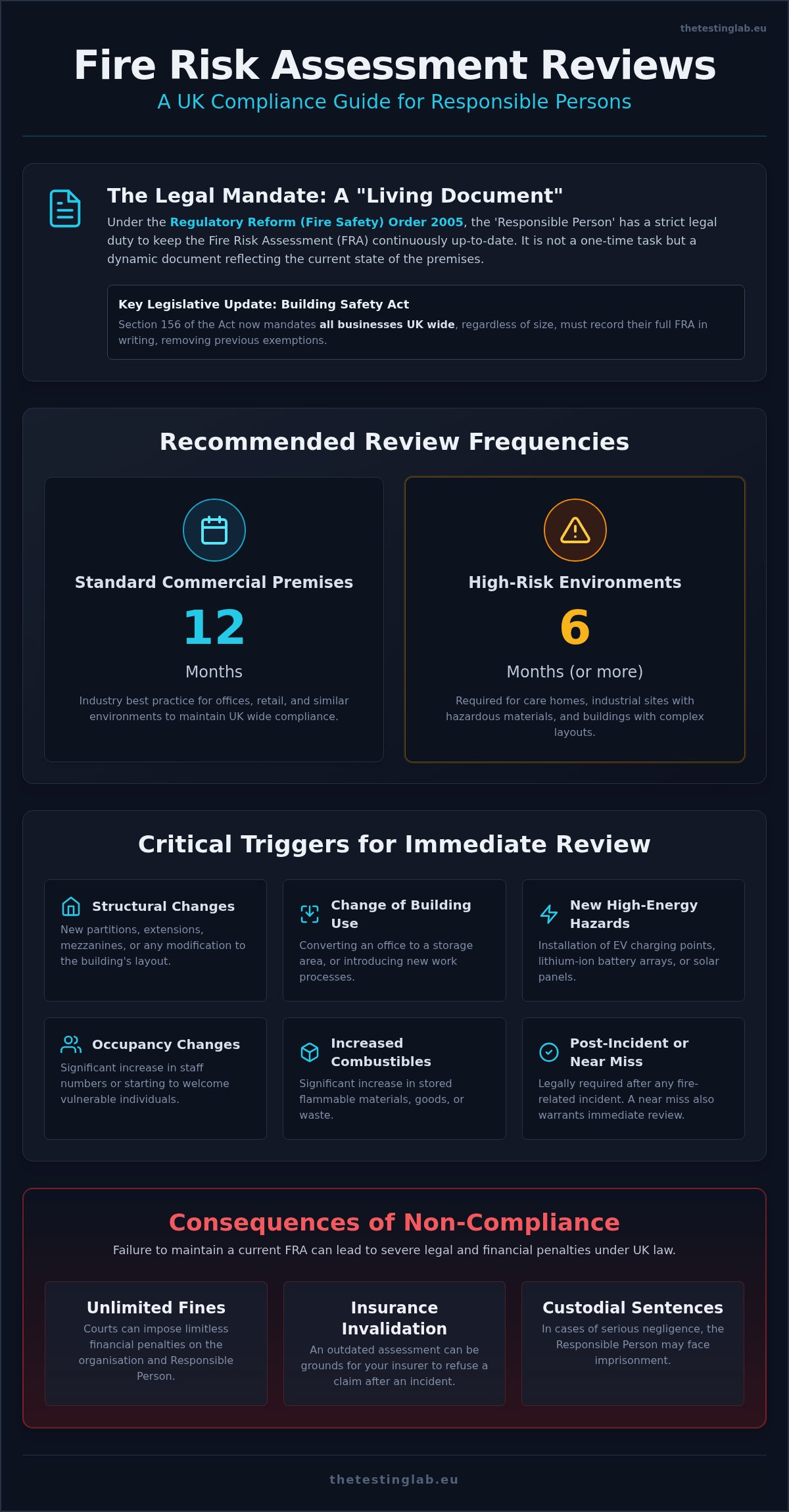
The Regulatory Reform (Fire Safety) Order 2005 stands as the cornerstone of fire safety governance across the UK. Under Article 9 of this Order, the “Responsible Person” carries a strict legal mandate to ensure that fire safety measures are not only implemented but consistently maintained. A central part of this duty involves keeping the fire risk assessment up to date. It’s no longer sufficient to view this as a stagnant piece of paperwork; a fire risk assessment is a “living document” that must accurately reflect the building’s current structural state, occupancy levels, and operational risks at all times.
Recent legislative shifts have intensified these requirements. Section 156 of the Building Safety Act, which has seen rigorous enforcement through 2024 and into 2026, now requires all businesses, regardless of size or employee count, to record their full fire risk assessment in writing. This removes previous exemptions for small businesses, ensuring a standardized level of transparency and accountability UK wide. Failing to maintain these records doesn’t just risk safety; it places the organisation in direct breach of statutory law.
Defining “Regular” Reviews in the UK Context
While the legislation uses the term “regularly,” determining exactly how often should a fire risk assessment be reviewed requires a methodology that balances statutory minimums with practical risk management. Industry best practice dictates a full professional review every 12 months for most standard commercial premises. This annual cycle ensures that safety equipment maintenance and staff training records remain aligned with the latest Fire safety principles. High-risk environments, such as care homes with sleeping occupants or industrial sites handling hazardous materials, often require more frequent intervals, sometimes every six months, to manage the heightened complexity of their risk profiles.
The Role of the Responsible Person
The “Responsible Person” is typically the employer, building owner, or landlord who holds the ultimate legal liability for fire safety within the premises. Failing to address how often should a fire risk assessment be reviewed for your specific site can lead to severe consequences, ranging from unlimited fines to custodial sentences under UK law. Choosing to partner with experts for professional fire risk assessments significantly mitigates this personal liability. By shifting the technical burden to an accredited consultancy, you ensure that your compliance strategy is backed by engineering precision rather than subjective internal guesses, protecting both your people and your professional standing.
Key Trigger Events for an Immediate Fire Risk Assessment Review
While the annual schedule serves as a reliable benchmark, certain operational shifts invalidate your existing safety strategy instantly. You shouldn’t only consider how often should a fire risk assessment be reviewed in terms of the calendar. You must also evaluate the physical and functional evolution of your premises. Any significant modification to the building layout, such as new partitions, mezzanines, or extensions, fundamentally alters fire spread dynamics and evacuation efficiency.
A change in the building’s “use case” is another critical trigger. Converting a standard office into a high-density storage area or a workshop significantly increases the combustible fuel load. Modern infrastructure, particularly the installation of EV charging points or lithium-ion battery arrays, introduces high-energy fire profiles that require specialized suppression considerations. Adhering to UK government guidance helps ensure these technological shifts are captured within your compliance framework. If your staff numbers increase significantly or you begin welcoming vulnerable individuals, your escape plan must be recalibrated to reflect these new occupancy realities.
Post-Incident and Near-Miss Evaluations
Legislation mandates an immediate review following any fire-related incident, regardless of the scale. Near-misses shouldn’t be ignored; they provide the empirical data needed to fix a failing system before a catastrophe occurs. During an investigation, Fire and Rescue Authorities will prioritize reviewing your post-incident updates to determine if you’ve acted with due diligence. This proactive approach is a hallmark of professional risk management UK wide.
Structural Modifications and Hidden Risks
Renovations often present hidden dangers to fire compartmentation. When walls are breached for new cabling or plumbing, the integrity of fire doors and partitions can be compromised. It’s vital to recognize that fire safety remedial works often coincide with the disturbance of older building materials. Before you begin any structural changes, you must account for the presence of hazardous materials. Seamlessly integrating asbestos consultancy services into your project planning ensures that fire safety upgrades don’t inadvertently lead to environmental health breaches.
Maintaining Compliance: Professional Reviews and Documentation
UK law explicitly states that the individual conducting your safety audit must be a “competent person.” This designation isn’t just a label; it requires verifiable training, experience, and deep technical knowledge. While some competitors might suggest you can handle these audits internally, doing so often leads to “site blindness.” This occurs when staff become so accustomed to their environment that they overlook mounting hazards. A professional assessment provides the objective engineering perspective needed to identify these gaps before they become liabilities.
A rigorous review encompasses more than a quick walkthrough. It must involve a detailed physical inspection of the premises, a thorough audit of fire logs, and a functional test of emergency lighting systems. All findings are then synthesized into a clear, actionable report. This documentation prioritizes remedial actions by risk level, giving you a structured path to maintaining safety standards UK wide without unnecessary operational downtime.
Why Accreditation Matters for Fire Safety
The precision of a UKAS accredited consultancy approach offers a level of due diligence that generic checklists can’t match. Insurance providers and legal authorities look for this level of methodological rigour when evaluating your compliance. Accredited specialists ensure your documentation survives the scrutiny of the latest building regulations and fire safety acts. It’s about shifting from a “tick-box” exercise to a robust, legally defensible safety strategy that protects your professional standing.
UK-Wide Support for Fire Safety Compliance
The Testing Lab PLC acts as a strategic partner, delivering comprehensive fire risk assessments alongside legionella risk assessments across the country. We help you streamline your operations by consolidating fire, water, and material testing into a single, managed compliance framework. This unified approach eliminates the friction of managing multiple vendors and ensures your safety protocols remain integrated and effective.
To guarantee your 2026 compliance and clarify exactly how often should a fire risk assessment be reviewed for your specific portfolio, you can request a professional quote for your UK-wide premises. Our team provides the surveying and risk management expertise required to take the weight of professional responsibility off your shoulders, ensuring every critical point is in the best hands.
Securing Your Statutory Compliance for 2026
Navigating the complexities of the Building Safety Act requires a transition from reactive maintenance to a methodical, precision-led strategy. You’ve seen that relying on the minimum legal standard for how often should a fire risk assessment be reviewed is no longer sufficient in a landscape of rigorous enforcement and increased transparency. By establishing a strict annual review cycle and identifying immediate trigger events, you protect your occupants and your professional reputation from the risks of non-compliance.
As a UKAS accredited consultancy founded in 2002, The Testing Lab PLC serves as a strategic partner in UK wide compliance. Our expert team provides specialized assessments for fire, asbestos, and legionella, ensuring that every critical safety aspect of your building is managed with engineering accuracy. We take the weight of professional responsibility off your shoulders, delivering documented proof of due diligence that satisfies both insurers and fire authorities.
This professional oversight is essential for community-focused organisations like the EAV Centre, allowing them to focus on delivering vital local services and support programs within a safe and compliant environment.
Book a Professional Fire Risk Assessment for Your UK-Wide Premises to ensure your safety documentation remains a living, legally defensible asset. Maintaining a safe, compliant environment is a continuous process, but with the right expert oversight, it becomes a streamlined part of your operational excellence.
Frequently Asked Questions
Is there a legal requirement for an annual fire risk assessment review?
Yes, while legislation uses the term “regularly,” the industry standard for UK wide compliance is an annual review. For most commercial buildings, a 12-month interval is the definitive answer to how often should a fire risk assessment be reviewed to remain “suitable and sufficient.” High-risk sites, such as care homes or industrial facilities, often require reviews every six months to account for rapid changes in their operational risk profiles.
For healthcare settings, fire safety is often part of a broader set of regulatory requirements. You can learn more about achieving comprehensive compliance and safety standards through specialized consultancy services.
What happens if I do not review my fire risk assessment?
Failing to review your assessment constitutes a criminal offence under the Regulatory Reform (Fire Safety) Order 2005. You risk receiving formal enforcement notices, unlimited fines, or custodial sentences in severe cases. Beyond legal penalties, insurance providers often invalidate policies if a recent review isn’t present. This leaves your organisation financially liable for all damages and business interruption costs following a fire incident.
Can I review my own fire risk assessment?
You can only review your own assessment if you meet the legal definition of a “competent person” with sufficient training and experience. While small business owners might use basic templates, they remain personally liable for any technical omissions. Appointing a specialist for surveying and risk management ensures your audit identifies complex risks like compartmentation breaches. Professional oversight provides a legally defensible layer of protection that internal reviews often lack.
Does a fire risk assessment expire?
A fire risk assessment technically becomes invalid the moment building conditions change, rather than having a fixed expiration date. If you modify your layout, change the building use, or introduce new equipment, the existing document no longer reflects the true risk profile. This is why determining how often should a fire risk assessment be reviewed is vital for maintaining a “live” safety strategy. Adopting an annual review cycle creates a formal checkpoint to verify the document’s ongoing accuracy.

Article by
P J F Thomas
CEO and Founder of TTL plc.
Disclaimer
Items declared are AI generated but do reflect our services. Please get in contact if you have any questions.