
With over 5,000 asbestos-related deaths annually in the UK, the Health and Safety Executive (HSE) has significantly intensified site inspections as of April 2026. This means the margin for error in property management has effectively disappeared, leaving many professionals concerned about the weight of asbestos duty holder responsibilities. You likely recognize that managing a commercial property involves substantial legal risk, yet the nuances of Regulation 4 often feel like a moving target. This is particularly true in multi-occupancy buildings where shared liability and complex tenancy agreements can create dangerous gaps in compliance.
It’s understandable to feel overwhelmed by the threat of unlimited fines or the potential for a two-year prison sentence for non-compliance. Our guide provides a definitive checklist to help you master your legal obligations under the Control of Asbestos Regulations (CAR) 2012, ensuring your UK wide operations remain fully protected. We will outline the precise steps for identifying materials, establishing a robust management plan, and determining exactly when the precision of a UKAS accredited consultancy is required to mitigate operational risk and ensure total regulatory alignment.
Key Takeaways
- Define your legal status under Regulation 4 of CAR 2012 to determine if you are the designated person responsible for non-domestic premises.
- Learn how to implement a systematic approach to asbestos duty holder responsibilities by establishing a live, accessible Asbestos Register for all site visitors.
- Discover the methodology for translating complex survey data into an actionable management plan that protects both staff and external contractors.
- Understand why UKAS accredited laboratory analysis is the only definitive way to identify bulk samples and ensure legal indemnity for your organization.
- Gain confidence in managing UK wide property portfolios through a structured, regulation-led compliance checklist designed for operational excellence.
Identifying the Asbestos Duty Holder under Regulation 4
The legal framework for managing hazardous materials in the built environment is rigid. Under the Control of Asbestos Regulations 2012, the “duty to manage” is a non-negotiable statutory requirement for all non-domestic properties UK wide. This includes industrial units, offices, and the common parts of residential blocks like foyers or lift shafts. The Duty Holder is the person or organisation responsible for the maintenance or repair of non-domestic premises. Understanding your specific asbestos duty holder responsibilities is the first step toward operational safety and legal indemnity.
In health and safety law, ignorance provides no protection against prosecution. Regulation 4 is designed to ensure that those in control of a building take proactive steps to identify and manage risks. If you manage a site, you’re expected to possess a methodological understanding of the building’s fabric. Failing to identify the presence of asbestos isn’t seen as an oversight; it’s seen as a breach of your professional duty.
Who Holds the Duty in Commercial Tenancies?
Determining who carries the burden of compliance in complex commercial settings requires a granular look at legal contracts. Often, responsibility is shared. A landlord might be responsible for the structural elements, while the tenant manages the internal fit-out. In multi-occupancy business parks across the UK, managing agents often act as the primary point of contact for compliance. You must review your tenancy agreements carefully. These documents define the boundaries of control. Misinterpreting these boundaries can lead to dangerous gaps where nobody takes ownership of the asbestos register or the broader asbestos duty holder responsibilities. For those managing complex portfolios, seeking expert asbestos surveying and consultancy is vital to clarify these legal lines.
The Consequences of Non-Compliance
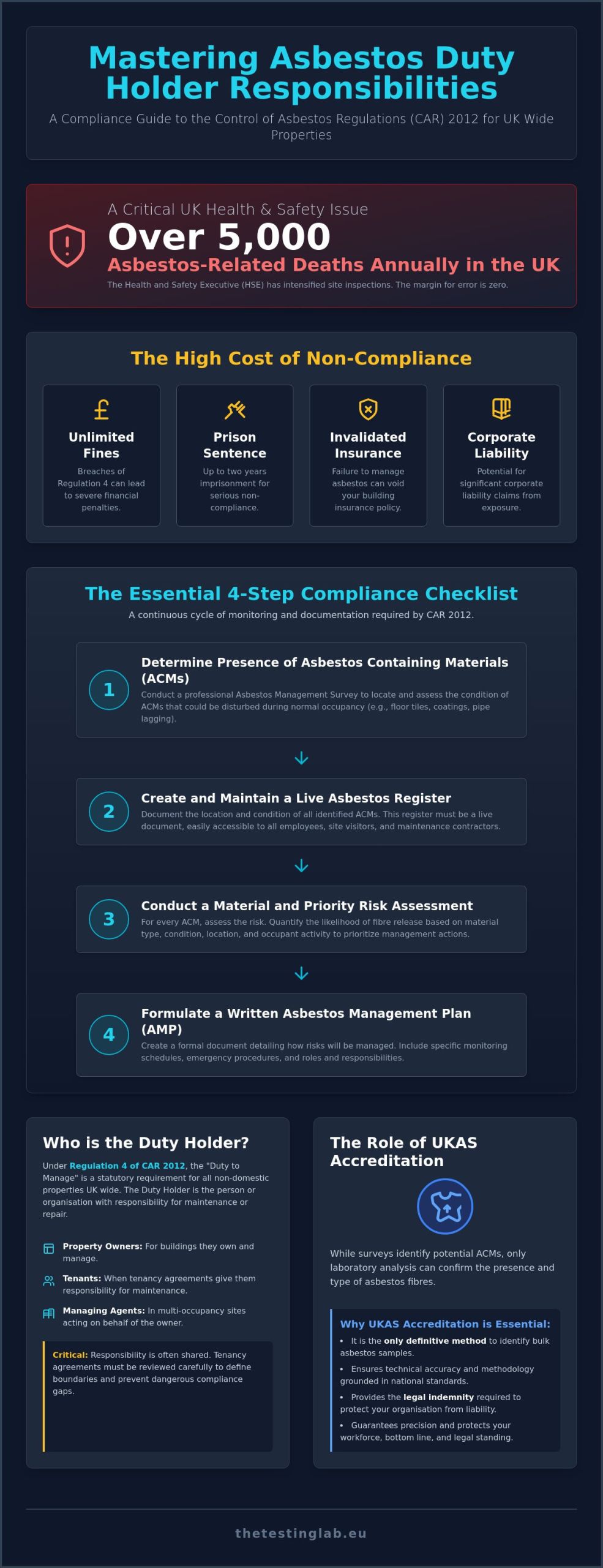
The HSE does not view compliance as a suggestion. Recent enforcement data from April 2026 shows two companies were collectively fined £88,300 for failing to manage risks properly. Beyond unlimited fines, a breach of Regulation 4 can invalidate your building insurance and trigger corporate liability claims. Engaging a professional asbestos consultancy ensures that your management strategy is grounded in technical accuracy rather than guesswork. This precision protects your workforce and your bottom line from the severe financial impact of HSE improvement notices.
The Essential Asbestos Duty Holder Responsibilities Checklist
Translating legal requirements into a functional onsite strategy requires a methodical approach. Fulfilling your asbestos duty holder responsibilities isn’t a one-time event but a continuous cycle of monitoring and documentation. This technical framework ensures that every UK wide property under your control remains safe for occupants and contractors alike. To achieve full alignment with the Control of Asbestos Regulations 2012, you should follow this four-step compliance sequence:
- Step 1: Determine the presence and condition of Asbestos Containing Materials (ACMs) through professional surveying.
- Step 2: Create and maintain a live Asbestos Register that’s readily accessible to all site visitors and maintenance staff.
- Step 3: Conduct a material and priority risk assessment for every identified ACM to quantify the likelihood of fibre release.
- Step 4: Formulate a written Asbestos Management Plan (AMP) that details specific monitoring schedules and emergency procedures.
Executing the Asbestos Management Survey
A management survey is the baseline requirement for any building constructed before the year 2000. It’s designed to locate ACMs that could be disturbed during normal occupancy. You’ll often find these materials in common building components like vinyl floor tiles, textured wall coatings, and lagging on plant room pipework. Accuracy at this stage is vital. Missing a single source of asbestos can compromise your entire safety system. Engaging professional asbestos consultancy services provides the technical precision needed to identify these materials before they become a liability.
Maintaining the Asbestos Register
Your register must be a dynamic document. It should clearly list the location, condition, and specific type of asbestos present in the building. Because materials degrade over time, annual re-inspections are a necessity to track any changes in stability. If you’re managing a complex portfolio, integrating professional oversight into your maintenance schedule ensures your register remains accurate and legally defensible. This proactive monitoring prevents the accidental disturbance of ACMs during routine repairs, which is the primary cause of exposure in commercial settings.
Implementing the Management Plan and UKAS Accredited Analysis
A written plan is merely a static document until it’s integrated into your daily operations. To truly fulfil asbestos duty holder responsibilities, you must bridge the gap between compliance paperwork and site-level activity. This starts with a robust ‘Permit to Work’ system. Every contractor or staff member entering a high-risk area must be briefed on the Asbestos Register before work begins. This prevents the accidental disturbance of ACMs, which remains a leading cause of HSE enforcement actions. For properties requiring high-level oversight, UK-wide asbestos and legionella surveying provides the necessary data foundation for these operational controls.
The Criticality of UKAS Accredited Lab Testing
Technical precision is the only safeguard against legal liability. Attempting to identify hazardous materials through visual inspection or self-sampling creates a significant risk profile for your organisation. UKAS accredited laboratories provide the only definitive method for bulk sample identification, ensuring that your management plan is based on empirical fact rather than assumption. UKAS accreditation is the only way to ensure lab results meet the ISO 17025 standard for testing. This level of chain-of-custody and analytical rigour is essential for maintaining a defensible compliance position UK wide. Fulfilling your asbestos duty holder responsibilities requires this commitment to scientific accuracy to ensure no material is overlooked.
Reviewing and Updating Your Strategy
A management plan isn’t a “set and forget” asset. It requires periodic reviews to remain effective, especially when building conditions change. Specific trigger events like structural renovations, accidental material damage, or a change in the building’s primary use necessitate an immediate update to your documentation. You must also ensure that maintenance workers and emergency services can access this data instantly. Clear communication of the plan’s contents is just as vital as the plan itself. If you need assistance in refining your strategy or conducting annual re-inspections, you can request a quote for UK-wide asbestos management support to ensure your site remains fully aligned with the latest regulatory standards.
Securing Long-Term Compliance and Operational Safety
Mastering asbestos duty holder responsibilities requires a transition from reactive fixes to a proactive, systems-based approach. You’ve seen that compliance under CAR 2012 isn’t just about a single survey. It’s about maintaining a live Asbestos Register and ensuring every contractor is briefed through a robust Permit to Work system. By grounding your management plan in technical accuracy, you eliminate the legal risks associated with non-domestic property management across your portfolio.
Similarly, for businesses managing the movement of specialized equipment or materials across global sites, you can learn more about Perimeter Global Logistics (PGL) for comprehensive freight and transportation support.
Our independent consultancy provides UKAS Accredited Laboratory Analysis and CAR 2012 compliant reporting to take the burden of liability off your shoulders. With our UK wide coverage, we act as your strategic partner in navigating the complexities of Regulation 4 with precision and transparency. Don’t leave your site’s safety to chance when methodical expertise is available to secure your operations.
Secure your building with our UK-wide Asbestos Consultancy and gain the confidence that your property assets are fully protected by industry-leading standards. We’re ready to help you build a safer, more compliant future for your workspace.
Frequently Asked Questions
Is an asbestos survey a legal requirement for all UK businesses?
An asbestos survey is a legal requirement for any UK business operating in non-domestic premises constructed before the year 2000. Regulation 4 of CAR 2012 mandates that the person in control of the building must take reasonable steps to find out if there are materials containing asbestos. This process is the foundation of fulfilling asbestos duty holder responsibilities to ensure the safety of employees and visitors UK wide.
How often should an asbestos management plan be reviewed?
You should review your asbestos management plan at least every 12 months to ensure it remains accurate and effective for your site. However, an immediate review is triggered by specific events such as structural changes, material damage, or a change in the building’s use. Regular re-inspections of known ACMs are critical to track their condition and update the live Asbestos Register accordingly to maintain compliance.
Can a tenant be the primary asbestos duty holder?
A tenant can be the primary duty holder if their lease or tenancy agreement specifies they’re responsible for the maintenance and repair of the premises. In many commercial settings, the burden of asbestos duty holder responsibilities is shared between the landlord and the tenant. You must examine your legal contracts to determine where the “duty to manage” lies for specific parts of the building to avoid compliance gaps.
What happens if I disturb asbestos without a management plan in place?
Disturbing asbestos without a management plan can lead to severe legal and health consequences, including unlimited fines and up to two years of imprisonment. Without a plan, you’ve failed to identify risks, which often results in immediate HSE enforcement action. Such incidents also frequently invalidate building insurance and expose your organisation to significant civil liability claims from affected individuals who may have been exposed to hazardous fibres.

Article by
P J F Thomas
CEO and Founder of TTL plc.
Disclaimer
Items declared are AI generated but do reflect our services. Please get in contact if you have any questions.