
Is your 12-month asbestos check actually protecting your business, or is it just a box-ticking exercise that leaves you exposed to HSE intervention? We know that as a duty holder, you’re likely balancing the safety of your occupants with the complex requirements of the Control of Asbestos Regulations 2012. It’s frustrating when the lines between “best practice” and “legal mandate” become blurred, especially when managing various asbestos-containing materials (ACMs) across a UK wide estate. Determining the correct asbestos re-inspection survey frequency shouldn’t feel like guesswork.
We’ve designed this guide to help you master the specific variables that dictate your inspection schedule to ensure your organization remains compliant through 2026 and beyond. You’ll learn how to move past generic advice to look at how material condition and location risk influence your timeline. We’ll provide a clear path toward building a robust Asbestos Management Plan (AMP) that reduces corporate liability. By the end of this article, you’ll have the technical clarity needed to manage your site with confidence and precision.
Key Takeaways
- Understand your legal “Duty to Manage” under Regulation 4 of CAR 2012 and how it mandates the continuous monitoring of asbestos-containing materials.
- Identify the specific risk factors and Material Assessment Scores that determine your optimal asbestos re-inspection survey frequency beyond the standard 12-month baseline.
- Learn how to integrate re-inspection data into a live Asbestos Register to maintain a robust and compliant Asbestos Management Plan (AMP).
- Discover the critical role of independent, UKAS accredited consultancy in providing precise verification and reducing organizational liability UK wide.
Understanding the Legal Requirement for Asbestos Re-inspections
The Control of Asbestos Regulations 2012 (CAR 2012) isn’t just a set of suggestions. It’s a strict legal framework that places a “Duty to Manage” on those responsible for non-domestic premises. To understand the asbestos re-inspection survey frequency required for your building, you must first distinguish between a one-off survey and ongoing monitoring. While a Management Survey identifies the presence of ACMs, the re-inspection survey is a targeted check. Its sole purpose is to monitor the condition of known materials and ensure they haven’t deteriorated over time.
Before diving into schedules, it’s useful to understand the material itself. What is Asbestos? In a construction context, it’s a hazardous mineral that only poses a risk when its fibres become airborne. Because these materials can degrade due to weather, vibration, or accidental damage, the Asbestos Register must be a live document. A re-inspection isn’t a full building survey; it’s a precise, methodical update to your existing records to maintain CAR 2012 compliance.
The Duty Holder’s Legal Responsibility
In the UK, the “Duty Holder” is typically the owner of the building or the person responsible for its maintenance through a contract or tenancy agreement. This role carries significant weight UK wide. If you’re managing properties in the capital, our specialist surveying services can help you navigate these local and national requirements. Failing to maintain an accurate Asbestos Management Plan (AMP) isn’t just a lapse in paperwork. It’s a criminal offence that can lead to heavy fines or prosecution by the HSE.
The core objective is the safety of everyone who enters the building. Maintenance staff and external contractors are at the highest risk of accidental exposure. Regular re-inspections provide the data needed to tell these workers exactly where hazards are and what condition they’re in. Without this information, you can’t guarantee a safe working environment, which is the cornerstone of your legal obligations. It’s your responsibility to ensure the data stays current through a risk-based approach.
Factors Determining Asbestos Re-inspection Survey Frequency
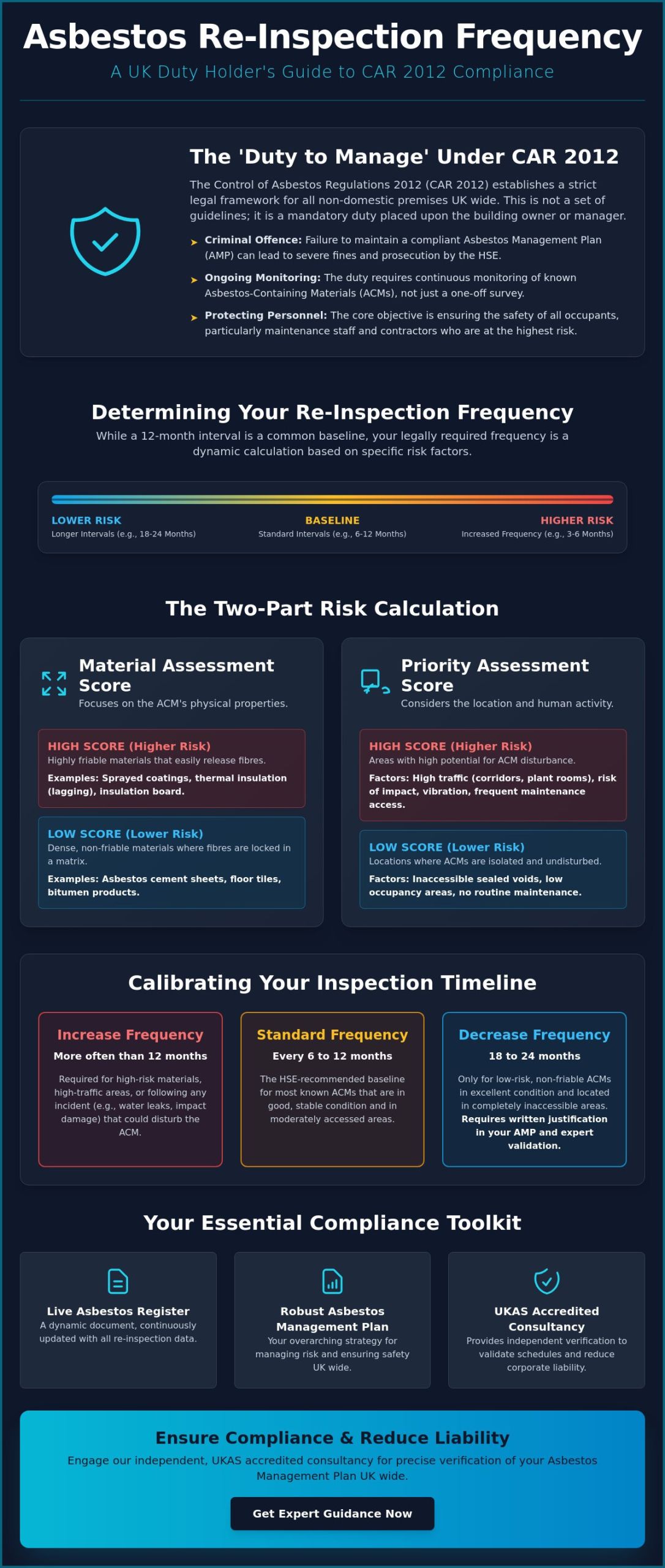
While the 12 month interval is the standard baseline for stable materials, your asbestos re-inspection survey frequency isn’t set in stone. It’s a dynamic calculation based on two critical metrics: Material Assessment and Priority Assessment. These frameworks, as detailed in the HSE Approved Code of Practice, help duty holders move away from arbitrary dates toward a data-driven safety strategy. This engineering-led approach ensures resources are focused where the risk is highest.
Material scores focus on the product type and its friability. For instance, a high-density asbestos cement sheet is far less likely to release fibres than low-density insulating board. Priority scores then layer on the human element. How often is the area accessed? Is there a risk of vibration from heavy machinery? Environmental stressors like persistent moisture or high air movement can accelerate the degradation of even stable ACMs, necessitating a more aggressive monitoring schedule.
When to Increase Inspection Frequency
High-risk materials require more vigilant oversight. Thermal insulation (lagging) and sprayed coatings are notoriously fragile; even minor disturbances can lead to fibre release. In high-traffic environments like schools, hospitals, or industrial warehouses UK wide, the risk of accidental impact is significantly elevated. You should also trigger an immediate re-inspection following any building incident. Significant pipe leaks, structural vibrations, or unauthorized maintenance work all require a professional check to ensure ACM integrity remains intact.
Can You Decrease Frequency?
It’s possible to extend intervals to 18 or 24 months, but only under strict conditions. This typically applies to low-risk, non-friable materials like thermoplastic floor tiles or bitumen products that are in excellent condition and located in completely inaccessible areas. You must provide a clear, evidence-based written justification within your Asbestos Management Plan. Engaging an expert asbestos consultancy is the most reliable way to validate these longer intervals while maintaining full legal compliance. This independent verification removes the burden of professional liability from your shoulders.
Implementing a Compliant Monitoring Strategy UK Wide
Effective management requires moving beyond reactive measures. To maintain a rigorous asbestos re-inspection survey frequency, you must integrate your findings into a live, accessible Asbestos Register. This isn’t a static document; it’s a real-time reflection of your building’s safety profile. When condition changes are noted, bulk asbestos identification plays a vital role in quantifying the potential for fibre release. Transitioning from fragmented paper records to a centralized digital management system allows for immediate compliance tracking across complex UK wide portfolios.
Choosing a UKAS accredited consultancy provides the independent verification necessary to withstand regulatory scrutiny. Professional surveyors don’t just look at the material; they evaluate the system as a whole. This methodical approach ensures that every entry in your register is backed by technical evidence, reducing the professional burden on the duty holder.
The Role of Professional Accredited Surveys
Relying on internal visual checks by untrained staff is a common mistake that fails to meet HSE competency requirements. A professional surveyor provides high-resolution photographic evidence, allowing for precise year on year comparisons of material degradation. This level of detail is essential for defensive documentation. For reliable results, all laboratory analysis should be handled via UKAS accredited asbestos testing. This ensures that every data point in your management plan is backed by rigorous scientific standards and independent verification.
Your Next Steps for UK Compliance
Compliance is a continuous cycle of assessment and action. The Control of Asbestos Regulations 2012 requires you to review your management plan at least every 12 months. If your current plan hasn’t been updated since the recent HSE consultation period, it’s time for a professional audit. Use the following checklist to secure your site:
- Verify that your Asbestos Register includes all previously identified ACMs.
- Confirm your current re-inspection dates are aligned with the risk scores of each material.
- Ensure all contractors have access to the latest register before starting work.
- Archive photographic evidence of material conditions to track changes over time.
Don’t leave your organizational liability to chance. Request a professional asbestos survey quote today to ensure your estate remains fully compliant and safe for all occupants.
Strategic Management for Future Compliance
Success in 2026 relies on the precision of your data and the independence of your advisors. Our team brings over 20 years of expertise and UKAS accredited laboratory services to every project, providing the technical certainty you need for complex multi-site portfolios UK wide. We act as your strategic partner, taking the weight of professional liability off your shoulders while ensuring your Asbestos Management Plan remains a robust, living asset.
Secure your UK-wide compliance with professional asbestos consultancy and ensure your estate is managed with methodical accuracy. Taking proactive steps today builds a safer, more resilient environment for everyone tomorrow.
Frequently Asked Questions
Is an annual asbestos re-inspection a legal requirement?
Yes, under Regulation 4 of CAR 2012, duty holders must ensure their Asbestos Management Plan is reviewed at least every 12 months. While the legislation focuses on the “duty to manage” risk, HSE guidance establishes the annual check as the minimum standard for most stable materials. This ensures any deterioration in condition is caught before it poses a health risk. High risk materials or active environments often require more frequent monitoring to maintain legal compliance UK wide.
What is the difference between a management survey and a re-inspection?
A management survey is the initial baseline assessment used to locate and identify asbestos containing materials within a property. In contrast, an asbestos re-inspection survey is a targeted follow up. It focuses specifically on monitoring the condition of known ACMs already listed in your existing register. While the initial survey involves sampling and identification, the re-inspection ensures those materials haven’t degraded or been disturbed since the last professional assessment.
How much does an asbestos re-inspection survey cost in the UK?
Costs for a re-inspection vary based on the size of the building, the number of ACMs present, and the complexity of the site. Factors like accessibility and the level of risk associated with the materials also influence the final investment. To get an accurate figure for your specific property, you should request a bespoke quote from an accredited consultancy. They’ll evaluate your existing register to provide a transparent, methodical breakdown of the required work for your portfolio.
What happens if I miss my asbestos re-inspection date?
Missing your scheduled date renders your Asbestos Management Plan (AMP) out of date and non-compliant with CAR 2012. This oversight increases your organizational liability and leaves you vulnerable to HSE intervention, which can result in significant fines or legal action. More importantly, it means you’re no longer accurately tracking the safety of your building. Maintaining your asbestos re-inspection survey frequency is critical for protecting contractors and staff from accidental exposure UK wide.

Article by
P J F Thomas
CEO and Founder of TTL plc.
Disclaimer
Items declared are AI generated but do reflect our services. Please get in contact if you have any questions.