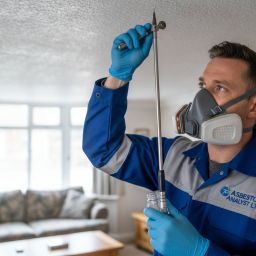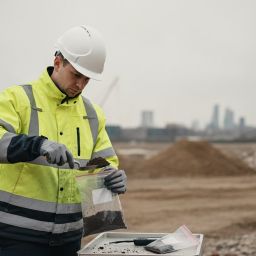
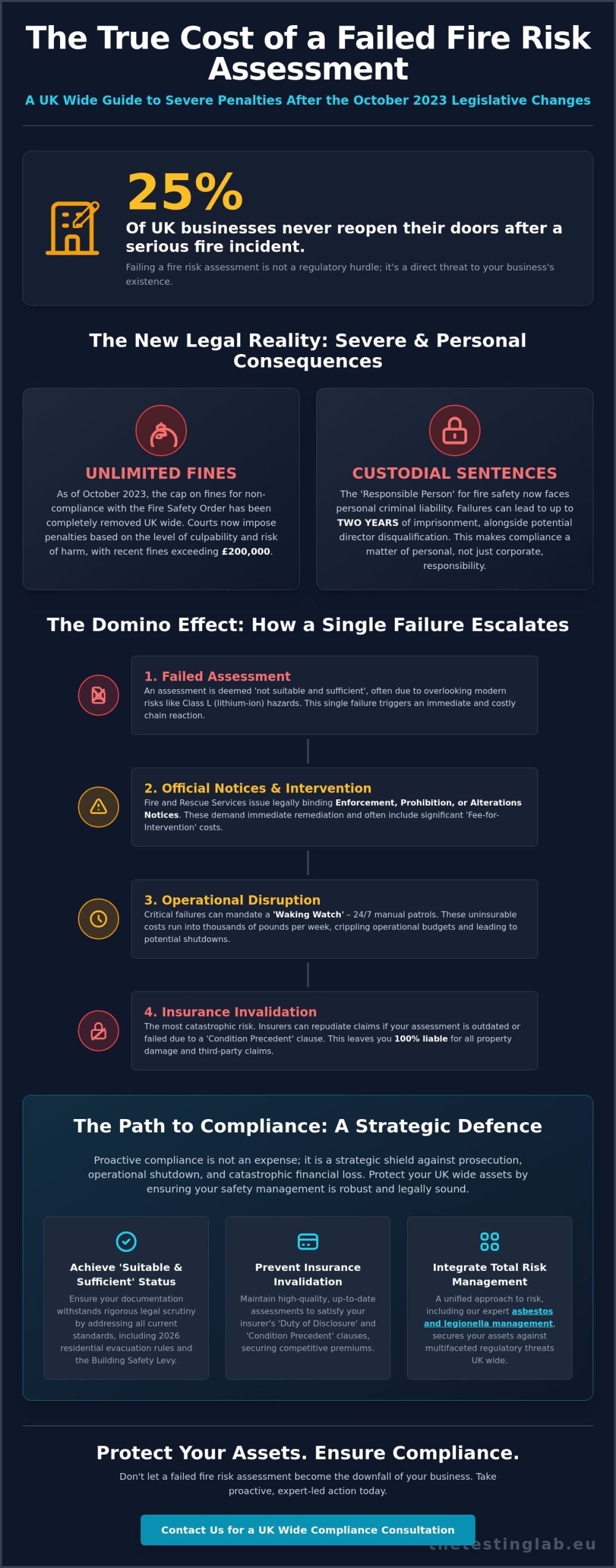
Did you know that 25% of UK businesses never reopen their doors after a serious fire incident? It’s a sobering statistic that highlights why the cost of failing a fire risk assessment extends far beyond a simple regulatory hurdle. Since October 2023, the UK government has removed the cap on fines for non-compliance with the Fire Safety Order, leaving businesses exposed to unlimited financial penalties. In the most severe cases, responsible persons now face up to two years of imprisonment for failing to maintain a suitable and sufficient assessment.
We recognize the complexity of managing these risks alongside the 2026 standards, such as the new residential evacuation requirements and the Building Safety Levy. You need a clear methodology to protect your UK wide assets from insurance invalidation and operational shutdown. This article quantifies the total financial risk of non-compliance and provides a structured path to rectifying a failed assessment. You’ll gain the technical clarity required to treat safety as a strategic capital protection measure. For those managing broader property risks, our expertise in asbestos and water safety management ensures your compliance remains precise and legally sound.
Key Takeaways
- Understand why the 2023 legislative shift means the cost of failing a fire risk assessment now includes unlimited financial penalties and potential custodial sentences UK wide.
- Identify the technical benchmarks that define a “suitable and sufficient” assessment to ensure your documentation stands up to rigorous legal scrutiny.
- Learn how to prevent insurance invalidation by aligning your safety reviews with 2026 standards, avoiding the high overheads of emergency manual patrols.
- Discover how technical due diligence acts as a strategic shield against prosecution while lowering the long-term operational costs of your safety systems.
- See how a unified approach to risk, including asbestos and legionella management, secures your assets against multifaceted regulatory threats.
The Immediate Financial and Legal Penalties of UK Fire Safety Breaches
The Regulatory Reform (Fire Safety) Order 2005 remains the cornerstone of fire safety across the UK. For 2026, the standard for a “suitable and sufficient” assessment has tightened. You can’t treat this as a simple administrative task. Failing to account for modern risks, specifically Class L (lithium-ion) hazards as defined in BS ISO 3941:2026, leads to an automatic failure. This technical oversight directly increases the cost of failing a fire risk assessment through mandatory legal intervention and potential business closure.
Unlimited Fines: The Judiciary’s Approach to Fire Neglect
The Cost of Legal Representation and Prosecution
Defending a fire safety prosecution often costs more than the eventual fine. Legal fees for expert witnesses and specialist counsel accumulate rapidly during multi-year investigations. A criminal conviction carries a lasting impact on corporate directors, often leading to disqualification and irreparable reputational damage. While our core expertise lies in asbestos and water management, the principle is universal: proactive compliance is always more cost-effective than reactive legal defense.
Operational Disruption and Hidden Costs: Beyond the Courtroom
While court fines grab headlines, the true cost of failing a fire risk assessment often manifests in unrecoverable operational expenses. If an inspector identifies critical failures, they might mandate a ‘Waking Watch’. This requires 24/7 manual fire patrols by trained marshals until the building’s fire alarm or structural integrity meets safety standards. For many UK wide businesses, these costs are crippling. They often run into thousands of pounds per week, a sum rarely covered by standard business interruption insurance. You can find more detail on legal obligations in the official government guidance on penalties.
Insurance Premiums and Risk Profiling
Insurers view a failed assessment as a red flag for poor management. Under the ‘Duty of Disclosure’, you’re legally obliged to inform your broker of any enforcement notices or failed audits. Failing to do so is fraudulent and voids your cover. Conversely, maintaining high-quality documentation demonstrates technical due diligence, which helps in securing more competitive premiums UK wide.
Remedial Works and Structural Interventions
Emergency repairs are always more expensive than planned maintenance. If a prohibition notice forces a shutdown, the cost of expedited fire door replacements or compartmentation work skyrockets. In older commercial properties, these structural interventions often intersect with other hazardous materials. For example, replacing fire-rated ceiling tiles or wall panels frequently necessitates professional asbestos consultancy to ensure safe removal and air clearance. Managing these risks holistically through our integrated surveying services prevents project delays and ensures regulatory alignment across all safety disciplines.
Mitigation Strategies: Protecting Assets through Accredited Assessments
Effective fire safety management shifts the focus from reactive repairs to proactive asset protection. A high-quality, professional assessment acts as a form of technical due diligence. In legal terms, this provides a “statutory bar” by demonstrating that the Responsible Person took all reasonable steps to meet UK legislation. Transitioning to this proactive model significantly reduces the total cost of ownership (TCO) for safety systems. Instead of emergency call-outs, you rely on planned maintenance schedules that keep your UK wide operations running without interruption.
Integrated risk management is the most efficient way to maintain compliance. Many businesses now combine fire safety reviews with Legionella risk assessments to ensure holistic building health. This approach identifies overlapping risks, such as when fire-stopping works might disturb hazardous materials. By coordinating these surveys, you avoid the cost of failing a fire risk assessment and the subsequent project delays caused by secondary environmental hazards. Professional documentation also serves as a powerful tool when negotiating lower insurance premiums, as it provides insurers with a verified, low-risk profile.
Selecting a Strategic Safety Partner
Viewing surveying and risk management as a strategic investment rather than a mere overhead is vital for long-term stability. UKAS accreditation is the benchmark for this partnership. It ensures laboratory-grade accuracy in all material testing and survey data. Whether you are investigating fire-damaged soil or verifying the safety of structural materials, accredited data stands up to the highest levels of regulatory scrutiny UK wide.
Practical Steps After a Failed Assessment
If an assessment identifies significant failings, your response must be immediate. Life-critical defects require attention within the first 24 hours to satisfy fire officers and maintain insurance cover. You must document every action taken under the principle of “Reasonable Endeavours.” This clear audit trail proves you’re actively mitigating risks and can prevent the escalation of enforcement notices into unlimited fines. Secure your UK-wide compliance by booking a professional fire risk assessment with The Testing Lab PLC today.
Strategic Asset Protection for 2026 and Beyond
The 2026 regulatory landscape for fire safety in the UK has reached a point of zero tolerance. Relying on outdated documentation or non-accredited assessments places your business at risk of unlimited fines and total insurance failure. The true cost of failing a fire risk assessment encompasses the unrecoverable overheads and structural complexities discussed throughout this analysis. It’s clear that compliance isn’t a box-ticking exercise; it’s a fundamental strategy for capital protection.
Our team provides the technical precision required to navigate these legislative shifts UK wide. As an independent consultancy with a UKAS Accredited Laboratory, The Testing Lab PLC specialises in identifying complex environmental and structural risks that others often overlook. We integrate fire safety logic with our core expertise in asbestos and water management to provide a unified compliance shield. We take the burden of professional responsibility off your shoulders so you can focus on your core operations.
Request a UK-wide compliance quote from the accredited specialists at The Testing Lab PLC to secure your properties. Your path to total regulatory peace of mind starts with a single, expert audit.
Frequently Asked Questions
How much is the average fine for failing a fire risk assessment in the UK?
Fines for fire safety non-compliance are now unlimited following legislative changes in October 2023. While there’s no fixed average, serious breaches frequently result in penalties exceeding £50,000. Recent UK wide enforcement data from February 2026 shows combined fines for defendants reaching over £200,000 for systemic failures. The total cost of failing a fire risk assessment is calculated by the courts based on business turnover and the severity of the risk posed to life.
Can I be sent to prison for failing to provide a suitable fire risk assessment?
Yes, individuals identified as the ‘Responsible Person’ can face a custodial sentence of up to two years for serious fire safety neglect. Courts increasingly use imprisonment as a deterrent where systemic failures show a reckless disregard for safety. In early 2026, a UK wide case saw a defendant receive a ten-month suspended sentence alongside heavy financial penalties. This underscores the necessity of maintaining a “suitable and sufficient” record at all times to meet the Regulatory Reform (Fire Safety) Order 2005.
Does insurance cover fire damage if my fire risk assessment was out of date?
Most commercial insurance policies won’t pay out if you haven’t maintained a valid, up-to-date fire risk assessment. Insurers treat fire safety compliance as a ‘Condition Precedent’ of the contract. If an investigation reveals an outdated assessment or ignored remedial actions, the insurer may repudiate the claim entirely. This leaves the business liable for all property damage and third-party losses. This risk highlights why integrated safety management, including professional surveying and risk assessments, is essential for capital protection.
What is the cost of a ‘waking watch’ if my building fails its fire safety audit?
Waking watch costs vary depending on building size but often reach several thousand pounds per week for 24/7 manual patrols. These costs are almost always unrecoverable and must be paid until fire safety systems are remediated to a standard acceptable to the Fire and Rescue Service. Because these expenses are operational rather than incident-related, they aren’t typically covered by standard insurance. Proactive audits and regular technical due diligence are the only ways to avoid this specific financial burden.

Article by
P J F Thomas
CEO and Founder of TTL plc.
Disclaimer
Items declared are AI generated but do reflect our services. Please get in contact if you have any questions.