Commercial Fire Risk Assessment for a Bradford Textile Mill Conversion
What if the mill’s original layout is the biggest risk in its new commercial life? A commercial fire risk assessment Bradford textiles mill conversion project needs to reflect the proposed use, occupancy and altered escape routes, not simply the building’s industrial past. Historic timber, concealed voids and leftover textile dust may also affect how fire and smoke could spread.
Under the Regulatory Reform (Fire Safety) Order 2005, the Responsible Person must ensure a suitable and sufficient fire risk assessment is completed and acted on. This guide explains what project information to prepare and which building features to consider as the conversion progresses. The Testing Lab PLC provides commercial fire risk assessments UK-wide, with its head office in Doncaster, supporting project teams with building-specific assessments.
Key Takeaways
- A commercial fire risk assessment Bradford textiles mill conversion should reflect the building’s proposed use, expected occupancy and layout.
- Gather conversion plans, occupancy assumptions and details of existing fire precautions to help prepare for the assessment.
- Review escape routes, compartmentation, fire doors and alarm arrangements as part of understanding the building’s fire safety provision.
- The Testing Lab PLC provides assessments UK-wide as a national service provider, with its head office in Doncaster. Share the site details and conversion plans to request a quote.
What a Commercial Fire Risk Assessment Means for a Bradford Mill Conversion
A commercial fire risk assessment is a structured review of fire hazards, who could be at risk and what precautions are in place. For a former textile mill, it should consider the building during conversion and how people will use it once the new commercial space opens. A commercial fire risk assessment Bradford textiles mill conversion is therefore specific to the planned project, rather than a standard review based only on the building’s industrial past.
The history of textile manufacture helps explain a mill’s original purpose, but its history alone doesn’t determine current risk. The assessment should focus on present conditions and the proposed operation. A workspace, public-facing venue or mixed commercial use can involve different patterns of occupancy and access, so escape arrangements and precautions need to be considered in that context.
How the proposed use changes the assessment priorities
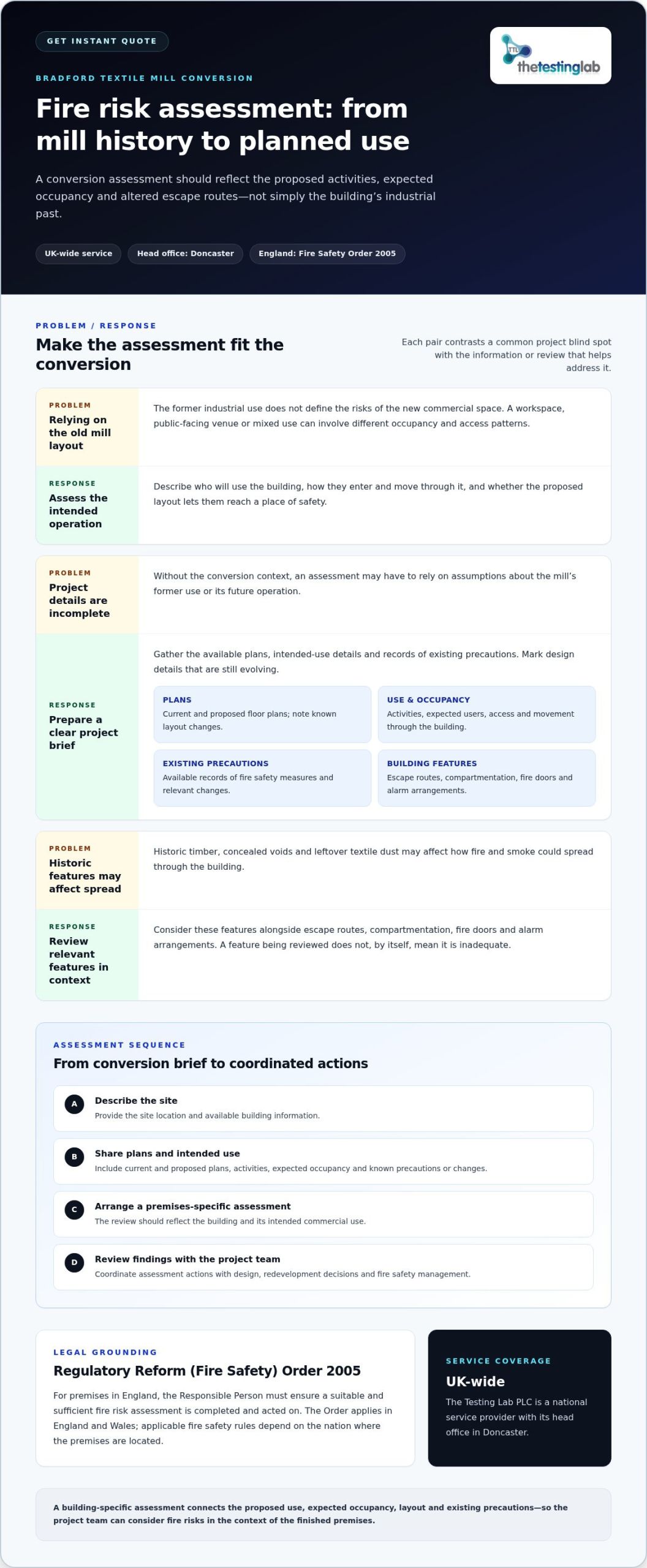
Separate inherited building features from risks linked to the planned use. Consider who may be in the building, how they enter and move through it, and whether the layout allows them to reach a place of safety. An arrangement suitable for one use may not suit another, so assess the intended operation rather than relying on existing assumptions.
For a Bradford property in England, the relevant fire safety legislation is the Regulatory Reform (Fire Safety) Order 2005. It requires the Responsible Person to ensure a suitable and sufficient fire risk assessment is completed and acted on. The Testing Lab PLC provides commercial fire risk assessments UK-wide as a national service provider, with its head office in Doncaster. The applicable fire safety rules depend on the nation where the premises are located.
Bradford Textile Mill Conversion Fire Risk Assessment Checklist
Good preparation helps the assessment reflect the conversion plans instead of relying on assumptions about the mill’s former use. For a commercial fire risk assessment Bradford textiles mill conversion project, gather the information available and flag details that are still being developed.
What project information should be ready before the assessment?
- Plans: Provide current and proposed floor plans, noting known layout changes and any areas where the design is still evolving.
- Use and occupancy: Describe the intended activities, who is expected to use the premises, and how people will access and move through the building.
- Existing precautions: Share records of fire safety measures and relevant changes already made, where available.
- Building features: Identify escape routes, compartmentation, fire doors and alarm arrangements for review.
These details give the assessor context for reviewing the building. A feature being reviewed does not mean it is inadequate. The assessment records relevant findings and risks; design choices, construction work and remedial decisions remain part of the wider project process. Keep the plans and description of the intended use aligned, so the assessment reflects how the premises are expected to operate.
For premises in Bradford, the GOV.UK guidance on workplace fire safety responsibilities explains duties under the Regulatory Reform (Fire Safety) Order 2005, which applies in England and Wales. The Testing Lab PLC provides commercial fire risk assessments UK-wide, including in Bradford, Carlisle, Chester, Lancaster, Liverpool, Manchester, Preston, Salford, Berwick-upon-Tweed, Durham, Middlesbrough, Newcastle upon Tyne, Sunderland, Doncaster, Huddersfield, Hull, Leeds, Sheffield and Wakefield. Its head office is in Doncaster.
Once you’ve outlined the site and conversion plans, you can request a quote for a commercial fire risk assessment.
Commissioning a Commercial Fire Risk Assessment for a Bradford Conversion
Once the conversion information is assembled, commissioning can follow a clear sequence: describe the site, share the proposed plans and use, arrange the assessment, then review the findings and coordinate any actions with the project’s fire safety management. This keeps the assessment focused on how the building is intended to operate, rather than treating its former mill use as the whole picture.
What to expect from the next steps
For a commercial fire risk assessment Bradford textiles mill conversion, provide the site location, current and proposed floor plans, intended activities, expected occupancy and details of known fire precautions or changes. The assessment is tailored to the premises and its intended commercial use. Under the Regulatory Reform (Fire Safety) Order 2005, the Responsible Person must ensure a suitable and sufficient assessment is completed and acted on for relevant premises in England and Wales. Review the findings with the project team so assessment actions can be coordinated with design and redevelopment decisions.
Refurbishment teams may also need to consider building risks beyond fire. The Testing Lab PLC provides asbestos consultancy services to support building-risk considerations during refurbishment planning.
The Testing Lab PLC is an independent national service provider offering commercial fire risk assessments UK-wide, with its head office in Doncaster. Share the site and conversion plans to request a quote: Get instant Quote.
Set Your Bradford Conversion Up for a Safer Next Stage
A mill conversion needs fire safety decisions grounded in how the finished premises will be used. A commercial fire risk assessment Bradford textiles mill conversion should consider the proposed activities, occupancy, layout and existing precautions, giving the Responsible Person a structured basis for managing fire risks under the Regulatory Reform (Fire Safety) Order 2005 in England.
Prepare site details and conversion plans before commissioning the assessment, then review its findings alongside the wider redevelopment. In particular, make sure the plans describe the intended use and expected occupancy, and record any known changes to escape routes or existing precautions.
The Testing Lab PLC provides assessments UK-wide as a national service provider, with its head office in Doncaster. To discuss the site and conversion plans, Get instant Quote.
Frequently Asked Questions
Who is responsible for fire safety during a commercial mill conversion in Bradford?
The Responsible Person under the Regulatory Reform (Fire Safety) Order 2005 must ensure a suitable and sufficient fire risk assessment is completed and acted on for relevant premises in England. Depending on who has control of the premises and the project stage, this may be the owner, developer or managing agent. The project team should establish who holds this role and how fire safety responsibilities are managed during redevelopment and occupation.
What should a fire risk assessment cover in a textile mill conversion?
It should assess fire hazards, people who may be at risk and existing precautions in light of the mill’s proposed commercial use. For a commercial fire risk assessment Bradford textiles mill conversion, relevant matters include occupancy, access and escape routes, compartmentation, fire doors and alarm arrangements. The review should also take account of mill features such as combustible textile dust, timber construction and concealed voids where present.
Does a change of use mean a mill conversion needs a new fire risk assessment?
A change of use can alter occupancy, activities, access and escape arrangements, so an existing assessment may no longer reflect the building’s risks. The Responsible Person must ensure the assessment remains suitable and sufficient, and review it when it may no longer be valid or when significant changes occur. Assess the completed premises against its intended use, act on the findings and keep the assessment under review.
Does UK fire safety legislation apply in the same way across the UK?
No. Fire safety legislation is nation-specific, so the rules applying to a Bradford premises in England aren’t necessarily identical to those in Scotland, Wales or Northern Ireland. The Regulatory Reform (Fire Safety) Order 2005 applies in England and Wales. The Testing Lab PLC provides fire risk assessments UK-wide as a national service provider, with its head office in Doncaster, and grounds the assessment in the premises’ location.

Article by
P J F Thomas
CEO and Founder of TTL plc.
Disclaimer
Items declared are AI generated but do reflect our services. Please get in contact if you have any questions.