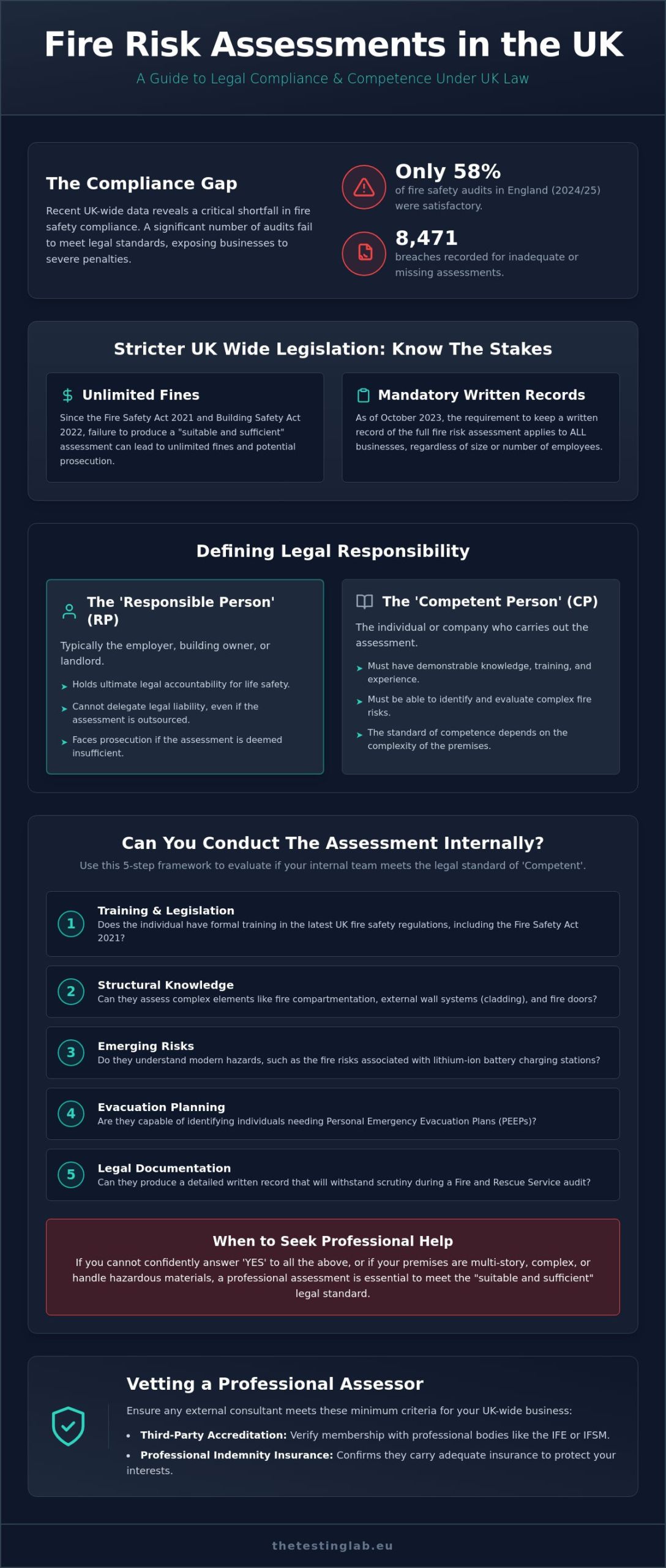
Did you know that only 58% of fire safety audits conducted by Fire and Rescue Services in England during the 2024/2025 fiscal year achieved a satisfactory outcome? With 8,471 recorded breaches specifically related to inadequate or missing assessments, the question of who can carry out a fire risk assessment has never been more critical for legal survival. Since October 2023, the law requires every assessment to be recorded in full, regardless of your company size, and failure to meet these standards can now result in unlimited fines.
We understand the pressure of managing multiple safety risks, from asbestos to legionella, while trying to decipher complex legislative jargon. It’s a significant responsibility that often feels like a burden on your internal resources. This guide provides a clear framework to help you understand the legal definition of competence and determine the most secure path for your business. We’ll examine the criteria for “suitable and sufficient” assessments and help you decide whether to handle the process internally or partner with a professional consultant. By the end, you’ll have a precise methodology to ensure your site remains safe and fully compliant with UK wide regulations.
Key Takeaways
- Understand the specific legal duties of the ‘Responsible Person’ and why defining a ‘Competent Person’ is the foundation of your UK wide compliance strategy.
- Use our 5-step evaluation framework to determine who can carry out a fire risk assessment within your organisation based on building complexity and technical risk factors.
- Recognise the boundary between simple premises and complex structures where internal assessments may no longer meet the “suitable and sufficient” legal standard.
- Learn how a professional, methodological approach can streamline your safety obligations by aligning fire risks with other mandatory surveys for asbestos and legionella.
Defining Legal Responsibility: The Responsible Person vs. the Competent Person
Under the Regulatory Reform (Fire Safety) Order 2005, the primary duty falls on the “Responsible Person” (RP). This individual, typically the employer, building owner, or landlord, holds ultimate accountability for life safety within the premises. While the RP determines who can carry out a fire risk assessment, they cannot delegate the legal liability itself. If the assessment is deemed “unsuitable or insufficient” by enforcement officers, the RP faces the consequences. These risks include unlimited fines, potential prosecution, and the invalidation of commercial insurance policies.
The legislation introduces the concept of a “Competent Person.” This isn’t just a job title; it’s a demonstrable standard of knowledge, training, and experience. In complex environments, relying on internal staff who lack specific fire safety qualifications often leads to technical oversights. A deficient assessment fails to identify critical ignition sources or evacuation bottlenecks, leaving the building vulnerable during a crisis. Determining who can carry out a fire risk assessment requires a realistic appraisal of internal skills versus site complexity.
The Regulatory Framework in the UK
UK wide compliance has become more stringent following the Fire Safety Act 2021 and the Building Safety Act 2022. These updates specifically mandate that fire risk assessments for multi-occupancy buildings must now include the structure, external wall systems, and individual flat entrance doors. These high-risk elements require a level of technical precision that goes beyond basic visual inspections. Failure to account for these specific areas is one of the most common reasons for audit failure.
When is a Written Record Mandatory?
A critical shift occurred on October 1, 2023. Previously, the “five or more employees” rule meant only larger businesses were required to record their findings. Now, the law requires all fire risk assessments to be recorded in full, regardless of staff numbers. Professional laboratories and consultancies, such as those specialising in integrated safety surveying, recommend detailed written documentation as a standard part of a robust risk management strategy. It provides the necessary paper trail to prove due diligence during a Fire and Rescue Service audit. Precision is non-negotiable.
Can You Carry Out Your Own Assessment? Evaluating Internal Competence
Determining who can carry out a fire risk assessment requires a realistic appraisal of the technical complexity of your site. For small, single-story offices with standard exits, the official government guidance suggests that the Responsible Person may be able to conduct the assessment themselves. However, multi-story buildings or sites with industrial processes introduce variables that demand specialist engineering knowledge. If your building contains hazardous materials or complex evacuation routes, the burden of proof for competence increases significantly.
To accurately decide who can carry out a fire risk assessment within your internal team for UK wide compliance, apply this 5-step framework:
- Training: Does the individual have formal training in the latest fire safety regulations?
- Structural Knowledge: Can they accurately assess the integrity of fire compartmentation and potential spread through voids?
- Emerging Risks: Do they understand the specific risks associated with lithium-ion battery charging stations?
- Evacuation Planning: Are they capable of identifying residents or staff requiring Personal Emergency Evacuation Plans (PEEPs)?
- Legal Documentation: Can they produce a written record that withstands legal scrutiny during an audit?
When these criteria aren’t met, or if your building features cladding systems or complex fire doors, it’s time to stop. The risk of missing structural flaws is too high for a non-specialist.
Vetting a Professional Fire Risk Assessor
If you seek external support, verify that the assessor holds third-party accreditation from professional bodies like the IFE or IFSM. They must carry professional indemnity insurance to protect your business interests. Technical competence in this sector is defined by a methodology that mirrors UKAS accredited standards, ensuring every hazard is quantified with precision.
The Multi-Hazard Approach to Site Safety
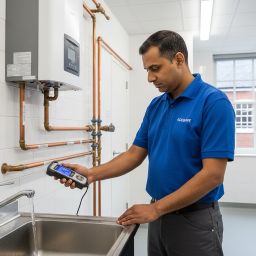
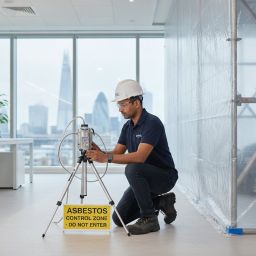
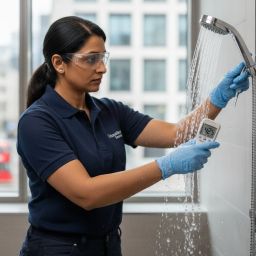
Fire safety shouldn’t exist in a silo. Managing a site involves balancing fire risks with asbestos consultancy services and legionella monitoring. A professional approach integrates these disciplines. For example, fire door installations often disturb old building materials, potentially triggering asbestos exposure. Our team at The Testing Lab PLC provides the strategic oversight needed to manage these overlapping risks simultaneously, ensuring total site safety without the administrative friction of multiple vendors.
The Professional Advantage: Strategic Compliance for UK Businesses
Technical excellence transforms fire safety from a reactive checklist into a proactive risk reduction strategy. While internal staff may understand daily operations, professional laboratories provide a level of methodological precision that addresses the hidden vulnerabilities of complex infrastructures. Deciding who can carry out a fire risk assessment is a strategic choice that impacts the long-term resilience of your operation. As The Responsible Person, your priority is ensuring that every hazard is quantified using data-driven insights rather than subjective observations.
This precision also applies to physical site maintenance; for example, Greenline Environmental offers commercial waste management services that help reduce the combustible ‘fire load’ in a building, which is an essential step in any proactive safety strategy.
Integrated Surveying and Testing Solutions
The most efficient safety strategies treat the building as a single, complex system. There is a clear operational benefit to using a single partner for both Legionella risk assessments and fire safety surveys. Structural-risk assessments, such as those identifying compromised compartmentation, often reveal issues that intersect with water management or asbestos containment. Managing these disciplines through a unified technical lens reduces administrative friction and prevents the fragmentation of critical safety data.
Ensuring Compliance Across the UK
Maintaining consistent safety standards for multi-site operations UK wide requires a scalable and rigorous methodology. Whether you are managing a single facility or a national portfolio, the criteria for who can carry out a fire risk assessment must remain uncompromising. For organisations seeking a robust foundation, our primary pillar for London-based surveying and compliance serves as a model for high-stakes technical surveying. To align your premises with current UK legislation and secure your operational future, you can request a quote for a comprehensive site survey today. We provide the technical magistery required to take the burden of professional responsibility off your shoulders.
Securing Your Operational Compliance and Site Safety
Ensuring your business meets the rigorous standards of the Fire Safety Act 2021 requires more than just a basic walkthrough. The decision regarding who can carry out a fire risk assessment should be based on a cold, technical appraisal of your building’s complexity and the specific hazards present. While internal assessments might work for the simplest of environments, the legal and safety risks of an “insufficient” record are too high for most UK wide operations. Precision is your best defense against liability.
By partnering with a UKAS Accredited Testing Laboratory, you gain the precision of an independent and professional environmental consultancy. We don’t just identify risks; we integrate them into a comprehensive safety strategy that covers multi-site businesses with total consistency. This methodological approach removes the professional burden from your shoulders and ensures your site remains a safe, compliant environment for everyone. Our team is ready to provide the technical oversight your organisation deserves.
Secure your UK-wide fire safety compliance with a professional assessment today. Protecting your people and your business starts with a single, precise step toward total compliance.
Frequently Asked Questions
Is it a legal requirement to have a professional fire risk assessment?
The law mandates that every non-domestic premises must have a “suitable and sufficient” assessment under the Regulatory Reform (Fire Safety) Order 2005. While you can perform it yourself in low-risk environments, the legal burden remains with the Responsible Person. Since October 1, 2023, all findings must be recorded in writing regardless of staff numbers. For complex infrastructures, professional assessments are the only reliable way to prevent unlimited fines and ensure UK wide compliance.
What qualifications should a fire risk assessor have in the UK?
An assessor should have demonstrable training, technical knowledge, and experience relevant to the specific building type. While no single legal qualification exists, professional body memberships such as the Institute of Fire Engineers (IFE) or the Institute of Fire Safety Managers (IFSM) are essential benchmarks. When deciding who can carry out a fire risk assessment, look for third-party accreditations that mirror UKAS standards to ensure the methodology remains legally defensible and technically accurate.
How often should a fire risk assessment be reviewed by a competent person?
You should review your assessment annually to maintain high safety standards. Legally, a review is mandatory if there’s a significant change to the building’s layout, occupancy, or internal processes. For instance, the Fire Safety (Residential Evacuation Plans) Regulations 2025 require duty holders to identify residents needing assistance. Ensuring a competent person evaluates these changes prevents the assessment from becoming obsolete and failing a Fire and Rescue Service audit during a routine inspection.
Can a landlord carry out a fire risk assessment for their own property?
A landlord can perform the assessment if they possess the necessary competence to identify all fire hazards and structural risks. However, recent legislative updates like the Building Safety Act 2022 have increased the technical requirements for multi-occupancy buildings. If the property features external cladding or complex fire door systems, most landlords find that who can carry out a fire risk assessment effectively is limited to accredited professionals who understand these intricate structural interactions and legal nuances.

Article by
P J F Thomas
CEO and Founder of TTL plc.
Disclaimer
Items declared are AI generated but do reflect our services. Please get in contact if you have any questions.