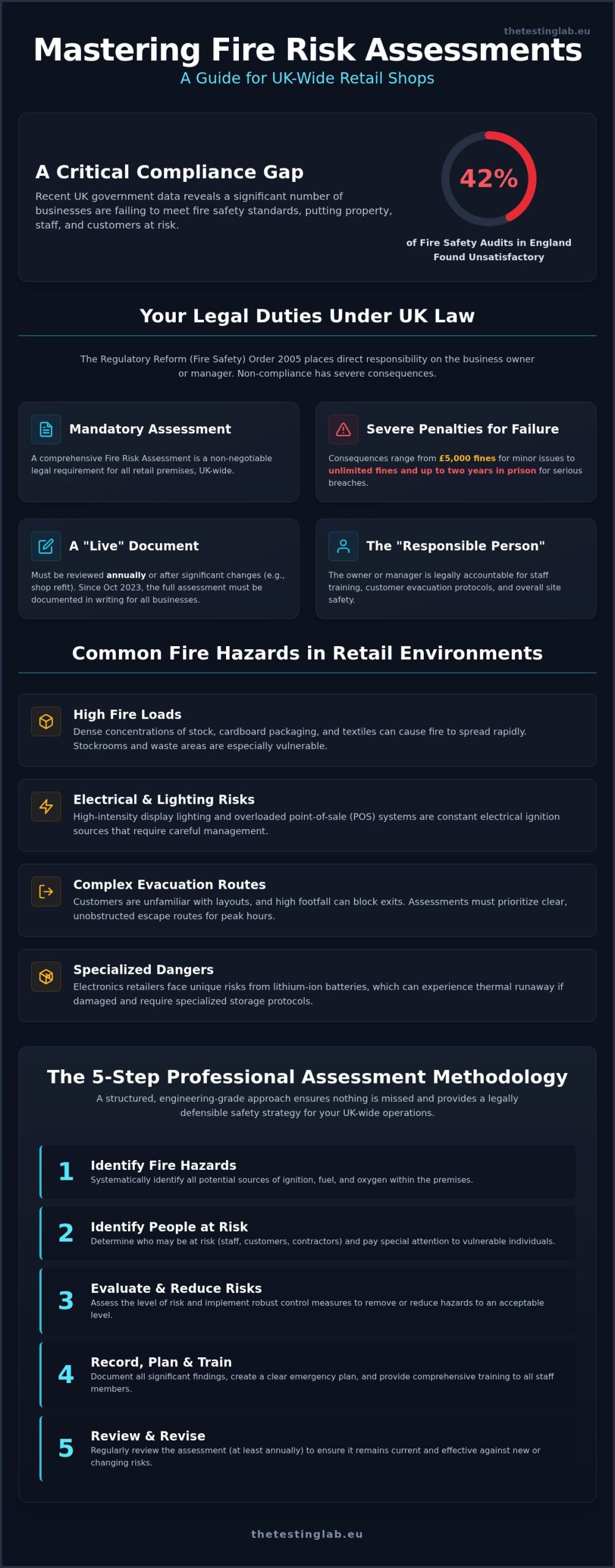
Did you know that 42% of fire safety audits in England were found to be unsatisfactory in the last year? For business owners, managing a fire risk assessment for retail shops often feels like hitting a moving target, especially with the 2025 updates to British Standards for alarms and lighting. It’s understandable to feel pressure when balancing the Regulatory Reform (Fire Safety) Order 2005 against the operational demands of high-footfall environments. We’ll help you master your legal obligations and protect your premises with our authoritative guide to UK legislation. This article provides a clear roadmap for achieving full compliance across your UK-wide sites, ensuring your safety documentation is technically sound and actionable. We’ll examine the specific requirements of the Fire Safety Act 2021 and how our methodology, which aligns with our local surveying and risk management, secures your business against regulatory risk.
Key Takeaways
- Understand your mandatory legal duties under the Regulatory Reform (Fire Safety) Order 2005 to ensure every premises meets current UK legislation standards.
- Identify and mitigate retail-specific hazards, such as high fire loads from stock and electrical risks from display lighting, to protect both staff and customers.
- Implement a robust 5-step methodology to streamline compliance and maintain consistent safety standards across all your UK-wide retail locations.
- Learn why a professional fire risk assessment for retail shops is essential for avoiding severe penalties and creating a documented, legally defensible safety strategy.
Statutory Duties and the Regulatory Reform (Fire Safety) Order 2005
Fire safety in the retail sector isn’t just a best practice; it’s a strict statutory obligation. Under the Regulatory Reform (Fire Safety) Order 2005, conducting a fire risk assessment for retail shops is a mandatory legal requirement for all premises. The core principle of the Order is to shift the responsibility for fire safety from the fire service to the person in control of the building. Non-compliance carries heavy penalties, ranging from £5,000 for minor issues to unlimited fines and up to two years in prison for serious breaches. For UK-wide operations, maintaining this standard across multiple sites is critical for risk mitigation.
Your assessment isn’t a static folder on a shelf. It’s a “live” document that must reflect the current state of your shop. You’re required to review it annually or immediately following any significant change, such as a shop floor redesign or a change in the type of stock you carry. Since October 2023, legislation requires all businesses, regardless of size, to record their full fire risk assessment in writing.
Defining the Responsible Person in Retail Management
The “Responsible Person” is usually the business owner or the manager with control over the premises. This role carries the legal weight of ensuring every employee receives adequate fire safety training and that customer evacuation protocols are flawlessly executed during an emergency. Retail spaces are often high-occupancy environments, which complicates escape routes. If your premises are large or complex, the legislation demands a level of professional competency that often exceeds internal resources. Leveraging expert surveying and risk management ensures your fire risk assessment for retail shops remains robust and legally sound across all UK-wide locations.
Identifying Retail-Specific Fire Hazards and Mitigation
Fire safety in retail requires a granular understanding of “fire load.” Dense concentrations of textiles, cardboard packaging, and flammable stock create environments where fire can spread rapidly. According to the official government guidance, managing these loads is a primary pillar of compliance. A comprehensive fire risk assessment for retail shops must also address high-intensity display lighting and overloaded point-of-sale (POS) systems, which represent constant electrical ignition risks.
Complex shop layouts, particularly in multi-level or partitioned stores, present significant evacuation challenges. Unlike staff, customers are unfamiliar with emergency exits. A professional fire risk assessment for retail shops must prioritize clear, unobstructed escape routes that account for high occupant volumes during peak trading hours. Ensuring your UK-wide sites have standardized signage and evacuation plans is vital for operational safety.
Managing Fire Loads in Stockrooms and High-Risk Areas
Beyond structural barriers, ensuring your premises are equipped with the right tools is essential; for expert advice on industrial safety gear and standards, Colorado Safety Supply Company serves as a valuable resource for maintaining a safe workplace.
Compartmentation is the primary method of fire containment in retail structures, utilizing fire-resistant barriers to limit the spread of fire and smoke. Stockrooms are often the most vulnerable areas due to high-density storage and waste accumulation. Electronics retailers must also address the specific danger of lithium-ion battery storage. These units can experience thermal runaway if damaged or incorrectly charged, necessitating specialized storage protocols. If you’re managing complex risks across multiple locations, our specialist surveying services can help integrate fire safety with broader compliance requirements.
Implementing a Professional UK-Wide Fire Risk Strategy
A professional fire risk assessment for retail shops follows a rigorous 5-step methodology designed for engineering-grade precision. First, we identify potential fire hazards. Second, we identify the people at risk. Third, we evaluate, remove, or reduce those risks. Fourth, we record the findings in a comprehensive report. Finally, we review the assessment regularly to ensure ongoing safety. According to The Fire Protection Association, this structured approach is vital for maintaining high safety standards. It’s not just a checklist; it’s a systems-based evaluation of your specific operational environment.
For businesses operating UK-wide, standardization is the key to managing liability. Fragmented DIY templates often fail to provide the professional indemnity or technical depth required for complex retail units. A UKAS accredited consultancy provides defensible, high-quality data that protects your brand across all regions. Integrating these audits with local asbestos and legionella surveying creates a unified compliance framework that saves time and resources while ensuring total site safety.
Integrating Fire Safety with Asbestos and Water Management
Structural risks often hide behind physical barriers. In older retail units, asbestos-containing materials can mask compromised fire stopping or hidden spread risks. Identifying these during a fire risk assessment for retail shops prevents catastrophic failures. Combining fire safety with legionella risk assessment services streamlines facility management and reduces operational downtime. This multidisciplinary approach ensures all critical safety systems are evaluated with professional accuracy. If you’re ready to secure your portfolio, you can request a quote for UK-wide material and risk testing to establish a clear baseline for compliance.
Securing Your Retail Portfolio with Statutory Precision
Maintaining a robust fire risk assessment for retail shops is no longer just about ticking boxes; it’s about protecting your people and your brand through methodology-driven safety. We’ve explored how the Regulatory Reform (Fire Safety) Order 2005 demands dynamic, recorded documentation that evolves with your shop layout and stock profiles. By moving away from generic templates toward a standardized, UK-wide strategy, you ensure every location meets the highest safety standards. Our UKAS accredited laboratory facilities and expert surveying team provide the technical depth needed for complex retail environments. We integrate fire safety with broader health and safety compliance, including local surveying and risk management, to take the professional burden off your shoulders. Request a professional Fire Risk Assessment quote for your UK retail premises today. We’re here to help you build a safer, more resilient business.
Frequently Asked Questions
Is a fire risk assessment a legal requirement for a small shop?
Yes, a fire risk assessment is a mandatory legal requirement for all business premises in the UK, including the smallest retail units. Since the legislative updates in October 2023, every shop, regardless of employee numbers, must maintain a written record of their assessment. This ensures that even micro-businesses remain compliant with the Regulatory Reform (Fire Safety) Order 2005.
How often should a retail fire risk assessment be reviewed?
You should review your fire risk assessment for retail shops at least once every 12 months to ensure it stays current. An immediate review is also necessary if you change your shop layout, increase stock levels, or alter your business activities. Maintaining this document as a live record is essential for managing safety across UK-wide retail locations.
Who is responsible for fire safety in a leased retail unit?
In a leased retail unit, the tenant is typically the “Responsible Person” for the area they occupy, including the shop floor and stockrooms. The landlord or building owner usually retains responsibility for structural fire safety and common areas like shared corridors. Both parties must cooperate to ensure the entire building meets UK-wide safety standards and legislative requirements.
Can I carry out my own fire risk assessment for my shop?
Can I carry out my own fire risk assessment for my shop?
Legally, you can perform your own assessment if you’re a “competent person” with the right training and knowledge. However, the technical complexity of modern retail environments often makes professional input safer. Appointing an expert ensures your fire risk assessment for retail shops is precise, technically sound, and capable of withstanding scrutiny from fire and rescue authorities during a site audit. For business owners who want to find out more about how professional safety and risk management services can support their operations, seeking expert advice is a proactive step toward total compliance.

Article by
P J F Thomas
CEO and Founder of TTL plc.
Disclaimer
Items declared are AI generated but do reflect our services. Please get in contact if you have any questions.