
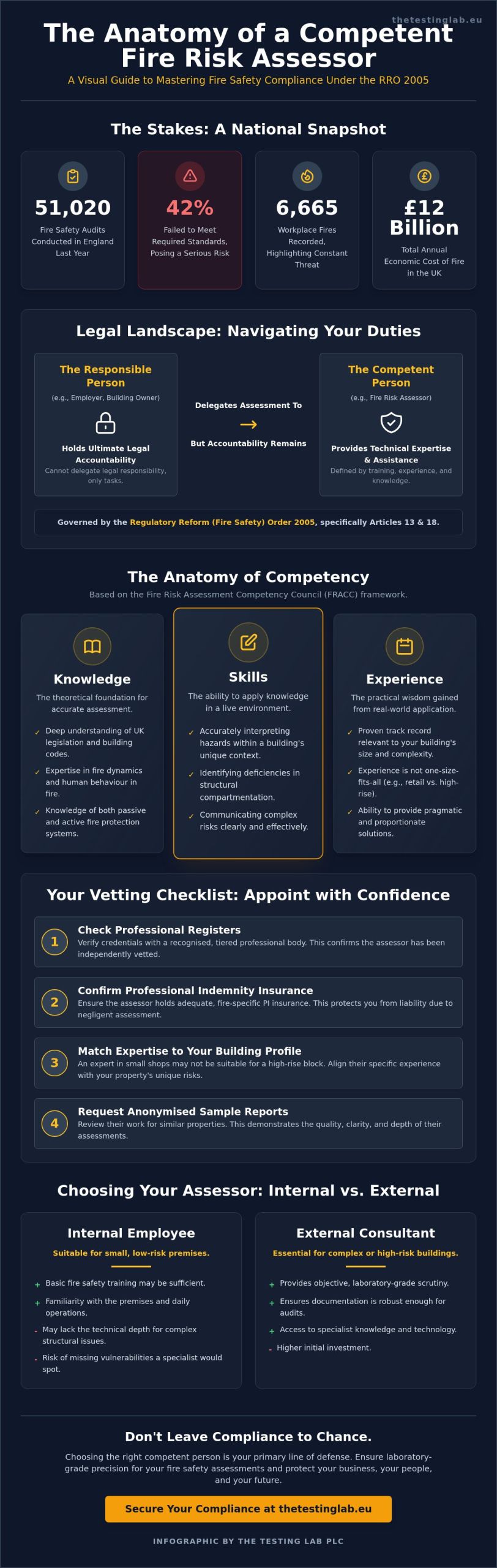
Did you know that fire and rescue services in England conducted 51,020 fire safety audits last year, and nearly 42% failed to meet the required standards? With workplace fires reaching 6,665 incidents and the total economic cost of fire hitting £12 billion, the person you choose to evaluate your premises is your primary line of defense against unlimited fines. It’s natural to feel overwhelmed by the technical jargon of the Regulatory Reform (Fire Safety) Order 2005 and the strict 2026 updates. Identifying a truly competent person for fire risk assessment is no longer just a box-ticking exercise. It’s about ensuring a verified alignment between an assessor’s specific technical expertise and your building’s unique risk profile.
At The Testing Lab PLC, we approach safety with laboratory-grade precision, whether we’re handling asbestos consultancy or legionella risk assessments. This guide will help you master the legal requirements for fire safety competency so you can appoint the right expert with absolute confidence. We’ll break down the three-tier competency framework established by BS 8674:2025, explain how Section 156 of the Building Safety Act 2022 changes your documentation duties, and provide a practical framework for vetting assessors to ensure total workplace compliance.
Key Takeaways
- Identify the specific legal criteria that define a competent person for fire risk assessment under the Regulatory Reform (Fire Safety) Order 2005.
- Utilise the FRACC framework to objectively verify an assessor’s technical knowledge, skills, and experience in structural fire protection.
- Recognise the critical legal boundary between the ‘Responsible Person’ and the expert to ensure you manage delegation without losing legal oversight.
- Implement a robust vetting process by checking tiered professional registers and confirming the presence of fire-specific Professional Indemnity insurance.
- Learn how to integrate fire safety into a wider strategic compliance framework that prioritises precision and risk mitigation across your entire property portfolio.
What is a Competent Person for Fire Risk Assessment?
Under the Regulatory Reform (Fire Safety) Order 2005, the responsibility for life safety in UK workplaces is clear. However, the technical execution of this duty often requires a specialist. A competent person for fire risk assessment is defined as an individual who possesses sufficient training, experience, and knowledge to assist the Responsible Person in meeting their statutory obligations. It’s vital to recognize that this person acts as a technical enabler. They provide the precision needed to identify hazards, but the legal accountability remains with the employer or building owner. In a broader health and safety context, the role of a Competent Person involves the ability to recognize hazards and have the authority to take corrective action. Competency is the dynamic synthesis of theoretical knowledge and the ability to apply it effectively in a real-world environment.
The Legal Requirement for Competency
Articles 13 and 18 of the Fire Safety Order form the legal backbone of this role. Article 13 mandates that the Responsible Person must appoint enough competent persons to implement procedures for serious and imminent danger. Article 18 goes further, requiring the appointment of one or more competent persons to assist in undertaking preventive and protective measures. While the law uses the term ‘competent’, it doesn’t provide a simple checklist. This subjectivity creates a risk for businesses. If an assessment is conducted by someone without the necessary expertise, the consequences are severe. Beyond the immediate threat to life, non-compliance can lead to unlimited fines and the total invalidation of insurance policies. Professional precision isn’t optional; it’s a legal safeguard.
Internal vs. External Competent Persons
Determining whether to use an internal employee or an external consultant depends on the complexity of your premises. For a small, low-risk shop, an internal staff member with basic fire safety training might suffice. However, for multi-occupancy buildings, industrial sites, or high-rise residential blocks, the risk profile demands a higher level of scrutiny. External consultants bring a laboratory-like focus to the process, identifying structural vulnerabilities that an internal generalist might miss. Appointing an accredited expert ensures your documentation is robust enough to withstand a fire service audit. If your business operates in complex environments, accessing professional London surveying support provides the strategic partnership needed to bridge the gap between technical assessment and total compliance. Choosing a competent person for fire risk assessment from an external consultancy often provides the technological confidence required to manage high-stakes liabilities.
Core Competency Criteria: Knowledge, Skills, and Experience
Judging whether someone is a competent person for fire risk assessment requires more than a glance at a CV. The Fire Risk Assessment Competency Council (FRACC) provides the industry gold standard for these evaluations. It breaks down competency into three distinct pillars: knowledge, skills, and experience. Knowledge involves a deep understanding of fire dynamics, UK legislation, and structural fire protection. Skills refer to the assessor’s ability to interpret these hazards in a live environment. Experience is often the most overlooked factor. An assessor who’s spent a decade in small retail units may lack the technical depth to evaluate a high-rise residential block. Government guidelines state that the Responsible Person must appoint a ‘competent person’ to manage these complexities with laboratory-grade precision.
Technical Knowledge Requirements
A true expert understands the nuanced difference between ‘Stay Put’ and ‘Simultaneous Evacuation’ strategies. They must identify whether passive fire protection, such as fire-stopping materials in service risers, is sufficient to maintain compartmentation. This isn’t just about spotting a blocked exit. It’s about a scientific understanding of how smoke and heat travel through a structure. It’s essential that your assessor demonstrates a comprehensive understanding of British Standards, particularly BS 5839 for fire detection and alarm systems, to ensure your hardware meets current safety benchmarks.
Practical Experience and Building Complexity
Mismatched expertise is a leading cause of failed fire safety audits. For example, a consultant without experience in high-rise cladding systems shouldn’t be assessing a 20-metre residential tower. Professional registers like the Institution of Fire Engineers (IFE) or the Institute of Fire Safety Managers (IFSM) are vital tools for verification. They offer a tiered approach to competency, ensuring the assessor’s background matches the building’s complexity. We’ve seen cases where generalist consultants failed to identify faulty fire dampers in complex ventilation systems, leading to costly enforcement notices. If you’re managing multi-site portfolios, a comprehensive surveying approach ensures that every variable, from fire safety to legionella, is handled with the same engineering-led precision. This level of thoroughness removes the burden of quality assurance from your shoulders and places it in expert hands.
Responsible Person vs. Competent Person: Navigating Legal Accountability
A common misconception in UK fire safety is that hiring an external expert transfers all legal liability to the consultant. This isn’t the case. Under the Regulatory Reform (Fire Safety) Order 2005, the ‘Responsible Person’ (RP), usually the employer, building owner, or landlord, retains ultimate legal accountability for the safety of the premises. While you can delegate the technical task of conducting an assessment to a competent person for fire risk assessment, you cannot divest yourself of the underlying legal duty. The consultant acts as a specialist advisor. Their role is to provide the data and recommendations that inform your decision-making. To protect your business, you must document the entire appointment process. This creates a clear record of your efforts to comply with the law if an incident occurs.
The Limits of Delegation
The RP’s involvement doesn’t end once the assessor leaves the building. You’re required to review the findings and sign off on the proposed action plan. An assessment is only as accurate as the information provided. This means the RP must grant the assessor full access to all areas of the building and provide a comprehensive history of previous fire incidents or structural changes. Managing safety requires a holistic view of your property’s health. Just as you would seek professional Legionella risk assessment services to ensure water safety compliance, fire safety requires the same level of integrated oversight. The London Fire Brigade emphasizes that the responsibility to appoint a suitably competent person lies squarely with the RP, regardless of the size of the organisation.
Ensuring Due Diligence in Selection
If a fire safety failure leads to prosecution, the RP may need to demonstrate a ‘due diligence’ defense. This involves proving that you made reasonable checks to ensure the person you hired was truly capable of the task. Relying on a cheap quote or a vague recommendation isn’t enough. You should look for professional third-party accreditation, such as UKAS-accredited certification bodies, which provide an objective benchmark of quality. It’s vital to maintain a meticulous audit trail of the assessor’s credentials, insurance documents, and previous project experience to satisfy regulatory scrutiny. This scientific approach to selection mirrors our own methodology at The Testing Lab, where every assessment is backed by verifiable data and engineering expertise. By treating the appointment as a strategic partnership rather than a one-off transaction, you significantly reduce your personal and corporate risk.
How to Verify and Appoint a Competent Fire Risk Assessor
Verification is where technical confidence meets corporate due diligence. Selecting a competent person for fire risk assessment requires a methodical approach that mirrors a laboratory audit. You aren’t just looking for a certificate; you’re looking for a verified alignment between an assessor’s expertise and your building’s specific risk profile. This process removes the burden of quality assurance from your shoulders and places it into a framework of objective proof. Follow these five steps to ensure your appointment stands up to regulatory scrutiny.
- Step 1: Check professional body membership. Search the Tiered Fire Risk Assessors Register (TFRAR) or similar registers held by the IFE or IFSM.
- Step 2: Verify Professional Indemnity (PI) Insurance. Ensure the policy explicitly covers fire risk assessment. General PI insurance often excludes fire-related claims.
- Step 3: Request redacted samples. Review work completed for buildings with similar occupancy and complexity. A retail-focused assessor may lack the depth required for an industrial chemical plant.
- Step 4: Confirm regulatory fluency. They must demonstrate a clear understanding of the Building Safety Act 2022 and recent amendments to the Fire Safety Order.
- Step 5: Review vulnerable occupant methodology. Ask how they evaluate Personal Emergency Evacuation Plans (PEEPs) for residents or staff with limited mobility.
Essential Questions to Ask Before Hiring
Interviewing a candidate reveals the depth of their engineering mindset. Ask what specific training they’ve received in fire safety engineering rather than general health and safety. Query their specific process for staying updated with the rapid changes in UK fire legislation. Finally, request references from clients in your industry. A competent person for fire risk assessment should provide evidence of handling similar challenges with precision. If you’re managing a complex portfolio, get a professional surveying quote to ensure every variable is accounted for by experts.
The Role of Third-Party Accreditation
Accreditation from bodies like BAFE or UKAS offers the highest level of assurance for UK businesses. It’s vital to distinguish between an individual qualification and a company-wide accreditation. Company-wide schemes imply that the organisation has robust internal quality control, peer review processes, and a commitment to ongoing professional development. Always request visual evidence of these certifications in .jpg or .png format. Storing these files in your digital audit trail provides immediate proof of due diligence during a fire service audit. This transparent, evidence-based approach is exactly how we handle multi-disciplinary compliance, ensuring that every assessment is backed by verifiable technical data.
Strategic Compliance with The Testing Lab PLC
Compliance isn’t a static destination; it’s a continuous process of technical verification. At The Testing Lab, we don’t view fire safety as a disconnected obligation. Instead, we apply a scientific mindset to every site inspection, bridging the gap between dense technical assessments and your corporate responsibility. Appointing a competent person for fire risk assessment through our consultancy means you’re gaining more than a report. You’re securing a strategic partner that understands how fire safety interacts with other critical environmental factors. This is why our professional London surveying support is built on a foundation of multi-disciplinary expertise. Our national reach ensures that multi-site commercial portfolios receive consistent, high-quality oversight across the entire UK.
The Laboratory Standard of Risk Assessment
We treat every fire risk assessment with the same rigorous methodology we apply in our UKAS-accredited laboratories. This engineering-led approach ensures that every recommendation is grounded in legislative accuracy and empirical data. We don’t guess; we measure. By integrating our fire safety expertise with our specialist Legionella risk assessments, we provide a holistic safety framework. This multi-disciplinary precision removes the fragmented nature of traditional compliance. It allows you to manage your property’s health from a single, trusted source of truth, backed by a team that values precision and quality above all else.
Get Started with a Professional Assessment
Securing your premises starts with a clear understanding of your current risk profile. Our onboarding process is designed to be seamless and transparent, providing you with immediate technological confidence. We’ll review your building history, evaluate your current fire-stopping measures, and provide a clear roadmap for total compliance. This methodical approach ensures that your competent person for fire risk assessment isn’t just a name on a document, but a technical advocate for your business. We take the burden of quality assurance off your shoulders, allowing you to focus on your core operations while we handle the intricacies of UK safety legislation. For bespoke consultancy that prioritises precision over generalisation, you can request a comprehensive quote for your fire safety needs today. Our team is ready to provide the professional support required to keep your workforce safe and your business compliant.
Future-Proof Your Fire Safety Compliance
The 2026 regulatory landscape demands more than a passive approach to safety. The distinction between a general consultant and a truly competent person for fire risk assessment lies in verified expertise and building-specific experience. By applying the FRACC framework and maintaining a robust audit trail, you protect your organisation from the legal and financial risks of non-compliance. While technical tasks are delegated, your strategic oversight as the Responsible Person remains the final safeguard for life safety across your UK premises; to ensure your financial compliance is managed with the same level of professional care, you can visit Fair View Accounting Services.
The Testing Lab PLC brings laboratory-grade precision to this critical process. As a UKAS Accredited Testing Laboratory with UK-wide coverage, we bridge the gap between complex legislation and practical workplace protection. Our expertise in complex fire safety and environmental risk ensures your multi-site commercial portfolio remains resilient and fully compliant. It’s time to move beyond guesswork and embrace a scientific approach to risk management that leaves nothing to chance; for organizations looking to extend this care to employee wellbeing, you can learn more about Addiction Centre.
Secure your business with a verified competent person from The Testing Lab PLC. Taking this step today transforms a legal obligation into a strategic asset that protects both your people and your reputation.
Frequently Asked Questions
Can I be my own competent person for fire risk assessment?
Yes, if you possess the training and experience to identify hazards accurately. Small, low-risk premises often allow the Responsible Person to handle this task internally. However, for complex structures, the risk of missing structural fire protection issues is high. You must be able to justify your competency if a fire occurs.
What happens if my fire risk assessor is found to be incompetent?
The legal accountability remains with you, the Responsible Person. If an assessor’s work is deemed unsuitable and sufficient, you face unlimited fines and potential prosecution. This highlights why vetting a competent person for fire risk assessment is a strategic necessity rather than a simple procurement task.
How often should a competent person review my fire risk assessment?
Review your assessment annually as best practice. You must conduct a review immediately after any significant structural changes, a change in building use, or following a near miss incident. Regular reviews ensure your safety measures evolve alongside your operational risks and building occupancy.
Is a fire risk assessment a legal requirement for all UK businesses?
Yes, it’s mandatory for all businesses regardless of size. Since October 1, 2023, Section 156 of the Building Safety Act 2022 requires all fire risk assessments to be recorded in full. The previous threshold of five employees has been removed; even the smallest businesses must now comply.
What is the difference between a fire marshal and a competent person?
A fire marshal manages day-to-day safety and evacuation procedures during an emergency. In contrast, the competent person identifies technical risks and specifies the fire-stopping measures or alarm systems required. One focuses on human movement; the other focuses on structural integrity and risk mitigation.
Does a competent person need to be accredited by a specific body?
No specific law mandates accreditation, but government guidance strongly recommends it. Choosing an assessor on a professional register like the IFE or IFSM provides objective proof of their skills. It’s the most reliable way to demonstrate due diligence to fire and rescue authorities during an audit.
Can a competent person for asbestos also do my fire risk assessment?
Only if they hold separate, verified qualifications for both disciplines. While we offer professional surveying support across multiple sectors, each assessment is conducted by a specialist in that specific field. Don’t assume an environmental expert is automatically qualified in fire chemistry.
What qualifications should I look for in a fire risk assessor in 2026?
Look for a competent person for fire risk assessment who is aligned with the BS 8674:2025 standard. This framework categorises competency into Foundation, Intermediate, and Advanced tiers. You should also verify their understanding of the BS 8214:2026 fire door revisions to ensure your structural protection meets current benchmarks.

Article by
P J F Thomas
CEO and Founder of TTL plc.
Disclaimer
Items declared are AI generated but do reflect our services. Please get in contact if you have any questions.