
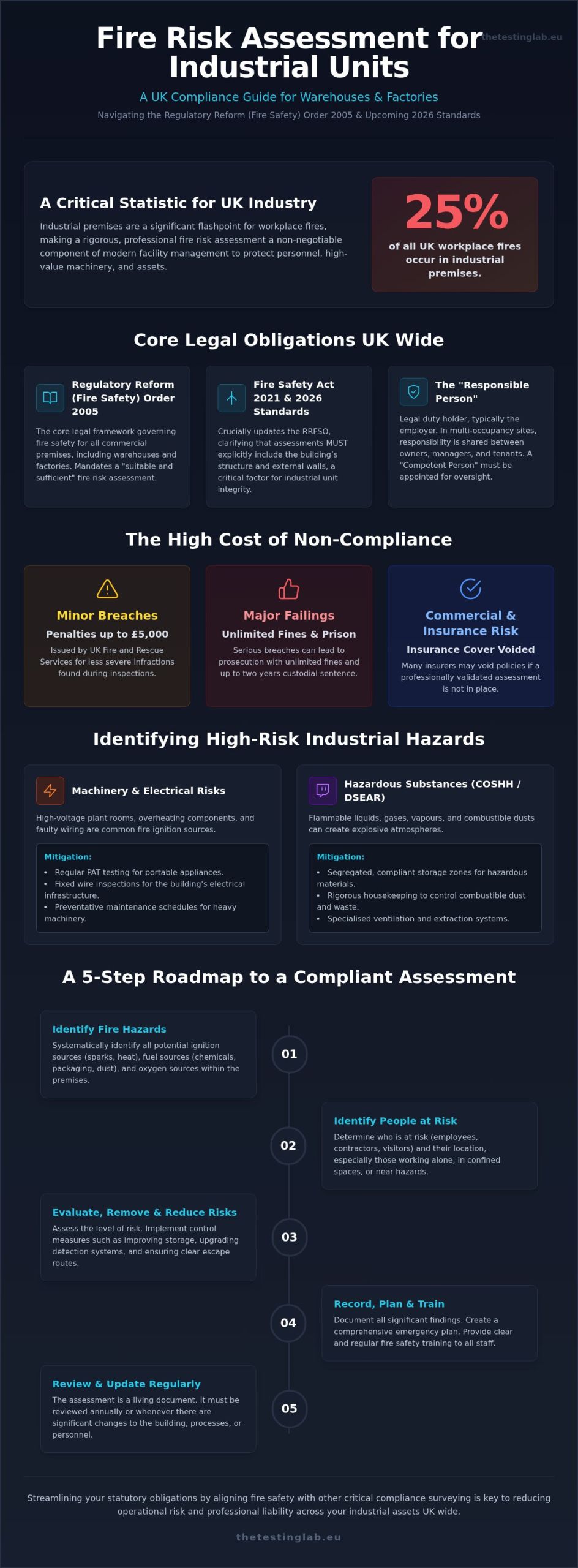
Industrial premises account for 25% of all workplace fires in the UK. It’s a sobering statistic that underscores why a rigorous fire risk assessment for industrial units is a non-negotiable component of modern warehouse and factory management. You likely understand that balancing high-speed operational throughput with the demands of the Regulatory Reform (Fire Safety) Order 2005 is a complex challenge. The risk of unlimited fines or catastrophic asset loss is real, particularly as 2026 standards bring renewed focus to building compartmentation and hazardous material storage.
This guide provides the technical roadmap you need to ensure your facility remains fully compliant UK wide. We’ve designed this resource to help you protect high-value machinery and personnel through a precise, engineering-led approach to safety. By aligning these fire safety protocols with your existing environmental compliance and surveying strategies, you can effectively remove the weight of professional liability from your shoulders.
We’ll explore the critical 2026 updates, including new British Standards for fire detection and the specific risk mitigation required for lithium-ion battery storage and the latest foam extinguisher restrictions.
Key Takeaways
- Gain clarity on the 2026 legal requirements under the Fire Safety Act 2021, specifically regarding building structures and external walls for industrial sites UK wide.
- Learn how to evaluate the critical interaction between specialized production processes and fire spread potential within high-hazard warehouse environments.
- Follow a precise 5-step roadmap for a fire risk assessment for industrial units that aligns with professional standards and protects high-value machinery and stock.
- Streamline your statutory obligations by aligning fire safety with other critical compliance surveying to reduce operational risk and professional liability.
Understanding Legal Requirements for Industrial Fire Safety
Compliance within the industrial sector isn’t just about checking boxes; it’s a rigorous legal obligation defined by the Regulatory Reform (Fire Safety) Order 2005 (RRFSO). This legislation remains the core framework governing safety for warehouses and factories UK wide. To maintain a “suitable and sufficient” UK fire safety regulations compliance profile, your documentation must reflect the latest 2026 standards. Under the Fire Safety Act 2021, a fire risk assessment for industrial units must now explicitly include the building’s external walls and structure. Ignoring these technical nuances doesn’t just invite risk; it creates a direct pathway to unlimited fines or custodial sentences for those in charge.
When evaluating these structural elements, it can be beneficial to consult with industrial fabrication experts; you can read more about Steeledge and their specialist services.
Defining the “Responsible Person” in Industrial Settings
Identifying the “Responsible Person” is often straightforward in a single-occupancy unit, where the employer typically holds the duty. However, complex leasehold structures and multi-occupied industrial estates complicate this. In these scenarios, the building owner, facilities manager, and individual tenants all share legal responsibilities. You must coordinate safety measures across the entire site to prevent gaps in protection. Documenting the delegation of tasks to a “competent person” is vital. This professional oversight ensures that high-hazard environments are managed with the precision required by law, effectively transferring the burden of liability from your shoulders to a strategic partner.
The Consequences of Non-Compliance
UK Fire and Rescue Services have increased their scrutiny of industrial premises, moving away from simple advice toward strict enforcement. Minor breaches can result in penalties up to £5,000, but major failings often lead to unlimited fines and up to two years in prison. Beyond the legal system, your commercial insurance is at stake. Many providers now stipulate that a “self-made” assessment without professional validation may void your cover. Integrating your safety strategy with other statutory requirements, such as compliance surveying, ensures that your industrial unit remains a safe, legally protected asset.
Identifying and Mitigating High-Risk Industrial Hazards
Industrial units UK wide house specialized hazards that generic commercial assessments often overlook. A high-precision fire risk assessment for industrial units must go beyond standard exit signs to evaluate the dynamic interaction between heavy manufacturing processes and the building’s fire spread potential. In the context of industrial chemical storage, the fire triangle represents the volatile combination of an ignition source, such as static discharge or mechanical friction, a fuel load of flammable vapours or liquids, and the ambient oxygen required to sustain combustion. Identifying these variables with engineering-led precision is the foundation of a professional fire risk assessment service.
Machinery and Electrical Fire Risks
High-voltage plant rooms and heavy machinery are frequent origin points for industrial fires. Overheating components, faulty wiring, and poorly maintained switchgear represent significant ignition risks that require technical oversight. Your fire strategy should integrate regular PAT testing and fixed wire inspections to mitigate these electrical hazards. Following official government guidance, these inspections provide the technical evidence that your safety systems can handle the operational load of a 24/7 industrial environment. This rigorous approach ensures that machinery failure doesn’t lead to catastrophic asset loss.
Hazardous Substances and COSHH Compliance
Managing flammable liquids, gases, and combustible dusts requires strict adherence to the Dangerous Substances and Explosive Atmospheres Regulations (DSEAR). Fine particulates in a woodworking shop or chemical vapours in a coating plant can turn a minor spark into a major event. Effective risk mitigation relies on precise operational controls:
- Segregated storage zones for hazardous materials to prevent cross-contamination.
- Rigorous “housekeeping” protocols to prevent the accumulation of combustible waste.
- Specialized ventilation and extraction systems to manage vapour density.
By addressing these technical risks through a strategic lens, you ensure your compliance framework remains robust and reliable.
The Professional Assessment Process and Compliance Roadmap
A professional fire risk assessment for industrial units isn’t a static checklist; it’s a methodological framework designed to evolve with your operational needs. Our UK-wide surveyors apply a consistent, lab-backed standard to every inspection, ensuring your national property portfolio meets the same high benchmarks for safety. By utilizing digital reporting, we provide real-time tracking of remedial actions. This allows facilities managers to monitor compliance status across multiple sites simultaneously, removing the administrative burden from your internal teams.
The 5 Steps of a Suitable and Sufficient Assessment
To meet the legal threshold of being “suitable and sufficient,” every assessment follows the official government guidance through five distinct phases:
- Identify fire hazards: Locating ignition sources and fuel loads within production and storage areas.
- Identify people at risk: Accounting for staff, contractors, and visitors, especially those in isolated plant rooms.
- Evaluate, remove, or reduce risks: Implementing technical controls to minimize the likelihood of fire spread.
- Record findings and prepare an emergency plan: Documenting the strategy and evacuation procedures for legal scrutiny.
- Review the assessment regularly: Updating the document following any significant change in machinery, layout, or 2026 legislative updates.
Integrating Fire Safety with Broader Compliance
Building safety is a system of interconnected risks. A high-quality fire assessment shouldn’t exist in a vacuum; it must reference your asbestos consultancy records and your legionella risk assessment. For instance, fire spread potential is often influenced by the presence of asbestos-containing materials in ceiling voids or wall panels. Using a single-source consultancy ensures that your occupational hygiene and building safety needs are managed with scientific precision and total transparency. If you’re ready to secure your facility and protect your assets, you can request a quote for professional compliance services to start your roadmap to full legal protection.
Securing Your Industrial Future through Precision Compliance
Maintaining a robust fire risk assessment for industrial units is no longer just a legal necessity; it’s a strategic investment in your operational resilience. The transition to 2026 standards demands a deeper focus on building compartmentation and the specific hazards of modern manufacturing processes. By integrating these safety protocols with your existing environmental compliance framework, you ensure that every technical vulnerability is accounted for UK wide.
The Testing Lab PLC brings the precision of an independent laboratory founded in 2002 to your facility. As a UKAS accredited consultancy, we provide comprehensive coverage for national industrial portfolios, delivering the methodological accuracy required to protect your staff and high-value machinery. You don’t have to carry the burden of professional liability alone. Our expert surveyors are ready to help you navigate the complexities of UK legislation with confidence and transparency.
Take the next step in securing your facility today. Request a Professional Fire Risk Assessment Quote from our specialist team and build a safer, more compliant working environment for the years ahead.
Frequently Asked Questions
How often should a fire risk assessment for an industrial unit be reviewed?
You should review your fire risk assessment for industrial units at least once every 12 months or immediately following any significant changes to the building, machinery, or work processes. For high-risk environments like factories UK wide, more frequent reviews may be necessary to account for evolving production hazards. This proactive approach ensures your safety documentation remains a living document that accurately reflects the current operational reality of your site.
Can I carry out a fire risk assessment for my factory myself?
You can legally conduct the assessment yourself if you’re a competent person with the training and experience to identify complex hazards, but this is rarely advisable for industrial settings. Factories often house high-voltage equipment and hazardous materials that require technical expertise to evaluate correctly. Most owners choose professional compliance surveying to remove the burden of liability and ensure the assessment meets the suitable and sufficient legal standard.
What specific fire safety equipment is mandatory for UK warehouses?
Mandatory equipment includes a fire detection and alarm system compliant with BS 5839-1:2025, emergency lighting, and clear signage for all escape routes. You must also provide portable fire extinguishers suited to your specific risks, such as CO2 for electrical plant rooms. Since July 2025, you must also ensure your foam extinguishers are PFAS-free to comply with the latest environmental and safety restrictions across all UK-wide industrial sites.
How does the Fire Safety Act 2021 affect industrial property owners?
The Fire Safety Act 2021 clarifies that a fire risk assessment for industrial units must now explicitly include the building’s structure, external walls, and any common parts. This means property owners are legally responsible for evaluating the fire spread potential of cladding and window systems. Failure to include these elements in your documentation could leave you vulnerable to enforcement action and might invalidate your commercial building insurance.

Article by
P J F Thomas
CEO and Founder of TTL plc.
Disclaimer
Items declared are AI generated but do reflect our services. Please get in contact if you have any questions.