An HMO license is more than just paperwork. It’s a commitment to a rigorous safety framework where the margins for error are non-existent. In 2026, the stakes are higher than ever with the full implementation of the Fire Safety (Residential Evacuation Plans) Regulations 2025. Neglecting a precise fire risk assessment for HMO properties isn’t just a technical fail; it exposes you to personal liability and the risk of unlimited fines. Most landlords recognize that safety is paramount, but the evolving landscape of UK legislation often creates more questions than answers.
We understand that keeping up with the Fire Safety Order 2005 and the nuances of “Responsible Person” duties feels overwhelming. You’re likely concerned about passing local authority inspections while ensuring your tenants are genuinely protected. This guide serves as your authoritative resource for UK-wide compliance, stripping away the confusion surrounding mandatory fire doors, emergency lighting, and comprehensive risk surveying. You’ll gain a clear understanding of how to implement a professional risk management strategy that secures your licensing, protects your reputation, and mitigates legal risk.
Key Takeaways
- Identify your mandatory obligations under the Regulatory Reform (Fire Safety) Order 2005 to maintain UK-wide legal compliance for multi-occupied buildings.
- Execute a precise fire risk assessment for HMO properties by following a methodological 5-step framework that prioritizes technical hazard identification.
- Understand the legal weight carried by the “Responsible Person” and how professional documentation shields landlords from personal liability and prosecution.
- Discover how to integrate fire safety with essential Legionella risk assessments and UKAS accredited asbestos testing to streamline your compliance strategy.
- Stay ahead of 2026 regulatory shifts, including the critical new requirements for Personal Emergency Evacuation Plans (PEEPs) for vulnerable tenants.
Legal Obligations for HMO Fire Risk Assessments UK Wide
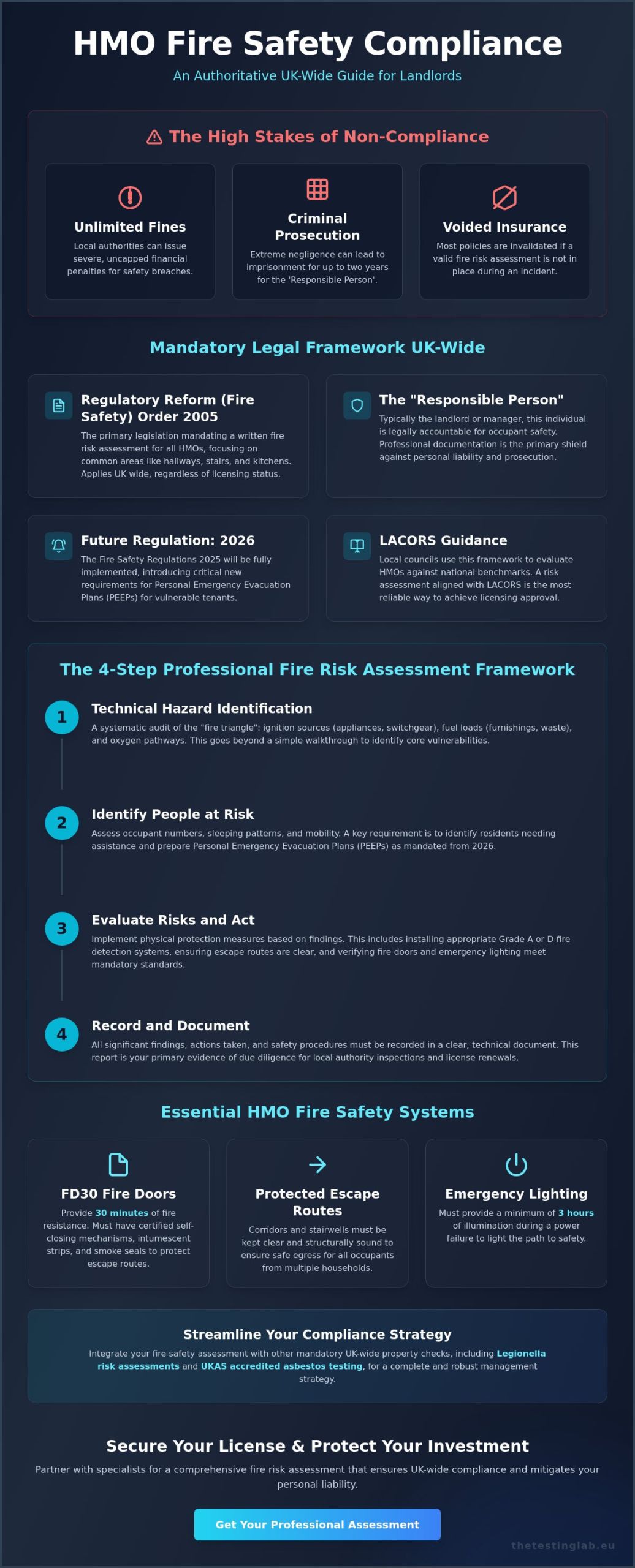
Compliance isn’t optional for landlords managing multi-occupied properties. Under the primary legislation of the Regulatory Reform (Fire Safety) Order 2005, every HMO must have a written record of fire safety measures. This requirement applies UK wide, regardless of whether the property requires a mandatory license from the local council. A professional fire risk assessment for HMO properties serves as the foundational document for this compliance, detailing how risks are mitigated in shared spaces. It’s a technical roadmap that ensures the building’s infrastructure supports safe evacuation.
The legal weight falls squarely on the “Responsible Person.” This individual is legally accountable for the safety of all occupants and must ensure the assessment remains current. Failing to maintain these standards leads to severe repercussions. Local authorities can issue unlimited fines, and in cases of extreme negligence, criminal prosecution can result in up to two years of imprisonment. Additionally, most insurers will void a policy if a valid assessment isn’t in place at the time of an incident. Professional documentation isn’t just a hurdle; it’s your primary shield against personal liability.
The Regulatory Reform (Fire Safety) Order 2005 Explained
This Order focuses on the structural safety and common areas of a building, covering hallways, stairwells, and shared kitchens where fire is most likely to spread. The “Responsible Person” is the individual or entity with control over the premises, typically the landlord or property manager, who carries the legal obligation to ensure fire safety standards are met. Recent updates, including the Fire Safety Act 2021, have expanded this scope to include external walls and flat entrance doors, making professional compliance surveying essential for modern HMO management.
LACORS Housing Fire Safety Guidance
Local councils use the LACORS framework to evaluate whether an HMO meets national safety benchmarks. This guidance provides a technical bridge between the Housing Act 2004 and the Fire Safety Order. It differentiates between property types, such as bedsits with high-risk cooking facilities and standard shared houses. Following these standards ensures your property passes inspection for a three or five-year license without costly remedial delays. Using a fire risk assessment for HMO properties that aligns with LACORS is the most reliable way to achieve local authority approval.
The 5-Step Framework for Professional HMO Fire Safety
A professional fire risk assessment for HMO properties requires more than a cursory walkthrough. It demands a systematic engineering approach to identify vulnerabilities that non-specialists often overlook. By following a structured framework, landlords can ensure their safety measures are both effective and legally robust across the UK wide landscape.
- Step 1: Technical Hazard Identification. We analyze the “fire triangle” by auditing ignition sources, fuel loads, and oxygen pathways. In shared kitchens, this involves inspecting high-use appliances and potential grease build-up, while plant rooms require scrutiny of electrical switchgear and ventilation systems.
- Step 2: Identifying People at Risk. Beyond counting occupants, this step assesses tenant mobility and sleeping patterns. Under the 2026 regulations, you’re required to identify residents who need assistance and offer person-centered assessments to create Personal Emergency Evacuation Plans (PEEPs).
- Step 3: Evaluate and Act. This phase translates findings into physical protection. It includes installing Grade A or D fire detection systems—which can be professionally managed by Scaitec Security Solutions Ltd—and ensuring emergency lighting provides the mandatory three hours of illumination during a power failure.
- Step 4: Professional Documentation. Significant findings must be recorded in a clear, technical format. This document serves as your primary evidence of due diligence during local authority inspections and licensing renewals.
Evaluating Escape Routes and Fire Doors
HMOs require “protected corridors” to ensure safe egress for multiple households. This hinges on the integrity of FD30 fire doors, which provide 30 minutes of fire resistance. These doors must feature certified self-closing mechanisms, intumescent strips, and smoke seals to prevent toxic gas infiltration. If you’re managing complex structural layouts, our specialist surveying services can help verify that these technical barriers meet current UK wide standards.
Reviewing and Updating Your Assessment
Compliance isn’t a static event. You must trigger a formal review after structural modifications, significant changes in tenant demographics, or at least every 12 months to account for wear and tear on safety systems. A fire risk assessment is a living document, not a static file, and it must evolve alongside the building’s usage to remain valid.
Selecting a Specialist Partner for HMO Compliance
Managing a multi-occupied building requires a multi-disciplinary approach to risk management. An independent fire risk assessment for HMO properties provides an objective layer of protection that internal checks often miss. For landlords operating UK wide, the complexity increases when managing high-density residential portfolios where structural integrity and environmental safety intersect. Partnering with an accredited specialist ensures that your safety strategy is grounded in technical precision rather than guesswork. For those managing properties in the capital, coordinating with a relocation specialist like Let’s Move London can help handle the logistical side of tenant moves or storage during essential safety upgrades.
Why Competence Matters in Fire Assessment
Attempting a “DIY” assessment in a multi-storey HMO is a high-stakes gamble. These properties often feature complex escape routes, mixed-use floor plans, and higher occupancy loads that demand technical precision. A professional surveyor doesn’t just check boxes; they provide a technical shield. By commissioning an expert, you transfer the burden of technical liability. You ensure that every intumescent seal and smoke detector meets the specific engineering standards required for legal compliance in 2026.
Holistic Property Compliance
True safety management isn’t siloed. During HMO conversions or major renovations, landlords must account for legacy materials and shared water systems. Integrating fire safety with UKAS accredited asbestos testing ensures that structural modifications don’t inadvertently release hazardous fibers. Similarly, managing water safety through legionella risk assessment services is vital for shared plumbing systems in high-occupancy buildings where stagnation risks are higher.
The Testing Lab PLC functions as a strategic partner rather than a mere vendor. We provide a unified solution for specialist surveying services in London and UK wide, streamlining the HMO licensing process. By combining these essential assessments, you reduce administrative friction. This unified approach ensures your property passes every inspection with technical confidence while maintaining a safe environment for your tenants.
Securing Your HMO Investment with Technical Compliance
Maintaining a multi-occupied property in 2026 requires more than just meeting basic standards. It demands a rigorous adherence to the latest UK wide safety protocols. By mastering the legal obligations of the Fire Safety Order and implementing a structured 5-step framework, you transform a complex regulatory burden into a manageable, professional process. A robust fire risk assessment for HMO properties doesn’t just satisfy a licensing officer. It provides a technical foundation that protects your tenants and shields you from personal liability.
Expertise is the most effective tool for mitigating risk. As an independent and accredited testing professional, The Testing Lab PLC offers the precision of a UKAS Accredited Laboratory to ensure every survey is legally sound. Whether you’re managing a single conversion or a large portfolio, our comprehensive UK wide coverage ensures your compliance is never in question. Request a professional fire risk assessment quote for your HMO today to secure your property’s future. Proactive safety management is the hallmark of a successful landlord, and we’re ready to help you achieve it.
Frequently Asked Questions
Is a fire risk assessment a legal requirement for all HMOs?
Yes, conducting a fire risk assessment for HMO properties is a mandatory legal obligation under the Regulatory Reform (Fire Safety) Order 2005. This requirement applies UK wide to every multi-occupied building regardless of its size or whether it requires a mandatory license. It serves as the primary document for fire safety management and is essential for passing local authority inspections and securing your property license.
How often should a fire risk assessment be reviewed for an HMO?
Current best practice suggests a formal review should take place annually to ensure all safety measures remain effective. For larger buildings or properties with high tenant turnover, we recommend a review every six months to account for increased wear on safety systems. You’ll also need to update the document immediately following any structural alterations, changes in building use, or if a fire-related incident occurs.
Can a landlord carry out their own fire risk assessment?
Landlords can legally perform their own assessments if they have the technical competence and knowledge to do so accurately. However, most local councils and fire authorities prefer assessments conducted by qualified professionals, especially for complex multi-storey buildings. Utilizing specialist surveying services ensures your documentation is robust and removes the burden of technical liability from your shoulders while ensuring you pass inspections.
What specific fire safety equipment is required in an HMO?
Standard requirements include FD30 fire doors with self-closing mechanisms and intumescent strips on all high-risk rooms like kitchens and bedrooms. You’ll need a Grade D, Category LD3 alarm system for small HMOs, while larger properties typically require a Grade A, Category LD2 system. Additionally, emergency lighting must provide three hours of battery-backed illumination along all common escape routes to meet 2026 UK compliance standards.

Article by
P J F Thomas
CEO and Founder of TTL plc.
Disclaimer
Items declared are AI generated but do reflect our services. Please get in contact if you have any questions.