
Did you know that asbestos-related diseases still claim approximately 5,000 lives every year across the UK? For many small business owners, the “Duty to Manage” feels like a legal minefield where one wrong step leads to heavy fines or compromised safety. You might be searching for a reliable asbestos register template for small business because you’re unsure if a DIY survey is sufficient to meet your statutory requirements. It’s a common frustration to face complex terminology when you simply need a clear, actionable path to compliance.
We’re here to take that professional burden off your shoulders by providing a methodology grounded in engineering precision. This guide will help you master your legal obligations and implement a robust framework for your site records. We’ll preview the 2026 updates to the Control of Asbestos Regulations 2012 and show you how to maintain a live, compliant register that protects your people and your reputation UK wide. By treating your register as a strategic asset rather than a static piece of paperwork, you ensure a safe environment and total regulatory alignment.
Key Takeaways
- Define your legal obligations under the Control of Asbestos Regulations 2012 and understand why the “Duty to Manage” is a non-negotiable requirement for UK wide operations.
- Identify the critical data points required for an asbestos register template for small business, including precise locations and material types verified by UKAS accredited testing.
- Learn how to bridge the gap between a standard management survey and a live, accessible register that protects contractors and employees before any site works commence.
- Establish a methodology for ongoing risk assessment that transforms your documentation from a one-off report into a proactive safety tool.
The Legal Requirement: Why Your Small Business Needs an Asbestos Register
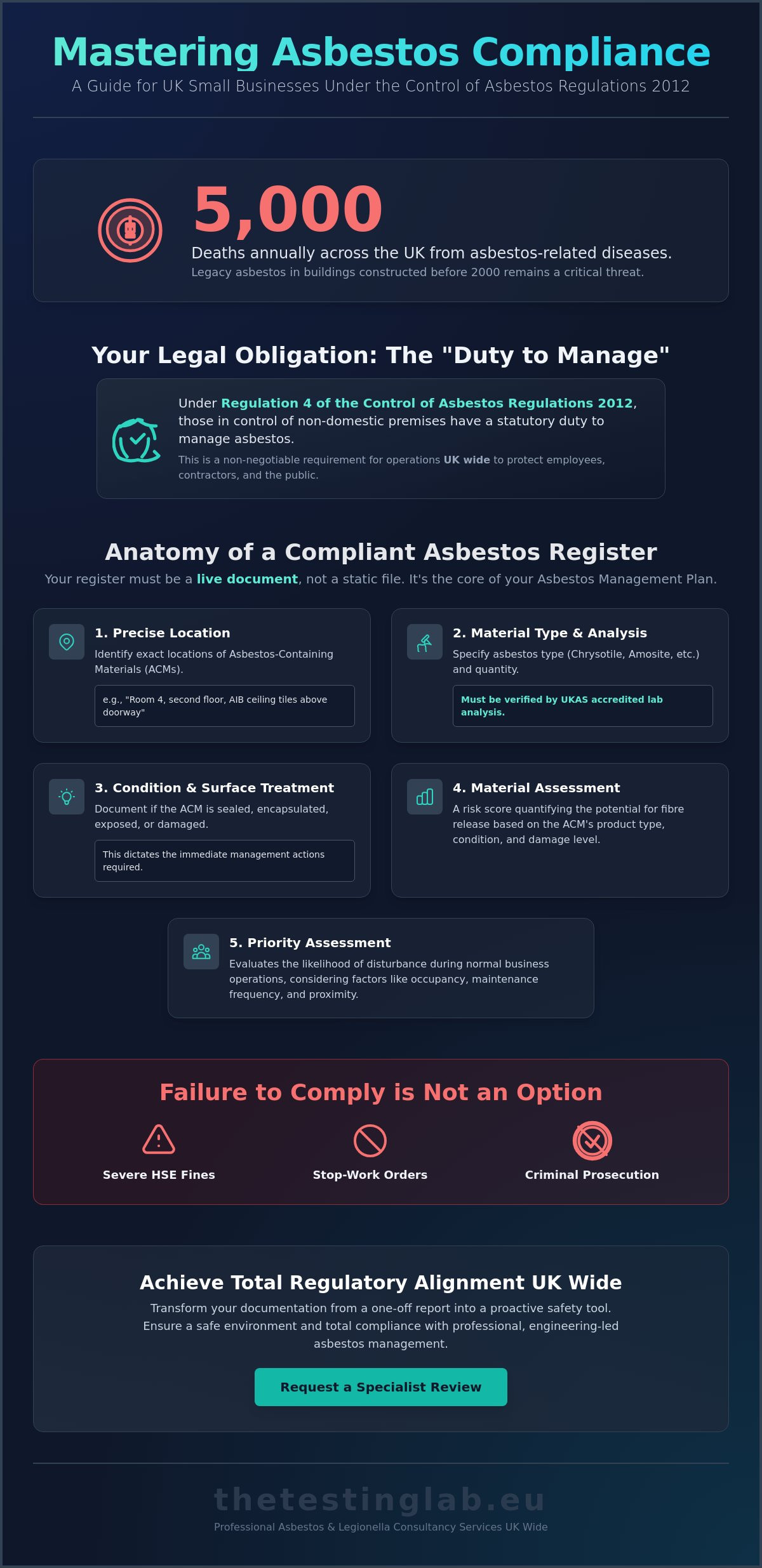
An asbestos register isn’t just a list; it’s the operational heart of your Asbestos Management Plan (AMP). Under the Control of Asbestos Regulations 2012 (CAR 2012), specifically Regulation 4, small businesses must identify and record the location and condition of any asbestos-containing materials (ACMs). Using a structured asbestos register template for small business ensures you capture every critical detail required by law. This documentation acts as a safety shield, protecting both your staff and any external contractors who visit your site UK wide.
The “Duty to Manage” is a statutory obligation. It requires those in charge of non-domestic premises to take active steps to prevent exposure. To understand the gravity of this, one must ask What is Asbestos? and why it remains so dangerous. Despite being banned decades ago, legacy materials still cause approximately 5,000 deaths per year in the UK. Failing to maintain an accurate register doesn’t just invite health risks; it opens your business to severe HSE fines, stop-work orders, and potential criminal prosecution.
Who is the “Duty Holder” in the UK?
Responsibility isn’t always straightforward. In most commercial leases, the duty holder is the person or entity responsible for maintenance and repairs. If you occupy a shared building or a managed office space UK wide, your lease agreement usually dictates whether you or the landlord holds this legal burden. If no survey exists for a building constructed before 2000, you must legally presume asbestos is present. You can find more specific guidance on regional requirements through our London and UK wide asbestos consultancy services.
The “Live Document” Concept
A static PDF sitting in a drawer isn’t a compliant register. The document must be updated whenever you conduct maintenance, discover new materials, or notice a change in the condition of known ACMs. If a contractor removes a section of asbestos-insulated piping, your records must reflect that change immediately to remain accurate. A live register is a dynamic record that evolves with the building condition. This transparency ensures that every person stepping onto your site has the most current data to stay safe.
Essential Components of an Asbestos Register Template
A functional asbestos register template for small business translates complex survey data into actionable site intelligence. It’s not enough to list “asbestos present” in a general area. You must provide specific locations, such as “Room 4, second floor, AIB ceiling tiles above the doorway,” to ensure contractors can navigate your premises safely UK wide. Vague descriptions lead to accidents. Precision prevents them.
Each entry should detail the asbestos type and quantity. Whether your building contains Chrysotile, Amosite, or Crocidolite, these must be verified through UKAS accredited lab analysis. Documenting the surface treatment is equally vital. Noting whether a material is sealed, encapsulated, or exposed dictates the immediate management actions required. International safety standards, such as the Federal Asbestos Regulations in the US, mirror this emphasis on granular documentation to prevent accidental exposure.
Conducting a Material Assessment
Conducting a material assessment involves a scoring system that quantifies the potential for fibre release. This score is based on the product type, its current condition, and the level of any existing damage. While templates provide the structure, professional asbestos consultancy is vital for accurate scoring. Miscalculating the friability of a material can lead to inadequate control measures and legal vulnerability.
Defining the Priority Assessment
The priority assessment evaluates the likelihood of disturbance during your day-to-day business operations. It considers occupancy levels, the frequency of maintenance, and how often people work near the ACMs. Even if a material is in good condition, a high occupancy rate might increase its overall risk rating. This calculation is what turns a simple list into a strategic safety tool. If you’re managing multiple sites UK wide and need to verify your risk scores, you can request a specialist review to ensure your data is robust and compliant.
From Template to Compliance: Implementing Your Asbestos Plan
Implementing your management plan begins with the transition from a Management Survey to a live register. While a survey provides raw technical data, an asbestos register template for small business organises that data into a searchable, actionable format. This document must be easily accessible to any contractor or maintenance worker before they start work on your premises UK wide. Providing this information is a legal necessity, not a courtesy. If you’re managing sites in the capital, our London asbestos consultancy can help bridge the gap between initial survey and active management.
Compliance isn’t a one-time achievement. The law requires duty holders to monitor the condition of identified materials at least every 12 months. This annual re-inspection ensures that any deterioration is caught before it becomes a hazard. If a material’s condition score increases during these checks, you must evaluate the risk threshold. When the potential for fibre release becomes too high due to damage or planned renovations, you must move from a “manage” strategy to professional removal.
The Role of UKAS Accredited Lab Testing
Visual inspection alone is never sufficient for legal certainty. UKAS accredited lab analysis is the only way to confirm the absence or presence of asbestos fibres within a material. Integrating these lab certificates directly into your digital register creates a transparent audit trail. This level of precision is essential for UK-wide compliance, providing definitive proof that your risk assessments are based on scientific fact rather than assumptions.
Securing Professional Support
Managing asbestos requires a methodological approach that many small businesses find daunting. A UK-wide consultancy takes the weight of professional responsibility off your shoulders by ensuring every inspection and lab test meets statutory standards. Partnering with experts allows you to focus on your core operations while we handle the technical complexities of safety. Ensure your business is compliant by requesting an asbestos survey quote from our specialist team.
Securing Your Statutory Future
Maintaining a compliant asbestos management strategy is a fundamental pillar of operational excellence. You’ve seen that a static document isn’t enough; true safety requires a dynamic record that evolves alongside your building. By using a robust asbestos register template for small business, you establish a clear methodology for protecting your workforce and staying on the right side of CAR 2012. This proactive approach turns a legal obligation into a strategic asset for your site.
Accuracy is paramount in this sector, as vague data leads to avoidable risks. Our team has operated as an independent consultancy since 2002, providing a UK-wide service that removes the professional burden from your shoulders. With our own UKAS accredited testing laboratory, we provide the scientific certainty needed to validate your site records and manage risk with engineering-grade confidence. We ensure that every material identified is handled with the precision your business deserves, allowing you to focus on other strategic goals like sourcing tech and marketing talent through trusttechrecruitment.co.uk.
Don’t let regulatory complexity stall your progress or invite unnecessary legal exposure. You can get expert assistance with your Asbestos Management Plan today to ensure every detail is handled with precision. Taking this step ensures your business remains a safe, compliant, and thriving environment for years to come.
Frequently Asked Questions
Do I need an asbestos register if my building was built after 2000?
Generally, you don’t need a register if the building was constructed after 1999. The UK ban on all forms of asbestos took effect then, meaning buildings from 2000 onwards are presumed safe. It’s still good practice to maintain construction records that prove the build date. For any premises constructed before this date, a register is a mandatory component of your health and safety documentation UK wide.
Can I create my own asbestos register for my small business?
Yes, you can maintain the document yourself using an asbestos register template for small business, but you shouldn’t conduct the initial identification alone. While you’re responsible for the “live” management of the record, the data within it must come from a professional survey. Legally confirming the presence of asbestos requires UKAS accredited lab testing to ensure your management plan is based on precise, scientific evidence rather than assumptions.
How often should a small business update its asbestos register?
Your register must be reviewed and updated at least every 12 months to remain compliant with CAR 2012. This annual re-inspection ensures that the condition of any identified materials hasn’t deteriorated. You must also update the document immediately following any maintenance work, accidental damage, or asbestos removal. Treating the register as a live document ensures that contractors working UK wide always have access to the most current safety data. For those coordinating site visits or overseeing maintenance projects in the South East, you can visit Brighton Airport Taxis for professional airport transfers and reliable local travel.
What happens if I don’t have an asbestos register and someone is exposed?
Failing to maintain a register can result in unlimited fines or criminal prosecution by the Health and Safety Executive. If exposure occurs without a register in place, you’ve breached your “Duty to Manage,” leaving the business liable for significant civil claims. Without an asbestos register template for small business to document your risk assessments, you cannot prove that you took the necessary legal steps to provide a safe environment for occupants.

Article by
P J F Thomas
CEO and Founder of TTL plc.
Disclaimer
Items declared are AI generated but do reflect our services. Please get in contact if you have any questions.