
Did you know that asbestos remains the single greatest cause of work-related deaths in the UK, claiming 5,000 lives every year? It’s understandable why the duty to manage asbestos regulations UK feels like a heavy administrative burden for many property professionals. Most dutyholders feel overwhelmed by the threat of HSE Fee for Intervention (FFI) charges and the technical complexities of managing contaminated soils during major redevelopment projects.
This guide will help you master the statutory requirements of CAR 2012, ensuring your UK wide operations meet every mandatory safety and independent testing standard. We’ll explore the critical distinction between licensed and non-licensed work, the necessity of UKAS accredited 4-stage clearances, and how to maintain compliant asbestos surveying to mitigate long-term liability through documented proof of safety. By adopting a methodical, engineering-led approach, you can transform these legal obligations into a robust framework for operational excellence.
Key Takeaways
- Identify the specific legal responsibilities of a dutyholder under CAR 2012 to ensure your UK wide assets remain fully compliant with current safety legislation.
- Navigate the duty to manage asbestos regulations UK by implementing a systematic management plan that prioritises independent UKAS-accredited verification over contractor self-certification.
- Discover the technical requirements of the mandatory 4-stage air clearance process and why an impartial analyst is essential for documented proof of safety.
- Master the complexities of hazardous waste disposal and environmental compliance, including the role of WAC testing in managing asbestos-contaminated soils.
The Legal Framework: CAR 2012 and the Duty to Manage
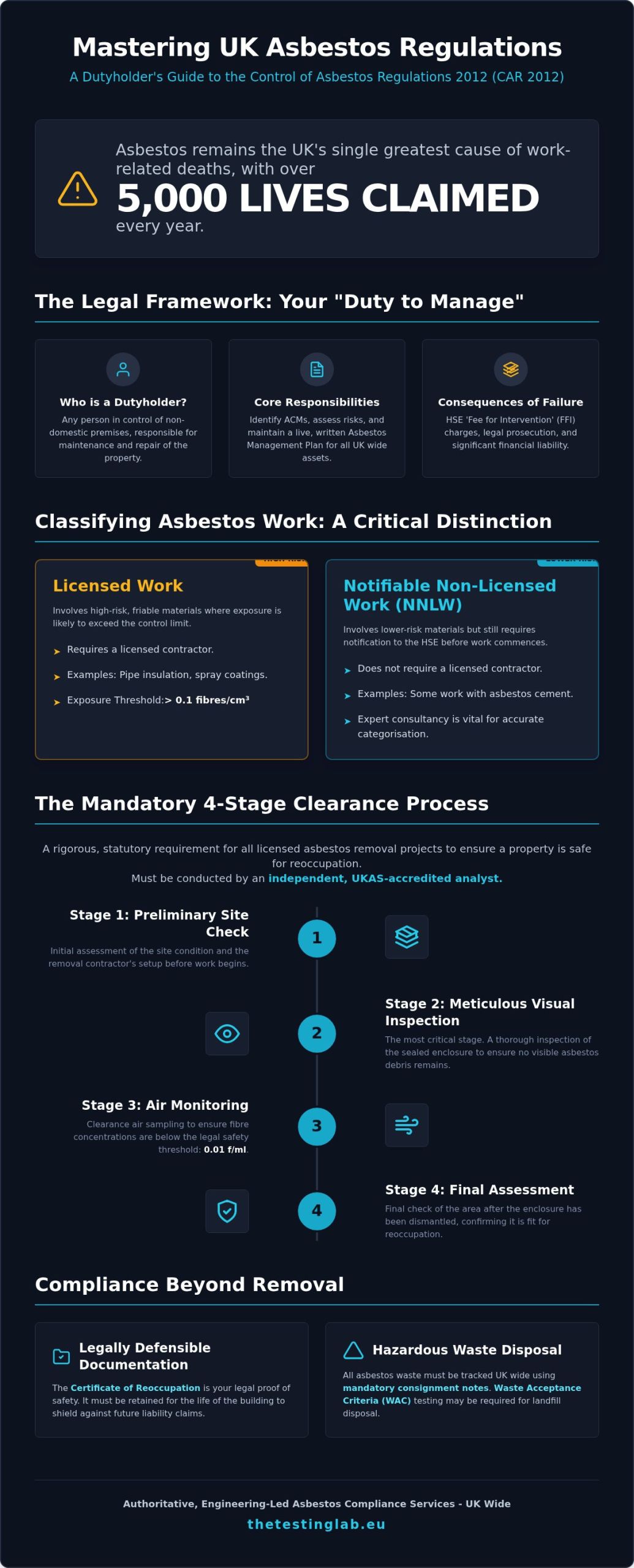
The Control of Asbestos Regulations 2012 (CAR 2012) represents the statutory pillar for all Asbestos Regulations in the UK. It mandates that anyone in control of non-domestic premises has a legal “duty to manage” any asbestos present. This individual, known as the dutyholder, is responsible for identifying asbestos-containing materials (ACMs) and assessing the associated risks. For UK wide operations, this isn’t just a safety suggestion; it’s a criminal requirement. Failure to maintain a live, written Asbestos Management Plan is a common trigger for enforcement and legal prosecution.
Mastering the duty to manage asbestos regulations UK requires more than a one-off survey; it demands a dynamic management plan. If the HSE identifies a material breach during an inspection, they apply the Fee for Intervention (FFI). This cost recovery scheme means the business pays for the inspector’s time spent identifying the breach and helping to rectify it. With current rates, non-compliance becomes an expensive liability that extends far beyond initial survey costs. It’s a system designed to place the financial burden of safety oversight directly on those who fail to meet their obligations.
Licensed vs. Non-Licensed Asbestos Work
Categorising work correctly is a critical technical step. Licensed work usually involves high-risk, friable materials like pipe insulation or spray coatings where exposure levels exceed 0.1 fibres per cubic centimetre. Conversely, some lower-risk tasks fall under Notifiable Non-Licensed Work (NNLW), requiring HSE notification but not a licensed contractor. Determining these boundaries requires a high level of precision. Engaging a specialist asbestos consultancy ensures that your project is categorised accurately, preventing legal exposure and ensuring that the duty to manage asbestos regulations UK is met with methodological rigour.
Mandatory Requirements for Asbestos Removal and Air Clearance
The 4-stage clearance process is a rigorous statutory requirement for all licensed asbestos removal projects in the UK. Following the Control of Asbestos Regulations 2012 ACOP, this procedure ensures a property is safe for reoccupation. It begins with Stage 1, a preliminary site check, followed by Stage 2, a meticulous visual inspection of the enclosure. These steps must be conducted by an independent analyst to ensure no residual debris remains before air monitoring begins. This visual confirmation is the most critical point for identifying hidden risks.
Stages 3 and 4 involve air monitoring (clearance sampling) and a final assessment of the site after the enclosure has been dismantled. For any business adhering to the duty to manage asbestos regulations UK, UKAS accreditation for the laboratory performing these tests is legally non-negotiable. It provides the technical assurance that air fibre concentrations are below the 0.01 f/ml threshold. This objective data serves as the primary evidence that the work area is decontaminated and safe for general use.
Independent Testing and the Chain of Custody
The legal framework demands third-party testing to eliminate potential conflicts of interest between removal contractors and analysts. Utilizing UKAS accredited asbestos testing creates a legally defensible audit trail. Dutyholders must retain the resulting Certificate of Reoccupation for the life of the building to prove ongoing compliance. This document is your shield against future liability claims. If you are managing UK wide assets, you can request a technical quote for independent verification to ensure your project meets these precision standards. Maintaining a clear chain of custody throughout the testing phase ensures that every data point is accurate and verifiable.
Disposal and Environmental Compliance Standards
Compliance with the duty to manage asbestos regulations UK extends beyond the building fabric to the final disposal of hazardous materials. Under the Hazardous Waste Regulations, dutyholders must ensure all asbestos waste is tracked UK wide using mandatory consignment notes. This technical audit trail is essential for proving waste has reached a permitted facility. Before disposal, Waste Acceptance Criteria (WAC) testing is often required to classify the waste accurately for landfill acceptance. It’s a precision process that prevents the significant financial and legal risks associated with mismanaged hazardous waste.
In dense urban environments, redevelopment projects face heightened scrutiny. The role of site-specific asbestos surveying is pivotal here, addressing the unique logistical and regulatory challenges of managing complex site clearances. Legal duties also apply to contaminated land. Dutyholders must protect site workers during excavation to prevent the accidental release of fibres into the atmosphere. Managing these risks requires a strategic partner who understands the intersection of construction logistics and environmental law.
Asbestos in Soils and WM3 Compliance
Identifying asbestos in soil requires analytical precision governed by the technical guidance of WM3 testing. Specialised asbestos in soils testing is mandatory for classifying excavated material and preventing illegal waste disposal. On brownfield sites, this methodical approach ensures developers satisfy local authority planning conditions while mitigating long-term liability. We treat soil contamination as a critical systems-level risk that requires UKAS accredited verification to ensure a safe and compliant site handover. Don’t leave your environmental compliance to chance when managing contaminated ground.
Future-Proofing Your UK Wide Asbestos Strategy
Navigating the duty to manage asbestos regulations UK requires a transition from reactive fixes to a methodical, systems-led approach. By prioritising independent 4-stage clearance and maintaining a live management plan, you protect your personnel and your bottom line from HSE intervention. True compliance is built on the foundation of impartial, UKAS accredited laboratory analysis that removal contractors simply cannot provide themselves. It’s about removing the burden of professional responsibility from your shoulders and placing it into the hands of a strategic partner.
We provide comprehensive UK wide service coverage, acting as your independent 4-stage clearance experts. Our team ensures every data point is legally defensible, helping you mitigate long-term liability with absolute precision. Secure your UK wide compliance with a professional Asbestos Survey and gain the technical confidence your operations deserve. Let’s work together to make your buildings safer today.
Frequently Asked Questions
What are the primary legal requirements for asbestos removal in the UK?
The primary legal requirements for asbestos removal are defined by the Control of Asbestos Regulations 2012. You’re required to conduct a thorough risk assessment and establish a written plan of work before any disturbance begins. Depending on the material’s friability, you must engage a licensed contractor or notify the HSE for Notifiable Non-Licensed Work (NNLW) to maintain compliance.
Is a 4-stage air clearance legally mandatory for all asbestos removal?
A 4-stage air clearance is a statutory requirement for all licensed asbestos removal projects across the UK. This process includes a preliminary site check, visual inspection, air monitoring, and a final assessment. While it’s not strictly mandatory for all non-licensed tasks, it’s the gold standard for fulfilling the duty to manage asbestos regulations UK and providing documented proof of safety.
Can a removal contractor perform their own air clearance testing?
A removal contractor shouldn’t perform their own air clearance testing because it creates a clear conflict of interest. To meet the duty to manage asbestos regulations UK effectively, you must appoint an independent, UKAS accredited laboratory. This ensures the impartiality of the 4-stage clearance process and provides a legally defensible audit trail that protects your organisation from long-term liability. For broader support with your safety obligations, Quantum Leap Safety Services offers specialist health and safety consultancy to help businesses maintain full regulatory compliance.
Failing to manage asbestos can lead to unlimited fines, HSE prosecution, and even imprisonment for dutyholders. Under the Fee for Intervention (FFI) scheme, the HSE recovers costs for time spent identifying material breaches. Beyond these immediate fees, your business faces significant civil liability risks and potential closure if you can’t prove that your UK wide operations meet mandatory safety standards. To help navigate these complex requirements and protect your organisation, MAR Legal provides expert commercial legal services tailored to business compliance and risk management.

Article by
P J F Thomas
CEO and Founder of TTL plc.
Disclaimer
Items declared are AI generated but do reflect our services. Please get in contact if you have any questions.