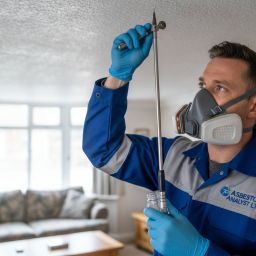
What if the material you suspect is harmless actually carries a legal “Duty to Manage” that could result in unlimited fines under the Control of Asbestos Regulations 2012? You likely recognize that the risk of disturbed fibres is a significant health hazard. However, confusion surrounding different survey types often creates unnecessary delays. Whether you have been researching asbestos sample testing Doncaster or managing a portfolio across multiple regions, the pressure to maintain UK wide compliance is a constant challenge. We’re here to handle the technical weight of quality assurance for you.
This guide will show you exactly how to use the scientific standards of UKAS accredited testing to ensure your property meets every UK health and safety benchmark. We’ll outline the laboratory processes that deliver fast, accurate results. We also explain how to secure a clear report that satisfies HSE inspectors. By the end of this article, you’ll have a transparent roadmap to achieving total peace of mind regarding your site’s safety.
Key Takeaways
- Understand why ISO 17025 and UKAS accreditation are the essential scientific benchmarks for identifying hazardous fibres within bulk materials UK wide.
- Identify the critical differences between Management and Refurbishment surveys to ensure your property remains fully compliant with current UK health and safety legislation.
- Learn to navigate the technical requirements of asbestos sample testing Doncaster specifications to secure a valid Asbestos Analysis Certificate for your records.
- Discover how a professional chain of custody and independent laboratory analysis provide the unbiased data necessary to mitigate long-term liability and safety risks.
- Master the interpretation of laboratory reports to move confidently from initial sampling to actionable remediation or safety management strategies.
Understanding Asbestos Risk and the Legal Necessity of Sample Testing
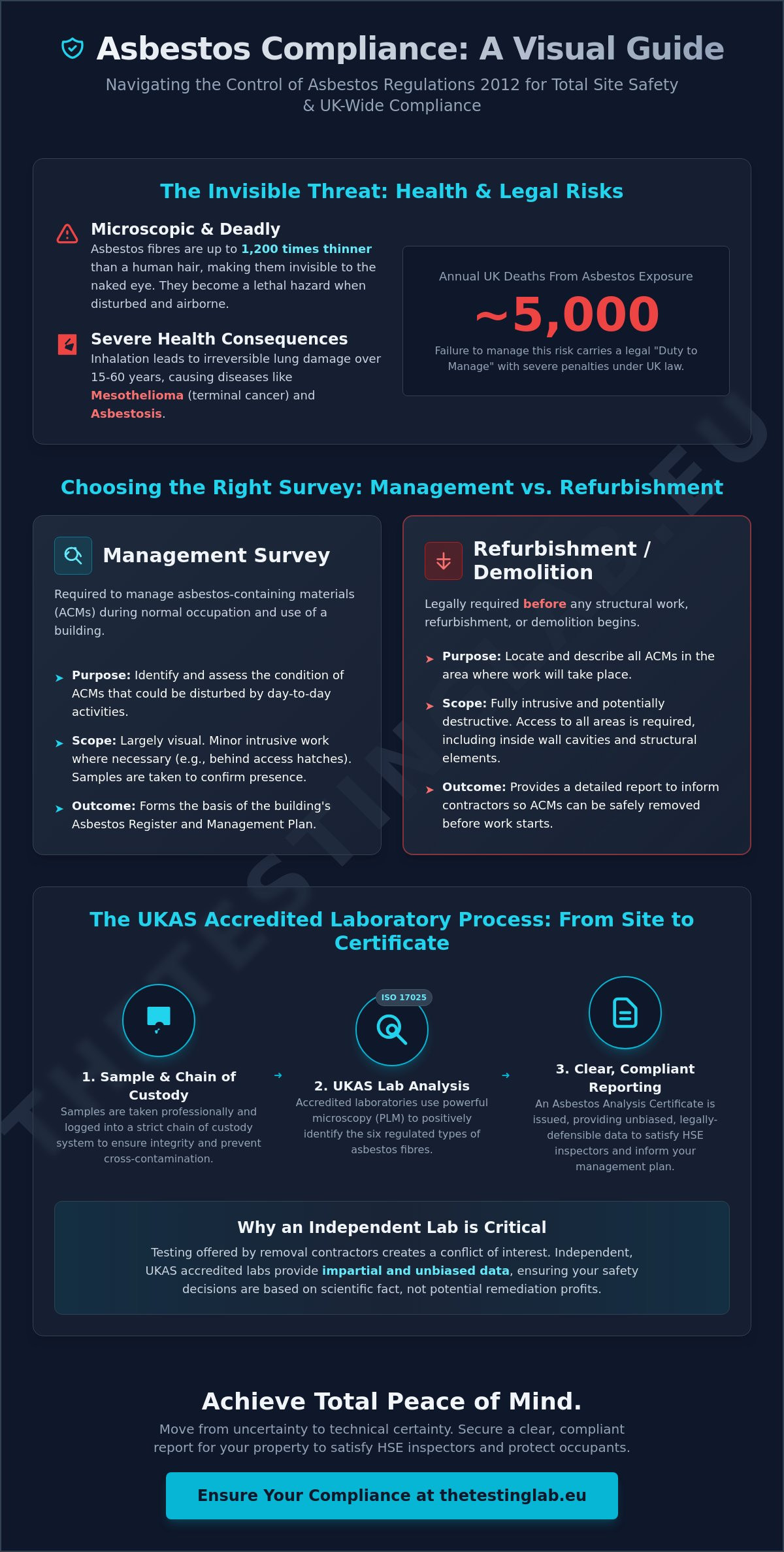
Asbestos sample testing isn’t just a box-ticking exercise; it’s a rigorous scientific protocol designed to identify hazardous fibres within bulk materials. Even the most experienced surveyors can’t identify asbestos with the naked eye. The fibres are microscopic, often 1,200 times thinner than a human hair, making them invisible until they’re disturbed and airborne. This asbestos overview highlights why these minerals were once favoured for their heat resistance, yet their structural properties make them lethal when inhaled. In UK wide construction and renovation projects, precise laboratory analysis is the only way to confirm if a material is safe to handle or requires specialist abatement.
The Control of Asbestos Regulations 2012 sets the benchmark for safety in the United Kingdom. These regulations mandate that any person responsible for the maintenance of non-domestic premises must identify and manage asbestos risks effectively. Failure to perform adequate testing before starting work leads to accidental exposure, which contributes to approximately 5,000 deaths annually in the UK. By integrating testing into the early stages of a project, we ensure that contractors and occupants aren’t blindsided by hidden hazards. It’s about moving from uncertainty to technical certainty through empirical evidence and engineering precision.
The Health Risks of Undetected Asbestos
When materials become friable, they crumble under slight pressure, releasing a cloud of invisible needles into the atmosphere. These fibres lodge deep in the lung tissue, causing irreversible damage over a latency period that typically spans 15 to 60 years. Long-term health implications are severe, including mesothelioma, a terminal cancer of the lining of the lungs, and asbestosis, which causes chronic respiratory failure. Because these risks are so high, we treat all suspect materials as hazardous until a UKAS accredited laboratory confirms otherwise. This cautious, data-driven approach prevents the optimism bias that often leads to site contamination during UK wide developments. Homeowners planning renovations should also be aware of the specific risks covered in our guide to asbestos in the home across UK wide residential properties, which outlines how these same hazards apply to domestic settings.
Regulatory Compliance UK Wide
Compliance isn’t optional for property owners or duty holders across the country. Every non-domestic property built before the year 2000 must maintain an up-to-date asbestos register. This document relies on accredited testing to serve as the primary evidence for health and safety audits. Without these reports, a business can face unlimited fines or imprisonment under UK law. The Duty to Manage as per HSE guidelines requires the person in charge to find out if there is asbestos in the premises, assess the risk, and keep a record of its location and condition to prevent accidental exposure. For those needing professional guidance on maintaining these records, our asbestos consultancy services provide the technical framework necessary for full regulatory alignment.
The Science of Bulk Analysis: How UKAS Accredited Laboratories Identify Fibres
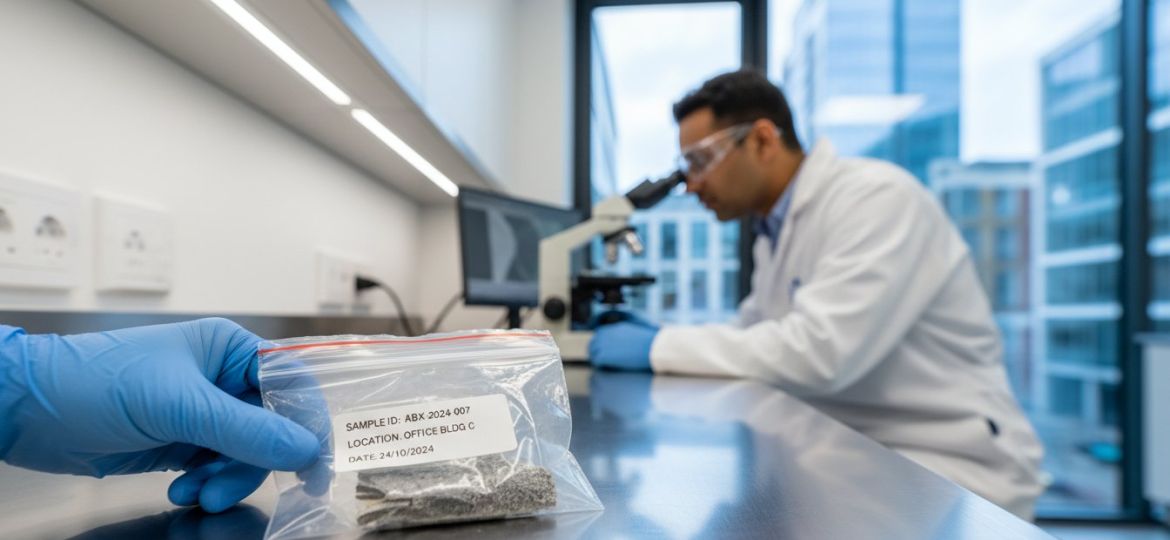
ISO 17025 accreditation isn’t just a certificate on a wall; it’s the baseline for technical competence in UK wide asbestos analysis. Labs must prove their staff are trained and their equipment is calibrated to exacting standards to ensure every result aligns with the Control of Asbestos Regulations 2012. When a sample enters our facility, we initiate a strict chain of custody. This digital and physical tracking prevents cross-contamination and ensures the integrity of the data from the moment of intake to the final report. For duty holders, this rigorous asbestos sample testing provides the legal certainty required for safety management.
Independence is a cornerstone of our methodology. Many removal contractors offer their own in-house testing, but this creates a clear conflict of interest. As an independent laboratory, The Testing Lab PLC provides impartial data. Our only goal is accuracy. We don’t have a financial stake in whether a sample is positive or negative. This transparency builds trust with clients who need to manage risks without the bias of potential remediation profits. Our approach combines high-volume capacity with high-precision processing, allowing us to handle complex batches without sacrificing the minute detail required for definitive identification.
Polarised Light Microscopy (PLM) Explained
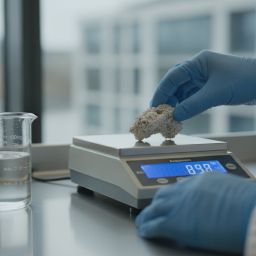
Identifying asbestos requires more than a simple visual check. Our analysts use Polarised Light Microscopy (PLM) to examine the morphology and optical properties of fibres. Each asbestos type has a unique mineral signature. We look for specific refractive indices and pleochroism to distinguish between white (Chrysotile), brown (Amosite), and blue (Crocidolite) fibres. Handheld scanners or home kits lack the magnification and light filtration needed for this level of precision. They often miss small concentrations that a lab-grade microscope catches easily. Professional asbestos sample testing ensures that even trace amounts are detected before they become a health hazard.
Quality Control and UKAS Standards
The United Kingdom Accreditation Service (UKAS) performs annual audits to verify our laboratory’s accuracy. We don’t just wait for external reviews. Our internal quality management involves double-blind testing, where a second analyst re-examines 5% of all samples without knowing the initial result. We also participate in the RICE (Regular Inter-laboratory Counting Exchanges) scheme to ensure our results are consistent with national benchmarks. This multi-layered approach to quality control guarantees that the data we provide is both reliable and legally defensible. For businesses seeking a strategic partner to manage their compliance, our asbestos consultancy services provide the technical depth required for full site safety.
Professional Surveys vs. Single Sample Testing: Choosing the Right Approach
The limitations of DIY sampling are significant. Without specialist training, you risk releasing millions of microscopic fibres into the air during the collection process. Professional surveyors use wet-sampling techniques and high-efficiency particulate air (HEPA) vacuums to prevent cross-contamination. They ensure every sample is truly representative of the entire material batch, which is a core requirement of the HSG264 guidelines. This precision prevents a situation where one safe sample leads to a false sense of security for an entire floor containing mixed-source materials.
Management Surveys for Long-Term Safety
Management surveys are the standard requirement for occupied buildings to ensure ongoing safety and compliance. The goal’s to locate Asbestos Containing Materials (ACMs) that could be disturbed during normal occupancy or routine maintenance. Our surveyors assess the material’s condition and assign a priority score based on the likelihood of fibre release. This data forms the basis of your mandatory Asbestos Management Plan. You can find more detail on these specific procedures in our guide to Asbestos Survey Types. This approach provides a long-term safety strategy rather than a one-off snapshot, ensuring that any asbestos sample testing Doncaster requirements are met with scientific rigour.
Refurbishment and Demolition (R&D) Requirements
Before any structural changes occur, an R&D survey is essential. These are fully intrusive and involve breaking into walls, ceilings, and floor voids to find hidden ACMs that a standard management survey might miss. Because the process is destructive, it’s typically performed in vacant areas. Under the Control of Asbestos Regulations 2012, R&D surveys are mandatory for any refurbishment or demolition project in the UK. Failing to commission one can lead to unlimited fines or immediate site shutdowns by the Health and Safety Executive (HSE). These surveys are a legal prerequisite because they provide the technical data needed to protect contractors from accidental exposure during high-risk structural work.
Navigating UK Legislation: Reports and Compliance Requirements
Securing a UKAS accredited analysis is the first step in meeting your legal obligations under the Control of Asbestos Regulations 2012 (CAR 2012). The resulting documentation serves as a legal shield, proving you’ve identified and assessed risks within your property. Whether you’re managing a single facility or a UK wide portfolio, the clarity of these reports dictates your next operational moves. Many duty holders search for asbestos sample testing Doncaster to resolve immediate site concerns, but the technical accuracy of the certificate is what satisfies an HSE inspector during a spot check. A valid certificate acts as proof of due diligence, and without it, any asbestos management plan lacks a scientific foundation.
Interpreting Your Analysis Report
A valid certificate must display the UKAS “tick and crown” logo and a unique laboratory reference number. If the report states “No Asbestos Detected,” the material is clear for the specific sample tested. However, “Trace Levels” indicates that while the bulk material isn’t asbestos, microscopic fibres were found, often requiring a reassessment of the surrounding area. You can find a detailed breakdown of these classifications in our guide on Understanding Your Asbestos Analysis Report. Positive results will specify the fibre type, such as Chrysotile, Amosite, or Crocidolite. This data directly influences the risk score in your management plan, as different materials have different friability levels and potential for fibre release.
Legal Record Keeping and HSE Audits
UK law is uncompromising regarding documentation. Under CAR 2012 Regulation 4, you must retain asbestos survey records for the entire lifespan of the building. If employees or contractors are potentially exposed to fibres, health records must be kept for 40 years to comply with health and safety statutes. Digital record keeping ensures these documents are accessible across UK wide sites instantly, which is a critical requirement for multi site managers. When an HSE inspector requests evidence of your “Duty to Manage,” they’ll look for a continuous trail from the initial asbestos sample testing Doncaster request to the final inclusion in your risk register. This is where asbestos consultancy becomes a strategic asset, helping you translate raw lab data into actionable safety protocols that protect your staff and your business from liability.
Do you need expert help interpreting your results or building a compliant management plan? Contact our specialist consultancy team today for professional, engineering led guidance.
Reliable Asbestos Testing Solutions for Residential and Commercial Properties UK Wide
The Testing Lab PLC delivers a robust framework for asbestos management that spans the entire UK. Our approach isn’t merely about ticking boxes. It’s about providing a scientific foundation for your health and safety strategy. By operating as an independent laboratory, we ensure that every piece of data is unbiased and legally defensible under UK health and safety regulations. This independence is vital for businesses that require transparent results to protect their workforce and satisfy insurers.
We understand that speed is often as critical as accuracy. Our UK-wide logistics network allows for a fast turnaround, often delivering results within 24 to 48 hours of sample receipt. This efficiency helps prevent costly delays on construction sites or during property transactions. Whether you’re managing a single residential unit or a complex industrial estate, our team treats every sample with the same engineering rigor. While some providers focus on limited areas, our reach covers everything from major cities to remote sites, ensuring that queries for asbestos sample testing Doncaster lead to a nationwide standard of excellence. Residential property owners can also benefit from reviewing our dedicated resource on identifying and testing asbestos in the home Doncaster and across the UK for a comprehensive overview of domestic compliance requirements.
Commercial and Industrial Laboratory Services
Large-scale infrastructure projects and national retailers face unique challenges in asbestos management. We’ve developed a scalable model to handle high-volume analysis without compromising on precision. For projects involving brownfield developments, we provide specialized asbestos in soils testing. This is essential for meeting environmental standards and ensuring land is safe for redevelopment.
Our bulk pricing models are designed for consistency. We provide fixed-rate structures for high-volume sample analysis, allowing project managers to forecast costs accurately. Many clients who initially search for specific regional services, such as asbestos sample testing Doncaster, find that our national laboratory capacity offers better value and faster reporting than smaller local setups. We also offer water absorption testing to determine the porosity of materials, which is a key metric in identifying certain types of asbestos-containing materials (ACMs).
Getting Started with Your Sample Analysis
Securing your property’s safety starts with a clear, methodical process. You can book a comprehensive survey or submit individual samples directly to our laboratory for immediate processing. We’ve removed the friction from the compliance journey, moving you from sample collection to a digital certificate of analysis with minimal downtime. Our commitment to precision and engineering excellence means you receive more than just a report; you receive a definitive answer.
The Testing Lab PLC remains committed to technical excellence and professional integrity. We act as your strategic partner, taking the weight of quality assurance off your shoulders so you can focus on your core operations. If you’re ready to secure your site, it’s time to work with a laboratory that prioritizes precision over everything else.
Secure Your Property with UKAS Accredited Precision
Managing asbestos risks isn’t just about safety; it’s a strict legal requirement under the Control of Asbestos Regulations 2012 as enforced by the HSE. You need more than a simple visual check to ensure full compliance across your UK wide portfolio. Our UKAS accredited laboratory (ISO 17025) provides the scientific certainty required to identify hazardous fibres with absolute precision. With over 20 years of environmental testing expertise, we’ve helped thousands of clients navigate complex legislative reports while maintaining the highest standards of accuracy.
Whether you’re managing commercial sites or residential properties, choosing an independent PLC ensures unbiased results every time. We position ourselves as your strategic partner, taking the weight of quality assurance off your shoulders through a meticulous, engineering led approach. For those specifically requiring asbestos sample testing Doncaster, our team delivers rapid, accurate bulk analysis that stands up to regulatory scrutiny. We treat every sample with laboratory grade rigour to ensure your project remains on track and fully compliant. Our commitment to transparency and knowledge sharing means you’ll always understand the data behind your reports.
Request an Accredited Asbestos Testing Quote
Take the first step toward a safer, fully compliant environment today; our specialists are ready to support your next project with unmatched technical confidence.
Frequently Asked Questions
Is asbestos sample testing a legal requirement in the UK?
Yes, asbestos sample testing is a legal mandate under the Control of Asbestos Regulations 2012. Regulation 4 requires duty holders of non-domestic premises to identify and manage asbestos risks effectively. Failure to comply can result in unlimited fines or even 2 years of imprisonment. It’s a critical step in maintaining safety standards across any UK wide property portfolio to protect occupants.
How long does it take to get asbestos test results from a UKAS lab?
Most UKAS accredited laboratories provide results within 24 to 48 hours of receipt. Some facilities offer a premium 4 hour turnaround for emergency situations where immediate data is vital. This speed is essential for maintaining project timelines and ensuring site safety isn’t compromised. Precision in the lab ensures these quick results remain technically robust and accurate for your records.
Can I take an asbestos sample myself and send it to a lab?
While you can technically take a sample yourself, the HSE strongly advises against it. Professional asbestos sample testing ensures compliance with HSG248 guidelines and prevents accidental fiber release during the process. DIY sampling risks your health and can lead to expensive decontamination costs if you disturb the material incorrectly. It’s safer to trust a specialist partner for this technical task.
What is the difference between a UKAS accredited lab and a standard lab?
A UKAS accredited lab operates under ISO/IEC 17025 standards, which confirms their technical competence and integrity. Standard labs don’t undergo the same rigorous annual audits by the United Kingdom Accreditation Service. Choosing an accredited facility ensures your data is legally defensible and meets the high precision requirements of UK legislation. This accreditation is the gold standard for testing quality.
How much does a single asbestos sample test cost UK wide?
Costs for asbestos sample testing fluctuate based on the laboratory’s location and the required turnaround speed. According to industry data, prices for a single sample can start from a base rate but increase for fast-track 24 hour services. You should request a formal quote to get an exact figure in GBP (£) for your specific project needs across the UK.
What should I do if my asbestos test result comes back positive?
You must immediately update your asbestos management plan as required by CAR 2012. If the material is damaged, you’ll need to restrict access and consult a licensed contractor for encapsulation or removal. It’s vital to record the location and condition of the material to prevent future disturbance during maintenance work. This proactive approach ensures long-term safety for all building users.
Does a negative asbestos test result mean my building is 100% safe?
A negative result only confirms the absence of asbestos in that specific sample. It doesn’t guarantee the entire building is clear. To achieve a higher level of certainty, you’ll need a comprehensive Management Survey or an R&D Survey. These assessments provide a detailed map of all potential risks across your UK wide site, ensuring no hidden hazards remain undetected during renovations.
How often should asbestos materials be re-tested or monitored?
The Health and Safety Executive recommends re-inspecting known asbestos materials at least every 12 months. This annual monitoring ensures that any degradation or damage is caught early. If the material is in a high-traffic area, you might need to increase this frequency to every 6 months to maintain safety. Consistent monitoring is the foundation of a robust asbestos management strategy.

Article by
P J F Thomas
CEO and Founder of TTL plc.
Disclaimer
Items declared are AI generated but do reflect our services. Please get in contact if you have any questions.