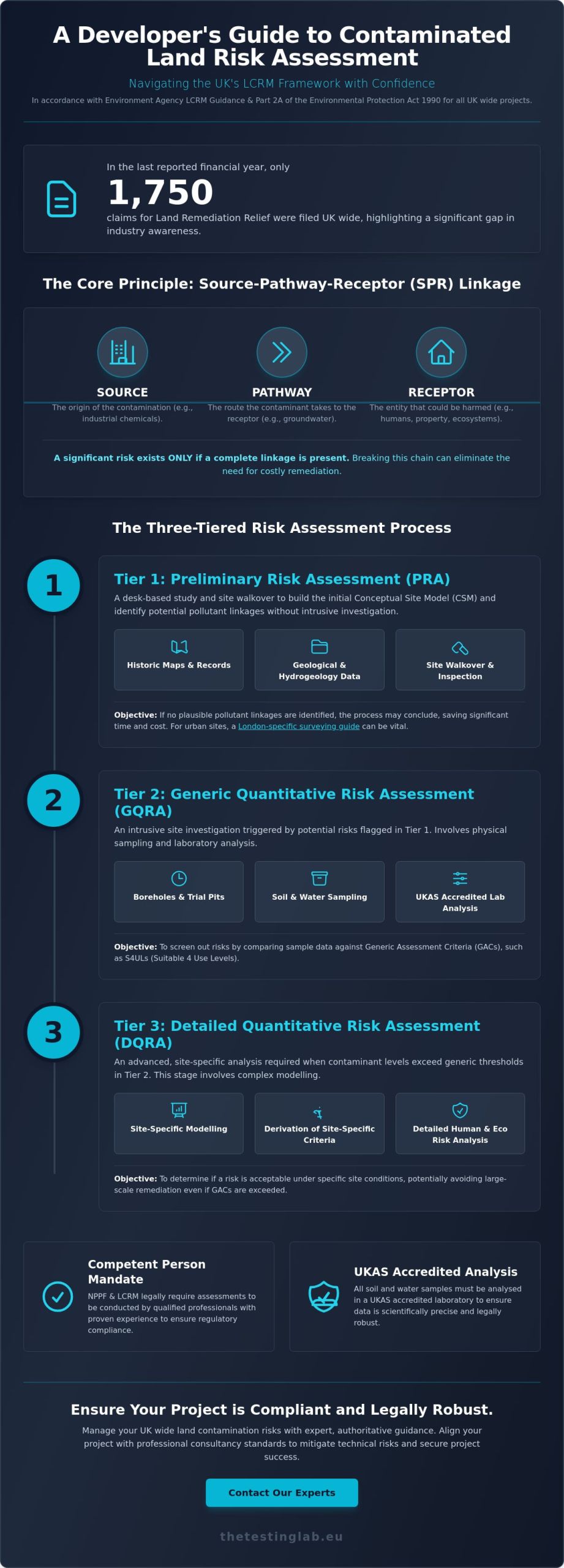
Did you know that only 1,750 claims for Land Remediation Relief were filed UK wide in the last reported financial year? This statistic highlights a significant gap in industry awareness, as many businesses struggle to interpret the complex Environment Agency requirements. Mastering the current contaminated land risk assessment guidance is essential to unlocking these incentives and avoiding costly project delays. We recognize that the uncertainty surrounding intrusive site investigations and the “polluter pays” principle can be a major pain point for developers and site managers alike.
This guide provides a clear roadmap for LCRM compliance, ensuring you understand exactly how to move through the mandatory stages of land management. You’ll gain a technical understanding of the tiered risk assessment process, from Tier 1 preliminary desk studies to Tier 3 detailed quantitative analysis. We also examine why your data must meet UKAS standards and how strategic partnerships, like those found on our pillar page, ensure your soil investigation testing is both legally robust and scientifically precise. By the end of this article, you’ll have the methodology needed to manage professional liability with absolute confidence.
Key Takeaways
- Understand how the Environment Agency’s LCRM framework serves as the definitive roadmap for UK wide compliance under Part 2A of the Environmental Protection Act 1990.
- Learn the technical distinctions between Tier 1 Preliminary Risk Assessments and Tier 2 Generic Quantitative Risk Assessments to determine exactly when intrusive investigations are necessary.
- Master the contaminated land risk assessment guidance to ensure all site data meets the rigorous UKAS accredited laboratory standards required by regulators.
- Discover the precision required in soil sampling and chain of custody procedures to maintain data integrity during transit and laboratory analysis.
- Align your project with professional consultancy standards to mitigate technical risks and ensure your land management strategies are legally and scientifically robust.
Navigating the Land Contamination Risk Management (LCRM) Framework
The Environment Agency’s LCRM framework serves as the procedural backbone for land management across the UK wide territory. LCRM was introduced in 2020 to replace the aging CLR11 guidance, and it received critical updates in 2025 to better align with modern environmental standards and reporting technologies. It provides the definitive contaminated land risk assessment guidance for developers, ensuring that land is made “suitable for use” under the UK planning regime. Most assessments are triggered by planning conditions, though some are driven by the statutory requirements of Part 2A of the Environmental Protection Act 1990. Understanding the UK Contaminated Land Regime is essential for establishing a robust legal and technical defense for any site redevelopment.
A central requirement of this framework is the “competent person” mandate. The National Planning Policy Framework (NPPF) and LCRM specify that assessments must be conducted by professionals with the appropriate qualifications, experience, and professional memberships. This ensures that complex data, such as asbestos in soils testing, is interpreted with the precision required by regulators.
The Source-Pathway-Receptor (SPR) Linkage
The Conceptual Site Model (CSM) is the foundational element of any risk assessment. It maps out the “source” of the contamination, the “receptor” that could be harmed, and the “pathway” that connects them. A risk is only considered to exist if a complete contaminant linkage is present. If one of these three elements is missing, the linkage is broken. Our engineering approach focuses on identifying these linkages early, as severing a pathway can often eliminate the need for costly and intrusive remediation works.
Site Objectives and Sustainability in 2026
Modern risk management in 2026 demands that site-specific goals are established before Tier 1 assessments commence. These objectives must balance safety with environmental sustainability. The industry has moved away from “dig and dump” mentalities, favoring on-site treatment and waste reduction strategies. Using specialist WAC (Waste Acceptance Criteria) testing allows for the precise classification of materials. This level of detail helps minimize the volume of soil sent to landfills, significantly reducing both the environmental footprint and the financial burden of the project.
The Three Tiers of Contaminated Land Risk Assessment
The Environment Agency’s Land Contamination Risk Management (LCRM) guidance outlines a structured, three-stage process. This hierarchical approach ensures that technical resources are focused where the risk is highest. Professionals follow this contaminated land risk assessment guidance UK wide to move from broad site histories to minute chemical concentrations. Each tier serves as a filter. We only proceed to the next stage if the previous one cannot definitively prove the site is safe for its intended use.
Tier 1: The Preliminary Risk Assessment (PRA)
Every assessment begins with a desk study and site walkover. We analyze historic maps, geological records, and hydrogeology to build the initial Conceptual Site Model. For projects in high-density areas, referencing a London-specific surveying guide is vital. Complex industrial heritage and “made ground” typically found in urban environments require a more nuanced eye. The goal here is to identify potential pollutant linkages. If no linkages are found, the process concludes, saving the client significant time and capital.
Tier 2: Generic Quantitative Risk Assessment (GQRA)
When a potential risk is flagged in Tier 1, we proceed to an intrusive site investigation. This phase involves drilling boreholes or excavating trial pits to collect physical samples. These samples undergo rigorous analysis in a UKAS accredited lab to compare contaminant levels against Generic Assessment Criteria (GAC), such as the S4ULs (Suitable 4 Use Levels). Tier 2 aims to screen out low-risk linkages efficiently by proving concentrations are below safe thresholds. If your project reveals elevated levels, you can consult with our specialist team to determine if further modeling is required.
If concentrations exceed generic limits, a Tier 3 Detailed Quantitative Risk Assessment (DQRA) becomes necessary. This involves complex, site-specific modeling. We look at the unique local geology and intended land use to determine if the contamination actually poses a significant threat. This stage requires the highest level of engineering precision to avoid unnecessary remediation costs.
The Critical Role of UKAS Accredited Laboratory Analysis
Regulators UK wide maintain a zero-tolerance policy regarding data quality. If your laboratory data lacks UKAS accreditation, it will likely be rejected by the Environment Agency, rendering your contaminated land risk assessment guidance compliance efforts void. UKAS accreditation confirms a lab’s technical competence and the reliability of its results. This precision begins before the sample even reaches the bench. Field technicians must adhere to strict preservation protocols, ensuring samples remain chemically stable during transit. A robust chain of custody is essential to prevent cross-contamination and ensure the legal defensibility of the findings within the Land Contamination Risk Management (LCRM) framework.
Specialist Testing: Asbestos in Soils and Chemical Analysis
The identification of asbestos in soils has become a critical focal point for modern site investigations. Identifying asbestos fibers requires specialized microscopy and qualitative analysis that standard chemical suites don’t provide. For more complex mineralogical questions, we employ XRD analysis to identify crystalline phases that standard testing might miss. Additionally, if the site requires off-site disposal, WAC testing is mandatory to classify the waste correctly. Compliance with HMRC LOI fines testing is also necessary to avoid punitive tax rates on soil waste, ensuring your project remains financially viable.
Reporting and Verification Requirements
A Tier 2 GQRA report must do more than just list numbers; it must interpret them against the Conceptual Site Model developed in Tier 1. The laboratory certificate acts as the ultimate verification document for planning approval. It proves that the soil meets the required safety standards for its end use. For developers managing multi-faceted projects, our pillar page on London-specific surveying offers a broader look at urban compliance requirements. Integrating these lab findings into a final verification report is the only way to satisfy local authorities and secure site sign-off under current contaminated land risk assessment guidance. You can explore our full range of soil investigation testing services to coordinate broader site compliance across your entire UK wide portfolio.
Securing Site Compliance and Regulatory Approval
Adhering to the latest LCRM standards isn’t just a regulatory hurdle; it’s a strategic necessity for successful land development. By following the contaminated land risk assessment guidance established by the Environment Agency, you ensure that every stage of your project is grounded in scientific integrity and legal accuracy. We’ve explored how the tiered approach minimizes unnecessary intrusive work, while specialized laboratory analysis provides the definitive data required for planning sign-off UK wide. This methodology effectively removes the burden of professional liability from your shoulders.
As an independent UK wide consultancy, we provide the technical expertise needed to navigate these complexities. Our UKAS Accredited Laboratory (No. 2514) specializes in critical services like Asbestos in Soils identification and WAC testing, ensuring your site data is robust enough to withstand the most rigorous regulatory scrutiny. Don’t let compliance uncertainty or data gaps stall your project progress.
Request a UKAS Accredited Soil Analysis Quote to partner with a team that treats your site objectives with engineering precision. We’re ready to help you secure your site’s future with confidence.
Frequently Asked Questions
What is a Phase 1 contaminated land assessment?
A Phase 1 assessment, or Preliminary Risk Assessment (PRA), is the initial stage of investigating a site’s environmental history. It involves a desk study of historical records and geological maps to identify potential contamination sources before any ground is broken. This stage is a vital first step for planning applications on UK wide brownfield sites, as explained in our London-specific surveying guide. It ensures developer due diligence by establishing the initial Conceptual Site Model (CSM).
Who is considered a ‘competent person’ for land contamination?
A competent person is someone with the specific qualifications and experience required to manage land contamination risks under LCRM. This typically includes chartered geologists, chemists, or environmentalists who hold membership in a recognized professional body. Regulators require these experts to sign off on reports to ensure legal compliance. Their involvement guarantees technical accuracy when interpreting complex SPR linkages for sites UK wide.
Is a contaminated land risk assessment a legal requirement?
While not every project requires one, the planning regime and Part 2A of the Environmental Protection Act 1990 make these assessments a practical necessity for most developments. Local Planning Authorities often mandate them if contamination is suspected on a site. Failing to provide reports that follow current contaminated land risk assessment guidance can lead to enforcement action, project delays, or significant legal liabilities if pollutants are discovered after construction begins.
How long does a contaminated land risk assessment take to complete?
Timelines vary significantly based on the level of detail required by the Environment Agency. A Tier 1 PRA desk study can often be completed within 1 to 2 weeks. A Tier 2 assessment involving intrusive site investigation and UKAS-accredited laboratory analysis typically takes 4 to 6 weeks to allow for field work and chemical testing. Engaging an accredited laboratory early ensures your contaminated land risk assessment guidance compliance remains on schedule.

Article by
P J F Thomas
CEO and Founder of TTL plc.
Disclaimer
Items declared are AI generated but do reflect our services. Please get in contact if you have any questions.