Could a Legionella test alone demonstrate that your business is managing water safety properly? It can’t replace a systematic process. Effective legionella compliance for business means assessing risks, putting suitable controls in place, keeping clear records and reviewing arrangements when circumstances change.
UK responsibilities are grounded in the Health and Safety at Work etc. Act 1974 and COSHH, with ACOP L8 and HSE guidance supporting risk management. Use this checklist to review your responsibilities, spot gaps in assessments, controls and records, and decide whether specialist support could help. The Testing Lab PLC is based in Doncaster and provides water testing and Legionella services to customers across the UK.
This guide explains the main parts of a defensible management process and why testing should be proportionate to the risks identified. A sample result is useful only when considered alongside the system, its controls and how those controls are managed.
Key Takeaways
- Legionella compliance for business is an ongoing, documented process, not a one-off test. Review how risk assessment, controls, monitoring and records work together at your site.
- Check that system information is current, responsibilities are assigned, controls are being carried out and changes are reviewed.
- When selecting specialist support, define the gap you need to address, check the provider’s competence and scope, clarify deliverables, then agree next steps.
- The Testing Lab PLC is based in Doncaster and serves customers UK-wide. Specialist assessments and testing can support your process, but don’t replace your business’s responsibilities under UK health and safety law.
Legionella compliance for business: understand responsibilities and the risk-management cycle
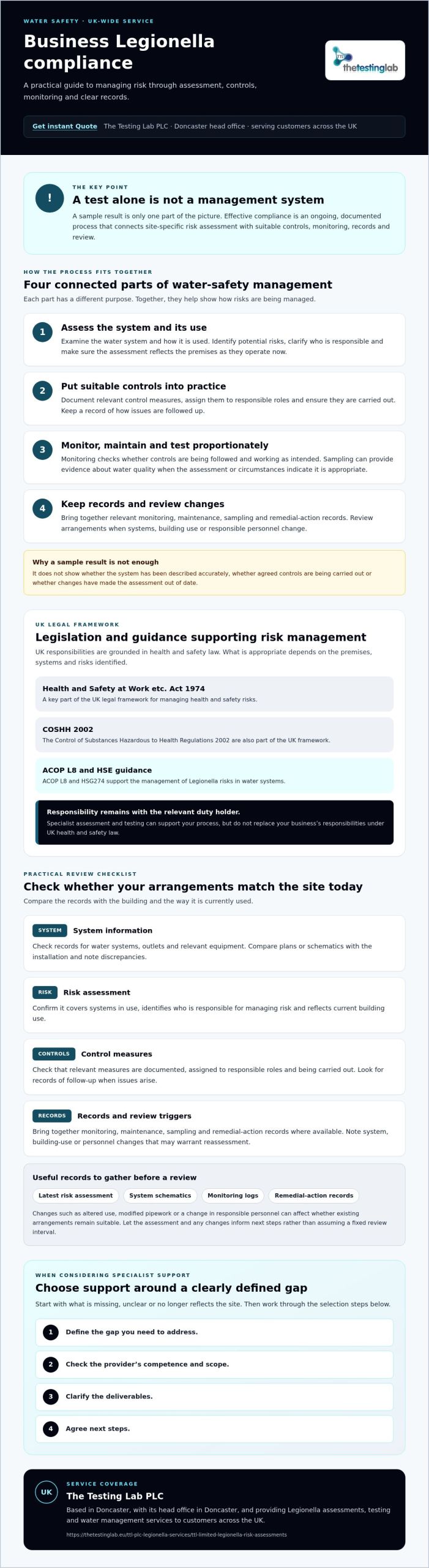
Legionella compliance for business is an ongoing, site-specific process. The Health and Safety at Work etc. Act 1974 and the Control of Substances Hazardous to Health Regulations 2002 (COSHH) are key parts of the UK legal framework for managing health and safety risks. HSE’s ACOP L8 and HSG274 provide supporting guidance on controlling Legionella in water systems. What’s appropriate depends on the premises, systems and risks, so a test alone cannot demonstrate that a business has managed those risks.
Legionella bacteria can cause Legionnaires’ disease, a serious form of pneumonia. This is why water-system risks need active management rather than a one-off response. See this overview of Legionnaires’ disease.
How risk assessments, controls and testing fit together
Each activity has a different purpose. A competent assessment examines the water system and how it is used, identifies potential risks and informs suitable control measures. The business then needs to put those measures into practice and assign responsibility for managing them. Monitoring checks whether controls are being followed and working as intended. Sampling can provide evidence about water quality where the assessment or circumstances indicate it is appropriate, but results are only one part of the picture.
For example, a sample result does not show whether the system has been described accurately, whether agreed controls are being carried out, or whether changes have made the assessment out of date. Keep relevant monitoring, maintenance and testing records so decisions and actions can be reviewed. If specialist assessment may help clarify site-specific risks, explore Legionella risk assessment services.
The Testing Lab PLC provides Legionella assessments, testing and water management services to customers across the UK, with its head office in Doncaster. Specialist support can inform your process, but responsibility for managing risks remains with the relevant duty holder.
Business Legionella compliance checklist: review systems, controls and records
Use this checklist to check whether your water-safety arrangements reflect how the building operates now. UK health and safety duties are explained in the HSE’s guidance on legal duties for Legionella control. Arrangements depend on the site and assessment findings, so a generic schedule is not a substitute for a site-specific review.
- System information: Check that records describe the water systems, outlets and relevant equipment. Compare any plans or schematics with the installation and note discrepancies.
- Risk assessment: Confirm the assessment covers the systems in use, identifies who is responsible for managing risk and reflects current building use.
- Controls: Check that relevant control measures are documented, assigned to responsible roles and being carried out. Look for records showing how issues are followed up.
- Records and review triggers: Bring together monitoring, maintenance, sampling and remedial-action records where available. Note changes to systems, building use or responsible personnel that may warrant reassessment.
What to gather before reviewing your water-safety arrangements
Collect the latest risk assessment, system schematics, monitoring logs and records of remedial actions before starting. Compare these with the site itself. Changes such as altered use, modified pipework or a change in responsible personnel can affect whether existing arrangements remain suitable. Record what needs checking instead of assuming a fixed review interval. The assessment and any changes should inform the next steps.
If records are missing, unclear or no longer reflect the site, a Legionella risk assessment may help clarify what needs attention. The Testing Lab PLC is based in Doncaster and serves customers across the UK. If specialist support appears appropriate, request a quote for Legionella support.
Choosing Legionella compliance support for a business in the UK
Get instant Quote
Choose support that addresses a specific gap in your water-safety arrangements, rather than selecting a provider simply because it offers a broad list of services. HSE’s Approved Code of Practice (ACOP L8) is a useful reference when checking how proposed work fits your approach to managing Legionella risk. Specialist input can support your process, but it does not transfer your business’s responsibilities.
- 1. Define the need: Decide whether you need an assessment, testing or help understanding existing findings. Describe the site, water systems and reason for seeking support.
- 2. Check competence and scope: Ask about relevant experience and confirm the proposed work covers the systems and locations in question. If accreditation matters to your decision, verify that its scope applies to the specific service or test.
- 3. Clarify deliverables: Agree what information you need to provide and what outputs you’ll receive, including how findings and recommended actions will be explained.
- 4. Agree next steps: Confirm responsibilities, access arrangements and how any follow-up support will be discussed. Don’t assume follow-up is included unless it has been agreed.
Questions to ask a Legionella service provider
Ask what the assessment or testing covers, what site information is needed, and how results or recommendations will be communicated. Clarify how urgent findings are raised and what happens after the report is delivered. Compare the scope of Legionella assessment services against the needs you identified.
The Testing Lab PLC provides Legionella risk assessments, fast Legionella testing and water management services. If you’ve identified a need for an assessment or testing, request a quote to discuss the requirement.
Make your next water-safety review count
Effective legionella compliance for business depends on a site-specific risk assessment, suitable controls and clear records, not testing alone. Use the checklist to identify changes, missing information or actions that need attention, then choose specialist support that matches the requirement.
The Testing Lab PLC provides Legionella risk assessments, testing and water management services to customers across the UK, with its head office in Doncaster. As you compare providers, confirm the scope of the work and check that any UKAS accreditation applies to the specific service or test. Specialist support can inform your arrangements, while your business retains its responsibilities under applicable UK health and safety law.
If you’ve identified a need for an assessment or testing, request a quote from The Testing Lab PLC to discuss the next step.
Frequently Asked Questions
Is Legionella compliance a legal requirement for every business?
UK health and safety duties under the Health and Safety at Work etc. Act 1974 and COSHH may apply where work creates relevant Legionella risks. Requirements depend on the premises and activities. Check current legislation and HSE guidance, and seek competent advice if responsibilities are unclear. The Testing Lab PLC serves customers in Carlisle, Chester, Lancaster, Liverpool, Manchester, Preston, Salford, Berwick-upon-Tweed, Durham, Middlesbrough, Newcastle upon Tyne, Sunderland, Bradford, Doncaster, Huddersfield, Hull, Leeds, Sheffield and Wakefield.
What should a business include in its Legionella compliance records?
Keep records that support your site’s risk-management arrangements. Depending on the assessment and systems, these may include relevant risk findings, assigned responsibilities, documented control measures, monitoring records and actions taken to address issues. There isn’t one universal document set for every site. Check applicable UK guidance, and make sure records are clear, current and accessible to those responsible for managing water safety.
How often should a business review its Legionella risk assessment?
Review timing should reflect the assessment, current guidance and relevant changes, rather than an assumed fixed interval. Changes to water systems, building use or management may mean the assessment needs review or updating. Follow competent advice and applicable guidance, and record why a review was carried out and what decisions followed. This helps keep legionella compliance for business aligned with actual site conditions.
Does Legionella testing alone prove that a business is compliant?
No. Sampling or testing can provide useful evidence when appropriate, but it doesn’t replace a risk assessment, suitable controls or management action. Whether testing is needed depends on the water system and circumstances. Consider results alongside the wider water-safety arrangements, including how controls are monitored and issues addressed. If findings are unclear, seek competent support to interpret them and decide on proportionate next steps.

Article by
P J F Thomas
CEO and Founder of TTL plc.
Disclaimer
Items declared are AI generated but do reflect our services. Please get in contact if you have any questions.