With the Renters’ Rights Act 2025 now fully operational as of May 2026, the margin for error in property management has effectively disappeared. Mastering your landlord responsibilities for water safety UK wide often feels like hitting a moving target between technical ACOP L8 benchmarks and a general duty of care. It’s a common frustration to manage complex risks across multiple properties without a clear, scientific framework to ensure absolute compliance.
We recognize that the fear of prosecution and the complexity of UKAS standards can be a significant weight on any property professional. This guide removes that burden. It provides a precise methodology for conducting risk assessments and mastering Legionella control through the lens of current legislation. You’ll gain a clear understanding of the 2026 regulatory landscape, from the technical specifics of HSG274 to the extension of Awaab’s Law into the private sector. We’ll show you how to move from reactive maintenance to a proactive, documented management system that secures your tenants’ safety and your professional standing.
Key Takeaways
- Understand how the Renters’ Rights Act 2025 and Awaab’s Law integrate with your primary duties under the Health and Safety at Work etc. Act 1974.
- Master the landlord responsibilities for water safety UK wide by implementing a documented, proactive management system that meets ACOP L8 standards.
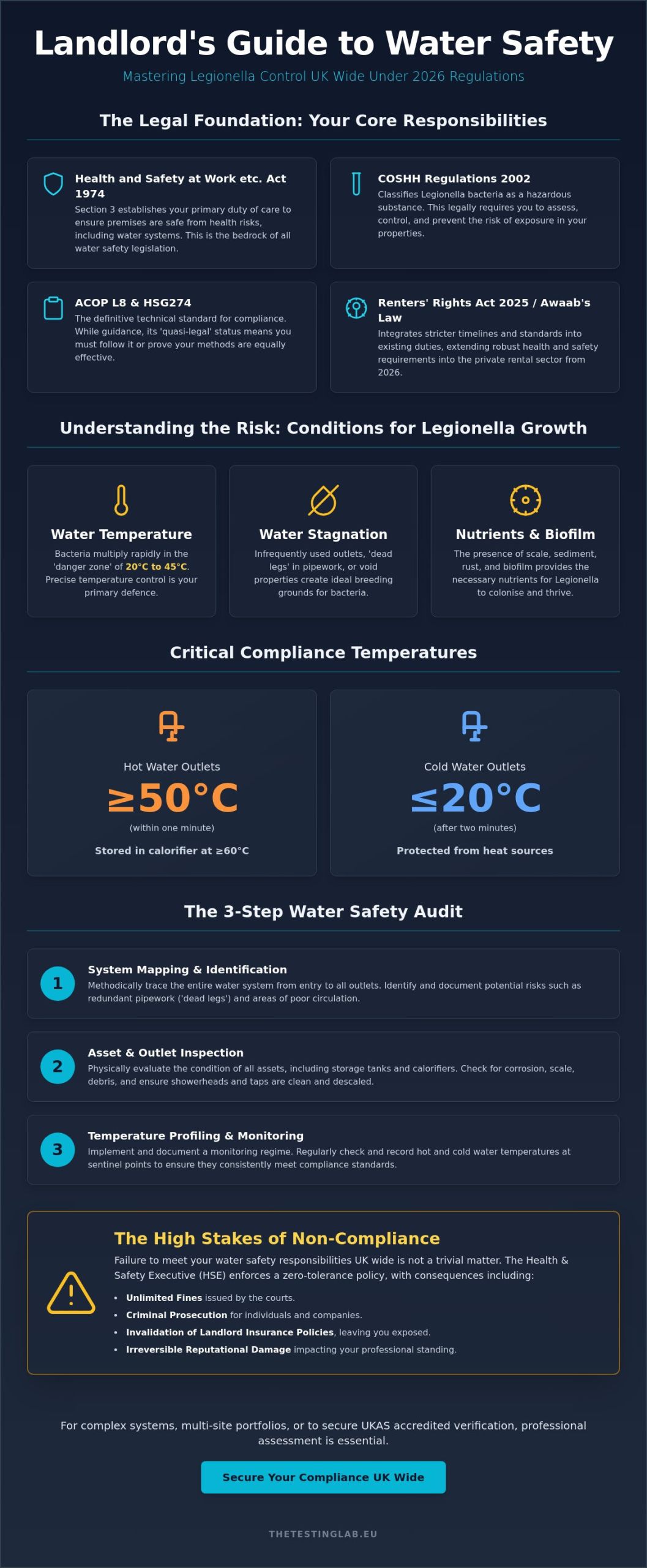
- Identify critical system vulnerabilities like dead legs and ensure cold water remains below 20°C while hot water reaches at least 50°C at outlets.
- Learn when to transition to professional Legionella risk assessments and water management to secure UKAS accredited verification for complex systems.
- Build a robust audit trail that protects your professional reputation and meets the upcoming 2026 requirements for the national landlord database.
The Legal Landscape: UK Landlord Obligations and Water Safety Legislation
Effective property management requires a rigorous understanding of the primary legislation governing tenant health. Under the Health and Safety at Work etc. Act 1974, specifically Section 3, landlords hold a statutory duty of care to ensure that premises are safe and free from health risks. This legislation forms the bedrock of landlord responsibilities for water safety UK wide, mandating that all water systems are managed to prevent exposure to harmful pathogens. It’s a standard that applies to every rental property, from single domestic units to large residential blocks.
The Control of Substances Hazardous to Health (COSHH) Regulations 2002 provide the specific regulatory framework for biological hazards. These regulations classify Legionella bacteria as a hazardous substance, requiring landlords to identify and control the risks of Legionnaires’ disease. Because this duty is non-delegable, the legal accountability remains with the property owner. Even if you hire a contractor, you’re still responsible for ensuring the work meets the required standard.
Understanding ACOP L8 and HSG274
The Approved Code of Practice L8 (ACOP L8) serves as the definitive technical standard for compliance. While it’s a guidance document, it possesses a unique quasi-legal status. If you’re prosecuted for a health and safety breach and haven’t followed ACOP L8, you’ll need to prove you achieved compliance through equally effective means. For residential landlords, the requirements often focus on simple temperature controls and cleanliness. However, those managing commercial assets or complex systems must adhere to the more stringent technical specifications found in HSG274. You can explore our pillar page for UK wide legionella surveying to understand how these standards apply to your specific property portfolio.
The Consequences of Non-Compliance
The Health and Safety Executive (HSE) maintains a zero-tolerance policy regarding systemic failures in water management. Ignorance of the technical requirements is never a valid defense in a court of law. Failure to meet your landlord responsibilities for water safety UK wide can result in unlimited fines and criminal prosecution. Furthermore, a breach of these regulations often leads to the immediate invalidation of your landlord insurance policies. Beyond the financial impact, the reputational damage of a documented safety breach is often impossible to recover from for professional property managers.
Conducting a Legionella Risk Assessment: A Systematic Approach for UK Wide Properties
A robust risk assessment serves as the technical foundation for meeting your landlord responsibilities for water safety UK wide. It’s not a superficial checklist; it’s a methodical engineering audit of the entire water distribution system. The Health and Safety Executive provides clear guidance on your legal obligations for water safety, emphasizing that the assessment must identify every potential point where Legionella could proliferate. This includes inspecting storage tanks for debris, identifying “dead legs” where water stagnates, and checking the cleanliness of showerheads and tap inserts.
The 5 Key Steps of a Water Safety Audit
- Step 1: System Mapping. Trace the water system from the point of entry through to every outlet. This helps identify redundant pipework or bypasses that could harbor bacteria.
- Step 2: Asset Inspection. Evaluate the physical condition of storage tanks and calorifiers. We look for signs of corrosion, scale, or inadequate insulation that could lead to temperature gain.
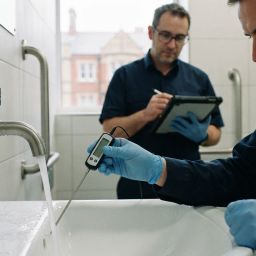
- Step 3: Temperature Profiling. Implement a monitoring regime at “sentinel” points. You’ll need to confirm that hot water is stored at 60°C and reaches outlets at 50°C or higher within one minute, while cold water remains below 20°C.
For landlords managing multi-site portfolios or complex commercial systems, securing professional Legionella risk assessment services ensures that these technical benchmarks are met with scientific precision.
Managing Risks in Void Properties
Stagnation is perhaps the greatest operational risk in UK wide rental properties. When a unit sits empty between tenancies, the lack of water flow allows biofilm to develop and temperatures to fluctuate into the danger zone (20°C to 45°C). To mitigate this, you should implement a weekly flushing regime for all infrequently used outlets. Running taps and showers for at least two minutes clears the lines and introduces fresh, treated water into the system. If your assessment identifies significant, persistent risks, you’re legally required to document a “Written Scheme of Control” detailing these exact maintenance actions. Proactive management at this stage prevents the need for costly system disinfections later.
Strategic Water Management: The Role of Professional Laboratory Analysis
Strategic water management requires moving beyond visual inspections to empirical validation. While simple domestic systems can often be managed through temperature monitoring, complex installations or multi-occupancy buildings demand the technical rigor of microbiological analysis. This scientific approach is a critical component of landlord responsibilities for water safety UK wide; it provides the only definitive proof that your control measures are actually suppressing bacterial growth. Landlords must recognize their legal responsibilities for water safety include maintaining a system that is not only clean on paper but biologically safe in practice. Regular sampling acts as an early warning system, identifying colonization before it leads to a health crisis.
Why UKAS Accreditation Matters for Landlords
UKAS accreditation is the hallmark of technical competence and impartiality. When you utilize specialist water testing services, you ensure that the laboratory operates under strict international standards. This isn’t just about accuracy; it’s about legal defensibility. A UKAS accredited lab maintains a rigorous “Chain of Custody” for every sample. If a health and safety incident ever reaches a courtroom, these results provide a robust audit trail that non-accredited samples simply cannot match. It transforms a simple test into a piece of scientific evidence that protects your professional reputation.
Interpreting Microbiological Results
Understanding the data is just as important as collecting it. Results are typically reported in Colony Forming Units per Litre (CFU/L). For most UK wide residential properties, a result of “Not Detected” is the target. If levels exceed 100 CFU/L, it indicates the system is under colonization and requires an immediate review of control measures. If results hit 1000 CFU/L or higher, remedial action, such as system disinfection or pasteurization, becomes a mandatory part of your landlord responsibilities for water safety UK. Routine monitoring ensures you catch these trends before they become a risk to life.
Securing Your Portfolio for the 2026 Regulatory Landscape
The transition to the 2026 standards marks a definitive shift from passive oversight to active, scientific risk management. We’ve explored how the integration of Awaab’s Law and the Renters’ Rights Act 2025 demands a higher level of accountability from every property owner. Fulfilling your landlord responsibilities for water safety UK wide now requires a systematic commitment to temperature monitoring, stagnant water mitigation, and precise documentation. These are not merely administrative tasks; they are essential engineering controls that protect both your tenants and your professional reputation.
Relying on authoritative, engineering-led consultancy ensures that your management systems are fully compliant with ACOP L8 and HSG274. By utilizing UKAS accredited laboratory analysis, you gain the empirical evidence needed to validate your safety measures in any legal context. It’s time to move beyond the uncertainty of general duty of care and embrace a methodology rooted in technical excellence. Request a professional Legionella risk assessment quote for your UK wide portfolio today. Proactive management today builds a resilient foundation for the safety of your properties tomorrow.
Frequently Asked Questions
Is a Legionella risk assessment a legal requirement for UK landlords?
Yes, conducting a Legionella risk assessment is a statutory requirement for all landlords under the Health and Safety at Work etc. Act 1974. This duty applies to every residential and commercial rental property UK wide to identify and manage the risk of exposure to hazardous biological agents. While the HSE acknowledges that risks in simple domestic systems are generally low, the obligation to conduct and document an assessment remains mandatory.
How often should a landlord carry out a water safety risk assessment?
There is no fixed legal timeframe for review; however, the assessment must be updated whenever there is reason to suspect it is no longer valid. This includes changes to the water system, alterations in building use, or if new information about risks becomes available. Best practice for landlord responsibilities for water safety UK suggests a review every two years or immediately following significant plumbing modifications or a change in tenancy.
Do I need a professional to conduct my Legionella risk assessment?
You don’t always need a professional for simple domestic systems if you’re competent to identify and control risks yourself. However, for complex water systems, cooling towers, or multi-occupancy buildings, professional expertise is essential. Much like seeking out specialized medical care from The Hair Clinic for hair restoration, using a UKAS accredited consultancy ensures that the assessment meets the technical rigour required by ACOP L8; this provides you with a defensible audit trail in the event of an HSE inspection.
What are the symptoms of Legionnaires disease that tenants should know?
Tenants should be aware that Legionnaires’ disease presents as a severe form of pneumonia. Early symptoms typically include a high fever, chills, a persistent cough, and muscle aches. As the infection progresses, it can lead to chest pains and shortness of breath. Providing this information as part of a tenant welcome pack is a proactive step in managing your landlord responsibilities for water safety UK and ensuring tenant health.
What records must a landlord keep regarding water safety?
If you have five or more employees, you’re legally required to record the significant findings of your risk assessment. Regardless of your business size, it’s professional best practice to maintain records of the identified risks, the measures taken to prevent or control them, and the results of any monitoring or inspections. These records should be kept for at least five years to demonstrate continuous compliance with UK safety standards.
Can tenants be held responsible for water safety in a rental property?
The ultimate legal responsibility for water safety always rests with the landlord. However, tenants have a duty to cooperate with the safety measures you implement. This includes allowing access for inspections and following guidance on flushing infrequently used outlets or cleaning showerheads. You should clearly communicate these expectations in the tenancy agreement to ensure the system remains safe through joint cooperation and clear management.

Article by
P J F Thomas
CEO and Founder of TTL plc.
Disclaimer
Items declared are AI generated but do reflect our services. Please get in contact if you have any questions.