A test report isn’t just a data summary; it’s your primary legal shield against HSE enforcement and corporate liability. While many providers offer basic analysis, knowing how to choose a testing laboratory that functions as a strategic partner is what secures your operational continuity. You’re likely aware that precision is non-negotiable, yet the risk of non-compliance and the sting of hidden processing costs remain constant pressures for UK businesses. Selecting the wrong partner doesn’t just delay a project; it compromises your legal standing.
This strategic guide clarifies the essential criteria for selecting a UKAS-accredited laboratory to ensure your projects meet UK legislative requirements with technical authority. We’ll explore why ISO/IEC 17025:2017 remains the gold standard for competence and how expert technical support transforms complex results into actionable insights. Whether you’re managing asbestos surveying and legionella risk assessments or complex soil investigations, a robust methodology is vital. You’ll learn how to secure legally defensible reports through a seamless UK-wide service that prioritizes both speed and scientific integrity.
Key Takeaways
- Understand why UKAS accreditation under ISO/IEC 17025:2017 is the mandatory benchmark for ensuring your test reports are legally defensible under UK legislation.
- Discover how to choose a testing laboratory that utilizes advanced material characterisation technologies to provide precise data for complex soil and asbestos investigations.
- Learn to evaluate a provider’s UK-wide logistical capabilities to ensure a secure chain of custody from the point of sample collection to final analysis.
- Identify the strategic advantages of partnering with a consultancy that integrates on-site surveys with in-house laboratory analysis to streamline your risk management processes.
The Foundation of Accreditation: How to Choose a Testing Laboratory for UK Compliance
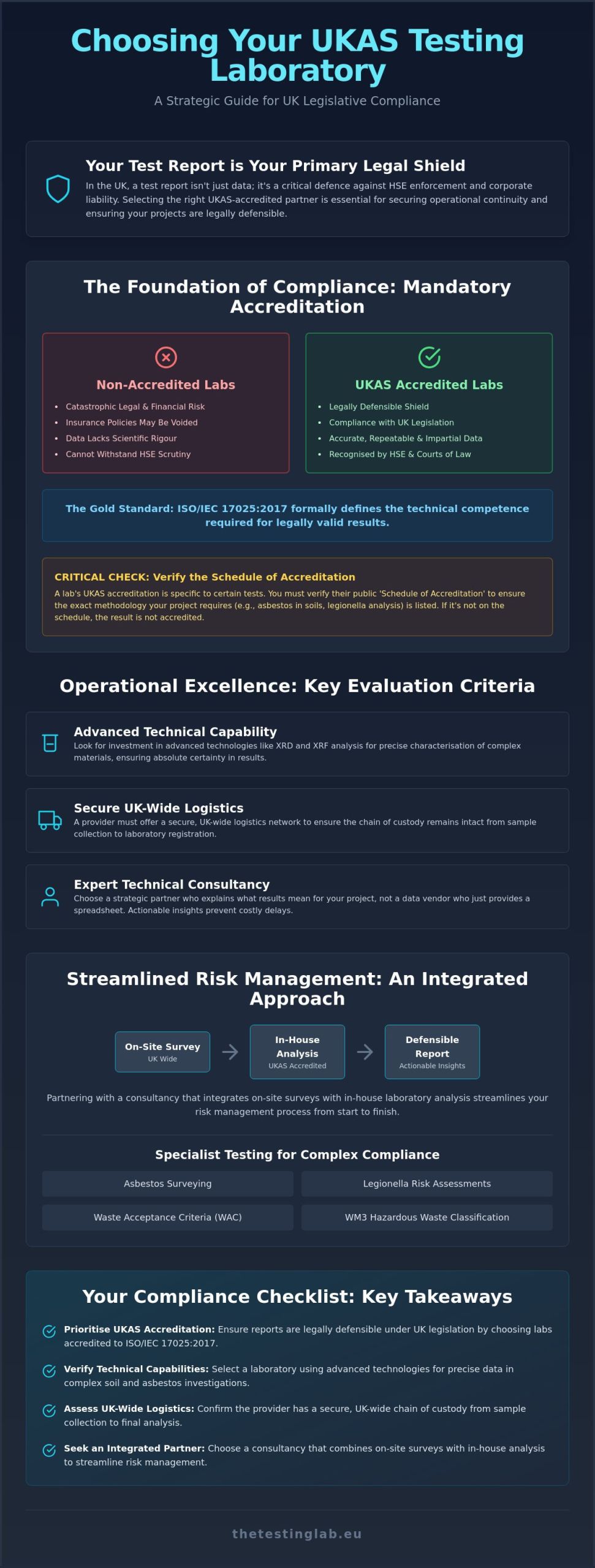
In the UK regulatory environment, accreditation isn’t a badge of honour; it’s a legal mandate for technical validity. Understanding how to choose a testing laboratory begins with recognising the United Kingdom Accreditation Service (UKAS) as the sole national body appointed by the government. Without this oversight, your data lacks the scientific rigour required to stand up in a court of law or during a Health and Safety Executive (HSE) inspection. For any business operating UK wide, UKAS accreditation is the only way to prove your results are accurate, repeatable, and impartial.
Relying on non-accredited facilities for high-risk materials like asbestos or legionella exposes your organisation to catastrophic risk. If a survey or sample analysis fails to meet the required standard, your insurance policies may be voided, leaving the business liable for health and safety breaches. A strategic partner provides more than just numbers; they provide a legally defensible shield. Technical competence is formally defined by ISO/IEC 17025 accreditation, which ensures a lab has the equipment, training, and quality systems to produce precise data consistently.
It’s vital to remember that a laboratory’s general status is less important than its specific scope. You must verify that their accreditation matches your project requirements exactly. A lab might be accredited for bulk asbestos identification but not for asbestos in soils. Choosing a partner with a broad, relevant scope ensures that every aspect of your environmental monitoring is covered by the same high standards of quality control.
Verifying the UKAS Schedule of Accreditation
Each laboratory holds a Schedule of Accreditation, which is a public document detailing their approved test methods. It’s a common mistake to assume a “UKAS Lab” can test anything. You must check the schedule to ensure the specific methodology you need, such as asbestos surveying or legionella risk assessments, is officially included. If the method isn’t on that specific document, the results aren’t accredited. This distinction is the difference between a compliant project and a significant legal liability.
Operational Excellence: Evaluating Technical Capability and Support
A laboratory’s value is also measured by its logistical reach. Prioritise providers offering a secure, UK-wide logistics network. This ensures the chain of custody remains intact from the moment a sample is collected on-site to its registration in the lab. However, the most critical differentiator is technical consultancy. A data vendor gives you a spreadsheet; a strategic partner explains what those results mean for your remediation strategy or site safety. If you need clarity on your next steps, engaging with an asbestos consultancy can prevent costly over-excavation or unnecessary project delays.
Turnaround Times vs. Analytical Accuracy
Speed is often a project requirement, but the fastest lab isn’t always the safest choice. Rigorous quality control protocols take time. You should look for a balance where rapid results don’t compromise the scientific integrity of the report. Transparent pricing is equally important. Ensure your partner provides clear, fixed-fee structures for site surveys and per-sample rates to avoid unexpected costs during the final billing phase. Knowing how to choose a testing laboratory involves weighing these operational efficiencies against the reliability of the data provided.
Specialist Testing for Complex Compliance
Standard testing often falls short for brownfield developments or hazardous waste management. You’ll need niche capabilities like Waste Acceptance Criteria (WAC) testing or WM3 hazardous waste classification. A lab capable of handling diverse matrices, including asbestos in soils and microbiological water monitoring, provides a single point of technical authority for your entire project. This integrated approach ensures that all regulatory submissions are comprehensive and ready for scrutiny by local authorities or the HSE.
Strategic Partnership: Integrating Lab Results into Risk Management
Selecting a partner is about more than just finding a facility; it’s about integrating scientific data into your broader risk management strategy. When you’re deciding how to choose a testing laboratory, the ability to provide integrated services is a primary differentiator. Choosing a provider that offers both on-site surveys and in-house analysis eliminates the friction between data collection and interpretation. This synergy ensures your site strategy is based on a cohesive understanding of environmental risks rather than fragmented reports from multiple vendors.
A strategic partner acts as a technical extension of your team. For large-scale projects, this relationship is vital for maintaining consistency across a UK-wide portfolio. Whether you’re managing fire risk assessments or complex legionella management programmes, having a single point of authority ensures that every decision is backed by accredited data. This long-term approach transforms testing from a reactive checkbox into a proactive tool for occupational hygiene and safety.
The Role of Asbestos Consultancy and Surveys
An Asbestos consultancy provides a layer of protection that simple sample analysis cannot match. They don’t just identify a material; they manage the risk it poses throughout the entire lifecycle of a building refurbishment or demolition. By integrating 4-stage clearances and air monitoring into your workflows, you ensure that your projects remain compliant with the Control of Asbestos Regulations 2012 and that sites are safe for re-occupation without delay.
Securing UK-Wide Compliance
Managing projects across multiple regions requires a partner with a robust national reach. Utilizing a London-based survey and testing pillar as part of a broader UK-wide compliance network allows for localized expertise with centralized quality control. It’s essential that your laboratory partner stays updated on evolving UK legislation, such as changes to GB CLP regulations, to ensure your business remains ahead of regulatory shifts and avoids the risk of non-compliance.
Before making your final selection, use this checklist to verify your choice:
- Accreditation: Is the specific test method covered on their UKAS schedule?
- Technical Expertise: Do they use advanced technology like XRD or XRF for characterisation?
- National Reach: Can they provide seamless UK-wide logistics and sample collection?
- Professional Authority: Do they offer consultancy to help interpret complex results?
Securing Your Operational Compliance through Technical Authority
Understanding how to choose a testing laboratory is the first step in mitigating professional liability and ensuring your projects remain compliant with UK legislation. We’ve established that UKAS accreditation isn’t optional; it’s the benchmark for technical validity. By prioritising laboratories that invest in advanced characterisation and offer integrated consultancy, you move beyond simple data collection into a proactive risk management strategy. This approach ensures every sample processed contributes to a safer, more efficient project lifecycle.
Our team operates as an independent UK-wide consultancy and UKAS accredited laboratory. We provide specialist expertise in asbestos, legionella, and soil analysis, ensuring your results are both precise and legally defensible. Whether you’re managing a single site or a national portfolio, our technical support takes the burden of professional responsibility off your shoulders. We’re here to ensure your most critical work stages are in the best possible hands.
Request a Professional Quote for UK-Wide Testing Services today and secure the technical partnership your business deserves.
Frequently Asked Questions
What is the difference between an ISO 9001 and an ISO/IEC 17025 accredited laboratory?
ISO 9001 is a general quality management standard, while ISO/IEC 17025 specifically certifies the technical competence of testing and calibration laboratories. When researching how to choose a testing laboratory, you must prioritize ISO/IEC 17025 because it ensures the accuracy of results through rigorous method validation. A lab with only ISO 9001 manages its business well but hasn’t proven its technical proficiency to UKAS for specific analytical methods.
How do I verify a laboratory’s UKAS accreditation status?
You can verify a laboratory’s status by visiting the official UKAS website and searching their database using the laboratory’s unique four-digit accreditation number. It’s essential to download the current Schedule of Accreditation to confirm the specific test methods you require are listed. This verification process is a critical step in how to choose a testing laboratory that meets UK legislative requirements for high-liability materials.
Why is the ‘Chain of Custody’ so important when choosing a testing lab?
Chain of custody is vital because it provides a documented, unbroken trail of sample ownership from the point of collection to final analysis. This traceability ensures that samples haven’t been tampered with or contaminated during transit, which is essential for producing legally defensible reports. For UK-wide projects involving hazardous materials, a robust chain of custody is the only way to satisfy HSE inspectors and insurance providers.
Can a laboratory provide both the survey and the analysis in the UK?
Yes, many leading UK providers offer integrated services that combine on-site surveys with in-house laboratory analysis. This model is highly efficient for managing asbestos surveying and legionella risk assessments, as it streamlines communication and reduces the risk of data loss. Choosing a partner with both capabilities ensures that the technical experts interpreting the results have a direct understanding of the site’s specific environmental context.

Article by
P J F Thomas
CEO and Founder of TTL plc.
Disclaimer
Items declared are AI generated but do reflect our services. Please get in contact if you have any questions.