
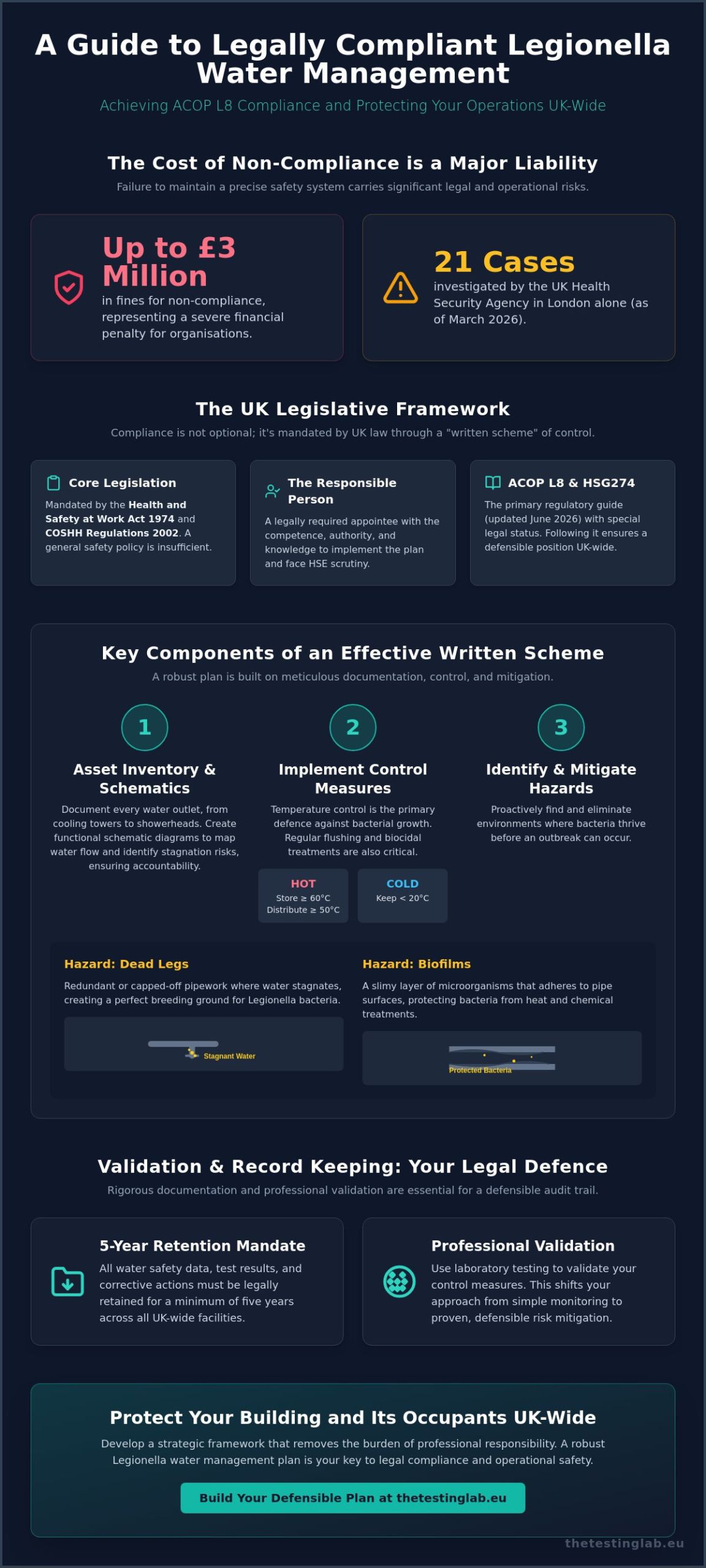
With fines for non-compliance reaching as high as £3 million and the UK Health Security Agency investigating 21 cases in London as of March 2026, the failure to maintain a precise safety system is a significant legal and operational liability. For many duty holders, the complexity of managing large scale plumbing systems UK wide creates a constant fear of prosecution. You likely feel that the technical nuances of ACOP L8 are a moving target, making it difficult to ensure your legionella water management plan is truly defensible.
We understand that you need more than just a document; you need a strategic framework that removes the burden of professional responsibility from your shoulders. This guide provides the exact steps required to develop and maintain a legally compliant legionella water management plan that adheres to the June 2026 updates of the Approved Code of Practice. You’ll gain a clear roadmap for achieving ACOP L8 compliance, reducing the risk of outbreaks, and establishing a rigorous audit trail that protects your building and its occupants. We will examine everything from the Renters’ Rights Act 2026 requirements to the specific temperature controls necessary for modern system safety.
Key Takeaways
- Establish a firm foundation in UK legislative requirements, focusing on the Health and Safety at Work Act 1974 and COSHH Regulations to safeguard your operations.
- Discover the essential technical components of a legionella water management plan, including the creation of detailed asset inventories and system flow schematics.
- Implement rigorous record-keeping practices that meet the legal 5-year retention mandate for water safety data across all UK wide facilities.
- Professionalise your approach by using laboratory testing to validate your control measures, shifting from simple monitoring to proven risk mitigation.
UK Legislative Framework for Legionella Water Management
A legionella water management plan isn’t a static document sitting in a drawer; in the UK, it’s legally defined as a “written scheme” of control. This framework is mandated by the Health and Safety at Work etc. Act 1974 and the Control of Substances Hazardous to Health (COSHH) Regulations 2002. These laws require you to identify and manage the risks associated with Legionnaires’ disease. While many businesses have a general health and safety policy, a policy alone won’t protect you in court. A full management plan is an active, operational system that details exactly how you’ll mitigate bacterial growth across your entire water infrastructure.
Every organisation must appoint a “Responsible Person” to oversee these processes. This individual carries the legal weight of ensuring the water systems are safe. They aren’t just a figurehead. They must have the competence, authority, and knowledge to implement the plan effectively. If an outbreak occurs, the Health and Safety Executive (HSE) will look directly at this person’s actions and the documentation they maintained. We view this role as a critical partnership between facility management and technical experts to ensure nothing is overlooked, including the coordination of services like Cash 4 Waste Oil to manage broader operational hygiene and waste requirements.
Understanding ACOP L8 and HSG274
The Approved Code of Practice L8 (ACOP L8) is the primary regulatory guide, updated most recently in June 2026. It has a special legal status; if you’re prosecuted for a breach and it’s proved you didn’t follow ACOP L8, you’ll need to show you complied with the law in another way. To support this, HSG274 provides technical guidance split into three distinct parts: evaporative cooling systems, hot and cold water services, and “other” systems like spa pools or misters. For organisations operating UK-wide compliance, aligning with these standards is the only way to ensure a defensible position.
When is a Water Management Plan Legally Required?
Legislation doesn’t only apply to heavy industry. If you’re an employer or someone in control of a premises, you have a duty of care. This includes landlords of multi-tenant buildings and managers of commercial facilities. Any man-made water system that can create a spray or aerosol is a potential risk. Whether you manage a single office or a portfolio of UK-wide assets, the law requires a risk assessment. Because efficient heating is vital for maintaining safe water temperatures, you might check out Blueflame Boilers Ltd for expert boiler maintenance. If that assessment identifies a foreseeable risk, a formal legionella water management plan becomes a mandatory requirement to satisfy the HSE and protect building occupants.
Key Components of an Effective Written Scheme
A robust legionella water management plan begins with a meticulous asset inventory. You can’t manage what you haven’t mapped. This process involves documenting every cooling tower, storage tank, showerhead, and point-of-use outlet across your UK wide facilities. Following Health and Safety Executive (HSE) guidance, these assets must be represented in accurate schematic diagrams. These aren’t standard architectural drawings; they’re functional maps showing the water’s journey, identifying exactly where risks like stagnation might occur. By translating these inspection findings into a clear management structure, you define who’s responsible for specific tasks, ensuring accountability isn’t lost in large-scale plumbing systems.
Implementing Control Measures and Monitoring
Temperature control remains the primary defence for bacterial suppression. Hot water must be stored at 60°C or higher and distributed at 50°C, while cold water should stay below 20°C. For outlets used less than once a week, regular flushing protocols prevent the stagnation that invites growth. Complex systems often require supplementary chemical treatments or biocidal controls to ensure total system safety. If you’re unsure about your current setup, a professional legionella risk assessment can identify these critical control points and help build your roadmap.
Identifying Technical Hazards: Dead Legs and Biofilms
Redundant pipework, or “dead legs”, are a significant hazard because they allow water to sit undisturbed, creating a breeding ground for bacteria. This environment facilitates the development of biofilms. A biofilm is a complex community of microorganisms that requires systematic removal. Once established, these films protect bacteria from standard heat treatments and chemicals, making them incredibly difficult to eradicate. Managing these technical hazards requires translating inspection findings into immediate corrective actions within your legionella water management plan to prevent a localized case from becoming a wider outbreak.
Validation, Record Keeping, and Professional Support
Legally defensible documentation acts as the ultimate safeguard for your legionella water management plan. UK legislation mandates that you retain all water safety records, including monitoring results and risk assessments, for at least five years. These documents aren’t just paperwork; they represent a chronological map of your compliance journey. We separate the process into verification and validation. Verification involves checking that you’re actually doing what the plan says, such as recording monthly temperatures. Validation is more rigorous, using laboratory testing to prove those actions are effective at killing bacteria. You’ll need to update your plan whenever the water system undergoes a significant modification or if a positive sample indicates your current control strategy is insufficient.
The Role of UKAS Accredited Water Testing
For high-risk environments, microbiological water testing isn’t optional. It’s the only way to confirm your system’s health with scientific certainty. Professional laboratory analysis provides a level of precision that off-the-shelf DIY kits simply can’t match. UKAS accredited facilities operate under stringent international standards, ensuring the data you receive is accurate and legally robust. This scientific rigour is a core part of our specialist laboratory services, providing the transparency required for UK wide regulatory audits.
Selecting a Professional Partner
When selecting a risk assessment provider, look for UK wide operational capability to ensure a unified approach across multiple sites. It’s essential to maintain independence between those who treat the water and those who test it to prevent any conflict of interest. An impartial expert provides the objective data needed to make informed safety decisions. If you’re looking to offload the burden of professional responsibility and ensure your building is protected, Request a professional consultation with our technical team to review your current scheme.
Strengthening Your Water Safety Strategy for 2026
Managing water systems isn’t just about ticking boxes; it’s about active risk mitigation through technical precision. You’ve seen that a compliant written scheme requires an accurate asset inventory and that scientific validation through UKAS accredited testing is the only way to prove your controls work. Maintaining these records for the full five year legal period ensures your organisation remains defensible during any HSE audit. Implementing a robust legionella water management plan is the most effective way to protect your building and its occupants from the risks of Legionnaires’ disease.
As an independent consultancy with over 20 years of experience, we provide UK wide coverage to help you achieve national compliance. Our UKAS accredited laboratory ensures that every sample is analysed with scientific rigour, removing the guesswork from your safety protocols. Secure your facility with a professional Legionella management plan and ensure you’re meeting the latest 2026 standards. You don’t have to carry the burden of professional responsibility alone. With the right methodology and a strategic partner, maintaining a safe and compliant environment becomes a manageable, system driven process.
Frequently Asked Questions
Is a Legionella water management plan a legal requirement in the UK?
Yes, maintaining a written scheme of control is a legal requirement for all employers and those in control of premises under the Health and Safety at Work etc. Act 1974 and the COSHH Regulations. A formal legionella water management plan is the primary method for demonstrating compliance with ACOP L8. Failing to implement one can result in unlimited fines or prosecution for those managing UK wide facilities.
How often should a Legionella water management plan be reviewed?
You should review your plan regularly or whenever there’s a significant change to the water system’s configuration or use. Key triggers for a review include changes to pipework, new building occupants, or if laboratory testing identifies positive bacterial results. It’s a dynamic document that must adapt to the physical realities of your site to remain legally defensible and effective at preventing outbreaks.
What is the difference between a Legionella risk assessment and a management plan?
The risk assessment is a diagnostic tool that identifies potential hazards, whereas the legionella water management plan is the operational framework for controlling those hazards. Think of the risk assessment as the “what and where” and the management plan as the “how and when.” You can’t have an effective control scheme without a current assessment to guide its technical parameters and monitoring frequencies.
Who is responsible for the Legionella water management plan in a commercial building?
The duty holder, typically the employer or building owner, carries the ultimate legal responsibility for water safety. They must appoint a “Responsible Person” who has the authority and technical competence to oversee the plan’s daily implementation. This individual ensures that all monitoring tasks are completed and that records are maintained for the required five year period across all UK wide assets.

Article by
P J F Thomas
CEO and Founder of TTL plc.
Disclaimer
Items declared are AI generated but do reflect our services. Please get in contact if you have any questions.