
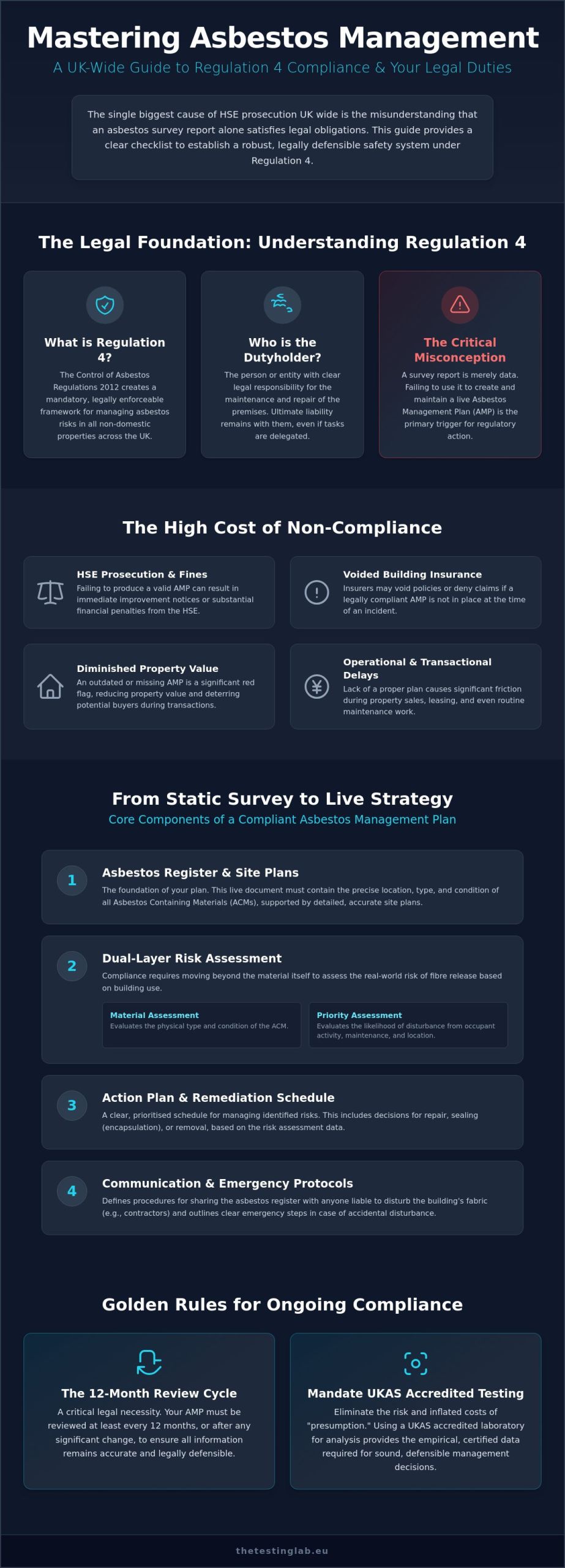
Most dutyholders across the UK believe that holding a survey report satisfies their legal obligations, yet this single misunderstanding is the primary catalyst for HSE prosecution. It’s completely normal to feel confused about the difference between a survey and a management plan or to struggle with identifying who the dutyholder actually is within your structure. By mastering the specific asbestos management plan requirements for 2026, you can move beyond the fear of non-compliance and establish a robust safety system. This guide provides a clear checklist of legal essentials under Regulation 4, helping you maintain a legally defensible position UK wide.
We’ll explore how to transition from static data to a live management strategy that stands up to scrutiny. This includes the precise frequency of reviews and the importance of professional asbestos surveying and independent analytical oversight. Understanding these technical processes doesn’t just keep you on the right side of the law; it ensures your property remains a safe environment for every occupant. By treating compliance as a methodical system rather than a one-time task, you protect both your people and your professional reputation.
Key Takeaways
- Define your legal obligations as a dutyholder under Regulation 4 to ensure full compliance for non-domestic properties UK wide.
- Identify the essential asbestos management plan requirements, moving beyond simple surveys to create a dynamic, site-specific risk assessment strategy.
- Learn why the 12-month review cycle is a critical legal necessity for maintaining the accuracy of your asbestos register and safety protocols.
- Understand the importance of independent UKAS accredited testing in eliminating the operational risks associated with presumed asbestos materials.
- Establish a legally defensible position by integrating professional consultancy and digital record-keeping into your property management framework.
Understanding Regulation 4: The Legal Duty to Manage Asbestos
Regulation 4 of the Control of Asbestos Regulations 2012 creates a mandatory framework for managing risks in non-domestic buildings. It isn’t just about knowing asbestos is there; it’s about a systematic approach to control. The scope extends to all commercial properties and the “common parts” of domestic buildings, such as foyers or lift shafts in blocks of flats. A critical mistake many property managers make is relying on “presumption” of asbestos. While the law allows you to presume materials contain asbestos, this often leads to inflated removal costs and unnecessary operational delays during maintenance. Professional identification through asbestos surveying provides the empirical data needed to meet specific asbestos management plan requirements without the guesswork.
Who is the Dutyholder in 2026?
Identifying the dutyholder is often the most complex step in multi-occupancy buildings or under modern commercial leases. The responsibility usually falls on the person or entity responsible for maintenance and repairs. In a typical commercial lease, this might be split between the landlord and the tenant depending on the specific terms of the agreement. The dutyholder is the individual or organization with clear legal responsibility for the maintenance or repair of non-domestic premises as defined under UK wide legislation. To execute the plan effectively, dutyholders often designate an “appointed person” to oversee day-to-day compliance, though the ultimate legal liability remains with the dutyholder.
The Consequences of Non-Compliance
The Health and Safety Executive (HSE) has tightened its focus for 2026, increasing the frequency of inspections and enforcement. Failing to maintain a valid Asbestos Management Plan (AMP) can lead to immediate improvement notices or substantial fines. Beyond regulatory penalties, non-compliance creates significant friction during property transactions. Modern buyers and insurers view a missing or outdated AMP as a high-risk liability. Without a legally defensible plan, you may find your building insurance voided or your property value diminished during a sale. Meeting the asbestos management plan requirements is therefore a strategic necessity for business continuity.
Core Components of a Compliant Asbestos Management Plan
A compliant document is more than a list of survey findings; it’s a strategic framework. To satisfy asbestos management plan requirements, you must synthesize survey data into actionable protocols. This starts with an accurate Asbestos Register, which acts as the central repository for the location, type, and condition of every identified material. It’s the blueprint that guides every maintenance decision across your property portfolio.
The Asbestos Register and Site Plan
Your register must include detailed site plans that map ACMs with precision. If certain building voids or ceiling spaces were inaccessible during the initial survey, they must be clearly marked as “areas not inspected.” Under UK law, these zones are treated as containing asbestos until proven otherwise. Engaging professional Asbestos Consultancy Services ensures these maps are technically accurate and legally defensible UK wide. This level of detail prevents accidental exposure during routine repairs.
Effective risk assessment moves beyond the “material assessment” (the physical condition of the asbestos) to include a “priority assessment.” This evaluates the likelihood of disturbance based on occupant activity, maintenance frequency, and the location of the material. If a high-risk material is in a high-traffic area, the plan must dictate immediate action rather than passive monitoring. It’s about proactive prevention rather than reactive cleanup.
Prioritising Actions and Remediation
Your plan should establish a clear schedule for repair, sealing, or removal. While many ACMs are safe to manage in situ if they’re in good condition, others require immediate abatement. This decision-making process must be transparent and based on empirical data from UKAS-accredited laboratories. Using certified data removes the ambiguity often found in generic risk assessments.
Communication is the final pillar of a robust system. You’re legally required to share the register with any contractor or occupant likely to disturb the fabric of the building. In the event of accidental disturbance, the plan must outline emergency procedures to isolate the area and prevent fibre release. If you’re unsure about your current documentation, requesting a professional asbestos survey review is a logical next step to ensure your system is robust and compliant.
Implementing and Reviewing Your Plan: The Role of UKAS Labs
Implementing a strategy is where technical data meets operational reality. To satisfy asbestos management plan requirements UK wide, dutyholders must commit to a mandatory 12-month review cycle. This annual re-inspection isn’t a mere administrative task; it’s a critical safety check to verify that the condition of known asbestos materials hasn’t deteriorated. Integrating UKAS accredited asbestos testing into this cycle provides the empirical evidence required to maintain a legally defensible position. If your building’s usage changes or maintenance work is planned, the plan must be updated to reflect these new risks immediately.
Day-to-day management also requires specific training for staff and contractors. Anyone likely to disturb the building fabric needs to understand how to read the register and follow the prescribed safety protocols. When moving from general occupancy to active construction, you must transition from a Management Survey to a more intrusive Refurbishment/Demolition Survey. This ensures that hidden ACMs are identified before they can be disturbed by heavy works, preventing costly project delays and health risks.
The Importance of UKAS Accredited Verification
Independent lab analysis is the only way to remove subjectivity from your risk management process. During any asbestos removal project, the 4-stage clearance process is a non-negotiable requirement for re-occupation. This process must be conducted by a UKAS accredited analyst appointed independently of the removal contractor to ensure total transparency. For complex sites where groundworks are necessary, incorporating UKAS Asbestos in Soils Testing ensures that environmental risks are managed with the same precision as the building fabric itself.
Integrated Compliance: Legionella and Fire Safety
Modern property management requires a holistic view of building safety. There’s a significant operational synergy between managing asbestos and conducting Legionella Risk Assessments, as both involve systematic monitoring of building assets. You must also ensure that your asbestos management plan doesn’t conflict with fire safety measures. For example, installing fire stopping through a wall containing asbestos-containing materials requires careful coordination to ensure fire integrity isn’t compromised while maintaining asbestos safety. Treating these obligations as a unified system reduces the professional responsibility on the dutyholder and ensures a safer environment for all occupants.
Securing Your Property’s Future through Strategic Compliance
Maintaining a compliant property in 2026 demands more than just a checklist; it requires a commitment to methodical, data-driven safety. You’ve seen how identifying the correct dutyholder and moving from static surveys to active priority assessments forms the backbone of a resilient strategy. By integrating annual reviews and independent laboratory analysis, you ensure that your approach to asbestos management plan requirements remains legally defensible and operationally efficient. This isn’t just about avoiding HSE fines; it’s about establishing a culture of transparency and safety that protects your occupants and your assets UK wide. For organizations looking to extend this commitment to environmental sustainability through textiles circularity and climate policy, Symolem offers specialized advisory services to support your strategic goals.
As a strategic partner, we take the weight of professional responsibility off your shoulders. Our team provides the precision of a UKAS Accredited Laboratory combined with the insight of an independent professional consultancy to keep your building safe. Whether you’re managing a single site or a complex national portfolio, we’re here to provide clarity in a complex regulatory landscape. We also offer specialized asbestos surveying to ensure your records are always up to date.
Request a Quote for UK Wide Asbestos Management and Testing and secure the peace of mind that comes with expert oversight. Your compliance journey starts with accurate data and ends with a safer environment for everyone.
Frequently Asked Questions
Is an Asbestos Management Plan a legal requirement for all UK buildings?
Yes, an Asbestos Management Plan is a mandatory legal requirement for all non-domestic buildings and the common parts of domestic premises built before the year 2000. Under the Control of Asbestos Regulations 2012, dutyholders UK wide must have a written plan to manage the risks from asbestos. This ensures that any person working on the building is aware of the location and condition of asbestos-containing materials before work begins.
How often should an Asbestos Management Plan be reviewed?
You must review your plan at least every 12 months to satisfy the core asbestos management plan requirements. This annual review is a legal necessity to verify that the condition of identified materials hasn’t deteriorated over time. You should also update the plan immediately if there are any significant changes to the building’s use, if maintenance work is scheduled, or if you suspect the original assessment is no longer valid.
What is the difference between an Asbestos Survey and a Management Plan?
The primary difference is that a survey identifies the presence of asbestos, whereas a management plan outlines how you’ll control the associated risks. A survey provides the raw data for your asbestos register; the management plan uses that data to set out repair schedules, communication protocols, and emergency procedures. You can’t have a compliant management plan without a professional survey to provide the initial evidence base.
Can I write my own Asbestos Management Plan?
Legally, the dutyholder can write the plan, but they must demonstrate the necessary competence and technical understanding to meet UK wide standards. Most dutyholders find it challenging to identify the “priority assessment” or establish defensible emergency protocols without expert help. Partnering with a professional asbestos surveying team ensures your plan is technically accurate and survives the scrutiny of an HSE inspection.

Article by
P J F Thomas
CEO and Founder of TTL plc.
Disclaimer
Items declared are AI generated but do reflect our services. Please get in contact if you have any questions.