This guide provides the methodology you need to master how to budget for compliance testing 2026, ensuring total legal peace of mind. We’ll outline a step-by-step framework to transition from reactive spending to a predictable, transparent model for asbestos, legionella, and fire safety testing. By integrating precise technical standards with strategic planning, you can streamline operations UK-wide. Whether you’re managing complex asbestos and legionella surveying or overseeing multiple industrial sites, this roadmap ensures your compliance remains a strategic asset rather than a liability.
Key Takeaways
- Learn how to conduct a comprehensive statutory audit of your UK-wide assets to identify mandatory testing frequencies and avoid costly legal penalties.
- Master a systematic 5-step framework on how to budget for compliance testing 2026 that accounts for laboratory fees and evolving health and safety regulations.
- Discover methods for accurately estimating sample volumes for specialized requirements, such as asbestos in soils and water absorption testing, to prevent mid-year budget deficits.
- Understand the financial and operational benefits of partnering with a single UKAS-accredited consultancy to reduce administrative overhead across multiple sites.
- Transition from reactive, high-cost emergency testing to a proactive, integrated strategy that ensures continuous compliance with UK building safety laws.
The 2026 Compliance Landscape: Why Statutory Testing Budgets are Non-Negotiable
Statutory testing isn’t a discretionary operational expense. It’s a mandatory legal requirement under UK health and safety law, specifically designed to protect occupants and employees. As we enter 2026, the framework for Regulatory compliance has shifted toward stricter, digitally-driven enforcement. Relying on reactive, “as-needed” spending creates significant financial exposure. When you master how to budget for compliance testing 2026, you move from crisis management to a model of operational excellence. Failing to maintain UK-wide consistency across your portfolio often results in regional compliance gaps that invite heavy scrutiny from the Health and Safety Executive (HSE).
The True Cost of Non-Compliance in the UK
The financial impact of a compliance breach extends far beyond a simple fine. Under current UK legislation, a “failure to manage” hazardous materials like asbestos or water systems can result in unlimited fines and even custodial sentences for duty holders. Beyond safety, fiscal compliance is equally sharp; for instance, HMRC LOI Fines Testing is now a critical tool for waste operators to avoid misclassification penalties. Proactive investment in asbestos consultancy ensures that your budget accounts for these risks before they manifest as emergency clearance fees or legal bills.
Why UKAS Accreditation is Your Budget’s Best Protection
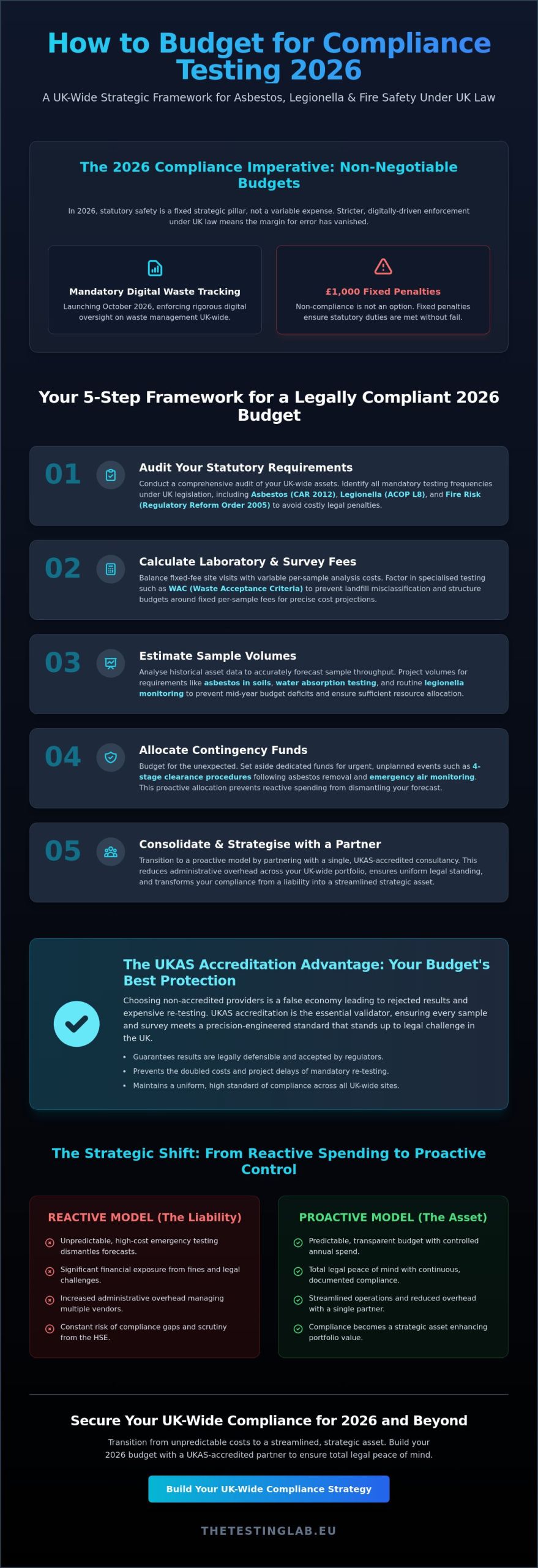
A 5-Step Guide to Budgeting for Compliance Testing in 2026
Creating a robust financial plan requires a granular understanding of technical requirements across your entire portfolio. When determining how to budget for compliance testing 2026, you must align your fiscal cycles with the UK government’s 2026-2027 budgeting guidance to ensure all statutory obligations are fully funded. A structured approach prevents the common pitfall of underestimating variable laboratory costs, which can quickly erode operational margins.
Step 1: Auditing Your Statutory Requirements
Begin by identifying the core pillars of your legal obligations: Asbestos (CAR 2012), Legionella (ACOP L8), and Fire Risk (Regulatory Reform Order). You’ll need to determine whether your assets require Management Surveys for ongoing occupancy or more invasive Refurbishment Surveys based on your 2026 capital project plans. Integrating Legionella risk assessment services into this initial audit ensures that water safety isn’t treated as an afterthought, preventing duplicate site visit costs later in the year.
Step 2: Calculating Laboratory and Survey Fees
Budgeting for site work involves balancing fixed-fee site visits with variable per-sample laboratory analysis. For construction or redevelopment sites, you must factor in specialized testing such as WAC (Waste Acceptance Criteria) to avoid landfill misclassification. Bulk asbestos identification fees are typically structured as a fixed price per sample, which allows for precise cost projections based on estimated material counts.
To complete your 2026 framework, follow these final steps:
- Step 3: Estimate Sample Volumes: Calculate expected throughput for asbestos in soils, water absorption, and legionella monitoring based on previous asset data.
- Step 4: Allocate Contingency: Set aside dedicated funds for 4-stage clearance and emergency air monitoring to handle unforeseen remediation needs.
- Step 5: Consolidate UK-wide Reporting: Centralize your data to eliminate the administrative redundancy of managing multiple regional contractors.
If you’re managing a complex portfolio and need a precise breakdown of these technical line items, you can request a tailored compliance quote to anchor your 2026 projections in real-world data.
Optimising Your 2026 Spend: Strategic Partnerships vs. Reactive Testing
The final pillar of a successful financial strategy involves moving away from fragmented, regional procurement. When you evaluate how to budget for compliance testing 2026, the choice between multiple local contractors and a single UK-wide accredited consultancy becomes a question of administrative efficiency. Managing dozens of separate relationships often leads to compliance drift, where varying report formats and inconsistent pricing models hide the true cost of your operations. By aligning with the UK Government’s Budgeting Guidance principles, you can centralize your data and achieve significant economies of scale.
Integrating Asbestos and Water Management
Logistical synergy is a primary driver for cost reduction. Scheduling legionella monitoring alongside asbestos re-inspections allows for single-visit efficiencies that lower travel fees and site disruption. An integrated asbestos consultancy approach provides a clear, digital chain of custody. This transparency is vital for budget auditing; it ensures every pound spent is mapped to a specific statutory requirement. UK-wide coverage guarantees that your pricing remains stable, whether you’re managing a facility in the Highlands or a commercial unit in the South East.
Leveraging Specialist Services for Long-Term Risk Mitigation
Precision in the laboratory directly impacts the bottom line. Utilizing advanced XRD/XRF analysis allows for definitive material characterization, often preventing the unnecessary removal of non-hazardous materials. Similarly, detailed soil investigation testing is essential for redevelopment projects. It prevents the massive overspend associated with misclassifying waste as hazardous, a mistake that can decimate a construction budget.
The Testing Lab PLC acts as your strategic partner, using an engineering-led methodology to turn compliance from a burden into a streamlined system. We remove the professional responsibility from your shoulders through technological confidence and UKAS-accredited accuracy. For a deep dive into specific regional requirements, explore our London surveying and compliance pillar page to see how we manage complex UK-wide portfolios with absolute precision.
Securing Your Statutory Future: Precision Budgeting for 2026
Mastering how to budget for compliance testing 2026 is about shifting from defensive spending to an offensive risk mitigation strategy. With nationwide UK and Ireland coverage, our independent asbestos and environmental consultancy provides the precision engineered data you need for complete legal certainty. Our UKAS accredited laboratory ensures that every material characterization is accurate, protecting you from the unlimited fines associated with a failure to manage. We’re ready to help you build a transparent, defensible budget that stands up to any regulatory challenge.
Take control of your fiscal planning today. Request a UK-Wide Compliance Testing Quote for 2026 and secure the professional expertise your assets deserve.
Frequently Asked Questions
How much should I budget for an asbestos management survey in 2026?
Budgeting for an asbestos management survey depends on the gross internal area of your property, its age, and its specific usage. Rather than a flat rate, you should forecast based on the complexity of the structure and the estimated number of sampling points required to satisfy CAR 2012. It’s best to request a site-specific quote that accounts for the technical precision needed for UKAS-accredited reporting across your UK-wide assets.
Is UKAS accreditation mandatory for all compliance testing in the UK?
UKAS accreditation is a legal requirement for asbestos laboratory analysis and is the gold standard demanded by the HSE for all site surveys. While some minor tests might not strictly mandate it, using non-accredited providers creates a significant risk of results being rejected by insurers or regulators. When you plan how to budget for compliance testing 2026, prioritizing UKAS-accredited consultancies is the only way to guarantee your data is legally defensible.
How often should a Legionella risk assessment be reviewed for budget planning?
Under ACOP L8, you must review Legionella risk assessments whenever there’s a reason to suspect they’re no longer valid, such as changes to the water system or building use. For your 2026 budget planning, most UK-wide organisations schedule a comprehensive review every two years to ensure continued safety. This proactive cycle prevents the sudden, unbudgeted expenses often triggered by system failures or emergency remedial works identified during late inspections.
Can I reduce my 2026 budget by combining different types of compliance testing?
You can achieve substantial logistical savings by integrating multiple statutory inspections into a single site visit. Scheduling asbestos re-inspections and water monitoring together reduces travel fees and surveyor day rates across your portfolio. This integrated strategy is a central pillar of how to budget for compliance testing 2026, as it minimizes site disruption and streamlines your administrative reporting into one transparent, manageable system.

Article by
P J F Thomas
CEO and Founder of TTL plc.
Disclaimer
Items declared are AI generated but do reflect our services. Please get in contact if you have any questions.