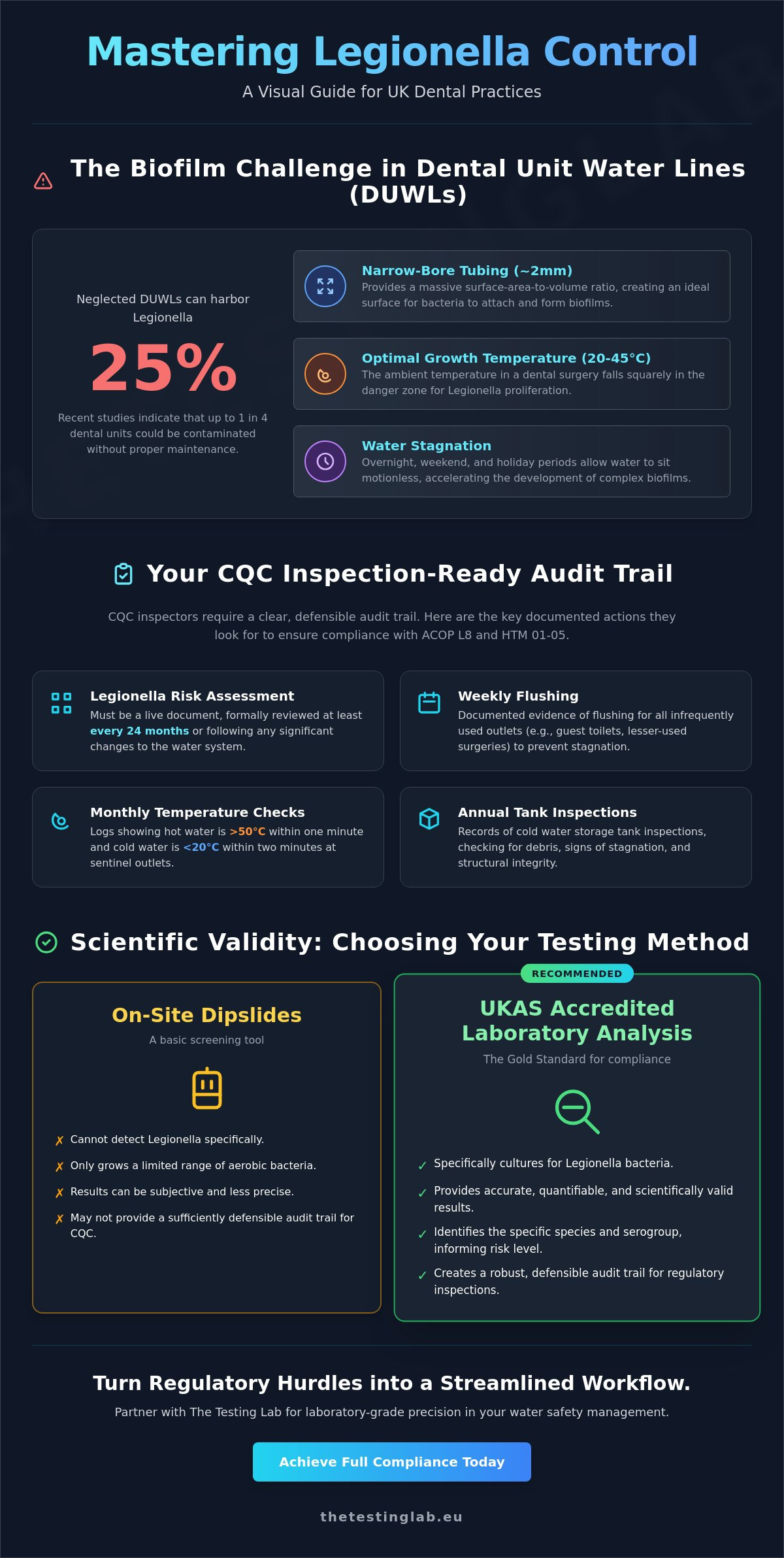
Did you know that recent studies indicate Legionella bacteria can be found in as many as 25% of dental unit water lines (DUWLs) when regular maintenance is neglected? For many practice managers, the complexity of HTM 01-05 and ACOP L8 regulations feels like a constant weight, especially with the looming pressure of a CQC inspection. It’s a common frustration to feel that water safety is a paperwork exercise rather than a precise scientific process. We understand that your primary focus is patient care, not deciphering technical manuals. This UK wide guide will help you master legionella testing for dental practices UK, providing you with the exact steps needed to achieve full regulatory compliance and a safe environment for everyone in your surgery. We’ll walk you through the 2026 standards for risk management, the role of a competent person, and how to build a clear, defensible audit trail that satisfies any inspector. By treating water safety with laboratory precision, you can turn a regulatory hurdle into a streamlined part of your professional workflow.
Key Takeaways
- Align your practice with the latest 2026 standards of HTM 01-05 and ACOP L8 to ensure a seamless, compliant CQC inspection process.
- Discover why the narrow-bore design of DUWLs creates a unique biofilm challenge and how to effectively disrupt these bacterial breeding grounds.
- Compare the scientific validity of UKAS accredited laboratory analysis against standard dipslides to ensure professional legionella testing for dental practices UK provides a defensible audit trail.
- Implement a clear, 5-step roadmap for Legionella risk management that removes the burden of compliance from your clinical staff.
- Learn how a strategic partnership for UK wide water management can transform your safety protocols into a transparent, laboratory-standard process.
CQC Compliance and the 2026 Regulatory Landscape for UK Wide Dentists
Compliance isn’t a static checkbox. For UK wide dental practices in 2026, the regulatory framework remains anchored in the Health and Safety at Work Act 1974 and the HSE’s Approved Code of Practice L8 (ACOP L8). These laws demand that practice owners manage the risk of exposure to Legionnaires’ disease with scientific rigour. The Care Quality Commission (CQC) views water safety as a critical indicator of a well-led practice. If you can’t demonstrate a clear, defensible audit trail for legionella testing for dental practices UK, you’re not just failing a technicality; you’re failing a fundamental safety obligation. Registered Managers must realize that ACOP L8 has a special legal status. If you’re prosecuted for a breach and it’s proved you didn’t follow the code, you’ll need to show you complied with the law in some other way.
A central requirement is the appointment of a “competent person.” This individual must have the necessary skills, knowledge, and experience to manage the practice’s water systems effectively. In many surgeries, this role is supported by a strategic partner like The Testing Lab PLC, ensuring that professional Legionella risk assessments are conducted with laboratory-grade precision. We take the burden of quality assurance off your shoulders, allowing you to focus on clinical excellence. Our engineering-led approach ensures that your water management protocols are both robust and easy to implement.
Understanding HTM 01-05 and HTM 04-01 Synergy
CQC Inspection Focus: What Inspectors Look For
- Evidence of weekly flushing for infrequently used outlets.
- Documented monthly temperature checks where cold water is below 20°C and hot water is above 50°C.
- Annual inspections of cold water storage tanks to check for debris or signs of stagnation.
- A clear log of any remedial actions taken when bacterial counts exceed safe limits.
The Science of Biofilms and Aerosol Risks in Dental Unit Water Lines (DUWLs)
Dental unit water lines (DUWLs) are engineered in a way that inadvertently creates a perfect incubator for Legionella. The narrow-bore plastic tubing, often measuring just 2mm in diameter, provides a massive surface-area-to-volume ratio. This physical structure encourages bacteria to adhere to the walls. Many of these tubes contain plasticisers, which are chemicals used to keep the lines flexible. Unfortunately, these plasticisers can act as a primary carbon source, essentially feeding the microbial colonies. When you combine this with the warm environment of a dental surgery, where temperatures often sit within the 20 to 45°C danger zone, bacterial growth becomes inevitable without rigorous intervention.
Stagnation is the final ingredient in this biological recipe. During overnight downtime or surgery weekends, the water in these lines sits motionless. In just 48 hours, a thin layer of pioneer bacteria can evolve into a complex, multi-species biofilm. This is why professional legionella testing for dental practices UK is a scientific necessity. It moves beyond visual checks and provides the empirical data required to prove your disinfection protocols are actually working. Without laboratory verification, you’re essentially operating on guesswork.
Biofilm Formation: The Invisible Threat
Biofilms are sophisticated biological shields, not just simple slime layers. Within a DUWL, Legionella bacteria often seek refuge inside single-celled organisms like amoebae. This relationship protects them from standard chlorine-based disinfectants and thermal shocks. The HSE Approved Code of Practice (ACOP L8) emphasises that once a biofilm is established, simple flushing is rarely enough to dislodge it. For immunocompromised patients, even a small fragment of dislodged biofilm can contain enough pathogens to cause a serious respiratory infection. Maintaining a laboratory-standard testing regime is the only way to ensure these invisible threats are managed across your UK wide practice network.
Aerosol Transmission During Common Procedures
The primary danger in a dental setting is the creation of contaminated aerosols. High-speed drills, ultrasonic scalers, and air-water syringes are designed to atomise water into a fine mist for cooling and cleaning. These tiny droplets can stay suspended in the surgery air for several hours, travelling up to six feet from the patient’s mouth. The ‘aerosol effect’ in dentistry refers to the suspension of contaminated water particles in the air, creating a direct inhalation pathway for Legionella bacteria into the deep lung tissues of patients and staff. Because these procedures are so frequent, the cumulative risk of exposure is significant. If you’re concerned about your current water quality, we recommend a professional consultation to evaluate your DUWL safety protocols.
Accredited Laboratory Testing vs. On-site Monitoring: Choosing the Right Path
Choosing between on-site monitoring and accredited laboratory analysis is a decision that directly impacts your surgery’s legal standing. While dipslides provide a quick, visual indication of gross contamination, they lack the sensitivity required for a truly defensible audit trail. Professional legionella testing for dental practices UK relies on UKAS accredited methods to detect specific pathogens at much lower concentrations. This precision is vital because a “clear” dipslide doesn’t always mean your water is safe; it simply means the bacterial load hasn’t reached the kit’s detection threshold. In a high-risk aerosol environment, relying on low-sensitivity tools is a risk you don’t need to take.
Total Viable Count (TVC) results are expressed in Colony Forming Units per millilitre (CFU/ml). In a dental context, Health Technical Memorandum 01-05 sets the target for DUWL water quality at 100 to 200 CFU/ml. If your results exceed these numbers, it indicates that your current disinfection regime is failing to control the biofilms we discussed earlier. A lab report provides the scientific evidence needed to justify remedial actions, such as a system shock treatment. It transforms a subjective observation into an objective, data-driven fact that satisfies both internal quality standards and external inspectors.
The integrity of your data also depends on a rigorous chain of custody. At The Testing Lab PLC, we treat every sample as a critical data point. From the moment the water is collected in a sterile container containing a neutralising agent (to stop the action of disinfectants) to its analysis in our controlled environment, every step is documented. This process ensures that the results you receive are an accurate reflection of your surgery’s water safety. Without this level of precision, your compliance efforts remain vulnerable to challenge during a CQC audit or legal inquiry.
The Benefits of UKAS Accredited Testing
Accuracy is the primary driver for professional analysis. Our UKAS accredited legionella services offer an independent verification of your water quality, removing the conflict of interest that comes with self-testing. It provides peace of mind that your patients are protected by a system that meets the highest scientific standards. The Testing Lab PLC acts as an extension of your clinical team, providing the technical expertise required to interpret complex microbiological data.
When to Test: Frequency and Triggers
Routine testing for DUWLs should be part of your annual compliance calendar, but certain events demand immediate action. If your practice has been closed for more than five days, or if you’ve recently undergone plumbing remodelling, the risk of stagnation and bacterial release increases significantly. Daily temperature monitoring remains your first line of defence, but laboratory-grade legionella testing for dental practices UK is the final verification that ensures your UK wide practice remains within safe parameters. We recommend testing whenever a risk assessment identifies a significant change in the system’s operation or environment.
5-Step Legionella Management Roadmap for Practice Managers
Moving from regulatory theory to clinical practice requires a structured approach that integrates water safety into your daily surgery workflow. For UK wide dental surgeries, the path to compliance isn’t found in a single product but in a consistent, documented process. This roadmap ensures that your practice meets the rigorous 2026 standards established by the HSE and the CQC. By following these steps, you establish a scientifically sound environment that protects your patients from the aerosol risks we’ve previously analysed. Regular legionella testing for dental practices UK serves as the ultimate validation for this entire management framework, proving that your roadmap is effective.
Step 1: The Legionella Risk Assessment
The roadmap begins with a comprehensive Legionella Risk Assessment (LRA). This isn’t just a survey; it’s a deep dive into your surgery’s specific infrastructure. You must identify all water sources, from cold water storage tanks to the complex internal lines of each chair. In 2026, a compliant LRA must include a precise schematic diagram of the entire water system to identify potential dead legs or areas of low flow. You also need to evaluate the susceptibility of your patient population. Surgeries treating a high percentage of elderly or immunocompromised patients require more stringent control measures. This assessment must be reviewed at least every 24 months or whenever you make significant changes to your plumbing.
Step 3: Maintenance and Disinfection Protocols
Step 4: Record Keeping and the Audit Trail
A CQC inspector’s first request is often your ‘Water Safety Logbook.’ Whether you maintain this in a digital or physical format, it must contain a chronological record of all flushing, temperature checks, and disinfectant dosing. It’s essential to store your laboratory certificates from The Testing Lab PLC in an easily accessible manner. You must ensure that your audit trail is robust enough to withstand legal scrutiny in the event of an outbreak. This level of transparency proves that you’ve exercised due diligence. If you’re unsure if your current records meet these standards, you can request a professional compliance review to identify any gaps in your documentation.
The final step is the annual review and microbiological monitoring. While daily checks manage the system, laboratory-grade legionella testing for dental practices UK provides the empirical proof that your protocols are working. We recommend an annual review of your entire management plan to ensure it remains aligned with the latest UK wide health technical memorandums. Keeping your team updated on these procedures ensures that water safety becomes a natural, effortless part of your surgery’s daily excellence.
Professional Water Safety Solutions for UK Wide Dental Practices
Choosing a water safety partner shouldn’t be a gamble. At The Testing Lab PLC, we move beyond the transactional nature of simple bottle-and-test services to provide a comprehensive, engineering-led solution for UK wide practices. We understand that practice managers are already juggling clinical standards, staff management, and patient satisfaction. By positioning ourselves as a strategic partner, we take the technical and administrative burden of legionella testing for dental practices UK off your shoulders. Our approach is rooted in laboratory precision, ensuring that every data point we provide is accurate, transparent, and ready for regulatory scrutiny.
Our UK wide network of competent risk assessors and laboratory facilities ensures that you receive consistent service, regardless of your surgery’s location. We don’t just hand over a report and walk away. We provide the context needed to understand your results. If a sample shows elevated bacterial counts, our experts are on hand to guide you through the necessary remedial actions. This high-level support transforms water management from a source of anxiety into a streamlined, defensible part of your quality assurance programme.
Strategic Partnership vs. Transactional Testing
Transactional testing often leaves you with more questions than answers. You might receive a certificate, but without the professional analysis to back it up, you’re still vulnerable during a CQC audit. Our laboratory-led approach focuses on reducing your administrative load. We track your testing intervals, manage your documentation, and ensure that your written scheme of control remains current. This proactive management means you’re never caught off guard by an expiring risk assessment or a missed temperature log. If you’re ready to upgrade your compliance strategy, you can request a specialist quote to see how our precision-focused services fit your practice.
Ensuring Long-Term Compliance and Safety
The regulatory landscape in 2026 demands more than just occasional checks. It requires a commitment to continuous monitoring and improvement. Our services are designed to stay ahead of future legislative shifts, providing you with a future-proof safety net. Transparent water safety management builds trust with both your staff and your patients. It shows a commitment to the highest standards of environmental health. A robust Legionella risk assessment pillar is the starting point for this long-term security. By integrating these scientific protocols into your daily operations, you create a culture of safety that goes beyond simple compliance. We’re here to ensure that your dental unit water lines and domestic systems remain a source of health, not a hidden risk. Professional legionella testing for dental practices UK is the final, essential piece of your surgery’s safety puzzle.
Mastering Your Water Safety Strategy
Our team provides expert UK wide consultancy and site surveys that are fully compliant with ACOP L8 and HTM 01-05. You can secure your dental practice’s compliance with a UK Wide professional Legionella risk assessment today and benefit from high-precision, UKAS accredited laboratory analysis. Taking control of your water hygiene is a straightforward process when you have the right strategic partner by your side.
Frequently Asked Questions
Is Legionella testing mandatory for UK dental practices?
Yes, legionella testing for dental practices UK is a legal requirement under the Health and Safety at Work Act 1974. The HSE’s ACOP L8 mandates that all employers must identify and assess sources of risk from Legionella bacteria. This assessment must lead to a written scheme for preventing or controlling the risk, which is a core part of your surgery’s legal health and safety obligations.
How often should I test my dental unit water lines (DUWLs)?
Routine microbiological monitoring of DUWLs should typically occur at least once a year to verify that your control measures are effective. However, the specific frequency depends entirely on your risk assessment. If your practice treats particularly vulnerable patients or has experienced previous high bacterial counts, your competent person may recommend quarterly testing to ensure a higher level of safety across your UK wide facilities.
What is the difference between a Legionella risk assessment and a water test?
A risk assessment is a comprehensive survey that identifies potential hazards within your entire water system, while a water test is the laboratory analysis of a specific sample. Think of the assessment as the diagnostic phase that identifies where bacteria might grow. The test is the scientific proof that confirms whether bacteria are actually present, providing the data needed for a defensible audit trail.
Can I perform my own Legionella risk assessment in a dental surgery?
You can only perform the assessment if you have the specific skills, training, and experience to be considered a “competent person” by the HSE. While the law doesn’t strictly forbid self-assessment, most practice managers appoint an external specialist. This ensures the report is objective, professionally produced, and capable of withstanding legal scrutiny or a detailed CQC inspection of your UK wide practice.
What should I do if my water test results show high bacterial counts?
You must immediately execute the remedial actions defined in your written scheme of control. This usually involves a chemical shock treatment of the affected lines using a validated disinfectant followed by a re-test to confirm the bacteria have been eradicated. It’s essential to record the high result, the action taken, and the follow-up result in your water safety logbook to prove you’ve managed the incident correctly.
What is HTM 01-05 and how does it relate to Legionella?
HTM 01-05 is the primary technical guidance for decontamination in UK dental practices. It provides specific protocols for managing the water quality in DUWLs to prevent the growth of biofilms and pathogens. By following this guidance alongside ACOP L8, you ensure that your surgery meets the required standards for water hygiene and patient safety, which is a major focus for regulatory bodies.
Does the CQC check for Legionella records during inspections?
The CQC routinely checks water safety records to assess if a practice is safe and well-led. Inspectors expect to see a current risk assessment, evidence of staff training, and a consistent log of temperature checks and flushing. Providing UKAS accredited laboratory results for legionella testing for dental practices UK is often the most efficient way to demonstrate that your surgery is operating within safe, scientific parameters.
What is a ‘competent person’ in the context of water safety?
A competent person is defined by the HSE as someone with the necessary skills, knowledge, and experience to manage Legionella risks. This individual is responsible for the day-to-day oversight of the written scheme of control. Many dental practices appoint an external strategic partner to fulfill this role, ensuring that their UK wide water management is handled with laboratory-level precision and expert oversight.

Article by
P J F Thomas
CEO and Founder of TTL plc.
Disclaimer
Items declared are AI generated but do reflect our services. Please get in contact if you have any questions.