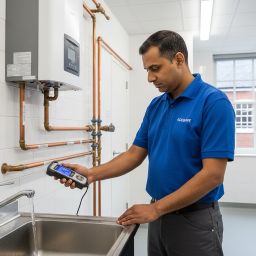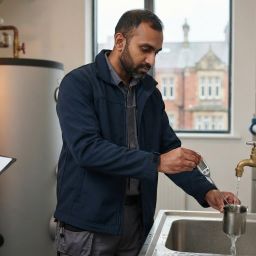
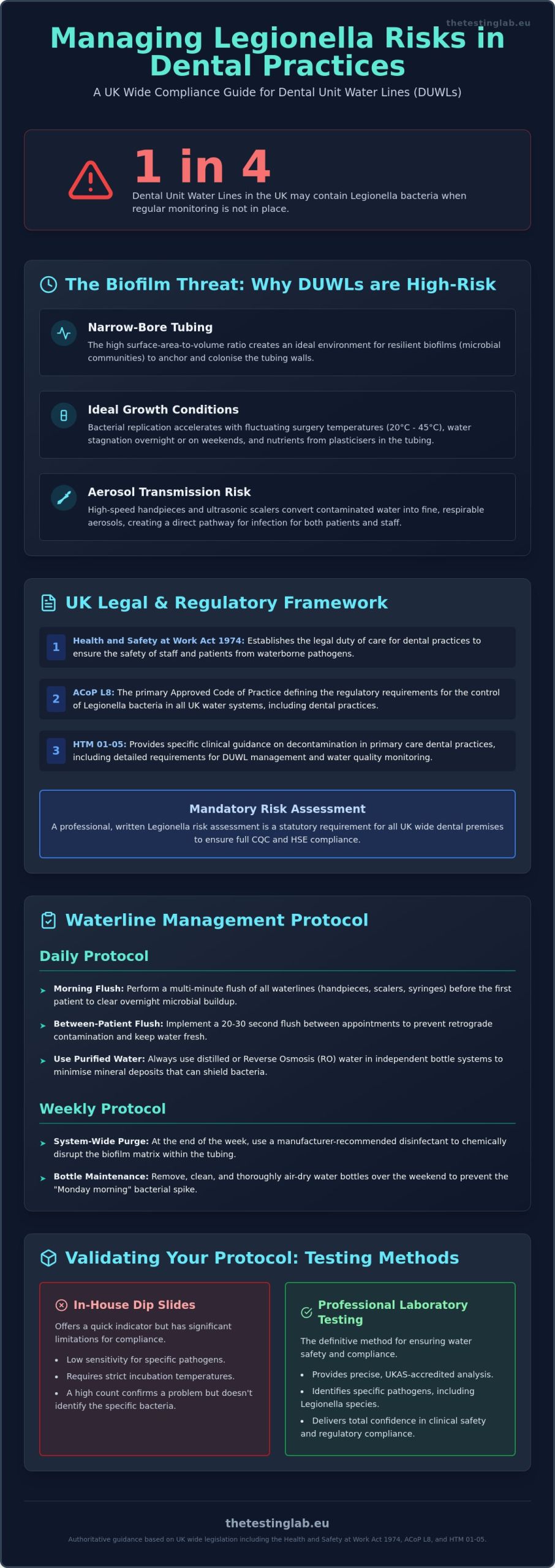
Did you know that research has shown Legionella bacteria can be present in as many as one in four Dental Unit Water Lines (DUWLs) across the UK when regular monitoring isn’t in place? For practice managers and clinical leads, managing legionella risks in dental chairs often feels like a constant battle against invisible biofilms within complex, narrow-bore tubing. We recognize that the pressure of CQC inspections and the inherent risk of aerosol-borne infection for both staff and patients can be a significant source of professional stress.
This guide provides the precise, methodology-driven framework you need to maintain a safe clinical environment. You’ll learn the exact steps required to manage biofilm effectively and ensure your practice remains compliant with HTM 01-05 and ACoP L8 standards UK wide. By following a structured approach to water management and risk assessment, you can move from reactive troubleshooting to proactive operational excellence. We will preview the essential maintenance schedules and technical requirements that take the weight of regulatory responsibility off your shoulders, ensuring your facility is protected in 2026 and beyond.
Key Takeaways
- Identify how the high surface-area-to-volume ratio in narrow-bore DUWL tubing creates an ideal environment for rapid biofilm and bacterial colonisation.
- Implement a methodological approach to managing legionella risks in dental chairs using validated daily flushing protocols and between-patient decontamination steps.
- Understand your legal obligations for maintaining a professional, written Legionella risk assessment across all UK wide dental premises to ensure full CQC and HSE compliance.
- Learn the critical role of the “Competent Person” in identifying system-wide vulnerabilities beyond the chair, including calorifiers and cold water storage tanks.
- Establish a robust maintenance schedule that ensures a safe environment for vulnerable patients while reducing the risk of aerosol-borne infections.
Understanding the Biofilm Threat in Dental Unit Waterlines (DUWLs)
DUWLs are complex hydraulic environments. Their narrow-bore plastic tubing provides an exceptionally high surface-area-to-volume ratio, which encourages the formation of resilient biofilms. These biofilms are sophisticated microbial communities that anchor themselves to the tubing walls. The plasticisers used in the manufacturing of the lines often provide the carbon source needed for bacteria to thrive. When surgery temperatures fluctuate between 20°C and 45°C, bacterial replication accelerates, turning a minor contamination into a systemic risk.
Effectively managing legionella risks in dental chairs requires an understanding of how stagnation influences water safety. During weekends or overnight closures, the lack of throughput allows bacteria to multiply undisturbed. This becomes critical when high-speed handpieces or ultrasonic scalers are activated, as they convert contaminated water into fine, respirable aerosols. Understanding Legionnaires’ Disease and its transmission via these aerosols is the primary reason why DUWL maintenance is a non-negotiable aspect of clinical safety.
UK Legislation: HTM 01-05 and ACOP L8
Successfully managing legionella risks in dental chairs is not just a clinical preference; it’s a statutory requirement for every practice UK wide. Under the Health and Safety at Work Act 1974, dental practices have a legal duty of care to ensure the safety of their staff and patients. This legislation requires a thorough Legionella risk assessment to identify and mitigate potential hazards within the water system. HTM 01-05 supplements this by providing specific clinical guidance on DUWL decontamination and water quality monitoring. ACOP L8 serves as the primary Approved Code of Practice, defining the regulatory expectations for the control of Legionella bacteria in all UK water systems.
Step-by-Step Protocol for Daily and Weekly Waterline Management
Moving from regulatory theory to clinical practice requires a methodical daily routine. Practical steps for managing legionella risks in dental chairs start with the physical displacement of stagnant water. Every morning, before the first patient arrives, perform a multi-minute flush of all waterlines, including handpieces, ultrasonic scalers, and air/water syringes. This mechanical action is vital for clearing the microbial buildup that occurs during overnight stagnation. Between patient appointments, implement a shorter 20 to 30 second flush. This prevents retrograde contamination and ensures the water delivered during procedures remains as fresh as possible.
Chemical management is the second pillar of an effective protocol. Flushing alone won’t strip away established, mature biofilms. You must utilize validated biocides or periodic shock treatments to chemically disrupt the biofilm matrix within the tubing. To minimize mineral deposits that can shield bacteria, always use distilled or Reverse Osmosis (RO) water in independent bottle systems. Adhering to these precise steps ensures HSE ACOP L8 Compliance and maintains a safe environment for your clinical team and patients UK wide.
Weekly Maintenance and Disinfection
At the end of each working week, a deeper intervention is necessary. Perform a system-wide purge using manufacturer-recommended disinfectants to ensure no pockets of bacteria remain. It’s essential to remove, clean, and air-dry water bottles over the weekend to prevent the “Monday morning” bacterial spike. For practice managers seeking to validate these internal processes, professional Legionella risk assessments for UK practices provide the necessary independent oversight to confirm your protocols are working effectively.
Dip Slides vs. Laboratory Testing
While in-house dip slides offer a quick snapshot, they have significant limitations. They often lack the sensitivity required to detect specific pathogens and require strict incubation temperatures that are hard to maintain in a busy surgery. If a dip slide shows a high Total Viable Count (TVC), it indicates that your biofilm control has been compromised. In these instances, professional laboratory testing is the only way to get a precise, UKAS-accredited analysis of the water quality. For total confidence in your clinical safety, you should partner with an accredited lab to handle your complex sampling requirements.
Professional Risk Assessments and UKAS-Accredited Laboratory Testing
A professional Legionella risk assessment is a statutory requirement for all UK wide dental premises. While daily flushing manages the local environment, a comprehensive assessment identifies systemic vulnerabilities that a standard cleaning routine might miss. This process is led by a “Competent Person” who evaluates risks beyond the dental unit, such as cold water storage tanks, dead legs in the pipework, and calorifiers. These components often act as the primary reservoir for bacterial colonisation before it ever reaches the handpiece. Establishing a robust “Water Management Scheme” is essential, and you must maintain all monitoring logs and inspection results for a minimum of five years to satisfy HSE and CQC auditors.
When managing legionella risks in dental chairs, the legal weight of your documentation depends on the quality of your evidence. Relying on generic testing kits doesn’t provide the same level of protection as a UKAS-accredited certificate. In the event of a CQC inspection or a health-related inquiry, a UKAS-accredited laboratory report serves as the gold standard for legal defensibility. It proves that your samples were handled and analysed with scientific precision. This level of oversight is a core component of Dental Practice Premises Safety, ensuring that clinical standards are met across the entire facility.
The Value of UKAS Accreditation in Water Testing
UKAS accreditation ensures that every stage of the testing process, from sample collection to microbiological analysis, meets rigorous international standards. UKAS-accredited labs follow standardized ISO methods for Legionella detection, providing the highest degree of sensitivity and specificity. This methodological accuracy is what allows practice managers to make informed decisions about their water safety protocols with absolute confidence. This same attention to detail is essential in clinical settings; for instance, when exploring high-end aesthetic results in a safe environment, you can check out Khan Dental.
Action Plans for Positive Results
If Legionella pneumophila is detected in your chair system, you must act immediately. Isolate the affected unit and implement a high-level disinfection protocol using validated chlorine-based agents or specialized biocides. Following treatment, re-testing through an accredited laboratory is mandatory. You can’t resume patient treatment until a “clearance” certificate is issued, confirming that bacterial counts have returned to safe levels. For practices requiring technical support, our team at The Testing Lab PLC provides the precision and expertise to navigate these critical compliance events via accredited surveying and testing.
Securing Clinical Excellence and Regulatory Compliance
Our expert consultants provide the technical precision needed to maintain total compliance. We offer comprehensive support through our UKAS Accredited Laboratory, delivering detailed microbiological water analysis reports that provide essential legal defensibility. Don’t leave your practice’s safety to chance or rely on the limited sensitivity of in-house testing. You can request a UK-wide Legionella risk assessment for your dental practice today to secure your facility’s operational future. For further guidance, view our specialist compliance resources. We’re ready to act as your strategic partner, ensuring your water systems remain safe and compliant for every patient.
Frequently Asked Questions
How often should dental waterlines be tested for Legionella in the UK?
HTM 01-05 requires an annual water sample to be taken from the water heater drain as a minimum standard. However, your Legionella risk assessment must be reviewed at least every 12 months to ensure continued safety. Many practices opt for more frequent Total Viable Count (TVC) testing, often quarterly, to validate that their biofilm control protocols are working effectively across all units.
What is the difference between HTM 01-05 and ACOP L8 for dentists?
HTM 01-05 is specific clinical guidance focused on decontamination in primary care dental practices, including DUWL maintenance. ACOP L8 is the overarching Approved Code of Practice that sets the legal standard for Legionella control in all UK water systems. To ensure full compliance UK wide, practice managers must adhere to both the clinical specifics of the HTM and the legal framework of ACOP L8.
Can I use tap water in my dental chair independent bottle system?
You shouldn’t use tap water in independent bottle systems because its mineral content and baseline microbial levels promote rapid biofilm formation. Distilled or Reverse Osmosis (RO) water is the professional standard for managing legionella risks in dental chairs. Using purified water reduces the nutrients available for bacterial growth and protects the narrow-bore tubing from scale buildup that can shield Legionella bacteria.
Who is considered a “competent person” for dental Legionella risk assessments?
A competent person is an individual with the specific technical knowledge, training, and experience to identify water system risks. While the practice owner is the “duty holder” with ultimate legal responsibility, they usually appoint a specialist consultant to perform the assessment. This ensures that the audit is independent, thorough, and meets the high standards required for legal defensibility during a CQC inspection.
What should I do if my dental chair dip slide shows a high bacterial count?
If a dip slide indicates a high Total Viable Count (TVC), you must immediately isolate the chair and perform a system-wide chemical shock treatment. Following disinfection, it’s vital to have a sample analysed by a UKAS-accredited laboratory to confirm the system is safe. Don’t resume patient treatment until you have a clear result, as this is a critical step in managing legionella risks in dental chairs.
Is a Legionella risk assessment a legal requirement for small dental practices?
Yes, a “suitable and sufficient” written Legionella risk assessment is a mandatory legal requirement for all dental premises UK wide, regardless of their size. The Health and Safety Executive (HSE) and the CQC require every practice to maintain a written scheme of control. For smaller practices, our specialist risk assessment services provide a cost-effective way to ensure you meet these statutory obligations without the burden of internal technical management.

Article by
P J F Thomas
CEO and Founder of TTL plc.
Disclaimer
Items declared are AI generated but do reflect our services. Please get in contact if you have any questions.