In March 2026, an unusual outbreak in London underscored a sobering reality: even with modern systems, the legionella risk in cooling towers remains a critical public health and legal liability. With UK courts now issuing unlimited fines for health and safety breaches, such as the £900,000 penalty handed down in 2024, the margin for error in water safety has effectively vanished. You likely understand that managing these complex evaporative systems isn’t just a routine maintenance task. It’s a high-stakes engineering challenge that requires navigating the technicalities of ACOP L8 while under the constant shadow of HSE intervention.
We recognize that the pressure to manage biofilm, scale, and legislative updates across UK-wide sites can feel overwhelming. This guide serves as your authoritative roadmap to mastering these complexities, ensuring you move from reactive troubleshooting to a state of total legal compliance. We’ll break down the 2024 updates to HSG274 Part 1 and provide a clear, methodical framework for mitigating risk. By the end of this article, you’ll have the professional clarity needed to maintain a safe operating environment and protect your organization from the severe consequences of non-compliance.
Key Takeaways
- Identify the specific engineering factors that transform cooling towers into high-risk bioreactors and how aerosolization facilitates the spread of bacteria over large distances.
- Navigate the legal landscape of UK legislation, including the essential responsibilities of a Duty Holder under ACOP L8 and the Health and Safety at Work Act.
- Implement a strategic water treatment programme designed to actively manage the legionella risk in cooling towers through precise chemical dosing and microbial monitoring.
- Recognise the critical role of UKAS-accredited laboratory analysis in providing the data-driven evidence required for full safety compliance.
- Develop a clear roadmap for achieving consistent, UK-wide operational safety that satisfies HSE requirements and protects your personnel from exposure risks.
Why Cooling Towers Present a High Legionella Risk
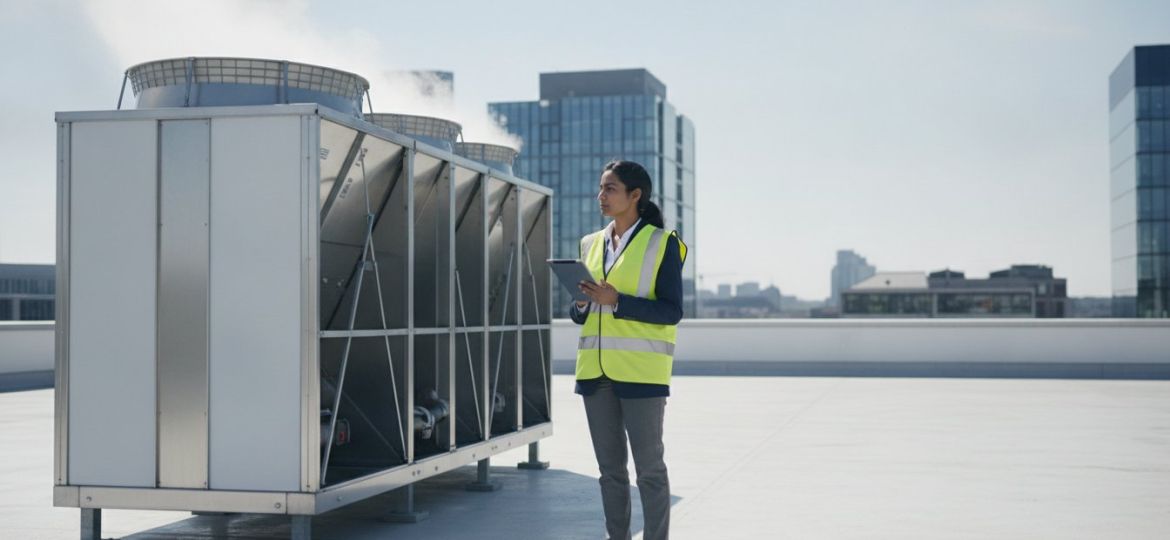
A Cooling tower operates by maximising the contact area between water and air to facilitate heat exchange through evaporation. While this is an efficient engineering solution for heat rejection, it inadvertently creates an ideal habitat for microbial growth. The combination of warm water, high oxygen levels, and incoming organic nutrients transforms these systems into industrial-scale bioreactors. Because of this inherent design, the legionella risk in cooling towers is significantly higher than in almost any other building water system.
The Biology of Proliferation in Water Systems
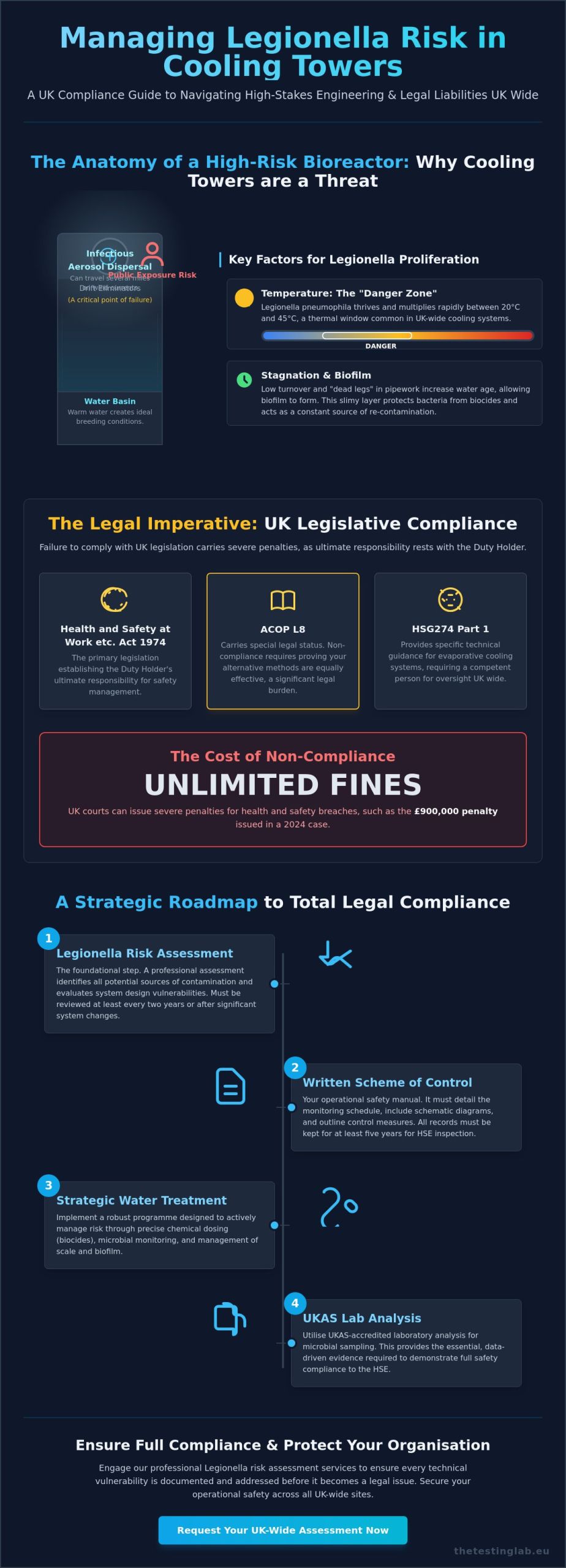
Bacterial colonisation depends on specific environmental variables that are often present in industrial loops. The primary driver is temperature. The 20°C to 45°C range represents a critical “danger zone” where Legionella pneumophila thrives and multiplies rapidly. In many UK-wide facilities, cooling water naturally settles within this thermal window. Stagnation also plays a vital role. When water age increases due to low turnover or “dead legs” in the pipework, chemical biocides lose their efficacy. This allows for the development of biofilm, a complex slimy layer that protects bacteria from disinfectants and provides a constant source of re-contamination.
Maintaining the integrity of your plumbing and drainage systems is essential to prevent these physical hazards; for professional assistance with site-wide facility management, learn more about CH Enviro.
Mechanisms of Exposure: From Tower to Atmosphere
The danger of a cooling tower isn’t just the presence of bacteria, but the method of dispersal. These systems generate a fine mist or aerosol as part of the cooling process. If the water is contaminated, these microscopic droplets carry the bacteria into the atmosphere. Wind currents can transport these infectious aerosols several miles from the source, potentially exposing the public far beyond the site boundary. This wide-reaching exposure path is why the HSE classifies these systems as high-risk under UK health and safety guidelines.
Engineering controls like drift eliminators are designed to capture these droplets before they exit the stack. However, their performance is not guaranteed. Scale buildup, corrosion, and physical damage can easily compromise their efficiency. When maintenance is neglected, the volume of aerosol release increases, and the risk to the surrounding community escalates. To manage these technical vulnerabilities, we offer specialist Legionella risk assessments to ensure your mechanical controls are operating at peak efficiency.
UK Legislative Compliance: ACOP L8 and HSG274 Requirements
Compliance isn’t just about following rules; it’s about managing legal liability and operational safety. The primary legislation is the Health and Safety at Work etc. Act 1974. The Duty Holder carries the ultimate responsibility for identifying and controlling the legionella risk in cooling towers. The HSE’s ACOP L8 provides the essential framework for this management. It has special legal status. If you’re prosecuted for a breach and didn’t follow the code, you’ll need to prove you complied in another way that is equally effective.
For technical specifics, you must refer to HSG274 Part 1. This guidance was updated in 2024 to refine how we manage evaporative systems. A core requirement is the appointment of a “competent person.” This individual must have the technical knowledge and authority to ensure the water management programme is executed correctly UK wide. Without this oversight, the risk of technical failure and subsequent legal prosecution increases significantly.
The Legionella Risk Assessment Process
A risk assessment is the foundational step. It identifies potential sources of contamination and evaluates how the system’s design or operation might encourage bacterial growth. This isn’t a static document. You must review it at least every two years, or sooner if there’s a significant change to the system. This includes changes in water treatment or plant upgrades. Engaging Professional Legionella risk assessment services ensures that every technical vulnerability is documented and addressed before it becomes a legal issue.
Maintaining a Written Scheme of Control
The written scheme is your operational manual for safety. It must include up to date schematic diagrams of the cooling circuit and a detailed monitoring schedule. This includes biocide levels, water temperatures, and microbial sampling results. Record keeping is vital. You need to keep these documents for at least five years to demonstrate compliance during HSE inspections. If you need help structuring these protocols, reviewing our water management services can help streamline your documentation process.
Implementing a Professional Monitoring and Testing Strategy
Transitioning from a risk assessment to active management requires a precise engineering approach to water chemistry. A robust treatment programme isn’t just about biocide dosing; it’s a careful balance of biocides, corrosion inhibitors, and dispersants. Biocides target the bacteria directly, while inhibitors and dispersants prevent the scale and biofilm that shield Legionella from chemical attack. This integrated regime is your primary defense against the legionella risk in cooling towers. Because these systems are dynamic, quarterly sampling is a non-negotiable requirement for all sites UK wide to verify that these controls are actually working.
Technical compliance rests on the data-driven protocols found in HSG274 Part 1. This guidance establishes clear action levels based on bacterial concentrations. For instance, counts exceeding 1,000 CFU/litre necessitate an immediate review of the treatment programme. If counts reach 10,000 CFU/litre, the system requires emergency disinfection and a full investigation into the failure of control measures. Rapid response to these “positive” hits is what prevents a localized issue from becoming a public health crisis.
Microbiological Water Testing and Analysis
Sampling techniques must be rigorous to be valid. You can’t rely on water taken from stagnant points; samples must be representative of the water circulating through the heat exchange process. Interpreting the resulting lab reports involves more than just looking at a “pass” or “fail.” You need to understand the specific Colony Forming Units (CFU) per litre to track trends in system health. If your data shows a steady upward climb, your chemical balance is likely failing. To ensure your data is interpreted with technical precision, you can book a specialist water management consultation with our expert team.
The Value of Independent Accredited Testing
Many operators rely on basic dip slides for weekly monitoring. While these are useful for a general snapshot of aerobic activity, they don’t provide the legal or technical depth required for Legionella detection. Only independent UKAS accredited testing provides the defensible evidence needed during an HSE inspection. By using an accredited laboratory, you ensure that the testing methodology meets the highest international standards. This professional rigor removes the burden of technical proof from your shoulders and places your compliance on a firm, scientific foundation.
Securing Your Cooling Tower Operations
Effectively managing the legionella risk in cooling towers is a continuous commitment to technical excellence and legal diligence. We’ve explored how the mechanical design of these systems necessitates a rigorous water treatment regime and why the 2024 updates to HSG274 Part 1 set a higher bar for monitoring. Relying on basic checks isn’t enough when the HSE demands a comprehensive written scheme of control and clear evidence of competence. It’s about moving from reactive maintenance to a systematic, data-driven safety protocol that protects both your personnel and your organization’s reputation.
For those looking to go a step further and develop custom industrial hardware or safety-oriented products, you might check out Keiteq Co Ltd, a firm specializing in end-to-end manufacturing and product design.
Our team of expert consultants operates UK wide, providing the technical oversight needed to maintain full compliance with ACOP L8. By integrating UKAS accredited laboratory analysis into your strategy, you gain the precise data required to make informed decisions about your water chemistry. We act as your strategic partner, taking the burden of professional responsibility off your shoulders through methodical precision and scientific rigor. Whether you require a Legionella risk assessment in London or a comprehensive audit of your national portfolio, we ensure every detail meets the highest standards.
Secure your UK-wide compliance with a professional Legionella risk assessment. Taking these proactive steps today ensures your systems remain safe, efficient, and fully aligned with the latest UK safety legislation.
Frequently Asked Questions
What is the legal requirement for Legionella testing in cooling towers?
Under HSG274 Part 1, the legal requirement for Legionella testing in cooling towers is quarterly as a minimum. These samples must be analysed by a UKAS accredited laboratory to ensure technical validity. If your system has a history of instability or high microbial activity, your written scheme of control should increase this frequency to manage the legionella risk in cooling towers effectively across your UK wide sites. Regular monitoring is the only way to verify your chemical treatment is working.
How often should a cooling tower be cleaned and disinfected?
Cooling towers must be cleaned and disinfected at least every six months. This bi-annual requirement is mandated by HSG274 Part 1 to prevent the buildup of scale, sludge, and biofilm. You should also perform disinfection after any major mechanical work, before initial commissioning, or if the system has been offline for more than seven days. Regular cleaning ensures that chemical biocides can reach the metal surfaces and maintain operational efficiency.
What are the specific action levels for Legionella counts in cooling water?
Specific action levels are defined by the concentration of Colony Forming Units (CFU) per litre. Counts below 100 CFU/l are considered under control. If counts reach 100 to 1,000 CFU/l, you must review your water treatment programme and retest. Any result exceeding 1,000 CFU/l requires immediate remedial action to mitigate the legionella risk in cooling towers. This typically involves system disinfection and a thorough investigation into why your control measures failed.
Can I carry out a Legionella risk assessment myself?
You can only conduct a risk assessment if you’re a competent person with the necessary technical training and experience. Given the high-risk nature of evaporative cooling, most Duty Holders appoint specialist consultants to ensure full compliance with ACOP L8. A professional assessment provides the engineering depth needed to identify subtle system vulnerabilities. You can access our specialist water management services to ensure your assessment meets these rigorous legal standards UK wide.
What happens if an HSE inspector finds Legionella in my cooling tower?
If an inspector finds evidence of poor management or high bacterial counts, they can issue an Improvement Notice or a Prohibition Notice. These legal documents force you to fix issues within a set timeframe or stop operations entirely. In cases of significant negligence, the HSE may pursue criminal prosecution. Courts now issue unlimited fines for health and safety breaches, which can reach hundreds of thousands of pounds for UK wide commercial operators.
Why are cooling towers more dangerous than domestic water systems for Legionella?
Cooling towers are more dangerous because they actively generate and disperse fine water droplets, known as aerosols, into the atmosphere. While domestic systems usually only affect people at the point of use, a contaminated cooling tower can spread bacteria over several miles. The internal environment of a tower, characterized by heat and organic nutrients, also acts as a high-efficiency bioreactor. This allows Legionella to multiply much faster than in standard plumbing systems.

Article by
P J F Thomas
CEO and Founder of TTL plc.
Disclaimer
Items declared are AI generated but do reflect our services. Please get in contact if you have any questions.