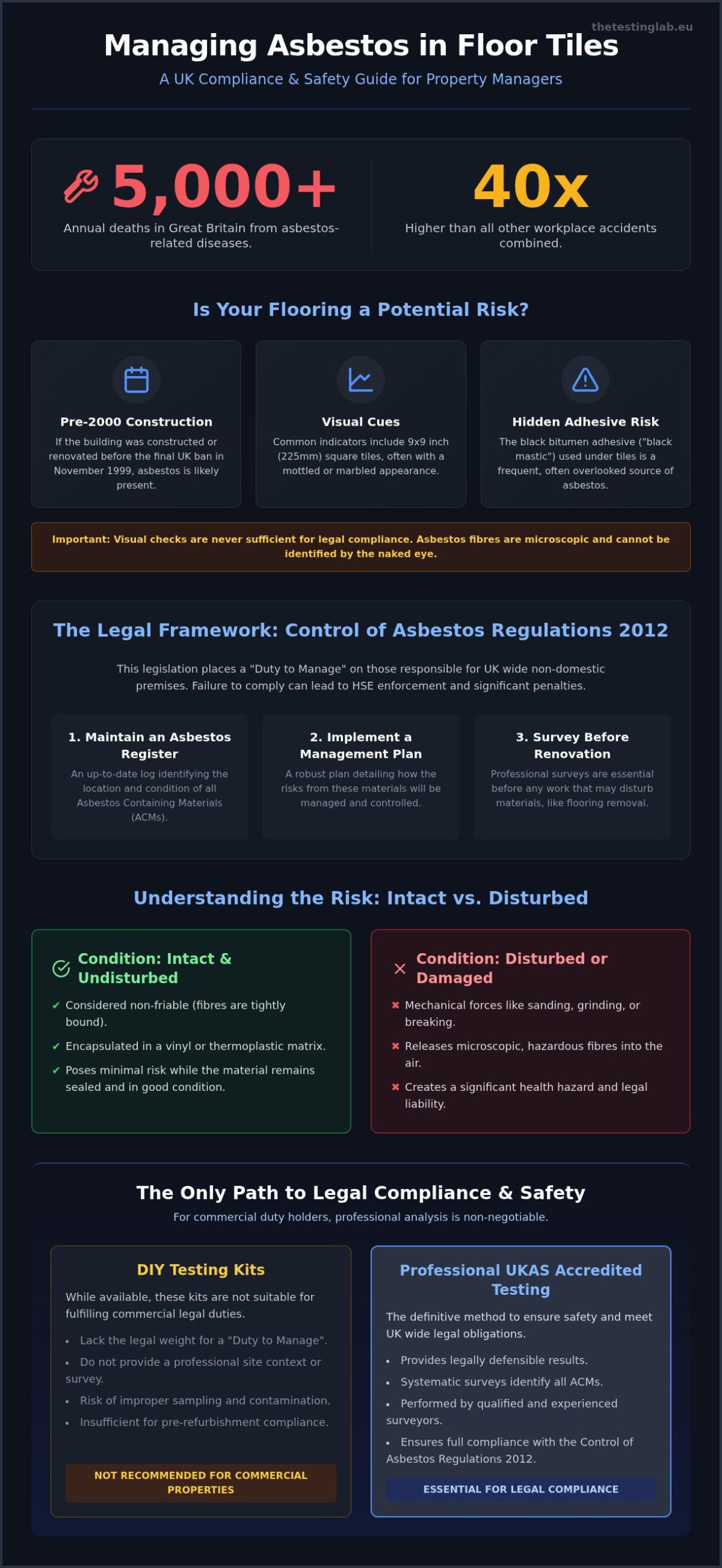
Over 5,000 people in Great Britain lose their lives to asbestos-related diseases every year, a figure that remains forty times higher than all other workplace accidents combined. It’s understandable why property managers feel a sense of dread when uncovering old vinyl during a renovation. You likely suspect that the brittle material beneath your feet contains asbestos in floor tiles, but the confusion surrounding the Control of Asbestos Regulations 2012 and the reliability of cheap DIY kits often leads to professional paralysis.
This guide provides a clear, methodology-driven framework to help you identify risk materials and maintain legal compliance. We’ll examine the specific requirements for managing these materials UK wide and explain why UKAS-accredited analysis is the only way to truly mitigate your liability. By understanding the nuances of specialist asbestos surveying, you can ensure your project remains safe and compliant with the latest 2026 HSE standards.
Key Takeaways
- Identify historical risk markers, such as 9×9 inch marbled tiles and bitumen adhesives common in UK buildings constructed before 1999.
- Navigate the legal requirements of the Control of Asbestos Regulations 2012 to fulfill your “Duty to Manage” asbestos in floor tiles.
- Learn why professional UK wide surveys are essential before any mechanical removal or renovation to prevent the release of hazardous fibres.
- Understand the strategic importance of UKAS-accredited laboratory testing for achieving definitive legal compliance and operational safety.
Identifying Asbestos in Floor Tiles: Historical Context and Signs
The History of asbestos use in the UK construction industry spans decades, as manufacturers favoured the mineral for its durability and fire resistance. Until the final ban in November 1999, asbestos in floor tiles was a standard specification across residential and commercial developments. If your building was constructed or renovated before 2000, there’s a strong probability that these materials remain in situ. For professional site inspections, see our asbestos surveying services.
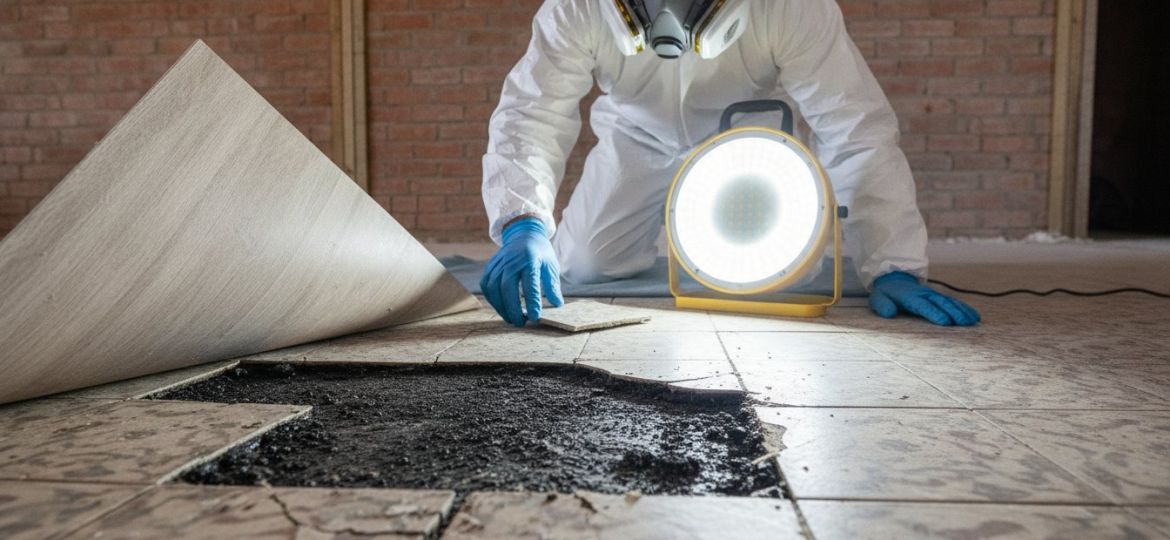
Identification often begins with physical dimensions. The most common indicators are 9×9 inch (225mm) square tiles, which frequently feature a distinct mottled or marbled aesthetic. It’s vital to recognize that both the thermoplastic tile and the black bitumen adhesive beneath it can contain Chrysotile, also known as white asbestos.
Common Materials and “Hidden” Risks
Vinyl-asbestos tiles (VAT) and thermoplastic variants are generally classified as non-friable. This means the fibres are tightly bound within a matrix, posing minimal risk while the material stays intact. However, they become hazardous when mechanical force is applied. Breaking, sanding, or power-grinding these tiles during a refurbishment releases microscopic fibres into the air.
Bitumen Adhesive and Testing
The bitumen adhesive, often called “black mastic,” is a frequently overlooked source of contamination. Even if the tiles themselves are replaced, this underlying layer often remains, hiding a significant asbestos risk. Visual checks are never sufficient for compliance. Because you can’t identify fibres with the naked eye, professional laboratory analysis is the only definitive method to confirm safety and meet your UK wide legal obligations.
UK Health Risks and Compliance: Control of Asbestos Regulations 2012
The legal landscape for property owners is defined by the Control of Asbestos Regulations 2012. This legislation places a specific “duty to manage” on those responsible for non-domestic premises. While asbestos in floor tiles is often considered lower risk because the fibres are encapsulated in a vinyl or thermoplastic matrix, this safety is conditional. The moment these materials are disturbed through mechanical grinding, sanding, or aggressive lifting, they release microscopic fibres. With over 5,000 asbestos-related deaths recorded annually in Great Britain, the HSE maintains strict oversight on how these materials are handled.
For more technical details on laboratory standards, read our guide on UKAS Accredited Asbestos Testing: The Complete Guide to Compliance & Safety (2026).
The Duty to Manage for UK Businesses
Legal compliance isn’t optional for any commercial building constructed before the year 2000. Duty holders must maintain an up-to-date asbestos register and a robust management plan. This documentation identifies the location and condition of all ACMs, including flooring and adhesives. If you fail to identify asbestos before a refurbishment project, you risk immediate HSE enforcement actions and significant financial penalties.
Professional asbestos consultancy is essential for assessing material degradation and determining the appropriate risk category. Our team operates UK wide to help businesses transition from operational uncertainty to full regulatory alignment. If you’re planning work on a pre-2000 property, securing a professional survey ensures you meet your legal obligations while protecting your workforce from long-term health risks.
Professional UKAS Accredited Testing and Management
Compliance with the Control of Asbestos Regulations 2012 requires more than a visual guess or a retail DIY kit. While DIY options might appeal to residential homeowners, they lack the professional site context and legal weight required for commercial duty holders. Professional UK wide testing provides a systematic survey to identify the full extent of asbestos-containing materials (ACMs) within a structure. At The Testing Lab PLC, we prioritise independent analysis. This approach ensures there’s no conflict of interest between identifying asbestos in floor tiles and the subsequent removal process. By operating purely as a consultancy and laboratory, our results remain objective and scientifically sound.
To begin your compliance journey, you can request a professional asbestos testing quote through our technical team.
The Accredited Analysis Process
Our methodology follows a rigorous three-stage framework to ensure precision and safety:
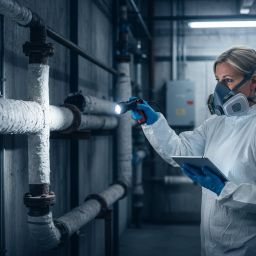
- Site Survey: A P402 qualified surveyor conducts a thorough inspection to identify all suspect flooring, including the tiles and the underlying bitumen adhesives.
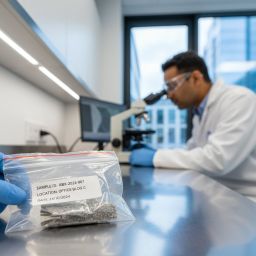
- Bulk Identification: Samples are analysed in our UKAS-accredited laboratory using Polarised Light Microscopy (PLM) to confirm the presence and type of asbestos fibres.
- Technical Reporting: We provide a detailed report outlining the material’s condition and the recommended management actions.
This systematic process removes the burden of legal responsibility from your shoulders. For projects requiring specific regional expertise, our specialist surveying teams provide the necessary technical oversight to maintain safety standards across your property portfolio. We treat every sample with the same precision, ensuring your management plan is built on verified data rather than assumptions.
Securing Your Property with Professional Compliance
Managing asbestos in floor tiles requires a transition from reactive concern to proactive methodology. Identifying historical markers and understanding the “Duty to Manage” under the Control of Asbestos Regulations 2012 are the first steps toward operational safety. Visual identification alone is insufficient for legal validity. By choosing UKAS-accredited laboratory analysis, you remove the professional burden of liability and ensure your refurbishment projects proceed without health risks or HSE intervention. Our specialists provide the technical oversight needed to maintain safety standards across your property portfolio.
Contact The Testing Lab PLC for UK wide UKAS accredited asbestos testing and consultancy. Our independent laboratory provides the precision and national coverage necessary to protect your workforce and your business. We’re ready to help you navigate these technical challenges with confidence.
Frequently Asked Questions
Is it dangerous to have asbestos floor tiles in my home?
Asbestos in floor tiles is generally low risk if the material is in good condition and left undisturbed. The hazardous fibres are encapsulated within a durable matrix, which prevents them from becoming airborne during normal use. However, the risk increases significantly during renovations or if the tiles are broken, sanded, or scraped, potentially releasing microscopic fibres into the air. If you are concerned about the health implications of past exposure and are looking for legal resources, you can check out Weitz & Luxenberg.
While homeowners aren’t legally prohibited from removing floor tiles, the process carries a high risk of contaminating your property. Professional removal is recommended to ensure that fibres aren’t released and that hazardous waste is handled according to UK regulations. For commercial duty holders, professional consultancy is often required to satisfy the “Duty to Manage” and maintain a safe working environment.
How much does it cost to test floor tiles for asbestos?
Professional testing involves per-sample laboratory analysis fees or fixed-fee site survey charges. These costs depend on the number of samples needed and the scope of the inspection. Choosing a UKAS-accredited facility for your analysis ensures that the results are legally valid and scientifically precise. This professional methodology is the only way to definitively manage the risks associated with asbestos in floor tiles.
What should I do if I have already disturbed asbestos floor tiles?
Stop all work immediately and isolate the affected area to prevent the spread of fibres. Don’t attempt to clean the debris with a standard vacuum, as this will further contaminate the air. You should contact a professional consultancy to perform air clearance testing and a thorough risk assessment. This ensures the site is safe and compliant with UK wide health and safety legislation.

Article by
P J F Thomas
CEO and Founder of TTL plc.
Disclaimer
Items declared are AI generated but do reflect our services. Please get in contact if you have any questions.