
Your laboratory analysis certificate isn’t just a collection of data; it’s a critical legal document that serves as your primary defense during an HSE audit. If you don’t know exactly how to read a lab analysis certificate, you’re potentially leaving your UK-wide operations exposed to significant regulatory risk. It’s common to feel frustrated by technical jargon or confused by the difference between mg/kg and fibers/ml. You aren’t alone in wondering if a report is truly valid or just a generic template.
We understand that the weight of professional responsibility can be heavy when interpreting complex safety data. This guide provides the clarity you need to decode technical reports, verify essential UKAS accreditation, and ensure every site meets current UK health and safety legislation. We’ll examine how to spot discrepancies, interpret results against legislative thresholds, and maintain the high standards required for local asbestos and legionella surveying. By the end, you’ll have the methodical framework needed to turn technical confusion into audit-ready confidence.
Key Takeaways
- Validate the laboratory’s UKAS schedule number and ISO 17025 status to ensure your reports meet mandatory UK-wide legal standards.
- Master the technical interpretation of units like mg/kg and fibers/ml to confidently assess if your site exceeds UK health and safety thresholds.
- Understand the critical distinction between “Not Detected” and zero by examining the Limit of Detection (LOD) within your results.
- Learn how to read a lab analysis certificate to spot subtle red flags, such as missing technical signatures or lack of analytical variation, before an HSE audit.
- Secure your site’s legal defense by transforming confusing technical data into transparent, audit-ready documentation.
The Anatomy of a UKAS Accredited Lab Certificate
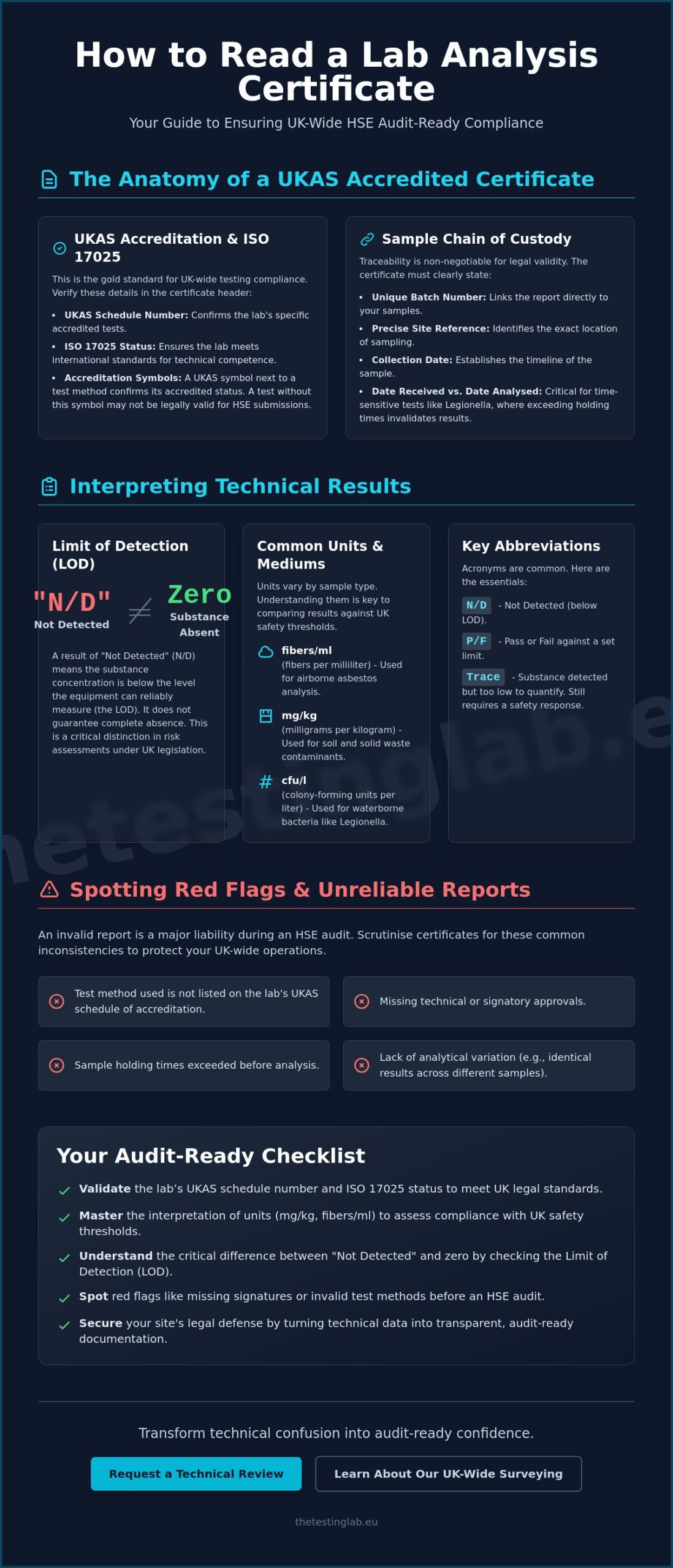
A Certificate of Analysis (COA) is a formal document verifying that a sample meets specific UK legislative or safety standards. It functions as the technical evidence of your compliance efforts. Knowing how to read a lab analysis certificate begins with identifying the laboratory’s UKAS schedule number and ISO 17025 status in the header. These elements confirm that the facility operates under rigorous, independent oversight, making the data reliable for UK-wide regulatory submissions.
Accreditation symbols on the report are equally important. These markers distinguish between UKAS-accredited tests and non-accredited “in-house” methods on the same sheet. If a specific test lacks the UKAS symbol, it may not be legally valid for certain HSE requirements or waste classification. You must verify that the specific method used for your sample is included in the lab’s current scope of accreditation.
The Role of UKAS and ISO 17025 in UK Testing
UKAS accreditation is the gold standard for UK-wide environmental testing compliance because it provides an external guarantee of technical proficiency. ISO 17025 is the international standard for testing and calibration laboratories. While a laboratory might be accredited, you must ensure the specific test method used for your project is also covered. This distinction is critical when defending your site’s safety record during an audit or legal inquiry.
Verifying Sample Chain of Custody
Sample traceability is non-negotiable for legal validity. A valid certificate must include a unique batch number, a precise site reference, and the exact collection date. For time-sensitive analysis, such as local asbestos and legionella surveying, the relationship between “Date Received” and “Date Analysed” is vital. If the holding time for a Legionella sample is exceeded before testing begins, the results lose their legal standing and cannot be used to prove compliance with UK health and safety legislation.
Interpreting Technical Results: LOD, Units, and Methods
Data interpretation is the core of effective site management. When you learn how to read a lab analysis certificate, you quickly realize that the “Result” column requires context from the “Method” and “LOD” columns. Every measurement must align with UK-wide statutory limits to remain legally robust. The Specification column serves as your direct comparison tool. It displays your site results alongside UK statutory limits or industry guidelines, such as HSG248 for asbestos, allowing for immediate identification of non-compliance.
The Limit of Detection (LOD) is a critical threshold. A result of “Not Detected” (N/D) doesn’t mean the substance is entirely absent; it simply means it’s below the level the equipment can reliably measure. This is why UKAS requirements for calibration reports mandate clear disclosure of these limits. Units also vary by medium. You’ll typically see mg/kg for soil contaminants, fibers/ml for airborne asbestos fibers, and cfu/l for waterborne bacteria like Legionella.
When lab results indicate the presence of persistent contaminants in residential water supplies, such as PFAS or heavy metals, implementing an advanced treatment system from Tradewinds Water Filtration can provide an effective solution for maintaining water safety.
Understanding Detection Limits and Thresholds
LOD significantly impacts your risk assessment for hazardous materials. For example, in WAC testing services, exceeding a chemical threshold by even a fraction can reclassify waste from inert to hazardous. In bulk material analysis, a “Trace” result indicates that while fibers were found, they were too few to quantify accurately. This still requires a methodical safety response.
Common Abbreviations in Environmental Analysis
Standardised acronyms streamline technical reports. N/D stands for Not Detected, while P/F indicates a Pass or Fail against a set specification. Reporting Limits are especially important in topsoil testing, where meeting British Standards depends on the sensitivity of the analytical equipment used. If you’re unsure about a specific result on your report, our team can provide a technical review to ensure your data is interpreted correctly.
Red Flags and Legal Validity: Spotting Unreliable Reports
Identifying a fraudulent or substandard report is just as important as understanding the data itself. When you master how to read a lab analysis certificate, you develop an eye for inconsistencies that could invalidate your entire safety file. One major red flag is the “too perfect” result. Natural materials and environmental samples rarely yield exact round numbers in chemical analysis. Genuine analytical variation is expected; if multiple batches show identical results, it suggests a lack of actual testing or a templated approach that won’t hold up in court.
Every legally valid UK certificate must be signed by an authorised technical signatory. Without this specific approval, the document is merely a sheet of paper rather than a verified record. You should also check that the lab uses current legislative versions of test protocols. Using outdated methods can lead to incorrect risk assessments and potential HSE intervention for UK-wide projects. Reliability depends on the lab’s commitment to methodological precision and regulatory alignment.
HSE Compliance and Legislative Requirements
A properly read certificate serves as the foundation for your asbestos consultancy and long-term management plan. For high-risk activities like 4-stage clearances and air monitoring, the law requires the use of UKAS-accredited laboratories. Integrating London-based surveying as part of your compliance strategy ensures that local site data meets the same rigorous standards applied UK wide. This alignment is essential for maintaining audit-ready documentation and fulfilling your professional duty of care.
How The Testing Lab PLC Ensures Traceability
The Testing Lab PLC ensures absolute traceability through digital tracking and strict UKAS-accredited protocols. We provide our UK-wide clients with transparent, verifiable data that stands up to the most demanding audits. Knowing how to read a lab analysis certificate allows you to verify our work, but we go further by providing clear technical support. If a certificate ever appears ambiguous, you have the right to request clarification or a re-test. Our team is committed to ensuring that your documentation is not just a formality, but a robust legal defense.
Just as technical precision is required for lab reports, a professional digital presence is essential for modern compliance-led businesses; for those looking to improve their online infrastructure, UK Web Works offers specialist web design and development to help firms present their expertise effectively.
Securing Your Site with Technical Precision
Mastering the details of your laboratory reports ensures your UK-wide operations remain safe and compliant. You’ve learned that verifying UKAS accreditation and decoding technical units like fibers/ml are not just administrative tasks; they’re essential for your legal defense. Spotting red flags such as missing technical signatures or “too perfect” data protects your organization from the severe consequences of HSE non-compliance. Every data point on a certificate represents a critical link in your safety chain.
Understanding how to read a lab analysis certificate empowers you to take control of your site’s health and safety documentation. As an independent UKAS Accredited Laboratory with national coverage, we provide the precision you need to meet rigorous standards. Our consultancy is deeply grounded in UK legislation, offering specialist services from local surveying to independent 4-stage clearances. We act as your strategic partner, ensuring that your technical data is both accurate and legally robust.
Don’t leave your compliance to chance. You can request a professional review of your testing requirements to ensure your data is accurate and audit-ready. We’re here to help you navigate these technical complexities with confidence and clarity.
Frequently Asked Questions
What is the difference between a Lab Report and a Certificate of Analysis?
A Certificate of Analysis (CoA) is a formal document that confirms a sample meets specific UK legislative or safety standards, whereas a lab report is often a broader summary of analytical findings. The CoA acts as a critical legal record that requires technical signatures and UKAS accreditation symbols to be considered valid for regulatory submissions. Learning how to read a lab analysis certificate properly involves recognizing that the CoA provides the precise evidence needed to prove your site is compliant with UK-wide health and safety laws.
Does a lab certificate expire for asbestos or soil samples?
Laboratory certificates don’t have a fixed expiration date; however, their validity is tied to the stability of the site conditions at the time of sampling. For asbestos, a certificate remains valid until the material is disturbed or removed. UK-wide projects often require fresh analysis if site conditions change or if soil batches are moved. You must ensure your documentation accurately reflects the current state of the project site to remain compliant with HSE audits and avoid legal disputes.
What should I do if a lab analysis shows a “Fail” or “Exceedance”?
You must initiate your site’s risk management protocol immediately if a result shows a “Fail” or “Exceedance” against UK statutory limits. Understanding how to read a lab analysis certificate helps you identify the specific contaminant levels and determine if you need to consult with specialist surveying teams to implement remedial actions. This proactive approach ensures that any risk to health is mitigated before work continues, keeping your project aligned with UK health and safety legislation.
Can I use a non-UKAS accredited laboratory for HSE compliance?
No, you shouldn’t use a non-accredited facility for tasks where HSE guidance specifically mandates UKAS accreditation. For critical safety checks like 4-stage clearances or air monitoring, the law requires laboratories to be accredited to ISO 17025 by UKAS to ensure technical competence and legal traceability. Using an unaccredited lab for UK-wide projects can invalidate your safety documentation and lead to significant legal liabilities. It’s essential to verify the accreditation status of your testing partner before work begins.

Article by
P J F Thomas
CEO and Founder of TTL plc.
Disclaimer
Items declared are AI generated but do reflect our services. Please get in contact if you have any questions.