
Did you know that asbestos remains the largest cause of work-related deaths in Great Britain, claiming approximately 5,000 lives every year? For many property managers across the UK wide landscape, the “Duty Holder” status feels like a significant weight. It’s a role often clouded by the fear of HSE penalties, which in March 2026 saw companies fined over £88,000 for compliance failings. You likely feel the pressure to ensure every record is perfect, yet uncertainty about how often to update your data can lead to dangerous gaps in your safety strategy.
Mastering the asbestos register requirements UK is about more than just avoiding litigation; it’s about establishing a rigorous engineering framework for occupant safety. We understand that you want to move from confusion to total control over your premises. This guide clarifies your legal obligations under CAR 2012 and shows you how to maintain a live document that passes every health and safety audit. We’ll also explore how professional asbestos surveying and consultancy provides the technical precision needed to de-risk your building and protect your professional standing.
Key Takeaways
- Define your legal responsibilities under Regulation 4 of CAR 2012 to ensure your UK wide operations meet the mandatory “duty to manage” standard.
- Breakdown the essential asbestos register requirements UK, focusing on the precise recording of ACM location, type, and material condition.
- Understand how UKAS-accredited surveys provide the high-precision data required for a legally defensible and reliable asbestos record.
- Identify the specific operational triggers, such as building refurbishment or accidental damage, that require an immediate update to your live register.
- Establish a strategic framework that transitions your register from a static document to a live tool for passing health and safety audits.
Legal Framework: The Duty to Manage and CAR 2012
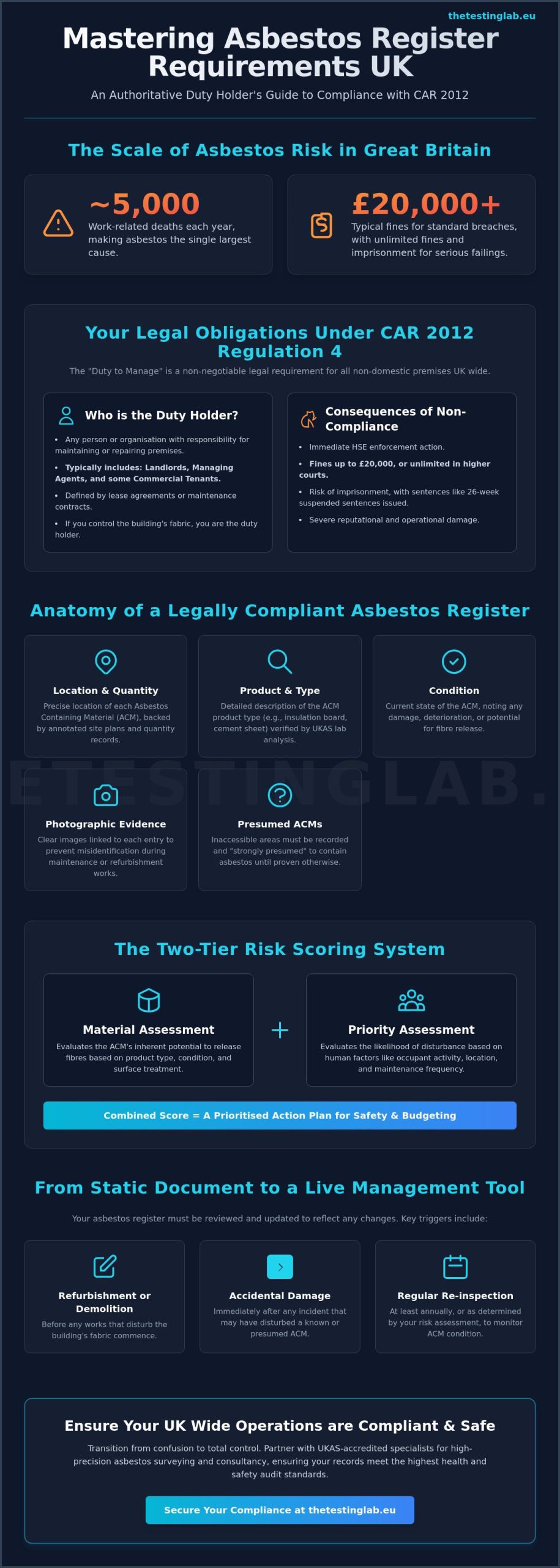
The foundation of asbestos safety in commercial property rests upon the Control of Asbestos Regulations 2012, specifically Regulation 4. This regulation mandates the “duty to manage” asbestos in non-domestic premises. At the heart of this mandate is the asbestos register. This isn’t just a static report; it’s a central, living record of all known and presumed Asbestos Containing Materials (ACMs) within a building. Meeting the asbestos register requirements UK involves a systematic approach to identifying risks and documenting them with engineering-level precision. This record serves as the primary tool for communicating risks to anyone who might disturb the fabric of the building during maintenance or refurbishment.
Who is the Duty Holder?
The law identifies the “duty holder” as the individual or organization responsible for the maintenance and repair of the premises. This definition applies UK wide and often includes landlords, commercial tenants, or managing agents. Responsibility is typically determined through the specific terms of lease agreements or maintenance contracts. If you have control over the building’s fabric, you’re likely the duty holder. Your primary objective is to maintain an accurate register that reflects the building’s current state. Partnering with a specialist for asbestos surveying and consultancy ensures that this responsibility is met with technical rigor rather than guesswork.
Legal Penalties for Missing or Inadequate Registers
Non-compliance carries heavy operational and legal risks. Under UK asbestos regulations, failing to produce a valid register can lead to immediate HSE enforcement actions. Standard breaches often result in fines up to £20,000 in magistrate courts, but serious failings can lead to unlimited fines and potential imprisonment. In March 2026, the HSE demonstrated this resolve when a site manager received a 26-week suspended prison sentence for asbestos-related failings. Where specific areas are inaccessible, the law requires a “presumed” register. You must treat any inaccessible material as containing asbestos until proven otherwise. This proactive methodology prevents accidental exposure during maintenance and keeps your premises audit-ready.
Essential Components: What Must an Asbestos Register Contain?
A compliant asbestos register serves as the technical blueprint for managing risk across your premises. To meet the specific asbestos register requirements UK, the document must record the precise location, product type, quantity, and current condition of every Asbestos Containing Material (ACM). This data isn’t based on anecdotal evidence; it requires the rigor of UKAS-accredited surveys to ensure that laboratory analysis backs every entry. Each record needs a unique identifier and photographic evidence to prevent identification errors during site works. When areas remain inaccessible, the duty holder must record them as “strongly presumed” to contain asbestos, following the RICS Asbestos Guidance for professional best practice.
Material Assessment vs. Priority Assessment
A valid register requires two distinct scoring systems to determine risk levels. The Material Assessment evaluates the ACM’s inherent potential to release fibres if disturbed, focusing on the product type and degree of damage. However, risk isn’t static. The Priority Assessment factors in the human element, such as the likelihood of disturbance based on room occupancy and maintenance frequency. Combining these scores allows you to prioritize remedial actions effectively and allocate budgets where they’re most needed for safety.
Technical Specifications for Record Keeping
Modern compliance requires a shift from static paper files to dynamic digital management. Effective records include clear, annotated site plans and standardized labelling protocols that match the register entries exactly. Integrating your data into a digital portal ensures that contractors can access real-time information before they start work, preventing accidental exposure. If you’re managing complex portfolios, professional UK wide asbestos consultancy services can help streamline this transition, ensuring your data remains both accessible and compliant. Our team can assist in refining these technical records to meet the highest audit standards.
Maintaining Compliance: Updates and Professional Verification
Compliance with CAR 2012 isn’t a one-time achievement but an ongoing commitment to building safety. The law requires that an asbestos register is treated as a “live document,” meaning it must be reviewed at least every 12 months. This annual cycle ensures that the asbestos register requirements UK are consistently met and that the management plan remains relevant to the building’s current state. However, time isn’t the only factor. You must update your records immediately following any refurbishment works, the accidental damage of a known material, or the professional removal of ACMs. Failing to capture these changes creates a legacy of inaccurate data that puts contractors and occupants at risk.
Annual Reviews and Re-inspections
It’s vital to distinguish between a desk-based register review and a physical re-inspection. While a review checks that your management actions are on track, a re-inspection involves a qualified professional physically assessing the condition of ACMs. Over time, factors like moisture, vibration, or simple wear and tear can degrade materials, increasing their risk score. Documenting these subtle changes with precision is essential for long-term compliance. Our team provides expert asbestos and legionella surveying UK wide to help duty holders maintain this level of detailed oversight.
The Role of UKAS Accredited Laboratories
Precision in the laboratory is what underpins the legal standing of your register. Independent laboratory analysis ensures that every sample is identified with scientific certainty, removing the risks associated with “presumed” status. When selecting a partner, you must verify that they hold valid UKAS accreditation for both surveying and testing. This accreditation is the gold standard for quality control and technical competence in the industry. To ensure your premises are fully protected and compliant, request a professional asbestos survey quote today and secure the technical expertise your building requires.
Secure Your Premises Through Technical Rigor
Managing asbestos risk requires more than a simple checklist; it demands a system of continuous oversight and technical precision. By establishing a live register that identifies every known and presumed material, you move from reactive maintenance to proactive risk management. A compliant register serves as your building’s safety blueprint, ensuring that every contractor and occupant remains protected from accidental exposure. Meeting the asbestos register requirements UK is a strategic necessity that safeguards both lives and your professional reputation.
As you refine your management plan, prioritize the accuracy that only independent, UKAS-accredited data can provide. Our team operates as a strategic partner, taking the burden of technical liability off your shoulders with expert consultancy and laboratory testing. We provide comprehensive national coverage, ensuring your portfolio remains audit-ready UK wide. You have the tools to master CAR 2012 compliance and create a safer environment for everyone in your building.
Take the next step in your compliance journey today. Ensure your building is compliant with our UK wide asbestos consultancy and benefit from the precision of a UKAS Accredited Laboratory. It’s time to turn your legal obligations into a robust framework for operational excellence.
Frequently Asked Questions
Is an asbestos register a legal requirement for all UK buildings?
No, the legal mandate applies specifically to non-domestic premises and the common parts of residential buildings constructed before the year 2000. Under Regulation 4 of CAR 2012, duty holders must maintain an accurate record of asbestos risks for these properties UK wide. If your building was constructed after 1999, it’s generally presumed to be asbestos-free, though verification is still a best practice for industrial sites with complex plant machinery.
How often should an asbestos register be updated under CAR 2012?
You must review and update your records at least once every 12 months to ensure continued compliance. Meeting the asbestos register requirements UK also involves immediate updates if the building undergoes refurbishment, if materials are removed, or if accidental damage occurs. Treating the register as a live document ensures that your risk scores always reflect the current physical state of the premises.
Who is allowed to see the asbestos register?
Legally, you must share the register with anyone liable to disturb the fabric of the building. This includes maintenance staff, visiting contractors, and emergency services. Providing this information is a mandatory safety step before any work begins to prevent accidental exposure. It’s also a requirement to make the data accessible to employees and building occupants to ensure transparency and maintain a safe working environment.
What happens if I don’t have an asbestos register for my commercial property?
Failing to maintain a valid register exposes you to severe HSE enforcement actions, including unlimited fines and potential imprisonment. Recent cases from March 2026 saw companies fined over £88,000 for failing to manage asbestos risks properly. Beyond financial penalties, you risk the health of your occupants and face significant legal liability if an accidental exposure event occurs because of missing or inadequate documentation.

Article by
P J F Thomas
CEO and Founder of TTL plc.
Disclaimer
Items declared are AI generated but do reflect our services. Please get in contact if you have any questions.