
What if your existing asbestos survey is actually leaving you vulnerable to prosecution under Regulation 4? Many duty holders managing properties UK wide mistakenly believe that a survey report is the final step, yet failing to implement a dynamic asbestos management plan is a common compliance gap. It’s natural to feel overwhelmed by the technicalities of tracking ACM conditions or confused about why a static document isn’t enough to satisfy the Health and Safety Executive.
This guide ensures you master the legal requirements and practical steps of creating a robust system to achieve total compliance. Whether you’re managing a single site or a complex portfolio, we’ll show you how to build a legally airtight framework. You can find more specific guidance on our London asbestos and legionella surveying pillar page. By the end of this article, you’ll have clear procedures for contractors and the peace of mind that your professional liability is fully managed.
Key Takeaways
- Identify your legal obligations as a Duty Holder under CAR 2012 to ensure your property portfolio remains compliant UK wide.
- Master the essential components of an asbestos management plan, moving beyond simple surveys to create a live, actionable safety document.
- Establish a rigorous 12-month review cycle and learn how to integrate UKAS accredited bulk identification to maintain the accuracy of your asbestos register.
- Define clear procedures and responsibilities for staff and contractors, ensuring professional liability is managed and safety is prioritized through a robust framework.
Understanding the Duty to Manage: Legal Foundations of the Asbestos Management Plan
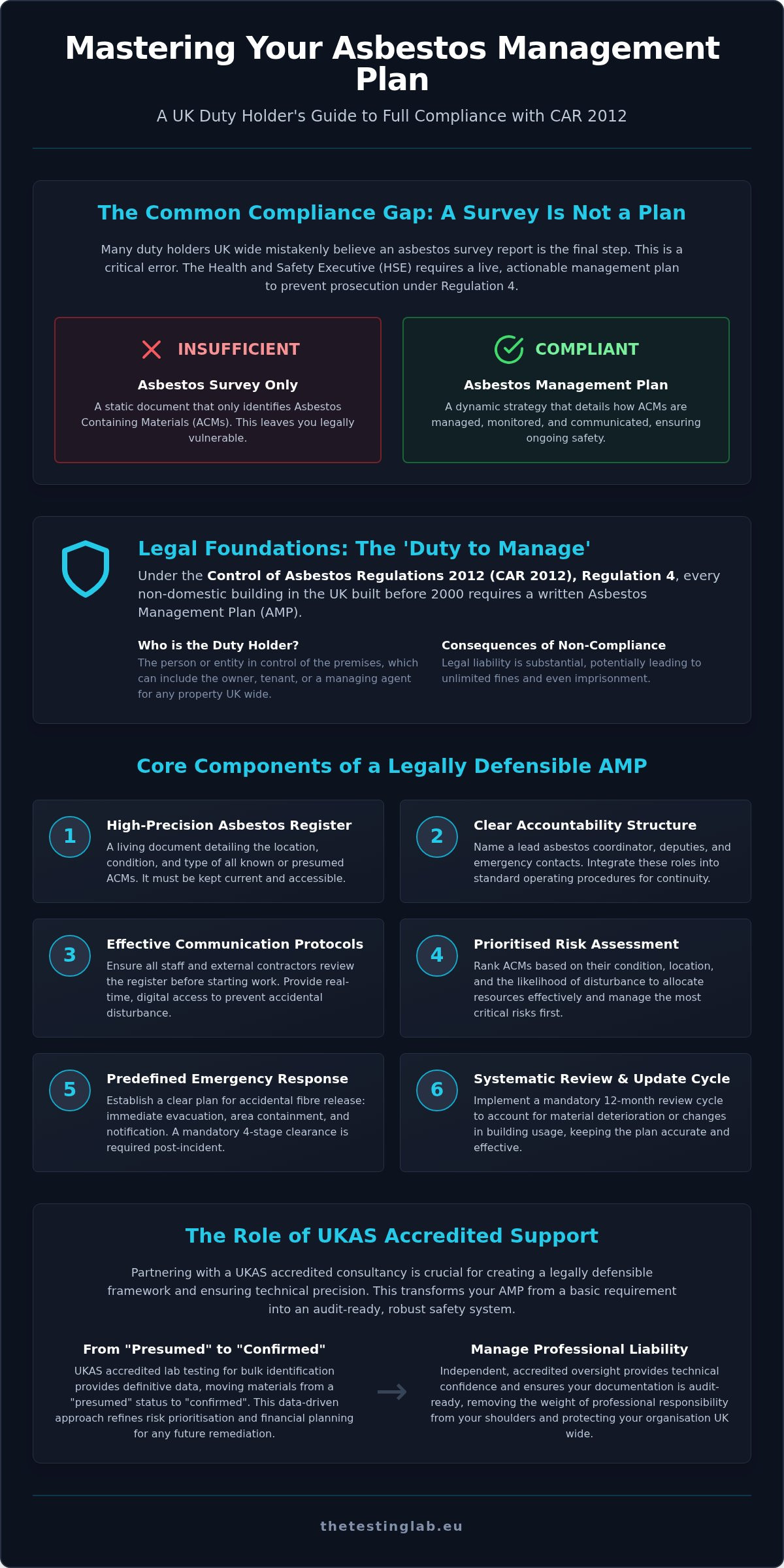
The Control of Asbestos Regulations 2012 (CAR 2012) mandates that every non-domestic building constructed before 2000 must have a written asbestos management plan. This isn’t just a paperwork exercise; it’s a living strategy designed to prevent accidental exposure. While Understanding Asbestos and its historical usage is the first step, the AMP provides the operational framework for safety. It details how you’ll manage identified materials, who’s responsible, and what happens during routine maintenance.
For property portfolios UK wide, the Duty Holder is usually the person or entity in control of the premises. This might be the owner, a tenant under a full repairing lease, or a managing agent. Legal liability is substantial. Failure to manage these risks can lead to unlimited fines or even imprisonment. A frequent error is assuming a survey report is a substitute for a plan. A survey identifies materials, but the asbestos management plan dictates how you interact with them every day.
Regulation 4 and Your UK-Wide Compliance Obligations
Regulation 4 outlines the specific duty to manage. It requires duty holders to locate asbestos, assess the risks, and prepare a plan that sets out how those risks will be managed. To be legally valid, an AMP must be site-specific; generic templates fail to address the unique structural risks of individual buildings. Partnering with a UKAS accredited asbestos consultancy ensures your framework is legally defensible. They provide the technical precision needed to bridge the gap between a static survey and a compliant management system. This strategic partnership removes the weight of professional responsibility from your shoulders.
Essential Components of an Effective Asbestos Management Plan
A robust asbestos management plan centers on a high-precision asbestos register. This living document must reflect the current status of all known materials, ideally verified through UKAS accredited lab analysis. It’s not enough to simply list locations; you must assign clear accountability. This includes naming a lead coordinator, designated deputies, and emergency contacts available UK wide. We recommend integrating these roles into your standard operating procedures to ensure continuity during staff changes.
Effective communication is the next pillar of compliance. Maintenance staff and external contractors must review the register before any work begins. Providing digital, real-time access to these records prevents accidental disturbance and ensures everyone on-site understands the risks. If you’re managing complex sites, our London asbestos surveying team can help structure this data for maximum clarity.
Risk Assessment and Emergency Response Procedures
Prioritising actions is critical for resource allocation. You should rank ACMs based on their condition and the likelihood of disturbance. If an accidental release occurs, your plan must include a predefined emergency response. This involves immediate evacuation, sealing the area, and notifying the duty holder. Following any disturbance, a 4-stage clearance process is mandatory. This includes visual inspections and air monitoring to confirm safety. For expert support in building these protocols, you can request a consultation with our technical team.
Implementing and Updating Your AMP with UKAS Accredited Support
Maintaining a compliant asbestos management plan requires more than a one-time setup. CAR 2012 specifies a mandatory 12-month review cycle to account for any material deterioration or changes in building usage. For organisations operating UK wide, this systematic cycle ensures that the asbestos register remains a precise reflection of actual risk. Integrating professional lab testing for bulk identification is the only way to move from “presumed” to “confirmed” status. This data-driven approach significantly refines your risk prioritisation and financial planning for future remediation.
Complex risks, such as asbestos in soils, require specialised methodological approaches that are often overlooked in standard building plans. Including soil investigation in your wider management strategy is vital for brownfield sites or properties with historical ground contamination. Independent, UKAS accredited oversight provides the technical confidence needed for audit-ready documentation. It transforms your plan from a basic legal requirement into a strategic asset that protects both your employees and the business’s long-term reputation.
Professional Consultancy for National Portfolios
Streamlining management across multiple sites requires a unified consultancy approach. This ensures consistency in how data is recorded and updated across your entire UK wide portfolio, making internal audits much simpler. Independent laboratory analysis is critical; it prevents the conflict of interest that occurs when removal contractors conduct their own testing. UKAS accreditation is a legal and technical necessity for all asbestos analytical work to ensure results are defensible in court. Using a single, accredited provider for both surveys and lab analysis simplifies the compliance journey and reduces administrative friction for your management team.
Securing Long-Term Compliance for Your Property Portfolio
Transitioning from a static survey to a dynamic asbestos management plan is the most critical step for protecting your assets. By establishing a 12-month review cycle and using UKAS accredited laboratory analysis, you’ll move into true operational safety. This proactive approach ensures every contractor across your UK wide portfolio works within a legally defensible framework. Since 2002, we’ve served as an independent strategic partner, taking the weight of professional responsibility off your shoulders. Our team’s ready to streamline your documentation with precision.
Get a Professional Quote for Asbestos Management and Consultancy UK-Wide to ensure your sites meet the highest safety standards.
Achieving total peace of mind regarding asbestos safety is entirely possible with the right methodological support.
Frequently Asked Questions
Who is responsible for writing the asbestos management plan?
The Duty Holder carries the legal responsibility for creating the asbestos management plan. Under CAR 2012, this is typically the person or organisation in control of the premises, such as the building owner or the tenant with maintenance obligations. While they hold the liability, they often appoint a UKAS accredited consultancy to draft the technical details to ensure the document is legally defensible.
How often should an asbestos management plan be reviewed in the UK?
An asbestos management plan must be reviewed at least every 12 months in the UK. This review ensures the asbestos register remains accurate and that the condition of any identified materials hasn’t deteriorated. If building works occur or if materials are accidentally disturbed, you should update the plan immediately. Consistent annual reviews are essential for maintaining compliance for property portfolios UK wide.
Do I need a new management plan if I have already had an asbestos survey?
Yes, you still need a management plan because a survey alone doesn’t satisfy Regulation 4. A survey identifies the location and type of materials, but the plan outlines the specific procedures for managing those risks. It’s the difference between having a map and having a safety protocol. Professional London asbestos surveying services provide the data foundation needed to build this comprehensive strategy.
What happens if I do not have a compliant asbestos management plan?
Failing to maintain a compliant plan can lead to severe legal consequences, including unlimited fines or imprisonment for the duty holder. Beyond the financial risk, non-compliance endangers the health of employees and contractors. The HSE actively enforces these regulations, so having a robust, audited system is the only way to protect your business from prosecution and ensure long-term safety UK wide.

Article by
P J F Thomas
CEO and Founder of TTL plc.
Disclaimer
Items declared are AI generated but do reflect our services. Please get in contact if you have any questions.