Could a single overlooked soil sample derail your entire multi-million pound development? In the UK construction sector, unforeseen ground conditions remain a primary cause of budget overruns and schedule delays. Conducting a thorough geotechnical site investigation UK wide isn’t just a box-ticking exercise; it’s a strategic necessity for structural integrity. You’re likely aware that the margin for error is non-existent when dealing with complex legislative frameworks and the physical realities of your site’s subsurface.
We understand that the pressure to deliver while managing risks like asbestos in soil can be overwhelming. This guide provides the clarity you need to master UK geotechnical requirements, from the nuances of BS 10175:2026 to the mandatory standards of UKAS-accredited laboratory testing. We’ll explore how to secure accurate material data for structural designs and ensure your project adheres to the latest legal standards, including the CDM 2015 regulations and the upcoming Geotechnical Data Bill. You’ll gain a clear roadmap for achieving full compliance and protecting your firm from long-term liability. For those managing broader safety, our expertise includes specialized asbestos and legionella surveying to keep your project on track.
Key Takeaways
- Ensure full legal compliance by understanding how geotechnical data satisfies the CDM 2015 framework for all UK construction projects.
- Navigate the phased investigation process, from historical desk studies to intrusive boreholes, to capture comprehensive site data efficiently.
- Discover why UKAS accreditation is the non-negotiable gold standard for any geotechnical site investigation UK wide to avoid planning refusals.
- Mitigate long-term structural and environmental liabilities by utilizing precise laboratory data for soil analysis and contaminant identification.
Understanding Geotechnical Site Investigation UK Requirements
A Geotechnical investigation is a mandatory risk assessment protocol required for any UK construction project before the first spade hits the dirt. It’s the technical process of evaluating the physical properties of a site to determine its suitability for the proposed structural loads. While some view it as a preliminary hurdle, it’s actually the most critical phase for ensuring long term stability and safety. The strategic execution of a geotechnical site investigation UK ensures that structural designs are based on empirical data rather than assumptions.
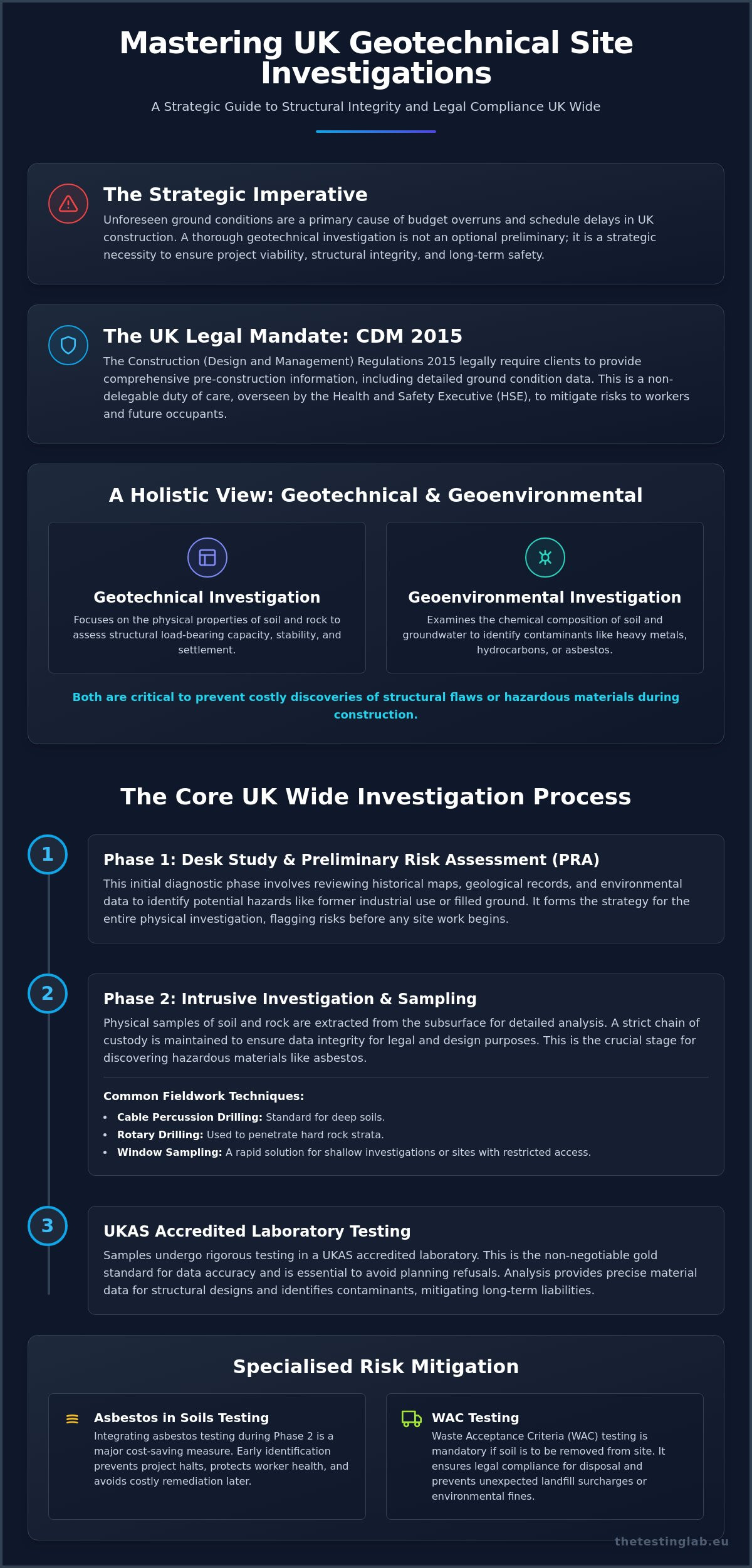
The legal framework governing these works is the Construction (Design and Management) Regulations 2015 (CDM 2015). These regulations mandate that clients provide pre-construction information to contractors; this information must include detailed ground data to prevent accidents during excavation. Adopting a rigorous approach to a geotechnical site investigation UK wide is essential for national infrastructure projects and commercial developments where consistency in data quality can make or break a project’s timeline.
The Legislative Necessity for Ground Investigations
The Health and Safety Executive (HSE) maintains strict oversight of site safety, ensuring that developers don’t cut corners on subsurface assessments. Every developer holds a non-delegable duty of care to ensure that ground conditions do not pose a risk to workers or future occupiers of the site. Failing to account for these variables can lead to enforcement actions or project shutdowns. Integrating these assessments with specialized asbestos consultancy services ensures that your compliance strategy covers both structural and hazardous material risks from the outset.
Geotechnical vs. Geoenvironmental: Why You Need Both
While geotechnical testing focuses on structural load-bearing capacity and soil mechanics, geoenvironmental testing looks at chemical composition. You need both. A site might be structurally sound but heavily contaminated with heavy metals or hydrocarbons. Integrated testing prevents the costly discovery of hazardous materials during the build phase, which often leads to expensive remediation or legal challenges. On former industrial sites where chemical processing was prevalent, it is often necessary to explore Glycol Reclamation and Technical Field Services to manage legacy fluid contaminants effectively. By merging these disciplines, you gain a holistic view of the ground’s behavior and its chemical profile, mitigating the risk of unforeseen environmental liabilities.
Core Phases of a Comprehensive Site Investigation UK Wide
A standard geotechnical site investigation UK wide follows a phased methodology to ensure no detail is missed. Phase 1 begins with a Desk Study and Preliminary Risk Assessment (PRA). This step identifies historical land uses, such as former industrial sites or filled ground, which could indicate potential contamination or stability issues long before equipment arrives on site. It’s the diagnostic stage that informs the entire physical exploration strategy.
Phase 2 involves the intrusive works. This is where physical samples are extracted from the subsurface for rigorous laboratory analysis. Integrating asbestos in soils testing at this stage is crucial. Discovering hazardous fibers mid-build can halt a project for weeks, so identifying these risks during the initial drilling phase is a major cost-saving measure.
Fieldwork Techniques and Sampling Protocols
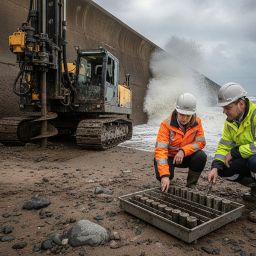
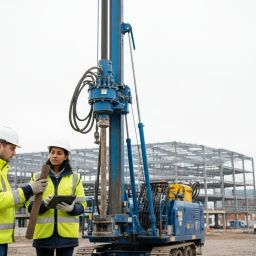
Engineers select drilling methods based on site geology and depth requirements. Cable percussion is standard for deep alluvial soils, while rotary drilling penetrates hard rock strata. For sites with restricted access or shallow investigations, window sampling provides a rapid, portable solution. Professional logging of soil and rock is the foundation of structural design; without accurate descriptions, foundation specifications may be dangerously flawed. Ensuring a strict chain of custody for every sample is essential for mitigating ground risk and maintaining data integrity for legal and insurance purposes.
Addressing Contamination: Asbestos and Chemical Risks
Geotechnical drilling shouldn’t happen in a vacuum. It must be paired with Waste Acceptance Criteria (WAC) testing if soil is to be removed from the site. Utilizing professional WAC testing services ensures you don’t face unexpected landfill surcharges or environmental fines. Identifying hazardous soil early protects worker health and prevents budget-destroying surprises. If you’re unsure about your site’s history, our team can help you navigate these complexities through a comprehensive asbestos in soils analysis.
The Critical Role of UKAS Accredited Laboratory Testing
UKAS accreditation isn’t just a badge; it’s the ISO/IEC 17025 standard in action. It guarantees that the data derived from your geotechnical site investigation UK is technically robust and legally defensible. Relying on non-accredited laboratories carries severe risks. You might face planning refusals from local authorities or find your professional indemnity insurance invalidated because the data quality wasn’t verified. Precision in the lab is what transforms a physical soil sample into a reliable engineering parameter.
Specialized laboratory analysis bridges the gap between a muddy sample and a precise structural specification. At The Testing Lab PLC, we act as a strategic partner, taking the technical burden off your shoulders. Beyond soil mechanics, we provide comprehensive Asbestos and Legionella surveying UK wide to ensure your site is safe from every angle. This integrated approach ensures that all environmental and structural risks are identified before they can impact your construction schedule.
Structural and Chemical Analysis in the Lab
Our laboratory processes include high-precision testing such as water absorption and triaxial strength assessments to determine how the ground will react under load. We utilize advanced XRD and XRF analysis for detailed mineralogical identification, which is vital for identifying reactive soils that could damage concrete foundations. Lab-verified soil strength dictates foundation depth and type, ensuring the building’s structural integrity for decades. Without this data, engineers are forced to over-design, leading to unnecessary material costs.
Ensuring Compliance with UK Environmental Standards
Environmental compliance is equally critical for modern developments. We use WM3 testing services to classify hazardous waste correctly, helping you avoid the legal pitfalls of mismanaged soil disposal on UK wide construction sites. Proper classification prevents the costly mistake of sending non-hazardous waste to specialized landfills or, worse, illegally tipping hazardous materials. A professional geotechnical site investigation UK is an investment in your project’s longevity, protecting you from future liabilities and ensuring a smooth transition from groundworks to completion.
Securing Your Project’s Foundation and Compliance
Successful development relies on transforming subsurface uncertainty into engineering certainty. By integrating legislative compliance with rigorous fieldwork and UKAS accredited analysis, you protect your investment from unforeseen delays and structural failure. A geotechnical site investigation UK wide ensures your project stands on a foundation of empirical data rather than costly assumptions. We’ve explored how a phased approach, from desk studies to intrusive sampling, identifies hidden hazards like asbestos before they impact your budget.
Since 2002, our team has operated as a strategic partner, providing independent and accredited testing for the construction sector. We specialize in high-stakes soil analysis, asbestos consultancy, and water management to remove the burden of professional liability from your shoulders. Whether you require specialized soil testing or comprehensive asbestos and legionella surveying, our UKAS accredited laboratory facilities deliver the precision required for full regulatory adherence.
Request a professional quote for your UK-wide site investigation today and ensure your next project starts with total confidence and methodological accuracy.
Frequently Asked Questions
What is the purpose of a geotechnical site investigation in the UK?
The primary purpose is to determine the physical and chemical properties of the subsurface to ensure structural safety and project viability. It provides the essential data engineers need to design foundations that can support the building’s load without risk of subsidence or failure. Additionally, it identifies potential ground hazards such as voids, high water tables, or chemical contaminants that could impact the construction process.
How much does a geotechnical site investigation cost UK wide?
Costs for a geotechnical site investigation UK wide vary depending on the site’s history, size, and the complexity of the proposed structure. A basic Phase 1 desk study represents the initial investment, while Phase 2 intrusive works involving boreholes and laboratory analysis require a larger budget based on the depth and frequency of sampling required. Complex sites with a history of industrial use often require more extensive chemical testing, which influences the final cost.
Is a geotechnical investigation a legal requirement for UK construction?
Yes, these investigations are effectively a legal requirement under the Construction (Design and Management) Regulations 2015 (CDM 2015). Clients have a legal obligation to provide contractors with pre-construction information regarding ground conditions to ensure safety during excavation and build phases. Failing to conduct an adequate investigation can lead to enforcement action by the Health and Safety Executive (HSE).
What is the difference between a site investigation and a ground investigation?
A site investigation is an all-encompassing assessment of the site’s entire environment, including its history, topography, drainage, and existing utilities. In contrast, a ground investigation is a specific subset of this process that focuses exclusively on the soil, rock, and groundwater conditions through physical sampling and technical testing. Both are necessary to form a complete risk profile for a development.
How long does a typical UK geotechnical site investigation take to complete?
Most investigations take between four and eight weeks from the initial desk study to the delivery of the final report. This timeline includes the time required for on-site drilling and sampling, followed by approximately 10 to 15 working days for rigorous analysis in a laboratory. Complex projects requiring long term gas or groundwater monitoring can extend this timeframe significantly.
Why is UKAS accreditation important for soil and material testing?
UKAS accreditation confirms that a laboratory operates to the ISO/IEC 17025 standard, ensuring that test results are accurate, reproducible, and technically robust. Most UK insurers and planning authorities won’t accept data from non-accredited facilities because it lacks the verified technical competence required to guarantee structural safety. Using a UKAS-accredited lab is the only way to ensure your data is legally and professionally defensible.

Article by
P J F Thomas
CEO and Founder of TTL plc.
Disclaimer
Items declared are AI generated but do reflect our services. Please get in contact if you have any questions.