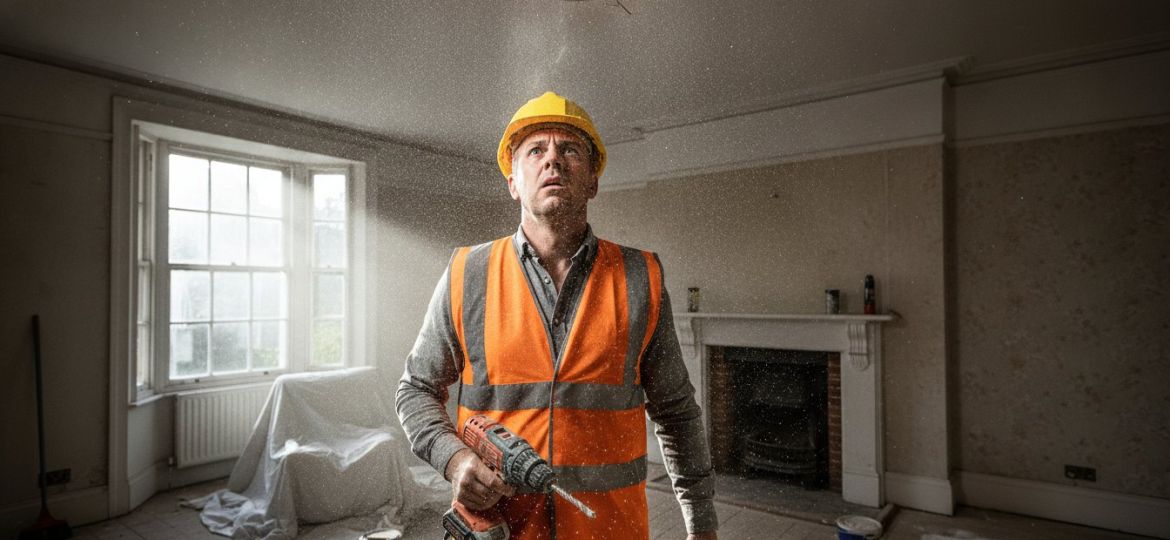
You’re midway through a renovation when a drill slip releases a fine, grey dust from an unidentified ceiling tile. It’s a moment of sharp anxiety that every property manager and tradesperson across the UK fears. You know the risks of fibre inhalation, but confusion over the immediate cleanup can lead to dangerous mistakes. Understanding exactly what to do if you disturb asbestos is not just a health precaution; it’s a strict legal requirement under the Control of Asbestos Regulations 2012.
The professional responsibility of site safety can feel overwhelming in an emergency. This guide provides the precise, compliant steps you must take to contain the area and protect everyone UK wide. We detail the transition from initial isolation to the essential UKAS accredited air monitoring and the 4-stage clearance process required to validate your property as safe for reoccupation.
Key Takeaways
- Stop all work immediately and evacuate the affected area to prevent the further spread of hazardous fibres and protect onsite personnel.
- Discover the essential legal protocols for what to do if you disturb asbestos to ensure full compliance with the Control of Asbestos Regulations 2012.
- Identify when an accidental disturbance necessitates a formal RIDDOR report to the HSE to maintain your organization’s legal standing.
- Understand why independent UKAS accredited validation from a specialist asbestos consultancy is mandatory for safe site reoccupation UK wide.
Immediate Emergency Steps After Accidental Asbestos Disturbance
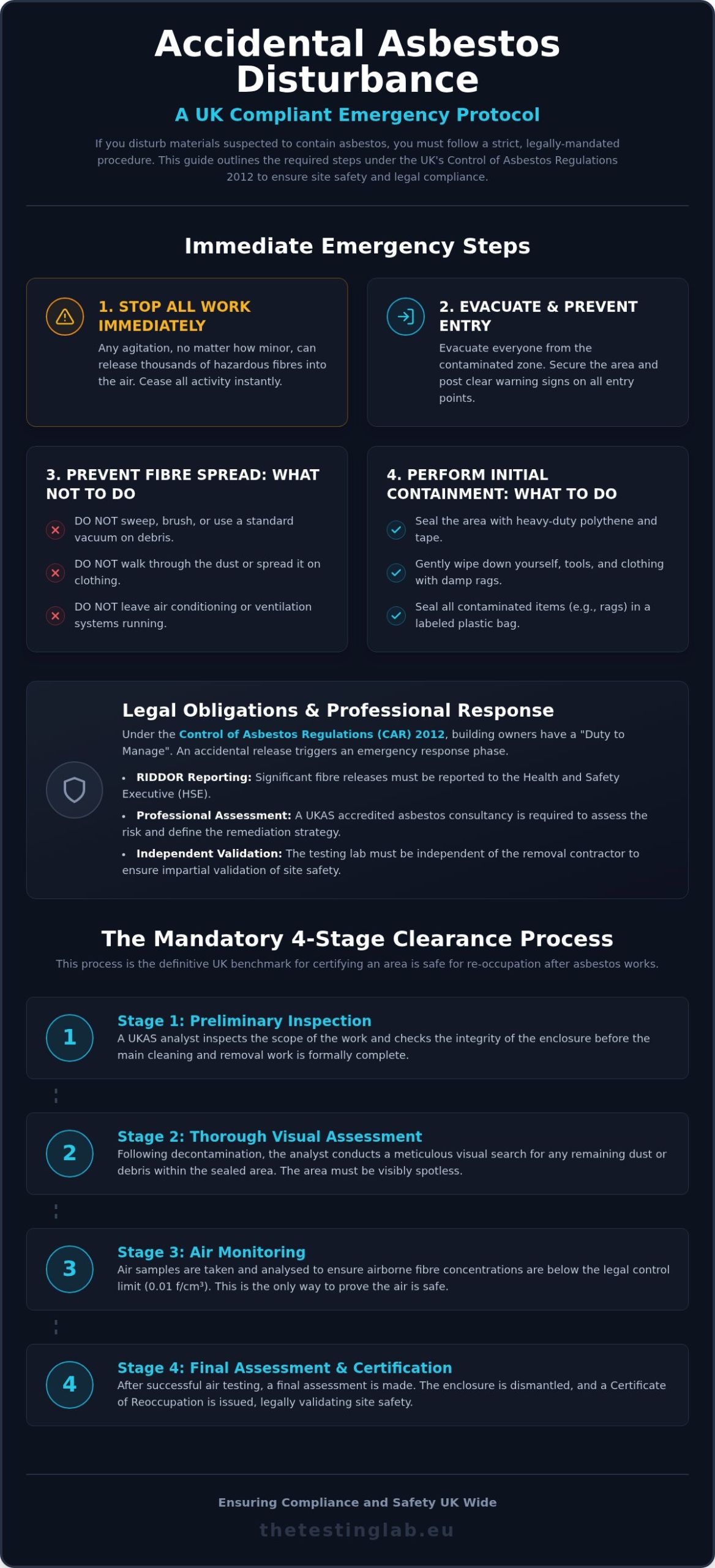
The moment you suspect a material has been breached, the priority is total cessation. Stop all work immediately. Even minor agitation can release thousands of microscopic fibres into the air. If you’re unsure about the underlying risks, understanding What is Asbestos? and its friable nature helps clarify why a small drill hole is a major hazard. Evacuate the room and prevent anyone else from entering the contaminated zone. This is the first critical phase in knowing what to do if you disturb asbestos while maintaining site safety.
Never attempt to sweep, hoover, or brush up any dust or debris. Standard domestic vacuums aren’t equipped with the necessary filtration; they’ll simply exhaust the lethal fibres back into the atmosphere. You must also switch off any air conditioning or ventilation systems. These systems can rapidly transport airborne particles throughout a building, turning a localized issue into a complex, site-wide emergency.
Securing the Contaminated Area and Preventing Fibre Migration
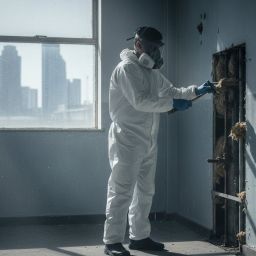
Isolation is the most effective way to prevent fibre migration. Seal the affected area using heavy-duty polythene and tape to create a temporary physical barrier. Place clear warning signs on all entry points to ensure no accidental incursions occur UK wide. If you were in the direct vicinity, don’t brush your clothes. Wipe down your tools and clothing with a single-use damp rag, then seal that rag in a plastic bag. For expert guidance during these high-pressure scenarios, contacting a specialist asbestos consultancy ensures your response meets rigorous UK standards.
Legal Obligations Under the Control of Asbestos Regulations (CAR 2012)
Under the Control of Asbestos Regulations 2012 (CAR 2012), the “Duty to Manage” is a non-negotiable legal obligation for building owners and managers. When an accidental release occurs, this duty shifts into an emergency response phase. If you’re unsure what to do if you disturb asbestos, your first step is determining if the incident must be reported to the HSE under RIDDOR. Significant fibre release from high-risk materials like pipe insulation or asbestos insulation board (AIB) typically triggers this reporting requirement UK wide.
Defining exactly what to do if you disturb asbestos requires a clear distinction between licensable and non-licensable work. Most disturbances of friable materials cannot be handled by standard maintenance teams. A professional asbestos consultancy provides the necessary risk assessments to categorise the disturbance and define the remediation strategy.
The Role of UKAS Accredited Asbestos Consultancy
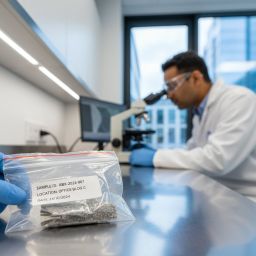
Legal certainty regarding re-entry can only be granted by a UKAS accredited laboratory. These specialists conduct precise bulk asbestos identification to confirm material types and fibre concentrations. Maintaining independence between the testing lab and the removal contractor is a regulatory necessity to prevent conflicts of interest. This methodology ensures that the 4-Stage Clearance Process is conducted with total impartiality. It’s the final authority on site safety. For those managing complex sites, our London asbestos surveying specialists offer the strategic partnership required to resolve contamination events with technical precision.
Professional Remediation and the 4-Stage Clearance Process
After the initial shock of a disturbance, the technical phase of remediation begins. Professional environmental cleaning is mandatory. Specialists use H-class high-efficiency particulate air (HEPA) filtration to capture microscopic fibres. This process ensures that the contamination doesn’t linger on porous surfaces or within the building fabric. When deciding what to do if you disturb asbestos, remember that air monitoring is the only way to measure the concentration of airborne fibres post-cleanup. It’s the only method that provides the empirical data needed to prove the air is safe for unprotected breathing.
Every gram of contaminated material must be treated as hazardous waste. All debris, including the rags and polythene used for initial containment, must be handled according to WM3 testing standards. This rigorous classification prevents environmental contamination at hazardous waste sites UK wide and protects the integrity of the waste stream during the disposal process.
Validating Site Safety for Re-Occupation
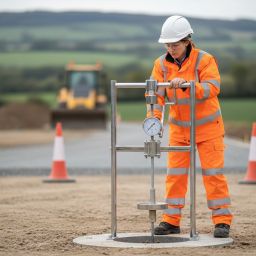
The 4-stage clearance procedure is the definitive benchmark for safety. It begins with a preliminary site inspection of the work area, followed by a meticulous visual assessment to ensure no dust remains. In licensable scenarios, smoke testing ensures the integrity of containment enclosures before work starts. After cleaning, air monitoring is conducted using phase-contrast microscopy to verify fibre levels are below the limit of quantification. The final stage is the issuance of the Certificate of Re-occupation. It’s vital for legal and insurance compliance, serving as your primary evidence that the building is safe. For complex projects, our experts provide asbestos surveying in London and throughout the country to ensure every step of the protocol is followed with engineering precision.
Securing Your Site with Regulatory Precision
Accidental disturbance requires immediate isolation followed by a transition to UKAS accredited validation. We’ve established that site safety depends on moving beyond basic containment to professional air monitoring and rigorous clearance protocols. Knowing exactly what to do if you disturb asbestos protects your health and your legal standing under CAR 2012. Our team provides UKAS Accredited Laboratory Analysis and independent professional consultancy to resolve these emergencies UK wide. By securing a Full 4-Stage Clearance Certification, you ensure that your property is legally compliant and safe for re-occupation. For strategic support on your next project, consider our specialized asbestos surveying in London.
Request an Emergency Asbestos Assessment UK Wide today. With a methodical approach and the right expert partner, you can resolve contamination risks efficiently and return to operations with total confidence in your environment’s safety.
Frequently Asked Questions
Can I clean up disturbed asbestos with a normal vacuum cleaner?
No, you must never use a standard domestic vacuum cleaner to clean disturbed asbestos. Standard filters allow microscopic fibres to pass through the motor and exhaust back into the room. This aerosolises the hazard rather than containing it. Only H-class vacuums with high-efficiency particulate air (HEPA) filtration are legally compliant for this task UK wide.
How long do asbestos fibres stay in the air after being disturbed?
Asbestos fibres are microscopic and exceptionally light, meaning they can remain suspended in the air for up to 72 hours after being disturbed. In still air, they settle very slowly. Any movement or draft can easily re-suspend them. This is why immediate isolation and professional air monitoring are critical steps in knowing what to do if you disturb asbestos.
Do I need to throw away my clothes if I accidentally disturbed asbestos?
Disposal is the safest and most compliant option for contaminated clothing. You should seal the items in heavy-duty plastic bags for hazardous waste disposal. If you choose to keep them, they must be cleaned at a specialist laundry facility equipped to handle asbestos. Never wash contaminated clothes in a domestic machine, as this risks contaminating your home and the water system.
Is it a legal requirement to have air testing after an asbestos disturbance?
Yes, it’s a legal requirement under CAR 2012 to conduct air testing as part of the 4-stage clearance process following the removal of licensable materials. Even for non-licensable disturbances, air monitoring is highly recommended to provide the legal certainty required for safe re-occupation. This independent validation ensures your site meets health and safety standards UK wide before anyone re-enters the zone.

Article by
P J F Thomas
CEO and Founder of TTL plc.
Disclaimer
Items declared are AI generated but do reflect our services. Please get in contact if you have any questions.