Could a single percentage point be the difference between a routine maintenance task and a five-figure licensed removal project? For many duty holders, the line between asbestos cement and Asbestos Insulating Board (AIB) is dangerously thin, often leading to massive overspends or the risk of HSE prosecution. Professional water absorption testing UK wide is the only scientifically validated method to resolve this uncertainty and ensure your site remains fully compliant with the Control of Asbestos Regulations 2012.
We know that managing asbestos risks feels like a significant professional burden, especially when materials look identical to the naked eye. You need a management plan that’s both cost-effective and legally robust. This guide explains how water absorption testing provides the definitive legal classification required for your health and safety files. We’ll look at the technical thresholds that distinguish these materials and how UKAS-accredited proof protects your business. From laboratory analysis to expert surveying and consultancy, you’ll learn how to secure the precision your projects demand.
Key Takeaways
- Learn how to accurately distinguish between Asbestos Insulating Board (AIB) and Asbestos Cement to ensure full compliance with the Control of Asbestos Regulations 2012.
- Understand the HSE-approved methodology behind the 30% threshold and how it dictates the legal handling requirements for your site.
- Discover how professional water absorption testing UK wide provides the UKAS-accredited proof required to satisfy health and safety auditors and insurers.
- Identify strategies to prevent significant project overspends by avoiding unnecessary licensed removal costs through definitive material classification.
- Streamline your asbestos management plan by obtaining precise laboratory results before the tender process to reduce operational delays.
Water Absorption Testing and the UK Legislative Framework
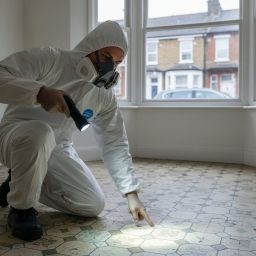
Professional water absorption testing UK wide serves as a specialized diagnostic process that measures the porosity and density of an asbestos-containing material. This analysis isn’t a standard bulk identification. While standard Polarised Light Microscopy (PLM) identifies the specific fibre types present, it can’t determine the density of the physical matrix. To fully comprehend What is Asbestos? in a construction context, we must examine how the material was manufactured. High-density products like cement behave differently under stress than low-density boards, and the law treats them accordingly. Visual inspections are notoriously unreliable because weathered cement often mimics the appearance of insulating board.
Asbestos Insulating Board (AIB) vs. Asbestos Cement
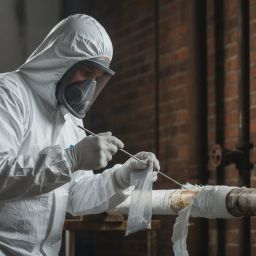
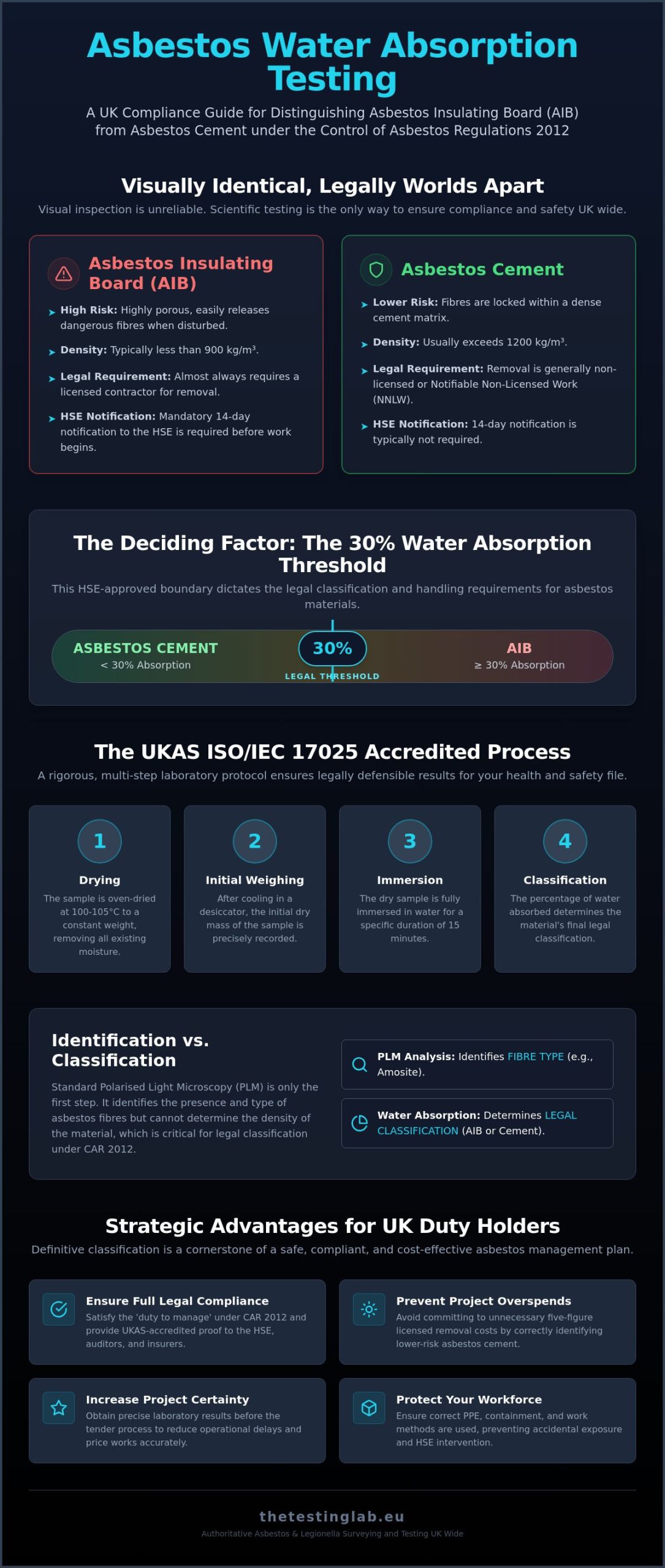
Asbestos Insulating Board (AIB) typically has a density of less than 900 kg/m³. It’s highly porous, which means it releases dangerous fibres far more easily when disturbed or cut. In contrast, Asbestos Cement is a heavily compressed product with a density usually exceeding 1200 kg/m³. The legal implications of confusing the two are severe. Misidentifying AIB as cement often leads to workers using incorrect PPE and inadequate containment. This creates a direct path to HSE intervention and potential prosecution for failing to protect employees and the public.
The Role of CAR 2012 in Material Classification
The Control of Asbestos Regulations 2012 (CAR 2012) creates a strict divide between licensed, non-licensed, and Notifiable Non-Licensed Work (NNLW). AIB removal almost always requires a licensed contractor and a mandatory 14-day notification to the HSE. Cement removal generally does not. Relying on a guess is a failure of the ‘duty to manage’ under Regulation 4. Our expert surveying services frequently identify materials that appear to be cement but fail the density threshold during laboratory analysis. Water absorption testing UK wide provides the scientific burden of proof needed for your health and safety files. This rigorous testing method is the only way to legally validate your material classification and ensure total site compliance.
The HSE Methodology: How Water Absorption Testing Works
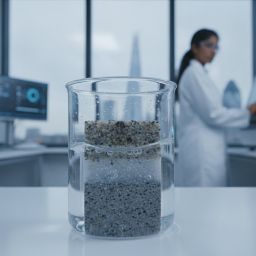
The technical procedure for determining material density follows a rigorous protocol detailed in The HSE Methodology. It isn’t a simple dunk test. To achieve reliable results for water absorption testing UK wide, laboratories must eliminate all environmental variables. We start by oven-drying the sample to a constant weight at 100°C to 105°C. This removes any existing moisture. After drying, the sample cools in a desiccator to prevent it from absorbing atmospheric water before we record the initial dry mass.
The core of the test involves a 15-minute immersion in water. This specific duration allows the liquid to penetrate the pores of the material. If the dry sample absorbs 30% or more of its weight in water, it’s legally classified as Asbestos Insulating Board (AIB). Materials absorbing less than this threshold are classified as asbestos cement. This 30% boundary isn’t arbitrary; it represents the point where the material’s porosity indicates a lower density and a higher propensity for fibre release.
Why PLM Analysis is Only the First Step
Standard Polarised Light Microscopy (PLM) is excellent for identifying whether a material contains Chrysotile or Amosite. However, it can’t tell you how that material was manufactured. Finding Amosite doesn’t automatically mean you have AIB. Many cement products contain Amosite but remain high-density. Density-based classification is a separate technical requirement. If you’re unsure about your material’s status, securing UKAS accredited asbestos testing is the only way to move from identification to definitive classification.
UKAS ISO/IEC 17025: The Gold Standard for Lab Testing
Accreditation to ISO/IEC 17025 ensures that every step, from calibrated weighing to oven temperature control, meets international quality standards. This creates a transparent chain of custody for UK wide construction projects. It’s about more than just numbers; it’s about legal defensibility. Relying on non-accredited tests is a significant liability risk for businesses because these results often crumble under HSE scrutiny or during insurance audits.
Strategic Advantages of Nationwide Water Absorption Testing
Implementing professional water absorption testing UK wide is a strategic asset management decision rather than a mere laboratory requirement. It stops the common trend of over-budgeting based on visual uncertainty. When property managers face ambiguous board materials, the default choice is often the most expensive one: assuming the worst-case scenario. This defensive approach leads to significant budget leakage. By obtaining definitive data early, you shift from reactive guesswork to proactive, evidence-based decision-making that keeps projects on track.
Cost Savings in Asbestos Removal
The financial implications are stark. Licensed asbestos removal requires specialized contractors, 14-day HSE notifications, and rigorous air monitoring; all of which drive up project costs. If a material is scientifically proven to be asbestos cement rather than AIB, the work can often be completed by non-licensed teams. This distinction can save thousands of pounds on a single commercial refurbishment. Competitive project tendering becomes much easier when the scope of work is clearly defined by UKAS-accredited reports. You avoid the “risk premium” often added by contractors when material classification is left in doubt.
Choosing a Partner for UK Wide Compliance
Managing multi-site commercial portfolios requires a partner who can ensure consistent safety standards. The Testing Lab PLC operates as a strategic extension of your team, providing professional clarity UK wide. We integrate density analysis with other critical disciplines, such as asbestos in soils testing, to provide a holistic view of site risks. This comprehensive approach aligns with the UK Legislative Framework and RICS best practices. It protects the ‘Responsible Person’ from the legal repercussions of misclassification while maintaining the momentum of your construction schedule. Precise documentation ensures your health and safety files are ready for any audit or insurance inquiry.
Securing Legal Certainty for Your Asbestos Management Plan
Accurately distinguishing between AIB and asbestos cement isn’t just a technicality; it’s a fundamental financial and legal safeguard for your business. We’ve explored how the 30% threshold dictates your removal requirements and why standard bulk identification often falls short of the necessary burden of proof. By choosing professional water absorption testing UK wide, you replace site uncertainty with definitive, laboratory-backed evidence. This precision ensures you don’t overspend on unnecessary licensed removals while remaining fully compliant with CAR 2012.
The Testing Lab PLC operates as an independent, UKAS ISO/IEC 17025 accredited facility, providing the technical expertise needed to manage complex portfolios. Our team removes the burden of professional responsibility from your shoulders, delivering results that satisfy both health and safety auditors and insurers. Whether you’re managing a single refurbishment or a multi-site commercial estate, we provide the clarity required for a cost-effective asbestos management plan. Request an accredited water absorption testing quote UK wide today to secure your site’s compliance. We’re ready to help you navigate your next project with confidence and technical precision.
Frequently Asked Questions
What is the 30% threshold in water absorption testing?
The 30% threshold is the specific metric defined by the HSE to differentiate between Asbestos Insulating Board (AIB) and asbestos cement. If a dry sample absorbs 30% or more of its own weight in water during the immersion process, it’s legally categorized as AIB. This threshold is critical because it indicates a porosity level that correlates with higher fibre release risks; a factor that necessitates licensed removal under UK law.
Can I use water absorption testing for all asbestos-containing materials?
No, this methodology is specifically designed for board-like materials where the density determines the legal classification. You wouldn’t use water absorption testing UK wide for products like textured coatings, vinyl floor tiles, or bitumen. It’s primarily utilized when a surveyor identifies a rigid board material that could be either a high-density cement or a lower-density insulating board; as these two have vastly different handling requirements.
How long does a water absorption test take in the lab?
While the water immersion phase only lasts 15 minutes, the complete laboratory process typically requires 24 to 48 hours for definitive results. The sample must be oven-dried until it reaches a constant mass, cooled in a controlled environment, and then weighed with high-precision scales. This methodical approach ensures that environmental moisture doesn’t skew the results; providing the accuracy required for your health and safety files.
Is water absorption testing a legal requirement under CAR 2012?
While CAR 2012 doesn’t explicitly name this test in every clause, it mandates that duty holders must accurately identify and manage asbestos risks. If a material’s classification is ambiguous, the HSE expects you to have a scientific basis for your management plan. Utilizing water absorption testing UK wide provides the necessary burden of proof to justify why a project is treated as non-licensed; protecting you from potential prosecution for misclassification.
Disclaimer
No human or animal was harmed during the making of this AI generated post and in my defence i was left unsupervised.