Could a single missed sample of asbestos in soil testing derail your entire multi-million pound development? In the current UK regulatory climate, the answer is a resounding yes. We understand that navigating Waste Acceptance Criteria (WAC) and the complexities of UK environmental legislation often feels like a bottleneck for your operations. It’s frustrating when uncertainty over contaminated land threatens to cause significant project delays and spiralling costs.
This guide provides a definitive roadmap to achieving full regulatory compliance through UKAS accredited soil analysis. You’ll discover how to implement a clear risk management strategy that ensures fast, accurate lab results across your UK wide sites. We’ll break down the technical requirements of WM3 and how to maintain safety standards without sacrificing project momentum. From strategic local asbestos surveying to complex soil investigation, we provide the engineering precision required for 2026 standards.
Key Takeaways
- Identify how historical demolition and waste management failures create hidden liabilities through the transition of fibres into breathable air.
- Ensure your site data is legally defensible by utilizing UKAS accredited asbestos in soil testing protocols that meet the latest 2026 technical standards.
- Streamline your Waste Acceptance Criteria (WAC) processes to avoid the financial burden of project delays and contaminated land misclassification.
- Adopt a consistent UK wide compliance strategy that integrates laboratory analysis into your broader long-term asset management and consultancy plans.
Understanding Asbestos in Soil: Risks and UK Legislative Framework
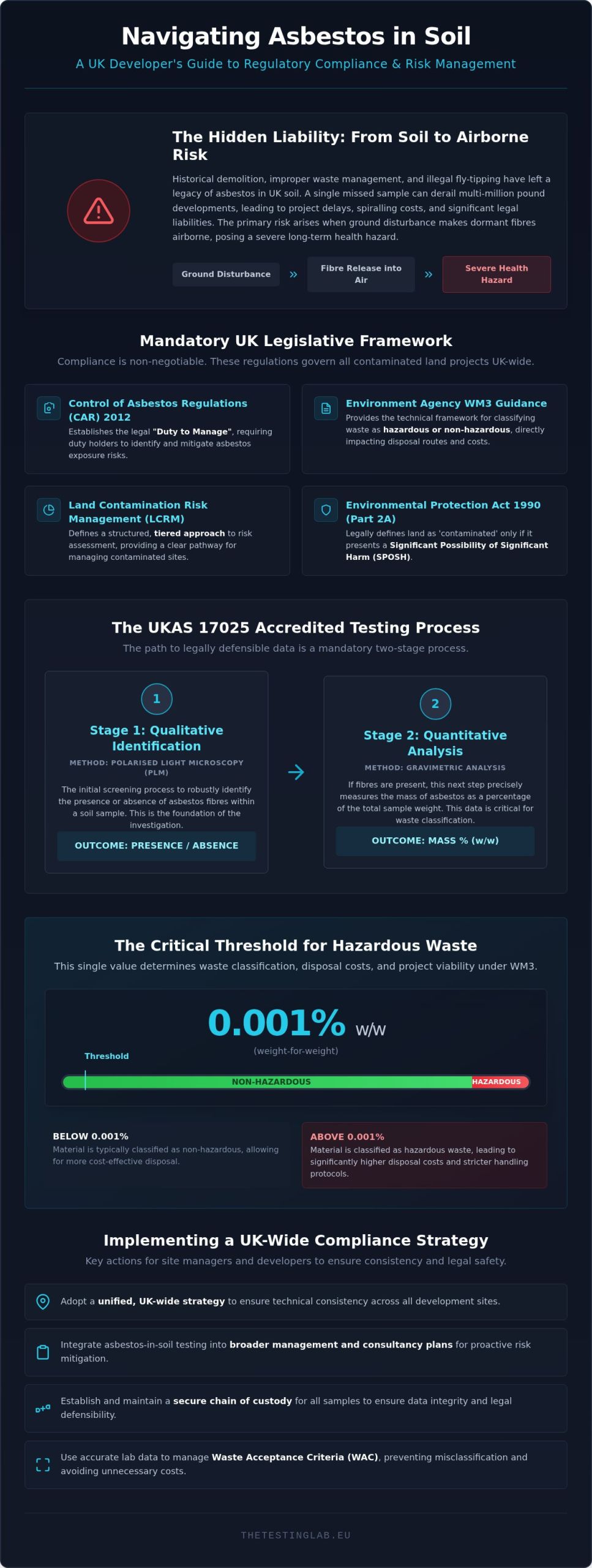
Asbestos contamination in UK soil isn’t a natural phenomenon; it’s a legacy of historical industrial practices, poor demolition protocols, or illegal fly-tipping. These fibres remain dormant and stable until the ground is disturbed. The primary risk during any development project is the transition of these microscopic fibres from the soil matrix into breathable air, where they pose a severe long-term health hazard to site workers and the public.
Precise asbestos in soil testing is the only way to quantify this risk before groundworks begin. Under the Control of Asbestos Regulations (CAR) 2012, duty holders have a legal Duty to Manage, requiring them to identify the presence of asbestos and mitigate exposure. On brownfield sites, this means integrating asbestos in soil testing into your initial site investigation to protect project ROI and legal standing UK wide.
Key UK Legislation Governing Contaminated Land
Site managers must look beyond CAR 2012 to ensure full compliance. The Environment Agency’s WM3 guidance provides the technical framework for classifying soil as hazardous or non-hazardous waste, a process that directly impacts your disposal costs. We align our methodology with the Land Contamination Risk Management (LCRM) framework, formerly CLR11, to provide a structured, tiered approach to risk assessment. Per Part 2A of the Environmental Protection Act 1990, land is only legally classified as contaminated if it presents a significant possibility of significant harm (SPOSH) to human health or the environment. By providing expert asbestos consultancy, we remove the burden of professional responsibility from your team.
UKAS Accredited Soil Testing Protocols and Laboratory Methods
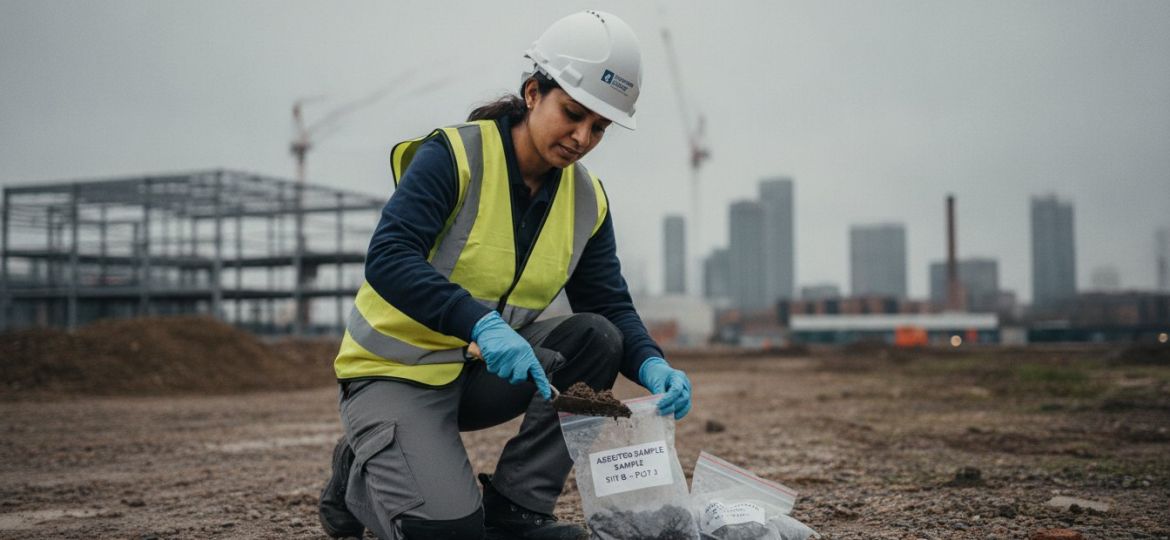
Legal defensibility in contaminated land management relies entirely on the quality of your data. This is why UKAS 17025 accreditation for all laboratory analysis is non-negotiable. Precise asbestos in soil testing ensures your results withstand scrutiny from the Environment Agency or local authorities. Our initial screening process, known as Stage 1, uses Polarised Light Microscopy (PLM) to identify the presence of asbestos fibres. This qualitative step is the foundation of any robust site investigation.
For brownfield redevelopment, asbestos in soils testing serves as a critical risk mitigation tool. It protects your workforce and prevents the accidental cross-contamination of clean areas. If you’re managing a complex site, you can request a technical consultation to align your testing regime with project timelines and budgetary requirements.
Quantification: From Identification to Gravimetric Analysis
Once fibres are identified, we transition from qualitative ‘presence/absence’ results to Stage 2: quantitative gravimetric analysis. This process determines the mass of asbestos present in the soil sample. The 0.001% weight-for-weight threshold is the critical benchmark here. If concentrations exceed this level, the material is likely classified as hazardous waste under WM3 regulations, which significantly increases disposal costs.
Understanding these levels is vital for the WAC and Waste Acceptance Criteria testing process. Landfill operators require this data to ensure they can legally accept the waste. We help you navigate these laboratory methods with engineering precision, ensuring your waste classification is accurate and your project stays on track UK wide.
Implementing a Compliance Strategy for UK-Wide Projects
Managing multiple development sites requires a unified, UK-wide strategy to ensure technical consistency and legal safety. Inconsistent sampling methods or varying laboratory standards across different regions can create massive liabilities and lead to conflicting data. By integrating asbestos in soil testing into your overarching asbestos consultancy and management plans, you create a robust framework that protects your project ROI. This proactive approach, supported by comprehensive local asbestos and legionella surveying, provides a vital safety pillar for your site operations regardless of location.
Best Practices for Site Managers and Developers
Efficiency in groundworks depends on meticulous data management and a clear understanding of laboratory outputs. We recommend several key steps to maintain project momentum:
- Establish a secure chain of custody: Every soil sample sent for laboratory analysis must be traceable from the point of extraction to the final report to ensure legal defensibility.
- Analyze the full certificate: Don’t just look for a ‘pass’ or ‘fail’ result. Understanding the specific fibre types and gravimetric concentrations allows your team to make informed remediation decisions rather than reacting to surprises.
- Schedule proactive WM3 testing: Don’t wait until the final stages of a project to classify your waste. Early testing prevents the common bottleneck of disposal delays at the end of the development cycle.
Establishing a precision asbestos in soil testing strategy ensures that your professional responsibility is shared with a strategic partner. This methodical approach transforms a regulatory hurdle into a manageable, predictable part of your project lifecycle.
Securing Your Project’s Future with Precision Analysis
Maintaining compliance on brownfield developments requires more than just ticking boxes. It demands a rigorous, engineering-led approach to risk management. We’ve explored how understanding the transition of fibres to air and implementing UKAS 17025 accredited laboratory methods protects both your workforce and your bottom line. Integrating precision WM3 and WAC analysis early in your project lifecycle eliminates the threat of costly disposal delays. Robust asbestos in soil testing remains the foundation of a successful remediation strategy.
As an independent UK-wide consultancy and UKAS Accredited Laboratory No. 23642, we act as your strategic partner. Our team provides the technical accuracy needed for complex contaminated land projects. Ready to ensure your site meets 2026 standards? Request a UK-wide soil testing quote from The Testing Lab PLC today. We’re here to support your next development with methodology you can trust.
Frequently Asked Questions
Is asbestos in soil testing a legal requirement for all UK construction sites?
Asbestos in soil testing is a legal requirement whenever a risk assessment identifies a foreseeable chance of contamination. Under the Control of Asbestos Regulations (CAR) 2012 and CDM 2015, duty holders must ensure workers aren’t exposed to fibres. While greenfield sites might require less scrutiny, brownfield developments almost always necessitate formal testing to satisfy local authority planning conditions and environmental health standards.
What is the difference between WAC testing and standard asbestos soil analysis?
Standard analysis identifies the presence and concentration of fibres to assess health risks on-site. Conversely, Waste Acceptance Criteria (WAC) testing is a specific requirement for landfill disposal. While standard asbestos in soil testing determines if the ground is hazardous, WAC testing evaluates how the waste will behave once buried, ensuring it meets the specific intake criteria of a licensed disposal facility.
How long does UKAS accredited asbestos in soil testing typically take?
Standard UKAS accredited analysis typically takes between three to five working days from the receipt of samples at the laboratory. We recognize that project timelines are often tight, so accelerated 24-hour or 48-hour turnaround times are frequently available for urgent site investigations. Fast results are essential to prevent standing time for plant machinery and avoid costly delays to your construction schedule.
What happens if asbestos is found in the soil during redevelopment?
If contamination is identified, you must immediately implement an asbestos management plan to protect site personnel. This doesn’t always mean total soil removal; solutions often include on-site capping, soil washing, or selective excavation of hotspots. We provide strategic consultancy to help you choose the most cost-effective remediation method while ensuring full compliance with the Environment Agency’s hazardous waste classification and WM3 guidance.

Article by
P J F Thomas
CEO and Founder of TTL plc.
Disclaimer
Items declared are AI generated but do reflect our services. Please get in contact if you have any questions.