A stagnant water system in an empty building isn’t just a maintenance oversight; it’s a dormant legal and biological liability that can result in unlimited fines under the Health and Safety at Work Act 1974. You’re likely aware that dormancy increases risk, yet the precise frequency of flushing and the rigour of re-occupancy protocols often remain points of significant confusion for duty holders. Successfully avoiding legionella in unoccupied properties requires a shift from passive observation to a structured, engineering led approach to water hygiene.
This guide provides the technical clarity you need to master essential flushing regimes and legislative requirements, ensuring your systems remain safe and compliant UK wide. We’ll outline how to align your operations with ACoP L8 and HSG274 standards to create a robust audit trail of risk management. By implementing these precise protocols, you can ensure a safe environment for returning tenants while securing the documented evidence necessary to satisfy HSE inspectors. For comprehensive support with your water safety strategy, our Legionella risk assessments and water management services provide the professional oversight required to mitigate these critical operational risks.
Key Takeaways
- Understand why water stagnation is the primary catalyst for biofilm accumulation and bacterial growth in UK wide building stock.
- Implement a precise weekly flushing regime as a core strategy for avoiding legionella in unoccupied properties, targeting high-risk dead legs and low-flow outlets.
- Learn the specific legislative triggers that mandate a full system disinfection and chlorination before any building is safely returned to service.
- Discover how UKAS accredited microbiological water testing provides the documented evidence required to validate system safety and satisfy ACoP L8 audit requirements.
The Science of Stagnation: Why Unoccupied Properties Are High-Risk Environments
Stagnation is the single most critical factor in the proliferation of Legionella pneumophila within UK wide building stock. When water sits motionless in pipes, it undergoes a fundamental biological shift. Without the mechanical shear stress of regular water flow, microbes easily adhere to internal surfaces. This inactivity creates a stable, hospitable environment for the bacteria responsible for Legionnaires’ disease to colonize and multiply. It’s a transition from a controlled utility to a dormant biological incubator.
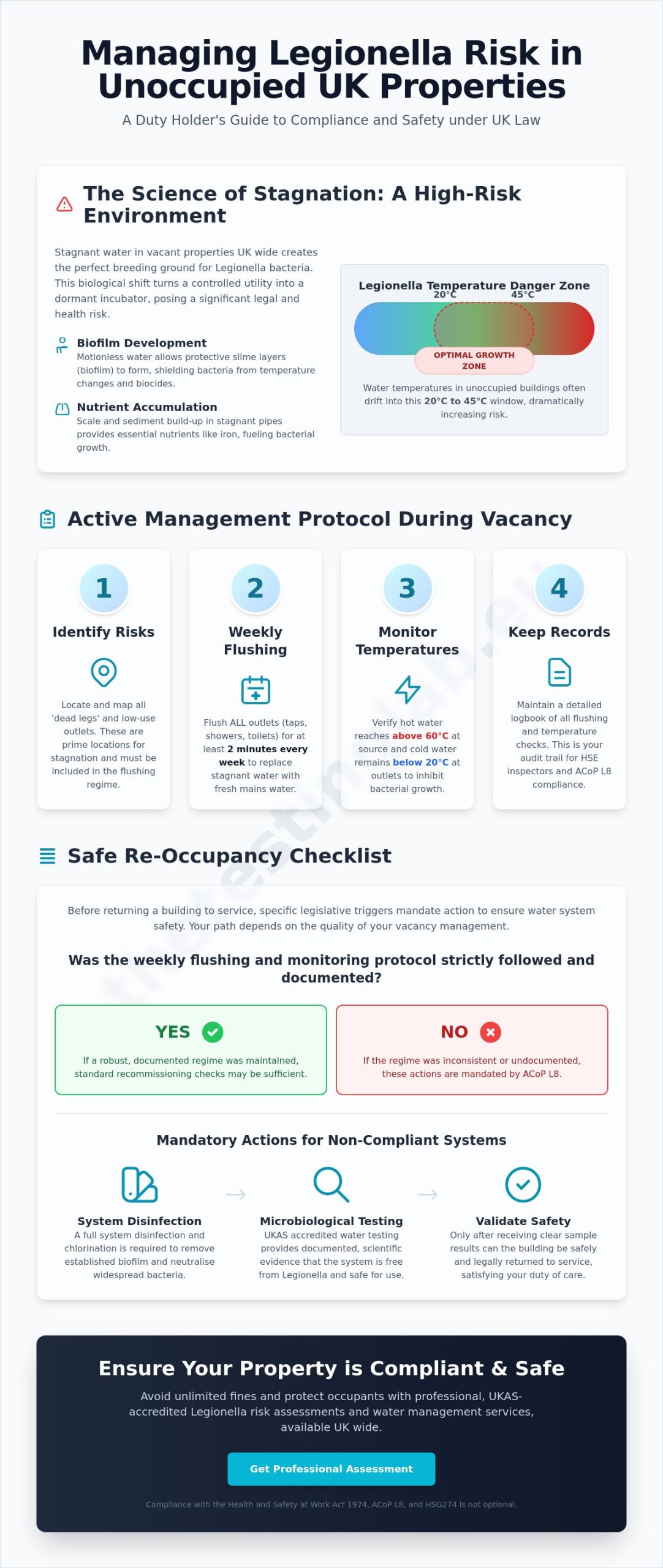
The “Legionella temperature window” typically sits between 20°C and 45°C. In unoccupied properties, heating systems are often lowered or deactivated, while cold water pipes aren’t being replenished with fresh, cold water from the mains. This causes internal water temperatures to drift directly into the danger zone. When you combine these ambient temperatures with the accumulation of scale and sediment, which provide essential nutrients like iron, the system becomes a self-sustaining environment for bacterial growth. Avoiding legionella in unoccupied properties requires understanding that these conditions develop rapidly, often within days of a building being vacated.
Biofilm Development in Low-Flow Systems
Stagnant water allows microscopic layers of slime, known as biofilm, to coat pipe interiors. These biofilms act as a protective shield, encasing bacteria and making them highly resistant to temperature fluctuations and standard biocides. While regular flushing is a vital preventive measure, it’s often insufficient once a complex biofilm is established. In such scenarios, simple water flow won’t dislodge the matrix; professional chemical intervention or full system disinfections are usually required to restore safety and compliance.
Legislative Framework: ACOP L8 and HSG274
Compliance isn’t optional for UK landlords or employers. Under the Health and Safety at Work Act 1974 and the COSHH Regulations 2002, property owners have a clear “duty of care” during vacancy. The HSE’s ACOP L8 holds a special legal status. If a duty holder is prosecuted for a breach, they must demonstrate they followed the code’s provisions or an equally effective alternative. Managing these risks through professional Legionella risk assessments and water management ensures that your technical protocols meet these rigorous legislative standards.
Step-by-Step Management: Avoiding Legionella During Property Vacancy
A common mistake is assuming a vacant building should be ‘mothballed’ by simply turning off the water supply. While mothballing is a valid long-term strategy, it requires a complex and costly recommissioning process. For short-to-medium term vacancies, active management is far more efficient for avoiding legionella in unoccupied properties. This approach maintains the system’s integrity and ensures it’s ready for immediate re-occupancy without the need for intensive remedial works.
Identifying ‘dead legs’ and low-use outlets is your first priority. These are sections of pipework where water can no longer flow, such as a redundant sink or a bathroom in a closed wing. According to HSE guidance on Legionella, these areas are prime locations for bacterial stagnation and must be integrated into your maintenance schedule. Neglecting even a single outlet can compromise the safety of the entire building.
The Weekly Flushing Protocol
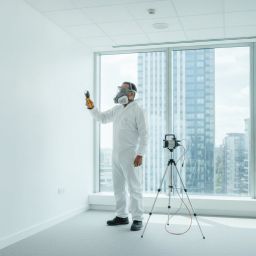
A rigorous flushing regime is the cornerstone of avoiding legionella in unoccupied properties, as it prevents the water from becoming stagnant. You must flush all outlets, including taps, showers, and toilets, for at least two minutes every week. This duration ensures the entire volume of water within the branch pipework is replaced with fresh, treated water from the main. To minimize the risk of inhaling contaminated droplets, place a plastic bag over showerheads or taps to contain the aerosol during the process.
Start by flushing the outlet furthest from the water entry point or the calorifier to draw fresh water through the entire main header, effectively ‘sweeping’ the system. It’s not enough to just run the water; you must also monitor temperatures. Ensure hot water reaches at least 60°C at the source and cold water stays below 20°C. If your system fails to hit these benchmarks, it indicates a failure in the thermal control regime that requires immediate attention.
Documenting Your Water Management Regime
Compliance isn’t just about doing the work; it’s about proving it. A health and safety audit will focus heavily on your ‘chain of evidence’. For every flushing event, you should record:
- Date and time of the activity
- Specific outlet ID or location
- Temperature readings for both hot and cold water
- The name of the person performing the task
Maintaining these records UK wide provides the transparency needed to satisfy regulatory inspections. Utilizing professional TTL PLC Legionella Risk Assessments ensures your documentation is structured correctly from day one. This systematic approach transforms a routine task into a robust legal defense. If you need assistance establishing a compliant regime, our team can provide expert water management support tailored to your property portfolio.
Re-Occupancy Protocols: Safely Bringing Water Systems Back Online
The final stage in avoiding legionella in unoccupied properties is the transition from maintenance to safe re-entry. You can’t rely on visual inspections alone to confirm a system is safe for tenants. If a property has been vacant for more than 30 days, or if your flushing regime was interrupted, a full system disinfection (chlorination) in accordance with BS 8558 is generally required. This chemical intervention neutralizes established biofilms that regular flushing might have missed during the vacancy period.
When to Conduct Microbiological Sampling
Sampling is the only way to validate that your control measures have worked. Triggers for sampling include properties being empty for over a month or instances where temperature controls failed to meet the required thresholds. It’s vital that you don’t take samples immediately after flushing; you must wait at least 48 hours to ensure the water sample is representative of the system’s actual state. For building managers in the capital, our London Legionella Surveying page provides specialized support within our UK wide service network. This methodical approach is supported by HSE guidance on Legionella, which emphasizes the duty holder’s responsibility to verify water safety before re-occupancy.
Interpreting Lab Analysis Reports
Professional lab analysis quantifies bacterial presence using Colony Forming Units per Litre (CFU/L). While DIY testing kits are available, they lack the precision and UKAS accreditation necessary to provide a legally defensible audit trail. UK health and safety standards dictate that any water sample returning a concentration higher than 1,000 CFU/L of Legionella bacteria necessitates an immediate review of the risk assessment, system disinfection, and follow-up sampling to confirm the efficacy of the remedial works. For further technical details on these action levels, refer to our Legionella Risk Assessment Services. The Testing Lab PLC serves as a strategic partner, providing independent, high-accuracy analysis to ensure your building is safe for return.
Securing Your Building’s Future through Proactive Compliance
Managing water hygiene in a vacant building is a continuous engineering challenge. It’s not a one-off task. By understanding the biological mechanics of stagnation and implementing a rigorous flushing protocol, you transform a potential liability into a managed asset. Transitioning back to full occupancy requires more than just turning on the taps. It demands the validation of UKAS Accredited Laboratory Analysis to ensure your duty of care is fully met and your tenants remain protected.
Successfully avoiding legionella in unoccupied properties depends on the integration of precise monitoring and independent professional consultancy. This structured approach provides you with comprehensive ACOP L8 compliance reporting. It safeguards both your occupants and your legal standing UK wide. Our team acts as your strategic partner, taking the technical burden off your shoulders. We ensure you’re always ready for re-occupancy with documented evidence of risk management.
Secure your UK-wide Legionella Risk Assessment today and gain the peace of mind that comes with industry leading expertise. You now have the roadmap to maintain a safe, compliant environment throughout any period of vacancy.
Frequently Asked Questions
How often should you flush taps in an empty house to avoid Legionella?
You should flush all water outlets at least once a week to maintain system hygiene. This frequency is the standard recommendation within HSG274 Part 2 to prevent the stagnation that leads to bacterial growth. For anyone responsible for avoiding legionella in unoccupied properties, this weekly task involves running taps and showers for at least two minutes to ensure the entire pipe volume is refreshed with treated water.
How long can water sit in pipes before Legionella bacteria starts to grow?
Water stagnation can become a significant risk factor in as little as two to seven days. Biofilms begin to establish themselves on pipe walls quickly when there’s no flow to provide mechanical scouring. If the ambient temperature in a UK wide building falls between 20°C and 45°C, the bacteria can multiply to dangerous levels within a week; this makes a consistent management regime essential for safety.
Do landlords have a legal requirement to test for Legionella in empty properties?
Landlords have a legal duty to carry out a risk assessment and implement control measures, but routine laboratory testing isn’t always a standalone requirement. Testing becomes mandatory if the risk assessment identifies a high risk or if control measures like temperature monitoring fail. Professional Legionella surveying and sampling is the only way to provide documented proof that a system is safe before new tenants move in.
What are the first signs of Legionnaires’ disease that tenants should know?
The initial symptoms often resemble a severe case of the flu, including a high fever, chills, and a persistent cough. Tenants might also experience muscle pain, headaches, and shortness of breath as the infection develops into pneumonia. These signs typically manifest between two and ten days after inhaling contaminated water droplets. Early diagnosis is critical; anyone showing these symptoms after moving into a previously vacant property should seek medical advice immediately.

Article by
P J F Thomas
CEO and Founder of TTL plc.
Disclaimer
Items declared are AI generated but do reflect our services. Please get in contact if you have any questions.