Relying on your removal contractor to verify their own cleanup isn’t just a conflict of interest; it’s a significant regulatory risk under the current asbestos air monitoring regulations UK. You likely understand that managing asbestos is a high-stakes responsibility where errors lead to heavy fines or legal action. It’s common to feel overwhelmed by the technicalities of which air test is mandatory for your specific project.
This guide clarifies the 2026 compliance standards, ensuring your site remains fully compliant and safe for re-occupation. We’ll break down the 4-stage clearance process, the importance of independent UKAS-accredited verification, and the latest HSE enforcement focuses to protect your business UK wide. By following this structured, methodology-driven approach, you’ll secure impartial third-party verification of site safety and establish a clear, documented path to re-occupation.
Key Takeaways
- Understand how Regulation 16 of the CAR 2012 dictates your legal duties regarding asbestos air monitoring regulations UK to ensure full statutory compliance.
- Learn why independent, UKAS-accredited verification is essential for impartial site safety assessments and conflict-free project management UK wide.
- Identify the technical differences between background and leakage testing to maintain rigorous environmental controls during hazardous works.
- Master the methodology of the 4-stage clearance process to ensure a safe, documented path to building re-occupation.
The Legal Framework: CAR 2012 and Asbestos Air Monitoring Regulations UK
The Control of Asbestos Regulations 2012 (CAR 2012) serves as the statutory foundation for managing hazardous fibres UK wide. While it evolved from the Control of Asbestos Regulations 2006, the current framework places a heavier emphasis on analytical transparency and precise exposure records. Regulation 16 specifically mandates the monitoring of exposure to ensure that control measures remain effective. Adhering to asbestos air monitoring regulations UK isn’t optional; it’s a critical component of a duty holder’s legal defense.
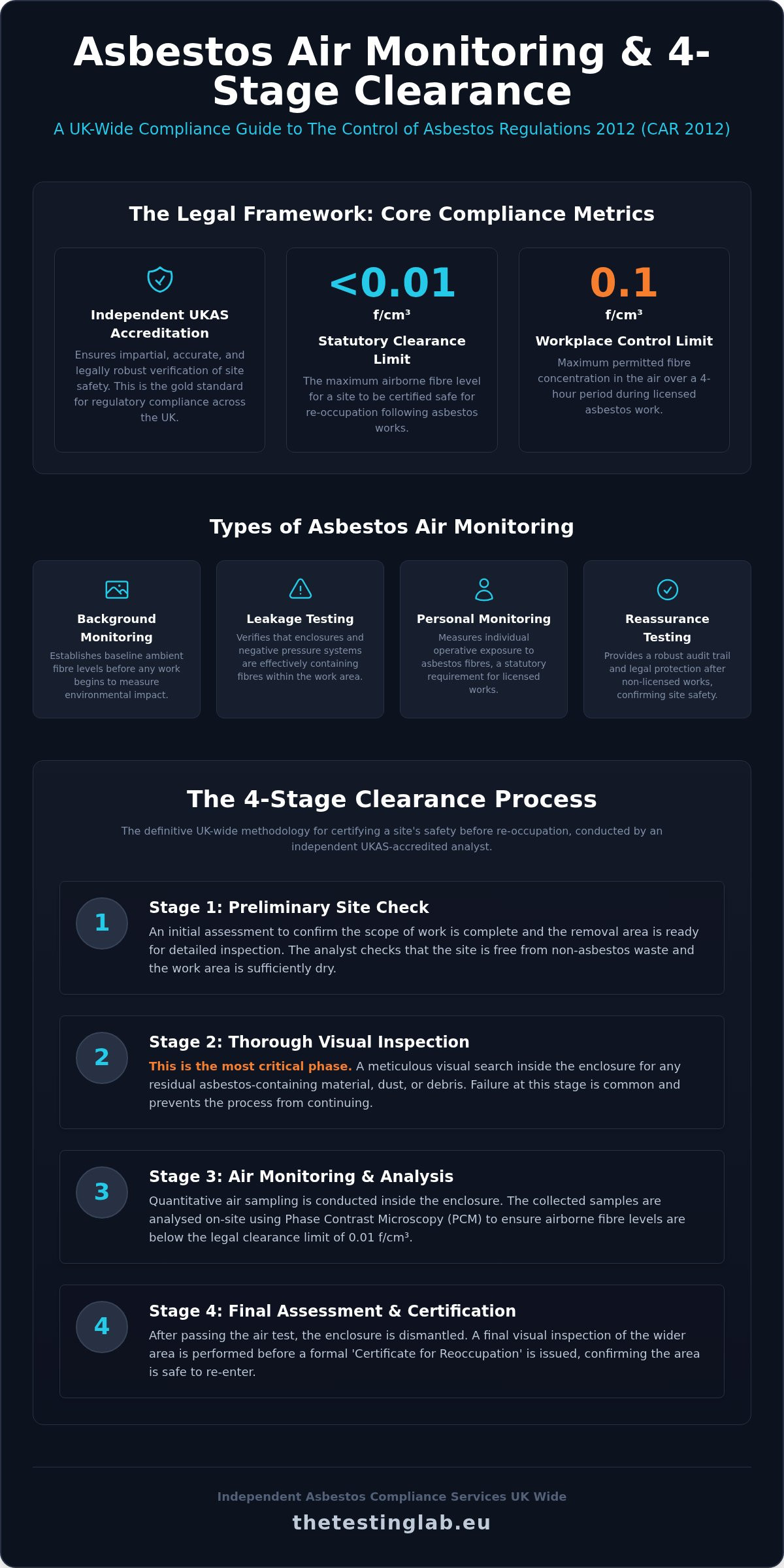
Under the ‘Duty to Manage’, responsible parties must ensure that airborne fibre levels remain below the statutory clearance limit of 0.01 f/cm3. Failing to maintain these standards can lead to immediate HSE intervention and potential prosecution. The Control Limit is the maximum concentration of asbestos fibres permitted in the air over a four-hour period, currently set at 0.1 f/cm3.
The Critical Role of UKAS Accreditation in 2026
In 2026, the HSE has increased its focus on the independence of air testing. UKAS accreditation represents the gold standard for laboratory analysis, providing a technical guarantee that the results are both accurate and impartial. Using a non-accredited laboratory for compliance-based air testing creates a significant legal vulnerability, as the data may not hold up under regulatory scrutiny. The Testing Lab PLC acts as a strategic partner, delivering independent asbestos consultancy that removes the professional liability from your shoulders UK wide. This impartial approach ensures that clearance certificates are based on precise, methodology-driven data rather than commercial convenience.
Types of Asbestos Air Monitoring: Which Test Does Your Site Require?
Site conditions and the nature of the material being disturbed dictate the specific analytical methodology required. Background monitoring establishes the ambient fibre concentration before any work begins. This baseline is vital for demonstrating that subsequent activities haven’t increased environmental risks. When projects involve land remediation, specialized testing for asbestos in soils is critical to ensure dust suppression remains effective. This technical rigor is a core expectation under the current asbestos air monitoring regulations UK for projects managed UK wide.
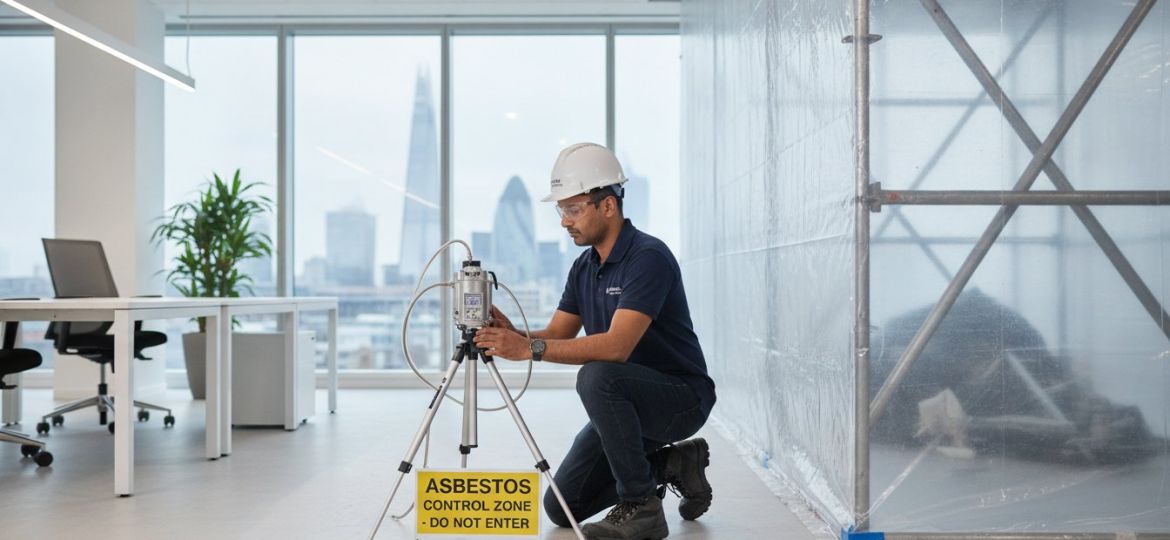
Leakage testing must be conducted during the initial stages of any large-scale removal project. These tests verify that enclosures and negative pressure systems are effectively containing fibres within the work zone. Personal monitoring provides granular data on individual operative exposure, which is a statutory requirement for licensed works. These protocols often trace their technical lineage back to the Control of Asbestos in the Air Regulations 1990, which helped establish the framework for modern safety standards.
Mandatory Monitoring Scenarios for UK Wide Projects
In 2026, the HSE has refined the distinction between mandatory requirements and best-practice safety measures. Licensed removal of friable materials, such as pipe insulation, necessitates comprehensive air monitoring throughout the project lifecycle. For non-friable materials like floor tiles or cement, while air monitoring isn’t always a strict legal mandate, reassurance testing is highly recommended. This provides a robust audit trail and legal protection for the duty holder. Every project requires a site-specific risk assessment to determine the necessary monitoring frequency. If you’re managing a complex redevelopment, securing an independent asbestos survey and monitoring plan is the most reliable way to maintain compliance with asbestos air monitoring regulations UK.
The 4-Stage Clearance Process: Ensuring Safe Re-occupation
The 4-stage clearance process is the definitive methodology for certifying a site’s safety before re-occupation. Under asbestos air monitoring regulations UK, this process must be conducted with absolute precision to prevent exposure risks. Stage 1 involves a preliminary site check to ensure the removal area is dry and free from waste. Stage 2, the thorough visual inspection, is arguably the most critical phase. Many projects fail here due to residual dust or debris. HSE research on 4-stage clearances highlights that a rigorous visual check is essential for identifying hidden contamination that air tests might miss.
Stage 3 transitions to quantitative analysis. We use Phase Contrast Microscopy (PCM) to count airborne fibres, ensuring levels are below the 0.01 f/cm3 threshold as dictated by asbestos air monitoring regulations UK. Finally, Stage 4 encompasses the post-clearance handover and the issuance of the Certificate for Re-occupation. It’s imperative to choose an independent laboratory for this process. This removes any conflict of interest between the removal contractor and the analytical team, providing duty holders with transparent, third-party verification of site safety UK wide.
Partnering for National Compliance and Site Safety
Multi-site operators require a consistent, methodology-driven approach across their entire portfolio. A UK wide network of consultants streamlines the clearance process, ensuring that every facility meets the same high standards of safety. Integrating asbestos consultancy with on-site lab testing reduces downtime and simplifies project management. You can request a professional asbestos air monitoring quote to secure your project’s compliance. Our team operates as a strategic partner, taking the professional liability off your shoulders and ensuring your London site or regional facility is safe for re-entry.
Securing Your Site Safety for 2026 and Beyond
Maintaining full compliance with asbestos air monitoring regulations UK requires a transition from basic oversight to rigorous, independent verification. The 2026 standards emphasize that analytical independence is the only way to truly mitigate legal risks and ensure environmental safety. By implementing a structured 4-stage clearance process and utilizing UKAS-accredited expertise, you protect your building’s occupants and your organization’s reputation. We operate as your strategic partner UK wide, delivering impartial results that stand up to the strictest HSE scrutiny.
Our UKAS Accredited Laboratory provides expert 4-stage clearance testing and independent consultancy to take the professional liability off your shoulders. We focus on methodology and precision so you don’t have to worry about the complexities of site safety. Secure your UK wide compliance with our independent asbestos air monitoring services and move forward with your redevelopment projects with total confidence. Ensuring a safe, re-occupiable environment is a complex task, but with the right expert support, it’s a goal you’ll consistently achieve.
Frequently Asked Questions
Is asbestos air monitoring a legal requirement for all removal works?
While not mandatory for every minor non-licensed task, it is a strict legal requirement for all licensed asbestos removal projects. For non-licensed work, monitoring is often necessary to demonstrate that fibre levels remain below the statutory control limit. Duty holders UK wide utilize these tests to maintain a robust audit trail and fulfill their statutory health and safety obligations.
What is the difference between a clearance test and reassurance monitoring?
A clearance test is a mandatory 4-stage process required to certify that an enclosure is safe for re-occupation after licensed work. Reassurance monitoring is a localized test performed after non-licensed disturbances or when an enclosure was not required. Both tests are essential for verifying safety under the asbestos air monitoring regulations UK, providing technical verification for building occupants.
How long does it take to receive asbestos air testing results on-site?
Preliminary on-site results are typically available within 60 to 90 minutes after the air sampling pumps have completed their cycle. Our analysts utilize mobile laboratory facilities to perform Phase Contrast Microscopy (PCM) immediately, facilitating rapid site handovers. This methodology ensures that projects UK wide maintain momentum without compromising the precision required for high-stakes regulatory compliance and safety verification.
Can my asbestos removal contractor perform the air monitoring themselves?
No, current guidance dictates that air monitoring and 4-stage clearances should be conducted by an independent, UKAS-accredited laboratory. This prevents a technical conflict of interest where a contractor would be auditing their own work. Adhering to asbestos air monitoring regulations UK requires this impartial verification to ensure the site is objectively safe for re-occupation by the general public.

Article by
P J F Thomas
CEO and Founder of TTL plc.
Disclaimer
Items declared are AI generated but do reflect our services. Please get in contact if you have any questions.