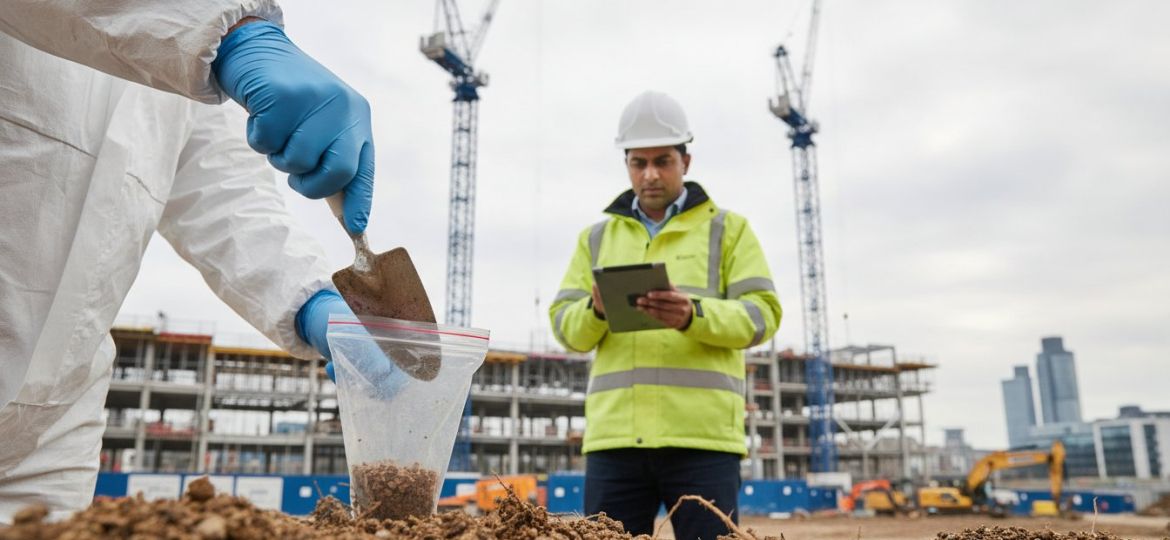
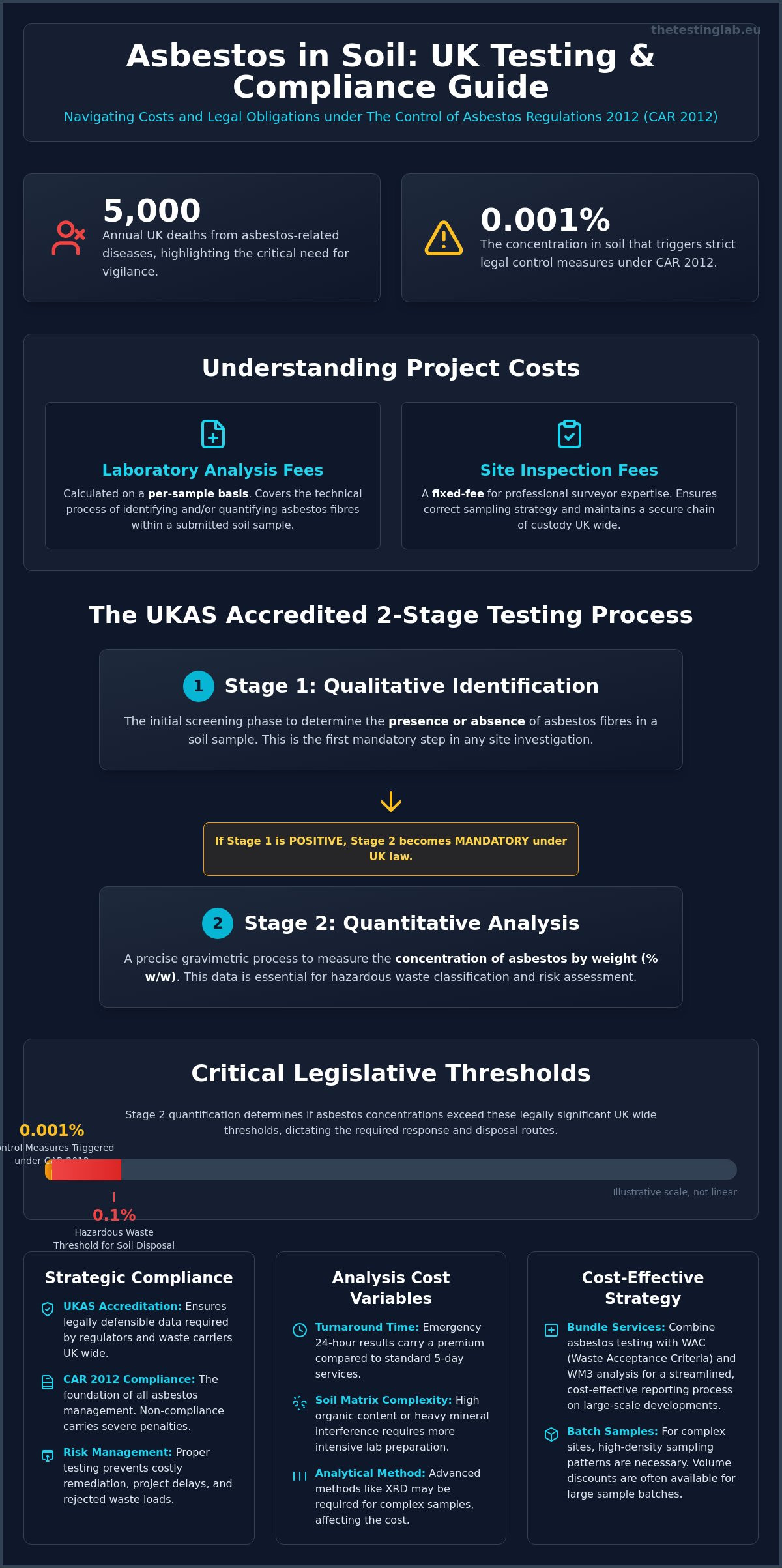
Asbestos-related diseases still claim approximately 5,000 lives annually in the UK, yet many brownfield developers remain unaware that even a 0.001% concentration in soil triggers strict legal obligations under CAR 2012. It’s understandable why project managers feel frustrated by the complexity of asbestos in soil testing cost UK considerations, especially when balancing tight construction budgets against rigid health and safety mandates. You need precision, not guesswork, to ensure your project stays on track and remains fully compliant with current legislation.
This guide provides a transparent breakdown of how professional laboratory fees are structured and explains the critical regulatory factors that influence site investigation expenses UK wide. You’ll gain a clear understanding of the technical distinctions between simple identification and full quantification. By the end of this article, you’ll know exactly how to manage your sampling batches to maintain compliance while securing a reliable testing partner for your next development. We’ll remove the burden of professional responsibility by clarifying the methodology behind every lab fee.
Key Takeaways
- Understand the technical breakdown between per-sample laboratory analysis fees and fixed-fee site inspections to eliminate budget unpredictability for your project.
- Identify the critical factors that determine the asbestos in soil testing cost UK, including the transition from qualitative Stage 1 identification to precise Stage 2 quantification.
- Master compliance with CAR 2012 by learning which testing methodologies are mandatory for hazardous waste classification and site risk assessments UK wide.
- Discover how bundling soil investigation with WAC and WM3 analysis provides a more cost-effective and streamlined reporting process for large-scale developments.
- Learn how partnering with an independent UKAS-accredited laboratory removes the burden of professional responsibility and ensures unbiased data for remediation strategies.
Understanding the Components of Asbestos in Soil Testing Costs
Accurate budgeting for land redevelopment depends on a granular understanding of how service providers structure their fees. The total asbestos in soil testing cost UK developers face is generally split between laboratory-side processing and consultancy-led site work. For those needing a comprehensive overview of asbestos risks, it’s vital to recognize that soil is a complex matrix. It requires more rigorous handling than standard building materials to ensure results are representative of the actual ground conditions. We view this not just as a fee, but as a precision-based risk management strategy.
Laboratory Analysis vs. Site Inspection Fees
Lab fees are typically calculated on a per-sample basis. This covers the technical process of identifying asbestos fibres within a soil sample. However, simply sending a bag of dirt to a lab isn’t enough for legal compliance. Professional site inspection charges are fixed fees that cover the expertise of a surveyor. They ensure samples are taken from the correct locations and depths, which prevents blind spots on a site that could lead to massive remediation costs later. Professional consultants also manage the necessary UK wide logistics, maintaining a secure chain of custody from the moment the sample is extracted to its arrival at the bench.
The Importance of UKAS Accredited Testing
Relying on non-accredited results is a significant risk under the Control of Asbestos Regulations 2012. UKAS accreditation ensures that the laboratory follows strict, audited methodologies for both identification and quantification. Choosing UKAS accredited asbestos testing provides the legal defensibility required for planning departments and waste carriers. For large-scale brownfield investigations, volume discounts are often available for large sample batches. This helps mitigate the asbestos in soil testing cost UK for complex sites requiring high-density sampling patterns. If you’re managing projects in the capital, our London-based surveying services offer a streamlined route to site assessment and expert sample collection.
Variables Affecting Professional Soil Analysis Pricing
Determining the total asbestos in soil testing cost UK requires a look beyond simple identification. While a basic Stage 1 analysis confirms the presence of fibres, it rarely provides enough data for a comprehensive risk assessment or waste classification. The pricing structure shifts significantly when you move from qualitative identification to quantitative analysis. This transition is essential because UK legislation, specifically CAR 2012, demands precise data once a positive identification is made. Several technical factors influence the final lab fee:
- Turnaround Requirements: Emergency 24-hour results carry a surcharge compared to standard five-day windows.
- Matrix Complexity: Soils with high organic content or heavy mineral interference require more intensive preparation.
- Analytical Method: Standard microscopy vs. advanced XRD or XRF for specific mineral identification.
Stage 2 Quantification: A Necessary Investment
If Stage 1 returns a positive result, Stage 2 quantification becomes mandatory to determine the concentration by weight. This process uses gravimetric quantification to measure whether the asbestos content exceeds the 0.1% hazardous waste threshold or the 0.001% threshold for control measures. For a deeper technical look at these methodologies, our asbestos in soils specialist page details the laboratory precision required. In cases where soil matrices are particularly complex, we utilize advanced XRD analysis to ensure results are legally defensible.
Legislative Compliance and Risk Management
Project timelines often dictate the final invoice, yet the cost of a delay on a major construction site far outweighs any laboratory surcharge. Following industry guidance for managing asbestos from CL:AIRE is the only way to mitigate the financial risk of a failed Material Management Plan. Inadequate data can lead to the rejection of soil at waste facilities, resulting in remediation expenses that dwarf the initial asbestos in soil testing cost UK. We act as your strategic partner to ensure your data is robust enough to withstand regulatory scrutiny UK wide. If you’re managing a site in the capital, our London surveying team can assist with rapid sample recovery and dispatch.
Strategic Compliance: Cost-Effective UK Wide Soil Investigation
Strategic compliance requires more than just reactive sampling. It involves a systematic approach where testing is integrated into the broader site investigation process. By bundling the asbestos in soil testing cost UK with other essential analyses, developers can achieve significant operational efficiencies. This method ensures that all legal bases are covered simultaneously. It reduces the need for multiple site visits and separate laboratory inductions, which can otherwise inflate project budgets. We operate as a strategic partner to streamline these technical requirements UK wide.
Our status as an independent consultancy removes the conflict of interest often found when testing and remediation are handled by the same firm. We provide unbiased, UKAS-accredited data that allows you to make informed decisions about soil management. This transparency is vital for maintaining the integrity of your project’s health and safety profile. Whether you’re managing a single brownfield plot or a national portfolio, consistent pricing structures help maintain financial control.
Integrating WAC and Waste Classification
Accurate waste characterisation is a commercial necessity for any development. Combining asbestos analysis with WAC testing allows for a seamless transition from site investigation to disposal. Without this integrated data, you risk misclassifying material. This can lead to HMRC LOI fines or the rejection of soil at the gate. We also provide WM3 testing to ensure your hazardous waste assessment is fully compliant with current environmental regulations.
Partnering for National Compliance
Effective risk management relies on following the AGS Asbestos in Soils Safety Guidance. Our team provides London and UK wide surveying services that adhere to these industry standards. This national reach ensures that your reporting remains consistent, regardless of the site location. To secure a clear breakdown of fees for your specific project, you can request a professional testing quote from our technical experts. We take the burden of professional responsibility off your shoulders by providing precise, legally defensible results.
Securing Regulatory Compliance and Project Efficiency
Managing ground contamination requires a shift from reactive sampling to a methodologically sound investigation strategy. By understanding the technical drivers behind the asbestos in soil testing cost UK, project managers can avoid the significant financial penalties associated with misclassified waste or inadequate risk assessments. We’ve explored how the transition from Stage 1 identification to Stage 2 quantification ensures your data is robust enough to meet CAR 2012 standards while protecting your site’s bottom line. Precision in the laboratory translates directly to cost stability on site.
As an independent UK wide consultancy, we offer the technical precision of a UKAS accredited laboratory. Our focus remains on providing CAR 2012 compliant reporting that removes the burden of professional responsibility from your team. Integrating these technical tests with WAC and WM3 analysis doesn’t just save time; it provides a comprehensive legal shield for your development process. Ready to streamline your site investigation? Request a UK Wide Asbestos in Soil Testing Quote today to ensure your project remains on track. Your project’s safety and success are built on the foundation of accurate, independent data.
Frequently Asked Questions
How much does a single asbestos in soil test cost in the UK?
The total asbestos in soil testing cost UK developers incur depends on the specific level of analysis required and the volume of samples submitted. While individual laboratory fees for fibre identification form the base cost, professional site visits and secure logistics for projects UK wide are typically provided as fixed-fee quotations. Scaled pricing is often available for large-scale brownfield investigations where high-density sampling patterns are necessary for compliance.
What is the difference between asbestos identification and quantification in soil?
Asbestos identification is a qualitative Stage 1 process that confirms the presence or absence of fibres within a soil matrix. Quantification is a more intensive Stage 2 gravimetric analysis that measures the exact percentage of asbestos by weight. Under CAR 2012, this quantification is mandatory once a positive identification is made to determine whether the soil exceeds the 0.1% hazardous waste threshold.
Do I need a UKAS accredited lab for soil testing on a brownfield site?
Yes, utilizing a UKAS accredited laboratory is a fundamental requirement for legal defensibility and regulatory compliance UK wide. Accreditation ensures that the testing facility follows audited, high-precision methodologies that meet the standards expected by the HSE and local planning authorities. Results from non-accredited sources are frequently rejected by waste disposal sites, which can lead to significant project delays and increased remediation expenses.
How long does it take to get asbestos soil test results back?
Standard laboratory turnaround times for soil analysis typically range from three to five working days from the point of sample reception. For time-critical construction projects where delays carry high financial risks, emergency 24-hour or 48-hour premium services are usually available. It’s best to confirm your specific timeline when requesting a technical quote to ensure the laboratory’s capacity aligns with your project’s operational schedule.

Article by
P J F Thomas
CEO and Founder of TTL plc.
Disclaimer
Items declared are AI generated but do reflect our services. Please get in contact if you have any questions.