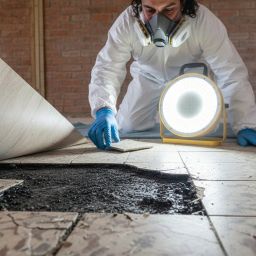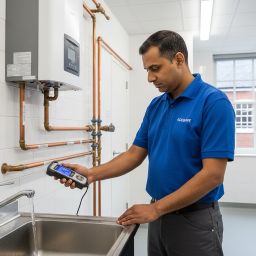
What if the complex document sitting on your desk is actually the most critical tool for your building’s safety rather than just another administrative hurdle? For many UK dutyholders, understanding an asbestos survey report feels like trying to decode a foreign language while the clock ticks on legal compliance. With approximately 5,000 asbestos-related deaths occurring annually in Great Britain, the stakes for getting your risk management right under the Control of Asbestos Regulations 2012 (CAR 2012) have never been higher.
It’s completely normal to feel overwhelmed by technical jargon or the subtle differences between presumed and confirmed asbestos. You want the peace of mind that comes from knowing your site is safe and your legal obligations are met. This guide will help you decode technical findings, interpret complex risk scores, and transform that data into a prioritised action plan. We’ll walk through exactly how to read your results so you can maintain a robust management strategy, whether you’re overseeing a small retail unit or a large office complex. For expert support in managing these requirements, you can access the professional asbestos surveying services of The Testing Lab PLC across the UK.
Key Takeaways
- Learn how your survey satisfies the legal “Duty to Manage” under Regulation 4 of CAR 2012 to ensure full compliance for your premises.
- Master the art of understanding an asbestos survey report by decoding the 0-12 material assessment scoring system to identify high-priority risks.
- Discover why the Asbestos Risk Register is your most vital tool for protecting contractors and staff before any maintenance work begins.
- Understand the critical role of UKAS-accredited laboratory analysis (ISO 17025) in providing legally defensible results for your building.
- Identify why the Executive Summary serves as your immediate roadmap for urgent safety actions and long-term risk management.
The Legal Significance of Your Asbestos Survey Report
A survey report isn’t just a technical summary; it’s a legal shield. Under the Control of Asbestos Regulations 2012 (CAR 2012), specifically Regulation 4, anyone responsible for non-domestic premises has a “Duty to Manage” asbestos. This duty requires you to identify the presence of asbestos, assess its condition, and create a plan to manage any risks. Understanding an asbestos survey report is the first step in this process. Without it, you can’t accurately populate your Asbestos Management Plan (AMP) or protect building occupants from the dangers of asbestos.
It’s vital to distinguish between a Management Survey and a Refurbishment/Demolition (R&D) Survey. A Management Survey is your standard tool for everyday occupancy. It’s designed to locate Asbestos Containing Materials (ACMs) that could be disturbed during normal use. In contrast, an R&D Survey is intrusive and mandatory before any construction or renovation work begins. It ensures hidden materials are identified before they’re accidentally disturbed. Your report isn’t a static file to be archived. It’s a living document. Asbestos conditions change over time due to wear, tear, or water damage. Regular reviews are essential to ensure the data remains accurate and your site stays compliant with UK law.
Why a Professional Survey is Mandatory
Attempting to sample materials yourself is a high-risk strategy that often leads to legal and safety failures. Professional surveys, conducted by organisations holding ISO/IEC 17020 accreditation, provide the precision required for legal defensibility. Inadequate management can result in unlimited fines or even imprisonment for those responsible. If your records are outdated or incomplete, you’re effectively flying blind during maintenance projects. For complex sites, seeking asbestos consultancy services ensures that your strategy aligns with the latest HSE guidance and keeps your team safe.
CAR 2012 and the Dutyholder Role
In commercial and industrial settings, the Dutyholder is typically the building owner, the tenant with maintenance responsibilities, or the appointed facilities manager. Your report acts as the foundation for the Asbestos Management Plan (AMP) by providing the raw data needed to set safety priorities. By understanding an asbestos survey report, you can ensure that every contractor walking onto your site has the most current information available to prevent accidental exposure. The Dutyholder’s primary responsibility under UK law is to identify the location and condition of asbestos and manage the risk to prevent exposure.
Key Sections of a Professional Asbestos Report
A high-quality asbestos report is structured to guide you from high-level risks down to granular, material-specific data. Understanding an asbestos survey report starts with recognizing that each section serves a specific safety function. While the full document might span dozens of pages, it’s designed to provide a transparent audit trail of the surveyor’s findings. This transparency is crucial because the document acts as the primary evidence that you’ve fulfilled the legal requirement for an asbestos survey. If sections are missing or vague, your legal protection is compromised.
The “Scope of Survey” is particularly critical. It defines exactly which parts of your building were inspected. If a specific outbuilding or ceiling void is excluded from the scope, the report doesn’t cover those areas. You can’t assume a room is “asbestos-free” just because it isn’t mentioned; it simply means it wasn’t part of the investigation. Clear boundaries prevent dangerous assumptions during future maintenance work. If you’re managing multiple properties, our team provides comprehensive asbestos surveying in London and across the UK to ensure no corner is left unexamined.
Decoding the Executive Summary
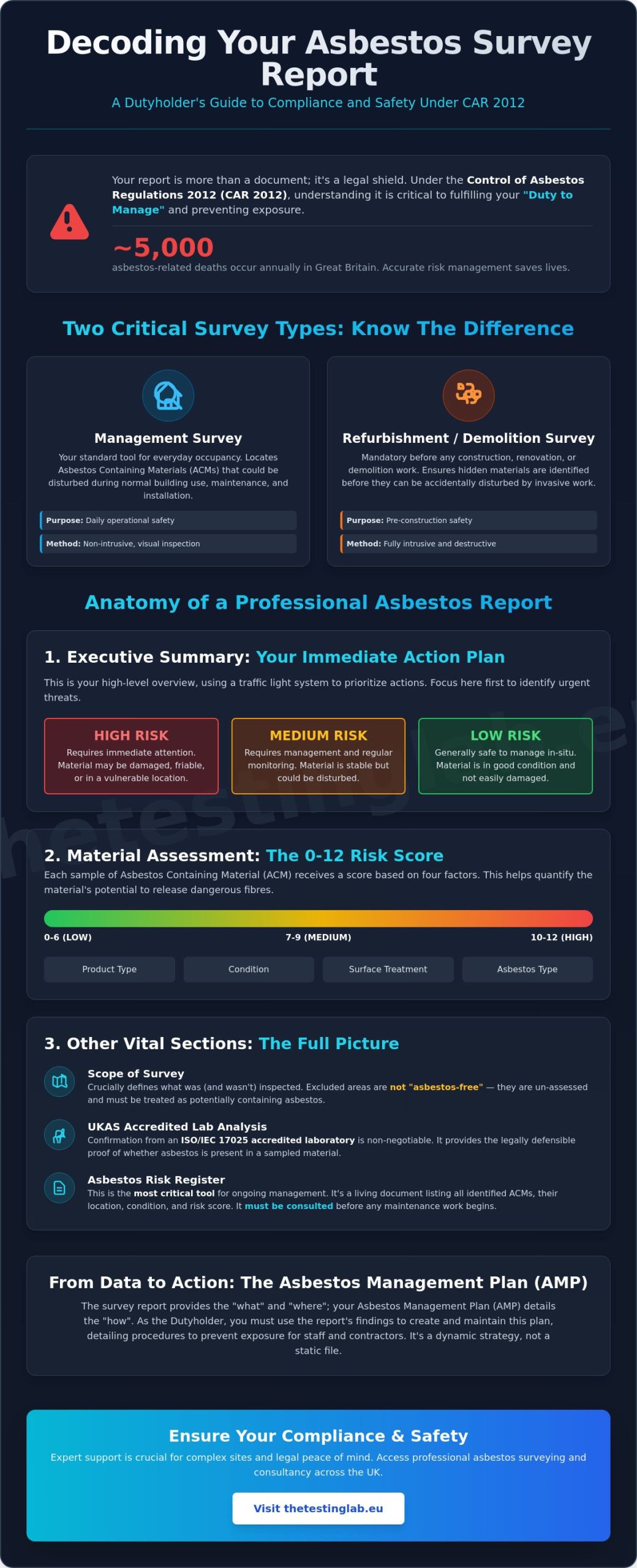
The Executive Summary is your immediate priority list. Professional surveyors use a “traffic light” colour-coding system to help you identify urgent threats. Red items indicate high-risk materials that require immediate attention, often due to their poor condition or high friability. Amber suggests a medium risk that needs monitoring, while green items are generally safe to manage in situ. This summary table allows you to report quickly to stakeholders or board members without getting lost in the technical appendices. It’s the most efficient way to communicate the current safety status of your assets.
Managing “No Access” Limitations
One of the most dangerous parts of any report is the “No Access” section. Surveyors often encounter areas they can’t safely enter, such as live electrical cupboards, high-level roof voids, or locked plant rooms. Under UK legislation, you must presume asbestos is present in any area that hasn’t been accessed. This isn’t just a suggestion; it’s a legal requirement. You’ll need to plan follow-up inspections for these areas, perhaps during a scheduled power shutdown or with specialist access equipment, to clear these limitations and fully secure your site’s safety. Ignoring these gaps is a major liability that can lead to accidental exposure during future repairs.
Interpreting Material Assessments and Risk Scores
Many dutyholders find the numerical data in their reports the most intimidating section. However, it’s actually the most logical part of the document. These scores aren’t arbitrary; they follow a strict formula designed to remove guesswork from safety management. This standardized approach provides a clear, defensible guide on how to read a survey report and prioritise your remedial budget. Without these scores, you’d have no way of knowing whether a floor tile or a pipe lagging poses a greater immediate threat to your staff.
The Material Assessment Algorithm (MAA)
The Material Assessment Algorithm (MAA) is a standardized scoring system used to determine the potential for asbestos fibres to be released from a material based on its physical properties. It examines four specific parameters, each scored from 0 to 3. The “Product Type” looks at how easily the material can be broken (friability). For example, solid floor tiles score low, while loose insulation or lagging scores high. The “Extent of Damage” is arguably the most critical variable; even a low-risk product becomes a high-priority issue if it’s currently crumbling or broken. The final two parameters, “Surface Treatment” and “Fibre Type,” account for how well the asbestos is sealed and its biological toxicity.
The total score ranges from 0 to 12. Understanding an asbestos survey report requires knowing these three thresholds:
- Low Risk (2-6): The material is in good condition and unlikely to release fibres during normal activity.
- Medium Risk (7-9): There’s a moderate potential for fibre release; these items need careful monitoring or encapsulation.
- High Risk (10-12): These are red-flag items that often require immediate restricted access or professional removal.
Presumed vs. Confirmed: The Lab Factor
A common point of confusion for dutyholders is the distinction between sampled and presumed materials. If a surveyor can’t safely take a sample, they’ll list the item as “Presumed” or “Strongly Presumed.” A “Strongly Presumed” label is used when the material looks identical to a confirmed sample taken elsewhere in the building. From a legal standpoint, you must treat these items as if they’re 100% confirmed asbestos until proven otherwise. This “safety first” approach prevents accidental exposure while you wait for further investigation.
Definitive proof only comes from bulk sample analysis in a UKAS-accredited laboratory. This process identifies the specific fibre type, such as Chrysotile (white), Amosite (brown), or the highly dangerous Crocidolite (blue). While the survey identifies where the risk is, the lab analysis confirms exactly what you’re dealing with. In cases where external grounds or brownfield sites are involved, asbestos in soils testing becomes an essential part of the assessment process to ensure the entire footprint of your property is secure.
Turning Findings into Action: The Asbestos Risk Register
The Asbestos Risk Register (ARR) is the most critical component of the entire document. While the rest of the report provides context and methodology, the register is your operational roadmap. It lists every identified and presumed Asbestos Containing Material (ACM) in a format designed for quick reference. Understanding an asbestos survey report means knowing that this register must be accessible to anyone likely to disturb the fabric of the building. It’s the primary tool you’ll use to brief plumbers, electricians, and maintenance staff before they pick up a drill. Providing this information isn’t just best practice; it’s a legal requirement to prevent accidental exposure.
Material vs. Priority Assessments
There’s a vital distinction between the Material Assessment provided by the surveyor and the Priority Assessment required from the dutyholder. The surveyor scores the material’s physical condition and fibre type. However, they don’t always know how the building is used daily. The Priority Assessment factors in “Human Exposure Potential.” For instance, an asbestos cement panel in a locked, rarely visited basement has a low priority score despite its material properties. Conversely, the same material in a high-traffic school hallway becomes a high priority because the likelihood of accidental impact is much greater. The Dutyholder must merge these two scores to determine the final risk level and remedial timeline.
Immediate Next Steps After Receiving a Report
Once the report lands on your desk, the clock starts on your management actions. You can’t simply file it away. Your first step is to communicate the findings. All building occupants and maintenance teams must know where ACMs are located to prevent accidental disturbance. Second, you should label identified materials where it’s safe and practical, using industry-standard warning signs. Finally, you must update your Asbestos Management Plan (AMP) to reflect the new data. This ensures your safety strategy is based on current facts rather than outdated assumptions.
For organisations needing site-specific support, our London asbestos surveying services provide the professional oversight needed to bridge the gap between a technical report and a safe working environment. You’ll also need to set a formal re-inspection schedule. Most management surveys require a review at least every 12 months to ensure materials haven’t deteriorated. If you’ve identified high-risk items, this frequency may need to be higher. If you’re ready to move from findings to full compliance, get a specialist quote to secure your building’s safety roadmap.
Ensuring Compliance with UKAS Accredited Analysis
The final pillar of understanding an asbestos survey report is the analytical certificate. While the surveyor’s on-site observations are vital, the laboratory results provide the definitive proof required for legal compliance. In the UK, the Health and Safety Executive (HSE) strongly recommends that all asbestos samples are analysed by a laboratory accredited by the United Kingdom Accreditation Service (UKAS) to ISO/IEC 17025 standards. This accreditation ensures that the lab’s methods, equipment, and staff competency are regularly audited for accuracy. Without this technical verification, your report lacks the legal weight needed to satisfy a health and safety audit.
A critical element often overlooked is the “Chain of Custody”. This is the formal procedure that tracks a sample from the moment it’s taken on-site to the second it’s analysed under a microscope. It ensures that samples aren’t tampered with, lost, or misidentified. When you review your report, check for the UKAS “tick” logo and the laboratory’s unique four-digit accreditation number. If this is missing, your report may not hold up in a court of law or during an HSE inspection. Independent testing labs provide the most unbiased results because their only objective is scientific accuracy, not the potential for lucrative removal contracts.
The Role of the Accredited Laboratory
Most asbestos samples undergo Bulk Identification using Polarised Light Microscopy (PLM). This technique allows analysts to identify specific fibre types by their unique optical properties. However, some materials, such as certain floor tiles or bitumen products, can be notoriously difficult to analyse using standard methods. In these complex cases, we employ advanced techniques like XRD Analysis (X-Ray Diffraction) to provide a higher level of certainty. This scientific rigour is also essential during the 4-stage clearance process, which is a mandatory legal requirement following the removal of high-risk asbestos materials to ensure the area is safe for re-occupation.
Choosing a Strategic Partner for Compliance
The Testing Lab PLC functions as more than just a service provider; we’re a strategic partner for UK dutyholders. By integrating both surveying and laboratory analysis, we maintain a seamless chain of custody and a unified quality control process. This laboratory-led approach removes the burden of quality assurance from your shoulders, giving you total confidence in your data. Our expertise in asbestos surveying in London and across the UK ensures that every sample is handled with engineering-level precision and technical authority.
Don’t leave your compliance to chance or unaccredited providers. Understanding an asbestos survey report is much easier when you’re working with a partner that prioritises transparency and scientific accuracy. If you have an existing report that needs a professional review, or if you require a new inspection for your premises, request a quote from our expert team today. We provide the clarity and legal peace of mind that only a truly independent, UKAS-accredited consultancy can offer.
Securing Long-Term Safety and Compliance
Your asbestos survey report is the foundation of a safe, legally compliant working environment. By moving beyond technical jargon and actively using your Asbestos Risk Register, you transform a static document into a dynamic safety shield. Compliance under current UK regulations isn’t a one-time checkbox; it requires ongoing vigilance and regular re-inspections to account for material degradation or building changes. Mastering the process of understanding an asbestos survey report ensures that every person on your site, from permanent staff to visiting contractors, remains protected from accidental exposure.
While managing safety compliance is a critical duty, maintaining clear and accurate financial records is equally important for any business owner. To ensure your accounting is handled with the same professional care, you can visit Stewart Accounting Services.
The Testing Lab PLC provides the technical assurance you need to manage these risks effectively. As a nationwide provider with a UKAS Accredited Laboratory, we offer independent and unbiased consultancy that puts your safety first. Whether you need a fresh inspection or a professional review of your current documentation, our team is ready to act as your strategic partner. Contact The Testing Lab PLC for expert asbestos consultancy and UKAS accredited surveys to ensure your premises remain fully compliant. Taking proactive steps today prevents the high costs and legal risks of tomorrow.
Frequently Asked Questions
What is the difference between an asbestos management survey and an R&D survey?
A Management Survey is the standard requirement for normal building occupation to ensure no asbestos-containing materials (ACMs) are disturbed during everyday use. In contrast, a Refurbishment and Demolition (R&D) Survey is a fully intrusive, destructive inspection mandatory before any construction or renovation work begins. While a management survey is non-destructive, an R&D survey involves accessing wall cavities and floor voids to locate hidden materials that might be disturbed during works.
How long is an asbestos survey report valid for in the UK?
An asbestos survey report doesn’t have a fixed expiration date, but the data within it must be kept up to date to remain compliant with CAR 2012. Most dutyholders schedule a formal re-inspection every 12 months to monitor the condition of identified materials. If the building’s layout changes or damage occurs, you’ll need to update the report immediately to ensure your management plan remains accurate and legally defensible.
Can I use a report from a previous building owner?
You can use an existing report as long as it’s accurate, covers the entire premises, and reflects the current condition of the building. However, the legal responsibility for understanding an asbestos survey report and acting on its findings rests entirely with the current dutyholder. If the previous report is outdated, incomplete, or lacks UKAS accreditation, commissioning a new survey is the safest way to ensure your site is compliant.
What does “No Access” mean in my asbestos report?
“No Access” indicates specific areas the surveyor couldn’t safely enter, such as locked plant rooms, high-level ceiling voids, or live electrical cupboards. Under UK law, you must presume these areas contain asbestos until a specialist inspection proves otherwise. It’s your responsibility to arrange access to these spaces later to clear the presumption and ensure your risk register doesn’t contain dangerous gaps in information.
Is it legal to manage asbestos in-situ if it is in good condition?
Yes, it’s perfectly legal and often the safest strategy to manage asbestos in-situ if the material is in good condition and unlikely to be disturbed. Removal isn’t always the best option because the process itself can release fibres into the air. Instead, you must record its location in your management plan and monitor its condition through regular inspections to ensure it remains safe for occupants.
What happens if a sample is “Strongly Presumed” to be asbestos?
A “Strongly Presumed” result means the surveyor is confident the material contains asbestos based on its appearance and similar confirmed samples found elsewhere on-site. You must treat this material with the same level of caution as a laboratory-confirmed sample. This involves including it in your risk register and briefing all contractors on its presence before they pick up a drill or start any maintenance work.
How much does a professional asbestos survey cost?
A typical management survey for a 2-3 bedroom house costs approximately £250. For commercial properties, prices range from £200 to £450 for small retail units, while larger office spaces around 1,000m² can cost between £695 and £1,390. These costs vary based on the building’s size, complexity, and the number of samples required for analysis. For precise budgeting, you can access professional asbestos surveying services in London and across the UK.
Do I need to evacuate the building if asbestos is found?
Finding asbestos doesn’t usually require an evacuation if the material is in good condition and hasn’t been disturbed. Most asbestos-containing materials are safe as long as they remain sealed and intact within the building’s fabric. If the report identifies high-risk damage or potential fibre release, you may need to restrict access to specific rooms while professional remediation or air clearance testing is performed by a specialist team.

Article by
P J F Thomas
CEO and Founder of TTL plc.
Disclaimer
Items declared are AI generated but do reflect our services. Please get in contact if you have any questions.