With 472 confirmed cases of Legionnaires’ disease reported in 2024 and a significant outbreak hitting London as recently as March 2026, the margin for error in water safety has vanished. For duty holders, implementing robust legionella control in hot and cold water systems isn’t just a technical requirement; it’s a critical legal safeguard against criminal prosecution. We understand that managing complex, aging systems while keeping up with rigorous testing frequencies can be a constant source of professional anxiety.
This guide provides a precise, engineering-led framework to help you master the essential strategies for Legionella management in accordance with ACOP L8 and HSG274. You’ll gain a clear understanding of your statutory obligations and the practical steps required to suppress bacterial growth UK wide. From maintaining storage temperatures at 60°C to verifying your results through UKAS accredited testing, we’ll show you how to transform a complex compliance burden into a streamlined, reliable process.
Key Takeaways
- Identify your specific legal obligations under the Health and Safety at Work Act 1974 and COSHH to ensure full regulatory alignment.
- Master the technical requirements for legionella control in hot and cold water systems by maintaining critical temperature thresholds throughout your infrastructure.
- Prevent the development of dangerous biofilms by implementing rigorous stagnation management and weekly flushing protocols for infrequently used outlets.
- Understand the necessity of independent, UKAS accredited laboratory analysis to provide definitive verification of your water safety measures.
- Establish a competent management structure that meets the technical guidance of HSG274 and protects your organisation from legal liability UK wide.
The Fundamentals of Legionella Control and UK Legislation
Legionella bacteria are naturally occurring organisms that become a significant public health hazard when they colonise man-made water systems. If inhaled via aerosolised droplets, they can cause Legionnaires’ disease, a severe and potentially fatal form of pneumonia. For a detailed Legionella bacterium overview, it’s clear these pathogens thrive in environments where water is allowed to stagnate or where temperatures aren’t strictly regulated. Effective legionella control in hot and cold water systems is mandated by the Health and Safety at Work etc. Act 1974 and the Control of Substances Hazardous to Health Regulations 2002 (COSHH). These laws place a non-delegable duty on employers and building managers to identify, assess, and manage biological risks.
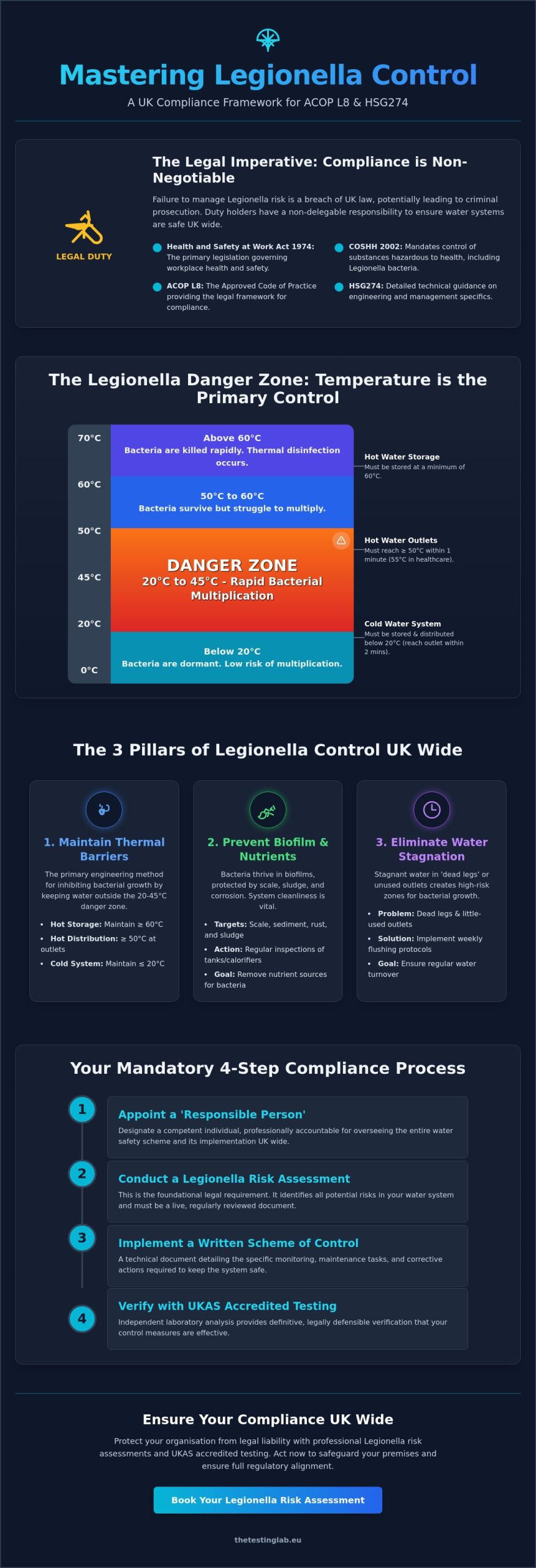
Bacterial proliferation is most aggressive within the “Danger Zone” of 20°C to 45°C. Within this range, the bacteria multiply rapidly; outside of it, they either remain dormant or are killed off by thermal disinfection. Maintaining strict thermal barriers is the baseline of any water safety strategy. To manage this effectively, an organisation must appoint a “Responsible Person.” This individual is professionally accountable for overseeing the written scheme of control, which is a technical document outlining the specific maintenance and monitoring tasks required to ensure safety.
ACOP L8 and HSG274: The Compliance Framework
The Approved Code of Practice (ACOP L8) provides the legal framework for compliance, while the technical guidance HSG274 offers the engineering specifics needed to achieve it. These aren’t mere suggestions; they’re the gold standard for legionella control in hot and cold water systems. These standards apply UK wide, ensuring that every facility, from a small office to a sprawling industrial complex, operates under the same rigorous safety parameters to protect occupants and the public.
The Requirement for a Legionella Risk Assessment
A Legionella risk assessment is the foundational legal requirement for any premises with a water system. It identifies potential dead legs, nutrient sources like scale or sludge, and temperature fluctuations that could encourage bacterial growth. For organisations operating UK wide, this assessment serves as the roadmap for all subsequent monitoring. A risk assessment is a live document that must be reviewed regularly or whenever significant changes are made to the water system.
Core Management Strategies for Hot and Cold Water Services
System cleanliness is equally vital. Legionella bacteria don’t exist in a vacuum; they thrive within biofilms that form on the internal surfaces of pipes and tanks. Scale, sediment, and corrosion provide the necessary nutrients and physical protection for these colonies to survive even moderate temperature fluctuations. Regular inspections of calorifiers and cold water storage tanks are essential to identify and remove these deposits before they compromise the entire network’s safety. Adhering to HSE guidance on Legionella control ensures your maintenance regime addresses these biological and physical risks simultaneously.
Temperature Benchmarks for Compliance
To meet UK regulatory standards, your water system must hit specific thermal targets at various points of the network. These benchmarks are verified through monthly monitoring of sentinel outlets:
- Hot Water Storage: Water must be stored at a minimum of 60°C at the calorifier or heater to ensure thermal disinfection.
- Hot Water Distribution: Water should reach at least 50°C (or 55°C in healthcare settings) at sentinel outlets within one minute of opening the tap.
- Cold Water: Cold water must be stored and distributed below 20°C, reaching this temperature at sentinel outlets within two minutes of operation.
Dealing with Dead Legs and Little-Used Outlets
A “dead leg” is a length of pipe leading to a fitting through which little or no water passes. These zones are high-risk because they promote stagnation and allow water to drift into the danger zone temperature range. Stagnant water facilitates the rapid development of biofilms, which then seed the rest of the system with bacteria. To mitigate this, you must implement a weekly flushing regime for all infrequently used outlets, including showerheads and taps. If your system has expanded or changed over time, it’s wise to use professional Legionella risk assessment services to identify and eliminate these hidden dead legs, ensuring your legionella control in hot and cold water systems remains airtight and legally defensible.
Microbiological Monitoring and UKAS Accredited Testing
While temperature benchmarks provide a vital preventative barrier, they’re proxy indicators of safety rather than definitive proof of bacterial absence. For comprehensive legionella control in hot and cold water systems, physical evidence of bacterial suppression is required. Independent, UKAS accredited laboratory analysis serves as the final layer of verification for any water management scheme. This process converts technical assumptions into scientific certainty, providing a robust “Chain of Custody” that protects duty holders during regulatory inspections or legal proceedings UK wide.
Interpreting laboratory results requires a methodical approach based on HSE’s HSG274 Part 2 Technical Guidance. Results are measured in Colony Forming Units per Litre (CFU/L). Findings exceeding 100 CFU/L suggest the system’s control measures are under stress, while counts over 1,000 CFU/L demand immediate investigation and remedial action. Without this data, a building manager is essentially operating in the dark, unable to prove that their engineering controls are actually working.
When is Water Sampling Required?
Sampling isn’t always a monthly requirement for every basic system, but it’s essential in specific high-risk scenarios. You must conduct microbiological testing in the following circumstances:
- When temperature controls consistently fail to reach the statutory benchmarks.
- Following significant system modifications, refurbishments, or periods of low occupancy.
- In facilities housing vulnerable populations, such as healthcare environments or care homes.
- When a system is treated with biocides rather than thermal controls.
The Testing Lab PLC: UK Wide Professional Support
The Testing Lab PLC acts as a strategic partner for microbiological water testing. Our technical team ensures every sample is handled with precision, maintaining data integrity from the point of collection to the final report. UKAS accreditation is the hallmark of our service, ensuring our findings are accurate and legally accepted across all jurisdictions. Whether you’re managing a single site or a London portfolio, you can submit a quote request to see how our expertise can streamline your national compliance audits.
Establishing Long-Term Regulatory Resilience
Achieving total compliance requires more than just meeting temperature benchmarks; it demands a systematic integration of engineering controls and scientific validation. By addressing the physical risks of stagnation and biofilm formation, you provide the necessary suppression of bacterial growth. However, the only way to definitively prove your legionella control in hot and cold water systems is effective is through independent, UKAS accredited laboratory analysis. This dual-track approach ensures your site remains safe and your legal position is fully protected UK wide.
We’re here to act as your strategic partner, offering impartial professional advice and full alignment with ACOP L8 and HSG274 standards. Our team simplifies the complexities of water management, allowing you to focus on your core operations with absolute confidence in your facility’s safety. Secure your UK wide Legionella compliance with a professional risk assessment and take the first step toward a robust, defensible water safety scheme today. You don’t have to navigate these technical requirements alone; expert support is always within reach.
Frequently Asked Questions
How often should Legionella control measures be reviewed in the UK?
Legionella control measures must be reviewed whenever there is reason to suspect they’re no longer valid or if significant changes have occurred in the water system. This includes alterations to the pipework, changes in building use, or if monitoring results indicate that control is being lost. While there’s no fixed statutory period, maintaining an up to date written scheme of control is a continuous legal requirement UK wide.
Is Legionella testing a legal requirement for landlords of domestic properties?
Carrying out a risk assessment is a legal requirement for all landlords, but microbiological testing is generally not mandatory for simple domestic systems. Landlords must ensure they identify and manage risks, such as keeping water temperatures outside the danger zone. If a system is complex or houses vulnerable tenants, a more detailed approach to legionella control in hot and cold water systems is necessary to meet health and safety obligations. To safeguard your property investments beyond health and safety, you can explore Mortgage and protection advice matching for comprehensive financial coverage.
What happens if Legionella is detected in a hot water system?
You must take immediate remedial action, which typically involves a combination of thermal or chemical disinfection and a review of your current engineering controls. HSG274 Part 2 outlines specific thresholds for action based on the concentration of bacteria found. Once remediation is complete, you’ll need to conduct follow up testing through a UKAS accredited laboratory to verify that the system is safe for continued use.
Can I carry out my own Legionella risk assessment?
You can perform the assessment yourself if you’re “competent,” meaning you have the necessary skills, knowledge, and experience. However, for larger or more complex infrastructures, most duty holders appoint professional consultants to ensure every dead leg and technical vulnerability is identified. Using a specialist ensures that your documentation is legally robust and provides an impartial view of your system’s safety status.
What are sentinel points in a water system?
Sentinel points are the “first and last” outlets in a water distribution network, specifically the ones nearest and furthest from the heat source or storage tank. Monthly temperature monitoring at these locations is a critical part of legionella control in hot and cold water systems. By checking these points, you can verify that the required temperatures are being maintained throughout the entire distribution loop, not just at the calorifier.
How much does a professional UK wide Legionella risk assessment cost?
The cost of a professional assessment depends on several technical factors, including the number of assets, the complexity of the pipework, and the geographic spread of the sites. Every building has a unique risk profile, so pricing is typically calculated after a preliminary review of the system’s scale. For an accurate estimate tailored to your specific requirements, you should request a technical proposal based on your site’s schematics and occupancy levels.

Article by
P J F Thomas
CEO and Founder of TTL plc.
Disclaimer
Items declared are AI generated but do reflect our services. Please get in contact if you have any questions.