If your assessor isn’t certified to the new BS 8674:2025 standard, your entire compliance strategy could be legally indefensible. We understand the pressure of managing complex safety requirements across the UK wide landscape. It’s difficult to distinguish between IFE, IFSM, and NEBOSH credentials while ensuring every fire risk assessment for commercial properties meets the stringent 2026 updates. You need more than a simple checklist; you need technical certainty that your documentation will stand up to rigorous regulatory scrutiny.
This expert guide simplifies the process of verifying assessor competency and aligning with the latest UK legislation. You’ll learn how to navigate tiered competency levels and manage fire safety alongside other critical risks like asbestos and legionella. We provide a clear verification checklist to help you secure professional, UKAS-standard results that protect your property, your people, and your reputation.
Key Takeaways
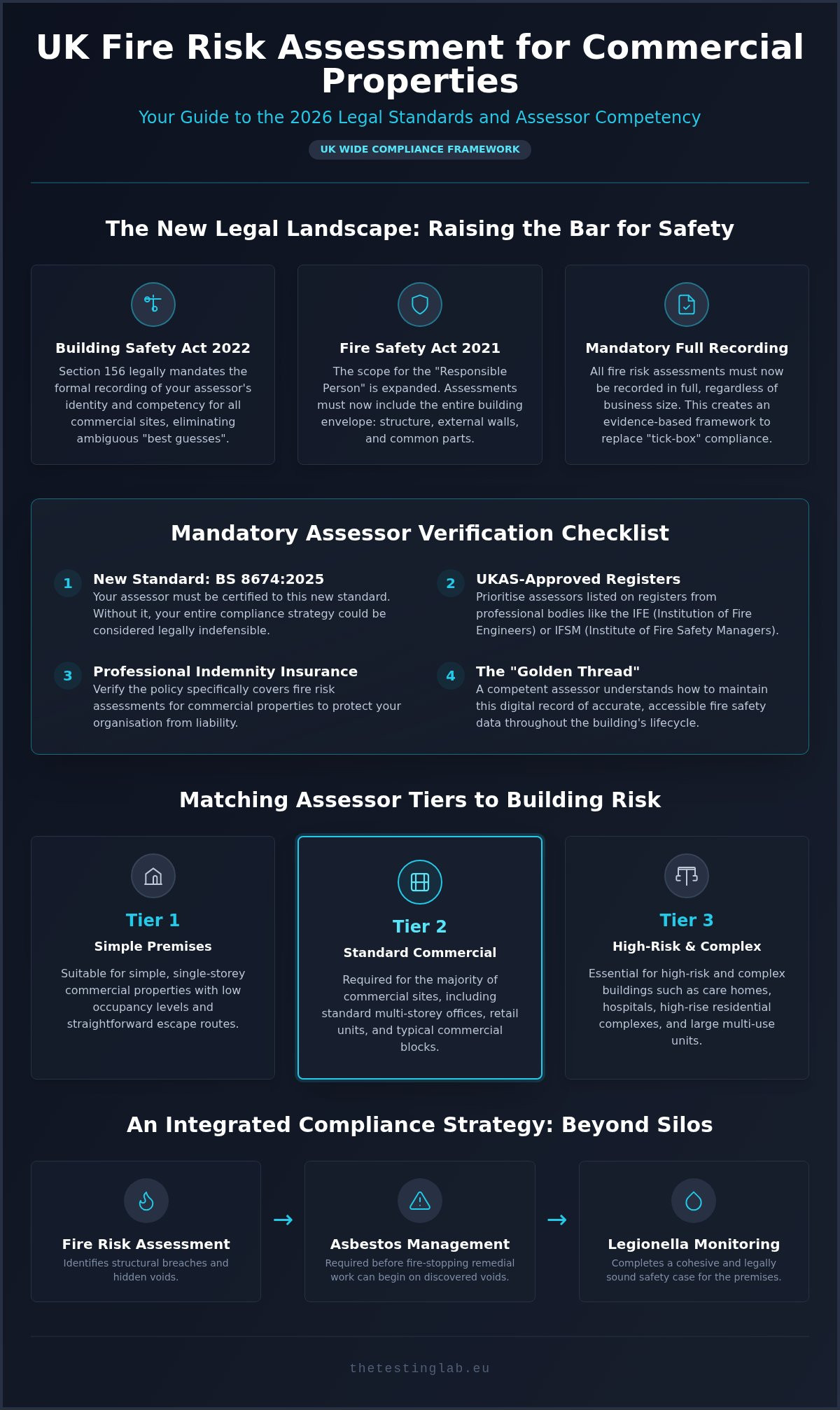
- Understand how Section 156 of the Building Safety Act now mandates the formal recording of assessor competency for every UK wide commercial site.
- Identify the specific UKAS-approved professional registers and insurance standards required to conduct a valid fire risk assessment for commercial properties.
- Learn to apply the new BS 8674:2025 framework to match the correct tier of assessor expertise to your building’s unique risk profile.
- Discover how an integrated compliance strategy streamlines fire safety, asbestos management, and legionella monitoring to reduce legal liability and operational costs.
Fire Risk Assessment for Commercial Properties: Legal Standards & UK Legislation
The Regulatory Reform (Fire Safety) Order 2005 remains the primary legislation for UK wide compliance. However, recent amendments have intensified the responsibilities of the “Responsible Person.” The Fire Safety Act 2021 expanded the scope of a fire risk assessment for commercial properties to include the building’s structure, external walls, and common parts. This ensures that Fire safety principles are applied to the entire building envelope, not just the interior.
Section 156 of the Building Safety Act 2022 creates a higher bar for transparency. It’s now a legal requirement to record your fire risk assessment in full, regardless of your business size. You must also formally record the identity and competency of your assessor. This legislative shift aims to eliminate the “tick-box” culture and replace it with a robust, evidence-based safety framework.
The Legal Definition of a ‘Competent Person’ in 2026
The UK Home Office defines a competent person as an individual with sufficient training and experience, or knowledge and other qualities, to properly assist in undertaking the preventive and protective measures. In 2026, this definition has evolved from a subjective claim into a verified professional standard. Property managers can’t rely on internal “best guesses” when the stakes involve legal liability.
Section 156 mandates that you document exactly why you believe your assessor is qualified. Self-assessment is now viewed as an incredibly high-risk strategy for most commercial sites. If an incident occurs, you must provide a defensible record of your due diligence. Integrating fire safety with other statutory duties, such as those found on our London compliance pillar page, helps create a cohesive and legally sound safety case for your premises.
Verifying Assessor Competency: Tiers, Qualifications, and Professional Registers
Verifying a provider for a fire risk assessment for commercial properties isn’t just an administrative hurdle; it’s a critical risk management step. You should prioritize assessors listed on UKAS-approved registers, such as the Institution of Fire Engineers (IFE) or the Institute of Fire Safety Managers (IFSM). These professional bodies ensure that the individual has undergone rigorous peer review and maintains up-to-date knowledge. It’s also vital to verify Professional Indemnity Insurance. This policy must specifically cover fire risk assessment for commercial properties to protect your organization from potential legal liabilities.
Modern building safety relies on the “Golden Thread” of information. This digital record ensures that fire safety data is accurate and accessible throughout the building’s lifecycle. An assessor with industry-specific experience, particularly for complex multi-use commercial units, will understand how to maintain this thread. You can find more details on your Legal fire safety obligations on the official government portal. This high-level knowledge is essential for UK wide compliance.
Tiered Competency: Matching Assessor Skill to Building Risk
The UK wide framework for competency is structured into tiers to ensure the assessor’s skill matches the building’s complexity. Choosing the wrong tier can lead to inadequate assessments and legal exposure.
- Tier 1: Suitable for simple, single-storey commercial premises with low occupancy levels.
- Tier 2: Required for standard multi-storey offices, retail units, or typical commercial blocks.
- Tier 3: Essential for high-risk buildings, including care homes, hospitals, and high-rise residential complexes.
If you’re unsure which tier applies to your property, you can Book a compliant fire risk assessment through our specialist team to ensure full legislative alignment.
Integrated Compliance: Fire Risk, Asbestos, and Legionella Management
Treating safety risks as isolated silos is a legacy approach that doesn’t meet the rigorous demands of 2026. A comprehensive fire risk assessment for commercial properties frequently identifies structural breaches or hidden voids that require immediate investigation. These voids often contain historical materials, making asbestos surveys a necessary prerequisite before any fire-stopping remedial work begins. Hazardous materials within building voids can significantly accelerate fire spread while releasing toxic particulates, creating a dual-threat scenario for occupants and responders.
Strategic managers now prioritize the efficiency of coordinating UKAS accredited asbestos testing alongside a fire risk assessment for commercial properties. This integrated methodology ensures that your compliance profile is holistic and defensible. Following the UK Government Fire Safety Guidance requires more than just a fire-focused lens; it demands an understanding of how different material risks interact within the built environment. Integrated reporting provides a unified view of statutory risk, allowing you to manage UK wide portfolios with technical precision.
Managing Statutory Risks UK Wide with a Single Strategic Partner
Adopting a ‘one-visit’ compliance model for multi-site operations UK wide significantly reduces administrative friction. By aligning fire safety with legionella risk assessments, you create a unified view of statutory risk across your entire portfolio. This centralized data management is essential for meeting the stringent audit requirements of UK Fire Authorities. It allows you to present a cohesive safety case that proves every critical risk is under professional control, rather than managing a fragmented collection of separate certificates.
Secure Your Building’s Future with Strategic Compliance
Ensuring a valid fire risk assessment for commercial properties requires more than just checking a box; it demands a technical alignment with the latest UK standards. By matching the correct competency tier to your specific building risk and integrating fire safety with asbestos and legionella management, you reduce legal exposure and operational friction. It’s about moving from reactive fixes to a proactive, evidence-based safety framework that stands up to regulatory scrutiny.
As a UKAS Accredited Consultancy with fully insured professional assessors, we provide strategic UK wide compliance management that takes the weight of professional responsibility off your shoulders. Request a quote for a UK wide fire risk assessment from our accredited team to ensure your documentation is technically sound and legally defensible. Protecting your assets and people is a continuous process, and we’re ready to partner with you to maintain the highest safety standards.
Frequently Asked Questions
Can I carry out my own fire risk assessment for a small commercial property?
You can legally conduct your own assessment if you’re the “Responsible Person,” but you must be able to prove your competency. Section 156 of the Building Safety Act mandates that all assessments be recorded in full. For most UK wide businesses, the legal risks associated with an inadequate fire risk assessment for commercial properties make professional verification the most secure and defensible path.
What specific qualifications should a qualified fire risk assessor hold in 2026?
Assessors in 2026 should be aligned with the BS 8674:2025 national framework. Look for professionals listed on UKAS accredited registers like the IFE or IFSM. These registers ensure the individual has the correct competency tier for your building’s complexity. Verification of Professional Indemnity Insurance is also essential to ensure that their specific fire safety advice is fully covered for your commercial premises.
How often should a commercial fire risk assessment be reviewed UK wide?
You should review your assessment annually to maintain UK wide best practices. While the law doesn’t state a specific timeframe, it must be updated if significant changes occur to the building, its occupancy, or its internal layout. High-risk structures, such as those exceeding 18 metres, now require mandatory annual reviews. Regular updates ensure your safety strategy remains technically accurate and legally valid.
Does a NEBOSH Fire Certificate make someone a fully qualified fire risk assessor?
A NEBOSH Fire Certificate is an excellent foundation, but it doesn’t signify full professional competency for every environment. It demonstrates knowledge of fire safety principles rather than the specialized expertise required for high-risk or complex sites. Professional assessors typically progress beyond this certificate to achieve accreditation on a UKAS recognized register, which validates their ability to handle intricate fire risk assessment for commercial properties.

Article by
P J F Thomas
CEO and Founder of TTL plc.
Disclaimer
Items declared are AI generated but do reflect our services. Please get in contact if you have any questions.