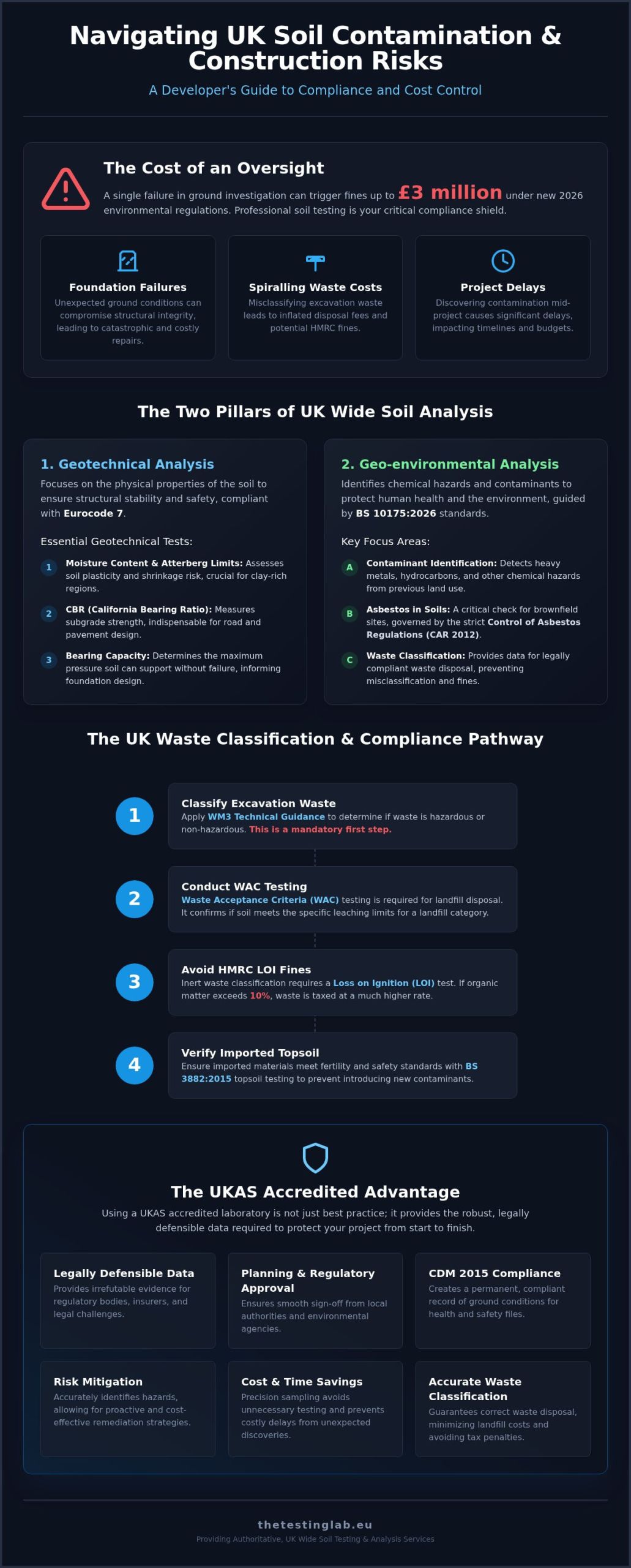
A single oversight in your ground investigation can trigger a fine of up to £3 million under the 2026 environmental regulations. For many UK wide developers, the ground beneath a site represents the biggest variable in their budget and timeline. It’s a valid concern; unexpected foundation failures and the spiralling costs of misclassified waste can quickly erode project margins. Professional soil contamination testing for construction sites isn’t just a box-ticking exercise anymore. It’s a critical compliance shield.
By mastering the latest BS 10175:2026 standards, you’ll ensure structural integrity and streamline your waste management strategy. This article provides a clear roadmap for UKAS accredited soil analysis, from initial site walkovers to specialist surveying services. We’ll explore how to secure a compliant Waste Acceptance Criteria (WAC) report and avoid the risk of HMRC LOI fines, keeping your project on track and legally defensible.
Key Takeaways
- Understand your legal obligations under the updated BS 10175:2026 standards to ensure your site investigation meets the latest UK wide statutory requirements.
- Discover how rigorous soil contamination testing for construction sites identifies hidden hazards like asbestos, protecting your project from structural failure and long-term legal liability.
- Learn to navigate Waste Acceptance Criteria (WAC) and WM3 technical guidance to accurately classify excavation waste and minimize disposal costs.
- Identify the strategic advantages of using a UKAS accredited laboratory to provide the legally defensible data necessary for planning approvals and regulatory sign-off.
The Fundamentals of Soil Analysis for UK Construction
Soil analysis is the scientific assessment of a site’s physical and chemical properties, providing the data needed to transform a plot of land into a viable building site. It isn’t just a preliminary step; it’s a legal and structural necessity. Every UK wide project requires Eurocode 7 compliant geotechnical investigations to guarantee long-term stability. By conducting these assessments early, developers can mitigate the risks outlined in this Contaminated Land Overview, ensuring that historical site uses don’t compromise modern safety standards or environmental health.
A critical distinction exists between geotechnical and geo-environmental testing. Geotechnical analysis focuses on structural mechanics, directly influencing foundation depth and pillar length. Geo-environmental analysis, specifically soil contamination testing for construction sites, identifies chemical hazards like asbestos in soils that could impact human health. Combining these perspectives allows for a holistic site model, reducing the likelihood of encountering “unforeseen ground conditions” that often derail budgets. Our team acts as a strategic partner, translating these complex datasets into actionable engineering solutions.
Essential Geotechnical Tests for Site Feasibility
Data accuracy at the feasibility stage prevents structural issues during the build phase. Moisture content and Atterberg limits are vital for assessing soil plasticity and shrinkage risk, which is particularly important in the clay-rich regions found UK wide. For infrastructure projects, CBR (California Bearing Ratio) testing is indispensable for road and pavement design, as it measures the strength of the subgrade. Bearing capacity is the maximum pressure the soil can support without undergoing shear failure or excessive settlement. Relying on UKAS accredited analysis ensures these figures are robust enough for both insurers and local authorities.
Navigating UK Regulatory Compliance and Waste Classification
Achieving regulatory compliance on UK wide projects requires a precise understanding of waste classification. Before any material leaves your site, you must apply WM3 technical guidance to determine if excavation waste is hazardous or non-hazardous. This step is mandatory. Once classified, Waste Acceptance Criteria (WAC) testing is required for landfill disposal. WAC results confirm if the soil meets the specific leaching limits of a landfill category. For a deeper look at statutory duties, refer to the UK Government Land Contamination Guidance.
Importing materials also carries hidden risks. Implementing BS 3882:2015 topsoil testing ensures that imported soil meets fertility and safety specifications. Additionally, accurate inert waste classification is vital to avoid HMRC LOI (Loss on Ignition) fines. If a sample exceeds the 10% organic matter threshold, the waste might be taxed at the much higher standard rate. Rigorous soil contamination testing for construction sites provides the legally defensible data needed to protect your project budget from these unexpected levies.
Managing Asbestos in Soils Contamination
Brownfield redevelopment UK wide frequently uncovers legacy asbestos. Under the Control of Asbestos Regulations (CAR 2012), developers have a strict legal duty to manage these risks. UKAS accredited laboratories use advanced microscopy to identify and quantify asbestos in soils, ensuring safe handling and disposal. If you’re managing a complex site, partnering with an accredited consultancy can help you navigate these sensitive remediation requirements efficiently.
Implementing a Professional Soil Testing Strategy UK Wide
A successful build depends on a site-specific sampling plan that targets high-risk areas without over-sampling. This precision reduces project delays and prevents the high waste disposal costs mentioned in previous sections. Professional analysis reports are essential for your CDM 2015 health and safety files, providing a permanent record of ground conditions for future site users. Following the UK Government Land Contamination Guidance ensures your strategy aligns with current legislative expectations. It’s about building a data-driven foundation that withstands regulatory scrutiny.
Relying on contractor-led analysis often introduces a conflict of interest, particularly when classifying waste for disposal. Independent labs offer a strategic advantage by providing objective, legally defensible data. When you invest in professional soil contamination testing for construction sites, you aren’t just buying a lab report; you’re securing a compliance shield for your entire project. This data is critical for obtaining planning sign-off and satisfying environmental health officers UK wide. If you need clarity on your site’s specific requirements, requesting a technical quote from an independent partner is the most effective first step.
Choosing a UKAS Accredited Testing Partner
UKAS accreditation is the gold standard for UK construction compliance, ensuring that laboratory methods are rigorous and results are accurate. A robust chain of custody, from site collection to final analysis, is non-negotiable to maintain data integrity. Independent laboratories provide more objective data than EPC-integrated services because they lack the financial incentive to influence waste classification or remediation outcomes. For complex sites, asbestos in soils testing should only be performed by specialists with the necessary UKAS credentials to ensure legal defensibility in court.
Securing Your Site’s Future through Technical Precision
Navigating the ground investigation landscape requires more than just compliance; it demands a strategic engineering approach. By adopting the revised BS 10175:2026 standards and ensuring rigorous soil contamination testing for construction sites, you protect your project from structural failure and escalating landfill taxes. Accurate waste classification through WAC and WM3 testing isn’t just a regulatory hurdle. It’s a method to safeguard your project’s margins against HMRC LOI fines and legal liabilities. As an independent UK wide consultancy and UKAS accredited laboratory, we provide the defensible data you need to satisfy planning authorities and insurers alike.
Our specialists in asbestos in soils are ready to help you de-risk your brownfield redevelopment. Don’t leave your site’s integrity to chance. Request a UKAS accredited soil analysis quote from The Testing Lab PLC today to ensure your project stands on solid, compliant ground. We’re here to help you succeed.
Frequently Asked Questions
Why is soil analysis required before beginning construction in the UK?
Soil analysis is a mandatory prerequisite for UK wide projects to ensure both structural stability and environmental safety. Under the Environmental Protection Act 1990, developers are responsible for identifying ground hazards. Conducting soil contamination testing for construction sites early prevents expensive remediation delays and ensures that foundation designs are based on accurate geotechnical data, satisfying both local planning authorities and insurers.
What is the difference between WAC testing and standard soil analysis?
Standard soil analysis identifies the total concentration of contaminants to assess risks to human health or the environment. In contrast, Waste Acceptance Criteria (WAC) testing measures how those contaminants leach out under landfill conditions. While standard testing is used for site characterisation, WAC is specifically required for landfill disposal classification, helping you avoid misclassification fines and manage waste disposal budgets effectively.
How long does a typical UKAS accredited soil analysis take?
If you discover asbestos, you must immediately stop work and secure the area to prevent fibre release. Under the Control of Asbestos Regulations 2012, you’re legally required to have the material identified and quantified by a UKAS accredited laboratory. Our specialists then provide a detailed assessment to determine if the soil can be remediated on-site or requires hazardous waste disposal at a licensed facility.

Article by
P J F Thomas
CEO and Founder of TTL plc.
Disclaimer
Items declared are AI generated but do reflect our services. Please get in contact if you have any questions.