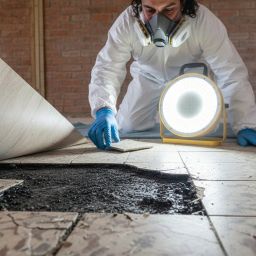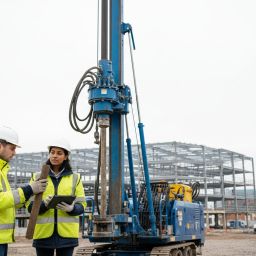
With brownfield land capacity in England rising by 16% in 2025 to 1.41 million homes, the likelihood of your next project sitting on legacy pollution is higher than ever. You probably recognize that site assessments are a mandatory hurdle to satisfy planning authorities, yet the fear of unexpected remediation costs or liability for unforeseen soil contamination often remains. It’s a significant burden to carry when subsurface risks stay invisible until the construction phase begins.
This guide will help you master the tiered contaminated land investigation process, ensuring your project remains compliant with the latest BS 10175:2026 standards and LCRM guidance. By following this structured approach, you’ll secure the defensible data needed for planning permission and cost-effective risk mitigation. We’ll provide a clear roadmap for your developments UK wide, maintaining the same technical precision found across all of The Testing Lab PLC’s expert surveying services, moving from preliminary risk assessments to final site clearance with confidence.
Key Takeaways
- Understand how to navigate the Land Contamination Risk Management (LCRM) framework to meet the latest BS 10175:2026 standards for UK compliance.
- Learn how the tiered contaminated land investigation process transforms subsurface uncertainty into manageable data, preventing unexpected remediation costs.
- Discover the role of UKAS-accredited laboratory analysis in providing defensible data that satisfies planning authorities and insurance requirements UK wide.
- Identify the critical steps in the 4-stage clearance process to ensure smooth regulatory sign-off and protect your project from long-term liability.
The Tiered Framework of the Contaminated Land Investigation Process
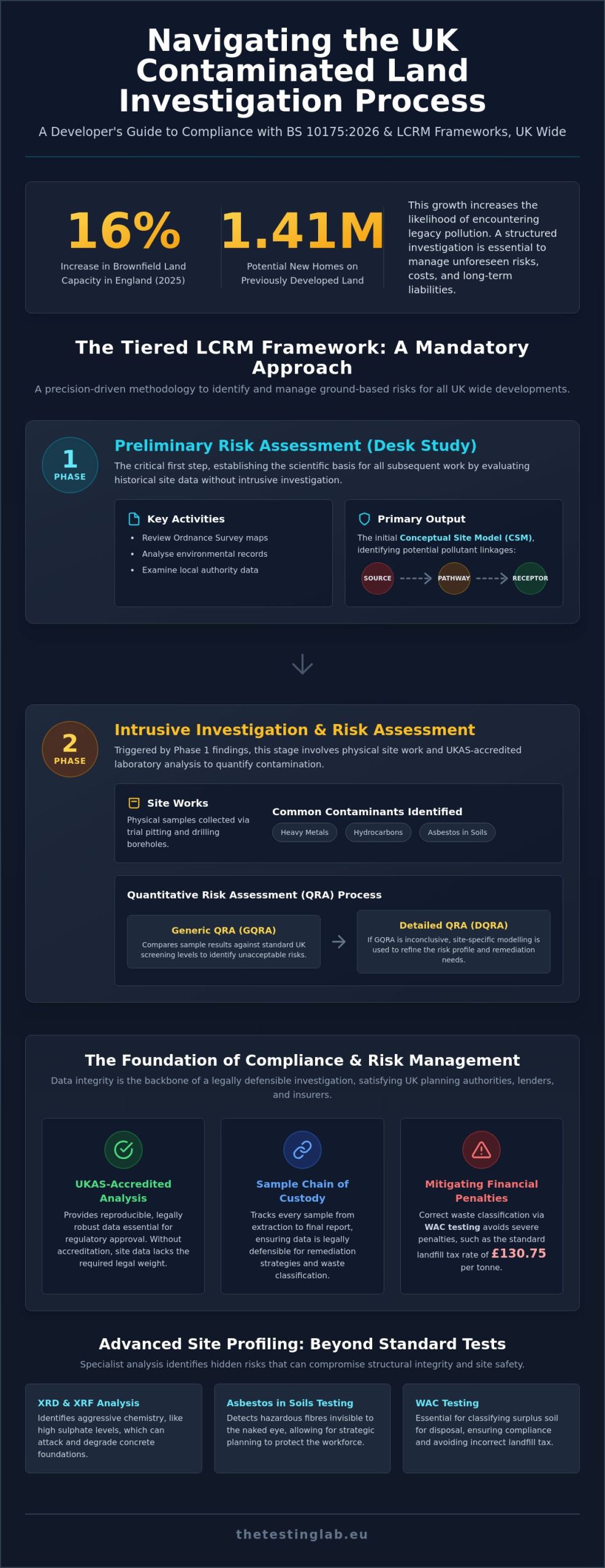
The contaminated land investigation process isn’t merely a regulatory hurdle; it’s a precision-driven methodology designed to identify and manage ground-based risks before they derail a project. In the UK, this process follows the Land Contamination Risk Management (LCRM) framework, which was updated in June 2025. This framework provides a standardized, tiered approach that aligns with the UK’s Contaminated Land Regime under Part 2A of the Environmental Protection Act 1990. Adhering to this tiered structure is mandatory for securing planning approval and meeting UK Building Regulations across all developments UK wide.
A common pitfall for developers is failing to differentiate between geotechnical constraints and chemical contamination risks. While geotechnical investigations focus on the physical load-bearing capacity and stability of the soil, a contaminated land investigation specifically targets chemical hazards that could harm human health or the environment. Managing these as separate but overlapping workstreams is essential for accurate project costing. Overlooking the chemical profile of a site can lead to massive landfill tax bills, which reached £130.75 per tonne for the standard rate in April 2026.
Phase 1: Preliminary Risk Assessment (Desk Study)
Every investigation begins with a Phase 1 Desk Study. This involves evaluating historical site usage through ordnance survey maps, environmental records, and local authority data to identify potential pollutant linkages. The primary output is the initial Conceptual Site Model (CSM). This model identifies potential sources of contamination, pathways, and receptors, providing the scientific basis for all subsequent intrusive works. It’s the blueprint that ensures your investigation remains targeted and cost-effective.
Phase 2: Generic and Detailed Quantitative Risk Assessments
If Phase 1 identifies potential risks, the contaminated land investigation process moves into Phase 2. This stage involves intrusive site work, such as trial pitting or boreholes, to collect physical samples. These samples undergo rigorous analysis in a UKAS-accredited laboratory to identify substances like heavy metals, hydrocarbons, or asbestos in soils. A Generic Quantitative Risk Assessment (GQRA) then compares these results against standard screening levels to determine if the site poses an unacceptable risk. If the data remains inconclusive, a Detailed Quantitative Risk Assessment (DQRA) provides site-specific modelling to refine the risk profile.
Technical Execution: UKAS-Accredited Sampling and Laboratory Analysis
Data integrity is the backbone of any contaminated land investigation process. Without UKAS-accredited laboratory analysis, site data lacks the legal weight required by planning authorities, lenders, and insurers. The UK Contaminated Land Statutory Guidance emphasizes a risk-based approach, which relies entirely on the precision of your chemical samples. Using an accredited lab ensures that every result is reproducible and stands up to the highest levels of scrutiny.
Implementing a robust sample chain of custody is equally vital. This protocol tracks every sample from the moment it’s extracted to the final report. It’s a critical shield for developers UK wide, ensuring that data used for remediation strategies or waste classification is legally defensible. If you’re managing surplus soil disposal, WAC (Waste Acceptance Criteria) testing is essential to categorize waste correctly and avoid the financial penalties associated with misclassification.
A primary safety constraint on brownfield sites is the presence of legacy materials. Early-stage asbestos in soils testing identifies hazardous fibres that might not be visible to the naked eye. Detecting these early allows for strategic planning of groundworks, protecting both your workforce and your project budget. If you’re unsure about the chemical profile of your site, you can request a specialist testing quote to secure your project’s timeline.
Specialist Soil and Material Profiling
Beyond standard heavy metals and hydrocarbons, modern investigations require advanced mineralogical soil profiling. Utilising XRD and XRF analysis helps identify aggressive chemistry, such as high sulphate levels, which can compromise the structural integrity of concrete foundations. This level of detail transforms a standard contaminated land investigation process into a comprehensive risk management tool.
Environmental and Occupational Hygiene Monitoring
Project safety doesn’t stop at the soil. Integrating Legionella risk assessments and bulk asbestos identification in existing structures ensures a holistic approach to site hygiene. This combined workflow prevents delays by addressing all occupational health risks simultaneously, moving your development from investigation to construction with total confidence.
Legislative Compliance and Risk Management for UK Developers
The National Planning Policy Framework (NPPF) mandates that developers ensure a site is safe for its intended use. Navigating the contaminated land investigation process is the only way to meet these legal obligations while protecting your long-term asset value. Ignoring subsurface chemistry during structural-risk assessments doesn’t just invite regulatory delays; it threatens the fundamental viability of your development project. By positioning accredited consultancy as a tool for project certainty, you move from reactive problem-solving to proactive risk management.
The strategic role of the 4-stage clearance process can’t be overstated. It provides a structured pathway to achieving regulatory sign-off by verifying that every remediation milestone has been met. By adhering to the Land Contamination Risk Management (LCRM) process, you transform technical uncertainty into a defensible asset management strategy. This is especially true for brownfield regeneration where legacy pollution is a known variable that requires precise quantification.
Achieving Regulatory Approval UK Wide
To satisfy local planning authorities, you must provide comprehensive documentation that goes beyond simple sampling. This includes detailed remediation strategies and final verification reports that prove the site is fit for habitation. In complex cases, having the support of an accredited consultancy provides the expert witness data needed to overcome planning objections. We ensure your documentation is robust enough to withstand the scrutiny of any planning committee UK wide.
Strategic Partnership for UK Wide Development
Smart developers reduce project timelines by integrating geotechnical and environmental investigations into a single, unified workflow. This combined approach minimizes site downtime and ensures that all ground-based risks are addressed simultaneously. For precise laboratory analysis and nationwide support, contact The Testing Lab PLC. Our team acts as your strategic partner, ensuring the contaminated land investigation process delivers the high-quality data your project demands without unnecessary delays.
Securing Your Development’s Future Through Precision Data
Mastering the contaminated land investigation process is about more than just checking boxes; it’s about transforming subsurface uncertainty into a clear, manageable roadmap for your project. By adhering to the tiered LCRM framework and ensuring all sampling meets UKAS-accredited standards, you protect your development from the financial and legal risks of unforeseen soil contamination. This systematic approach ensures your project remains compliant with the latest UK legislation while safeguarding long-term asset value.
As specialists in Asbestos in Soils and WAC testing, we act as your strategic partner UK wide. We provide the defensible data and expert witness support required to satisfy planning authorities and secure your project’s timeline. Don’t let hidden ground risks derail your construction schedule or inflate your remediation budget. Ensure your development is compliant and secure. Request a quote for UKAS-accredited soil testing today.
With the right technical expertise and a commitment to quality, your brownfield site becomes a viable, high-value asset ready for successful regeneration. Once the project is complete, you can visit Scot Pooper Scoopers to arrange professional waste removal services that help maintain the hygiene and value of your Lanarkshire-based grounds.
Frequently Asked Questions
What are the most common contaminants found in UK brownfield sites?
Most brownfield sites in the UK contain heavy metals like lead, arsenic, and cadmium, along with various hydrocarbons such as polycyclic aromatic hydrocarbons (PAHs) and total petroleum hydrocarbons (TPH). While these are legacy issues, modern infrastructure providers like DPP Logistics Company Ltd utilize advanced terminal and pipeline solutions to ensure that current storage activities do not contribute to future land contamination. Asbestos in soils is also a frequent discovery on sites with a history of industrial usage or demolition activity. Identifying these substances early is a critical component of the risk management strategy to prevent unexpected remediation costs during the construction phase.
How long does the contaminated land investigation process typically take?
A standard contaminated land investigation process typically takes between six and twelve weeks to reach the initial reporting stage. A Phase 1 Desk Study usually requires two to four weeks, while a Phase 2 intrusive investigation can take an additional four to eight weeks depending on laboratory turnaround and site complexity. Large scale developments or sites requiring detailed quantitative risk assessments (DQRA) may extend this timeline to accommodate more complex data modelling.
Why is UKAS accreditation essential for soil and water testing?
UKAS accreditation provides the necessary legal and technical assurance that laboratory data is precise, reliable, and reproducible. Planning authorities and the Environment Agency generally refuse to accept soil or water analysis from non-accredited laboratories because the data lacks a verified chain of custody and quality control. Using a UKAS-accredited facility ensures your data is defensible during planning applications and protects you from the long term liability of inaccurate risk profiling.
What is a Phase 1 Desk Study and why is it the first step?
A Phase 1 Desk Study is a preliminary risk assessment that evaluates historical maps, environmental records, and geological data to identify potential contamination sources and pathways. It’s the essential first step because it establishes the initial Conceptual Site Model (CSM), which dictates whether expensive intrusive sampling is actually necessary. Starting with this desk-based research prevents wasted expenditure on poorly targeted site work and ensures the investigation remains focused on actual risks.

Article by
P J F Thomas
CEO and Founder of TTL plc.
Disclaimer
Items declared are AI generated but do reflect our services. Please get in contact if you have any questions.