If you are reviewing tenders for site safety, is a lower initial quote actually protecting your bottom line, or is it merely masking a significant regulatory risk? Many duty holders find themselves overwhelmed by the technical distinctions between leak, background, and reassurance testing, often fearing that hidden costs will surface once a project is underway. It is a common frustration to feel caught between the pressure of strict HSE deadlines and the need for absolute procedural precision. We understand that you need more than just a service provider; you require a strategic partner who takes the weight of professional liability off your shoulders.
This guide provides a transparent analysis of the variables that determine the cost of asbestos air monitoring uk wide, grounded in the legal framework of the Control of Asbestos Regulations 2012. You’ll discover how to navigate the complexities of 4-stage clearances and why UKAS-accredited data is the only reliable metric for workplace safety. By the end of this article, you will have a clear roadmap for budgeting your asbestos management projects with confidence, ensuring every pound spent contributes to total legislative compliance and the safety of your personnel. We will examine the technical drivers of pricing, the importance of HSG248 standards, and how to structure your asbestos and legionella management strategy for long-term efficiency.
Key Takeaways
- Identify the specific air testing mandates under the Control of Asbestos Regulations 2012 to ensure your project meets all HSE legal requirements.
- Gain transparency on the variables affecting the cost of asbestos air monitoring uk wide, including the balance between on-site analyst time and laboratory analysis fees.
- Learn why the 4-stage clearance process is essential for verifying site safety and securing legal reoccupation after high-risk asbestos disturbance.
- Understand how partnering with a UKAS-accredited consultancy provides the technical precision needed to remove the burden of professional risk from your operations.
Understanding Asbestos Air Monitoring Requirements in the UK
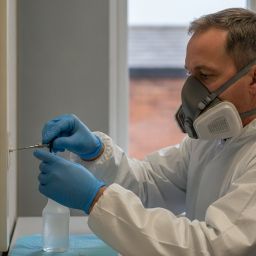
Asbestos air monitoring is a meticulous technical process designed to quantify the concentration of airborne fibres within a specific environment. It involves drawing a known volume of air through a filter using specialized, calibrated pumps. This captures microscopic particulates for subsequent analysis under Phase Contrast Microscopy (PCM). Understanding what asbestos is and how it behaves when disturbed is critical for any duty holder. The physical properties of these fibres allow them to remain suspended in the air for long periods, making precise measurement a non-negotiable safety requirement.
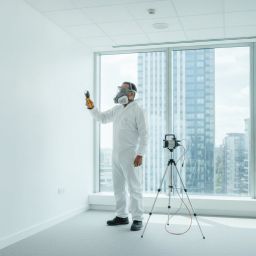
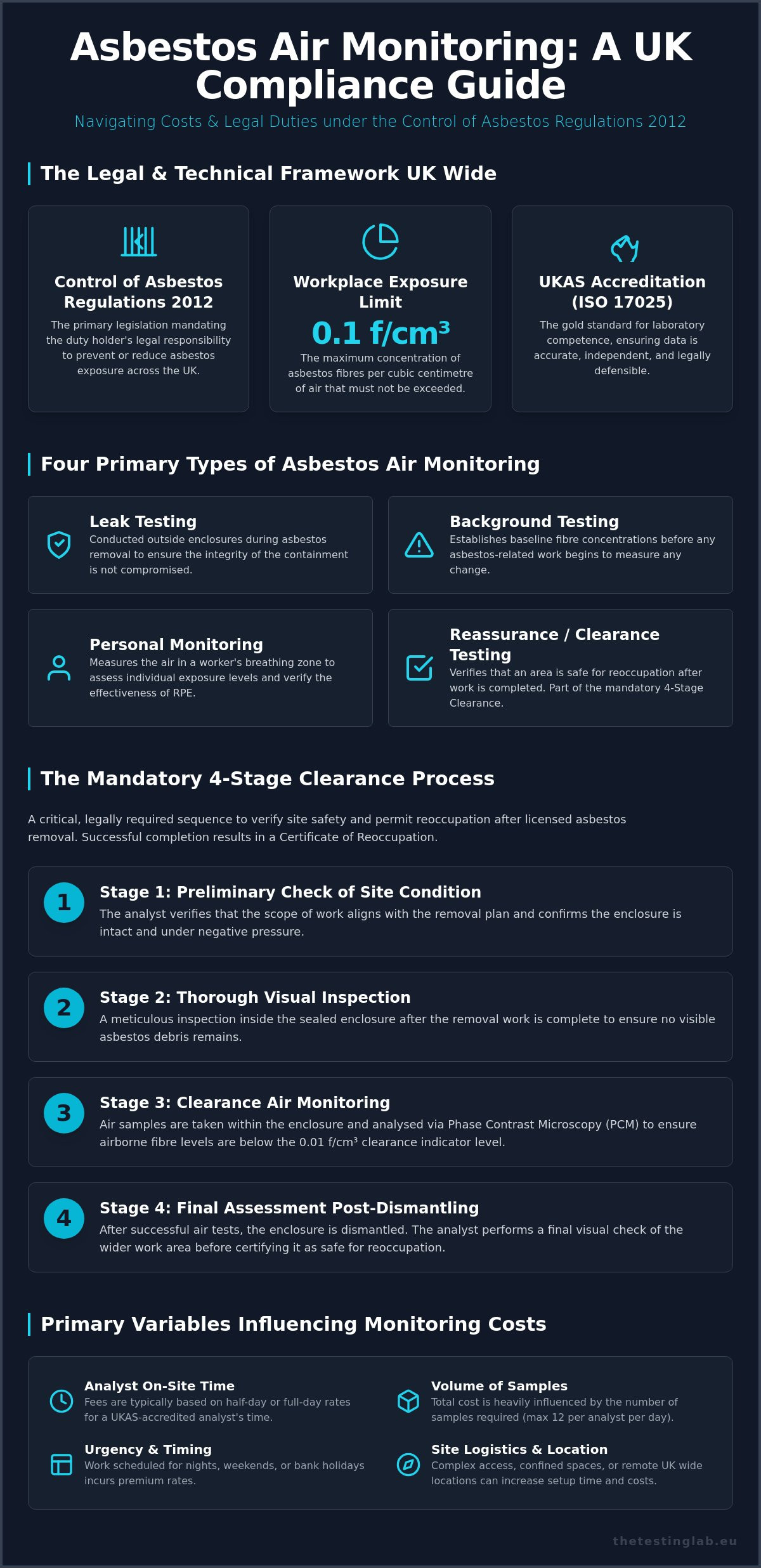
The Control of Asbestos Regulations 2012 (CAR 2012) mandates these tests to ensure that the workplace exposure limit of 0.1 fibres per cubic centimetre (f/cm3) is never exceeded. Monitoring typically falls into four distinct categories. Leak testing checks the integrity of enclosures during removal. Background testing establishes a baseline before work begins. Personal monitoring assesses the exposure of individual workers. Finally, clearance testing verifies that an area is safe for reoccupation. To remain legally defensible, these services must be delivered UK wide by independent, accredited analysts who provide unbiased, empirical data.
Legal Compliance and the Control of Asbestos Regulations 2012
Under CAR 2012, the duty holder carries the legal burden of preventing or reducing exposure to the lowest level reasonably practicable. Many organisations attempt to manage the cost of asbestos air monitoring uk by using off-the-shelf DIY kits. However, these products rarely meet the “suitable and sufficient” criteria required for commercial compliance. They lack the necessary calibration, chain of custody, and analytical rigour demanded by the HSE. Strategic planning through professional asbestos consultancy ensures your monitoring strategy aligns with the stringent requirements of HSG248, protecting both your workforce and your legal standing.
The Role of UKAS Accreditation in Air Analysis
ISO 17025 accreditation represents the gold standard for laboratory precision and technical competence in the UK. UKAS oversight provides a rigorous framework that guarantees the absolute independence of the testing laboratory from the removal contractor. This separation of interests is vital for transparency. Choosing non-accredited providers creates significant operational risks. Inaccurate data can lead to HSE improvement notices, substantial fines, and costly project delays. Accreditation isn’t just a badge; it’s your assurance that the data protecting your site is accurate, repeatable, and legally robust.
Breaking Down the Cost of Asbestos Air Monitoring UK
Professional fees for air monitoring are generally structured around daily or half-day rates for on-site analysts. This model covers the expert’s time, the deployment of calibrated sampling pumps, and the precise setup of the testing environment. While the day rate provides a baseline, the total cost of asbestos air monitoring uk wide is heavily influenced by the volume of samples required. Analysts are limited by the Approved Code of Practice to a maximum of 12 air tests per day, as this ensures each filter is analyzed with the necessary technical rigour under Phase Contrast Microscopy.
Site logistics also play a significant role in the overall budget. Projects with complex access requirements, such as those involving confined spaces or high-level work, demand more time for setup and retrieval. We often find that clients achieve greater administrative efficiency by integrating air monitoring with other specialist services, like legionella risk assessments. This holistic approach reduces the logistical burden on the duty holder and ensures all environmental risks are managed under a single, cohesive strategy.
Primary Variables Influencing Professional Fees
Urgency and timing are major cost drivers. Monitoring scheduled during night shifts, weekends, or bank holidays attracts a premium due to increased labour rates. The required turnaround speed for results also impacts the invoice. While standard reporting typically takes three to five days, emergency same-day results require dedicated laboratory capacity. If your project is on a tight schedule, you can request a detailed quote to see how these timing variables apply to your specific site.
Hidden Costs of Non-Compliance
The most significant financial risk isn’t the testing fee itself, but the cost of project failure. If an area fails a 4-stage clearance, the site must remain closed, and a mandatory re-test is required under the Control of Asbestos Regulations 2012. This doesn’t just lead to extra testing fees; it halts construction work and delays reoccupation. Inaccurate data from non-accredited providers can lead to unnecessary building closures or, worse, exposure incidents. A clear lab analysis certificate from a UKAS-accredited partner is a vital asset for your insurance records and long-term liability protection.
The 4-Stage Clearance Process: A Critical Reoccupation Cost
Reoccupying a property after high-risk asbestos removal isn’t just a matter of convenience; it’s a strict legal milestone. The 4-stage clearance process serves as the definitive safety audit required by the Health and Safety Executive. This procedure ensures that the contractor’s work meets the necessary cleanliness standards before any enclosure is dismantled. As a strategic partner for projects UK wide, we provide the independent oversight needed to verify that a site is truly safe for reoccupation.
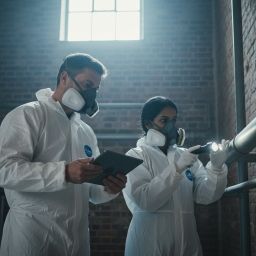
The foundation of this process lies in Stage 1 and Stage 2. Stage 1 involves a thorough review of the site integrity and the contractor’s paperwork. Stage 2 is a granular visual inspection of the entire work area. This is often the most time-consuming phase, as any trace of dust or debris will lead to an immediate failure. When budgeting, the cost of asbestos air monitoring uk for a 4-stage clearance must account for the analyst’s time during these critical visual checks, as they’re the primary defense against residual contamination.
What to Expect During the Clearance Procedure
Stage 3 introduces the active measurement of airborne fibres. Unlike static background tests, this stage uses “disturbance” or “brushing” techniques to simulate normal building occupancy. By agitating the air, the analyst ensures that any latent fibres are captured by the sampling pumps. This rigorous approach aligns with the UK Asbestos Air Measurement Regulations, providing empirical proof of safety. Once the air samples pass the 0.01 f/cm3 threshold, Stage 4 involves a final assessment after the enclosure is removed. To secure your project timeline, you can book a quote for asbestos air clearance with our technical team today.
Managing Multi-Site Compliance UK Wide
For national organisations managing a diverse property portfolio, the cost of asbestos air monitoring uk is best optimized through a centralized consultancy. Using a single UKAS-accredited partner ensures that reporting formats remain consistent across all locations. This uniformity is vital for internal health and safety auditing and insurance compliance. Our digital reports include high-resolution photographic evidence provided exclusively in .jpg or .png formats to ensure compatibility with all asset management software. By standardizing the clearance procedure UK wide, duty holders can maintain a clear, defensible audit trail that satisfies both the HSE and corporate governance requirements.
Securing Your Project with Legislative Precision
Effective asbestos management requires a shift from viewing air testing as a transactional expense to recognizing it as a vital risk-mitigation strategy. By prioritizing UKAS-accredited data and the rigorous 4-stage clearance process, you ensure that your operations remain fully aligned with the Control of Asbestos Regulations 2012. A clear understanding of the technical variables behind the cost of asbestos air monitoring uk allows for more precise budgeting and prevents the significant financial losses associated with building closures or HSE intervention. Whether you’re overseeing a single site or a national portfolio, the priority remains the empirical integrity of your safety data.
Our team serves as a strategic partner, providing the technical rigour of a UKAS Accredited Laboratory ISO 17025. As independent 4-stage clearance specialists with UK wide national coverage, we take the professional liability off your shoulders and ensure your site is safe for reoccupation. Don’t let regulatory complexity stall your progress when methodological excellence is within reach. We handle the critical details so you can focus on your core operations with total peace of mind.
Request a UK wide asbestos air monitoring quote from our UKAS accredited specialists
We look forward to supporting your next project with absolute transparency and professional dedication.
Frequently Asked Questions
How much does a standard asbestos air test cost in the UK?
The total cost of asbestos air monitoring uk is determined by several technical factors, including the specific type of monitoring required and the number of sample points across the site. Professional fees typically cover the analyst’s time on-site, the calibration of high-volume pumps, and the subsequent laboratory analysis under Phase Contrast Microscopy. Emergency call-outs or weekend work will naturally attract higher rates compared to standard scheduled visits for UK wide projects.
Is asbestos air monitoring a legal requirement for all renovation work?
Air monitoring is a legal requirement under the Control of Asbestos Regulations 2012 for all licensed asbestos removal projects and is often mandatory for non-licensed work to prove exposure limits remain below 0.1 f/cm3. Even when not strictly required by law, it’s considered best practice for any renovation that may disturb asbestos-containing materials. This empirical data provides essential legal protection for duty holders and ensures the safety of building occupants during and after construction.
What is the difference between a bulk sample and air monitoring?
Bulk sampling involves taking a physical piece of material to identify if it contains asbestos, whereas air monitoring measures the concentration of respirable fibres suspended in the atmosphere. While bulk samples confirm the presence of a hazard, air monitoring evaluates the actual risk to human health at a specific moment. For comprehensive site safety, we often recommend combining these methods with a strategic asbestos and legionella management plan to address all environmental risks UK wide.
How long does it take to get asbestos air monitoring results?
Standard laboratory analysis results are typically available within three to five working days, though many projects require a more agile response. We can provide expedited reporting for emergency situations, with preliminary results often delivered on-site immediately after the sampling period. The final UKAS-accredited certificate is then issued once the laboratory quality assurance checks are complete, ensuring the data is legally defensible and ready for your health and safety records.

Article by
P J F Thomas
CEO and Founder of TTL plc.
Disclaimer
Items declared are AI generated but do reflect our services. Please get in contact if you have any questions.