
Could a single administrative oversight really cost your business £150,000? In the current regulatory climate, that is the potential reality for landlords who fail to meet minimum EPC standards. It’s understandable why many property managers feel a sense of unease when scheduling their commercial property compliance checks UK. Between shifting energy efficiency targets and the strict mandates of the Control of Asbestos Regulations 2012, the margin for error is non-existent. You want to ensure your buildings are safe and your legal standing is beyond reproach, but the sheer volume of technical data can often lead to uncertainty regarding report validity.
This guide provides a precise framework to help you master the legislative requirements and practical steps to prove due diligence. We’ll show you how to transform compliance from a checkbox exercise into a robust, defensible audit trail. You’ll learn how to navigate the complexities of UK statutes, understand the necessity of UKAS accredited technical evidence, and select partners who act as a strategic extension of your own team. From asbestos management to water safety, we are moving from reactive fixes to methodical, systems-based protection.
Key Takeaways
- Understand the legal weight of the ‘So Far As Is Reasonably Practicable’ (SFAIRP) standard to ensure your management strategy aligns with HSE expectations.
- Learn how to integrate systematic commercial property compliance checks UK into a proactive asset management plan that prioritises high-risk technical areas.
- Identify the critical documentation required under CAR 2012 and ACOP L8 to maintain a compliant, safe environment and mitigate the risk of prosecution.
- Discover why UKAS accredited testing and ISO/IEC 17025 standards are the only reliable methods for building a defensible audit trail in a legal context.
- Gain a framework for selecting competent technical partners who provide the precision and transparency needed to offload professional liability effectively.
The Legislative Framework for UK Property Management Due Diligence
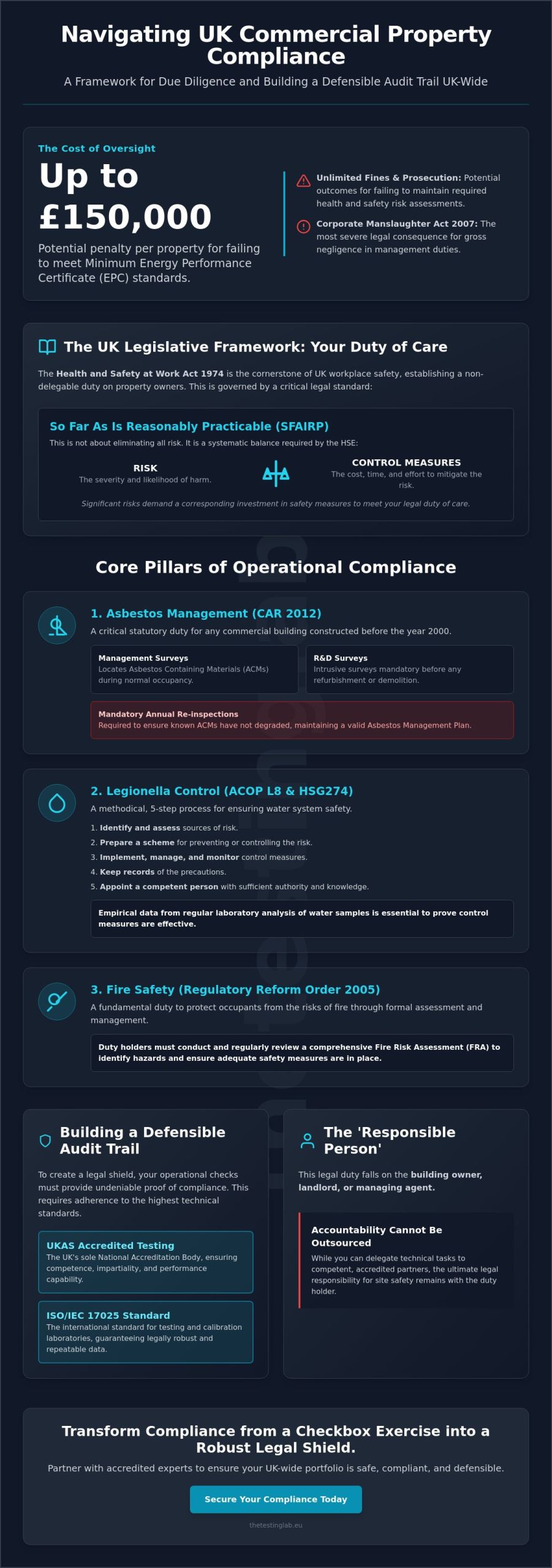
The Health and Safety at Work Act 1974 serves as the primary legislation for all UK operations. It places a non-delegable duty on employers and building owners to ensure the safety of employees and visitors. Central to this is the ‘So Far As Is Reasonably Practicable’ (SFAIRP) standard. This isn’t an absolute requirement to eliminate every conceivable risk. Instead, it requires a systematic balance where the cost, time, and effort of a safety measure are weighed against the level of risk. If the risk is significant, the HSE expects a corresponding investment in control measures. If you can’t demonstrate this balance, you haven’t met your duty of care.
The Management of Health and Safety at Work Regulations 1999 further clarifies these duties by mandating formal risk assessments. Failing to maintain these records can result in unlimited fines or prosecution under the Corporate Manslaughter and Corporate Homicide Act 2007. The financial stakes are high. For instance, non-compliance with EPC standards can trigger penalties of up to £150,000 per property. When you conduct commercial property compliance checks UK, you aren’t just following a checklist; you’re building a legal shield against these severe liabilities.
Statutory vs. Operational Due Diligence
The ‘Responsible Person’ and Legal Accountability
In the context of property management, the ‘Responsible Person’ or ‘Duty Holder’ is typically the building owner, landlord, or managing agent. This individual carries the legal burden for site safety. While you can outsource technical tasks to a specialist asbestos consultancy or water safety expert, you cannot outsource the legal accountability. The duty holder must ensure that any partner they select is competent and that the resulting data is legally robust and repeatable.
Core Pillars of Operational Health and Safety Compliance
Operational compliance isn’t a single event. It’s a continuous lifecycle. While many view commercial property compliance checks UK as a hurdle to clear during an acquisition, the HSE views them as a permanent requirement for risk management. This ongoing responsibility involves a deep understanding of tenant health and safety responsibilities. It ensures that the building remains safe for occupancy throughout its entire operational life, protecting both the asset and the people within it.
Asbestos Management: Surveys and Re-inspections
For buildings constructed before 2000, managing asbestos is a critical statutory duty under CAR 2012. You must distinguish between Management Surveys, which locate Asbestos Containing Materials (ACMs) during normal occupancy, and Refurbishment/Demolition (R&D) Surveys. R&D surveys are intrusive and mandatory before any structural changes occur. To maintain a valid Asbestos Management Plan, annual re-inspections are required. This ensures any known ACMs haven’t degraded or become friable. If you’re unsure of your building’s status, professional Asbestos consultancy and surveys provide the technical clarity needed to remain compliant.
Legionella Control and Microbiological Water Testing
Water safety protocols under ACOP L8 and HSG274 require a methodical approach. A robust Legionella risk assessment follows a 5-step process: identifying sources of risk, preparing a scheme for prevention, implementing controls, keeping records, and appointing a competent person. It isn’t enough to just check temperatures. Regular laboratory analysis of water samples is essential for high-risk HVAC systems and complex plumbing. This empirical data proves your control measures actually work in real-world conditions.
Beyond these, you must conduct Fire Risk Assessments (FRA) under the Regulatory Reform (Fire Safety) Order 2005. For sites with an industrial history, environmental and soil testing are equally vital to uncover legacy chemical or heavy metal risks. If you need assistance mapping these requirements across a portfolio, you can speak with our technical team for a tailored compliance audit that addresses your specific operational risks.
Building a Defensible Audit Trail with UKAS Accredited Testing
Technical competence isn’t a vague claim. It’s a verified status. When you present evidence to the Health and Safety Executive (HSE) following an incident, the technical validity of your data is the only thing standing between a successful defence and a criminal conviction. In a UK wide legal context, UKAS accreditation is the only recognised proof of this competence. It signifies that a laboratory or consultancy has been independently assessed against international standards, ensuring that your commercial property compliance checks UK are based on empirical, objective truth.
The ISO/IEC 17025 standard is the cornerstone of this process. It governs the quality management and technical requirements of testing laboratories. For property managers, this means that results for asbestos bulk identification or asbestos in soils testing are accurate and repeatable. Using non-accredited providers is a high-stakes gamble. If a report is found to be technically flawed during a legal challenge, your entire due diligence chain collapses. Integrating a digital chain of custody into your strategy ensures that every sample is tracked from the site to the lab, leaving no room for administrative error.
Verifying Competence in Your Supply Chain
Don’t assume a provider’s logo implies current accreditation for the specific task you require. You should always verify a partner’s schedule of accreditation directly on the UKAS website. This document details exactly which tests they are authorised to perform. It’s also vital to prioritise independent, third-party testing. Separating the inspection and testing from any potential remedial works avoids conflicts of interest and ensures the data you receive is unbiased and purely focused on safety and compliance.
Proactive Compliance and Digital Records
Proactive management requires a shift from reactive fixes to a planned preventative maintenance (PPM) schedule. This systematic approach ensures that surveys and risk assessments never lapse. Digital records are essential here; they must be organised and instantly accessible for an HSE inspector. A well-maintained digital audit trail demonstrates that you aren’t just reacting to problems, but actively managing your portfolio’s safety. Secure your portfolio with UK wide expertise. Contact our accredited specialists for surveying and testing.
Strengthening Your Portfolio Against Regulatory Risk
Effective property management in 2026 demands more than just awareness; it requires a commitment to technical precision and methodological rigour. By establishing a robust framework for commercial property compliance checks UK, you move beyond simple maintenance and into a position of strategic asset protection. You’ve seen how the legislative environment prioritises the quality of your technical evidence. A defensible audit trail isn’t built on guesswork. It’s constructed through the repeatable, accurate data that only UKAS accredited partners can provide.
We act as your strategic partner, taking the weight of professional liability off your shoulders. As an independent UKAS accredited testing laboratory with UK wide coverage, we offer specialist expertise in CAR 2012 and ACOP L8. Our approach ensures that your surveys, risk assessments, and lab results meet the highest international standards, providing you with total peace of mind during HSE inspections. It’s time to transition from reactive compliance to a proactive, systems based shield for your business. Secure your property compliance with UKAS accredited testing and lead with confidence.
Frequently Asked Questions
What is the legal definition of due diligence in UK property management?
Due diligence is the legal standard of taking all reasonable steps to avoid committing an offence under health and safety statutes. In the context of commercial property compliance checks UK, it requires proving that you have balanced the level of risk against the cost, time, and effort needed to control it. It’s an active process of risk identification and mitigation, rather than a passive state of awareness.
How often should an asbestos management survey be updated to maintain compliance?
While the initial management survey identifies the location of asbestos, you must conduct physical re-inspections typically every 12 months. This ensures your Asbestos Management Plan remains accurate and that the condition of known materials hasn’t deteriorated. If you plan any structural changes or refurbishment, you must commission a more intrusive Refurbishment and Demolition survey before work begins.
Is a Legionella risk assessment a legal requirement for all UK commercial properties?
Yes, conducting a Legionella risk assessment is a mandatory requirement for all commercial premises where water is used or stored. Under ACOP L8, duty holders are responsible for identifying and assessing sources of risk. You don’t necessarily need to test the water every month, but you must have a written scheme for preventing or controlling the risk of exposure.
What are the penalties for failing to demonstrate due diligence in the UK?
The consequences of non-compliance are significant and can include unlimited fines or custodial sentences for responsible persons. Specific regulatory breaches, such as failing to meet minimum EPC standards, now carry penalties of up to £150,000 per property. Beyond financial loss, the lack of a defensible audit trail leaves your organization vulnerable to corporate manslaughter charges in the event of a fatal incident.
Why is UKAS accreditation necessary for asbestos and water testing?
UKAS accreditation is the only recognised mark of technical competence and integrity for laboratories in the UK. It ensures that the provider adheres to the ISO/IEC 17025 standard, meaning their testing methods are accurate, repeatable, and objective. Without this accreditation, your technical reports lack the legal weight required to stand up as evidence during an HSE investigation or court proceeding.
Can I carry out my own commercial fire risk assessment?
Legally, you can perform your own assessment if you are a “competent person” with the appropriate knowledge and experience. However, for complex commercial assets, the risks are often too high for non-specialists. Most property managers opt for professional assessments to ensure that every structural and systems-based fire risk is identified in accordance with the Regulatory Reform (Fire Safety) Order 2005.

Article by
P J F Thomas
CEO and Founder of TTL plc.
Disclaimer
Items declared are AI generated but do reflect our services. Please get in contact if you have any questions.