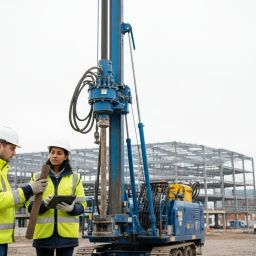
A geotechnical survey isn’t just a box-ticking exercise for planning permission. It’s the only thing standing between your project’s structural integrity and a catastrophic budget overrun caused by unforeseen ground conditions. We understand that evaluating the soil testing cost UK developers face can be a frustrating process, especially when quotes vary wildly without clear justification. It’s natural to feel concerned that a lower-cost option might miss critical contaminants or fail to meet the rigorous standards of Eurocode 7 or BS 5930.
This guide provides a transparent breakdown of the primary factors influencing geotechnical survey pricing in 2026 for projects UK wide. You’ll learn how UKAS-accredited lab testing acts as a strategic safeguard. This ensures your site remains compliant with Building Regulations Approved Document C and the Environmental Protection Act 1990. We’ll examine how precision data mitigates long-term structural risk and why a methodology-first approach is essential for securing insurance. Our focus on technical accuracy ensures that whether you’re managing ground investigations or other forms of specialised site surveying, you have a clear framework to protect your project’s financial viability.
Key Takeaways
- Understand how project scale and geological risk UK wide determine the overall scope and technical complexity of your geotechnical survey.
- Identify the specific operational variables that influence the soil testing cost UK developers encounter, from site logistics to required borehole depth.
- Ensure your project remains compliant with Eurocode 7 and BS 5930 standards by prioritising UKAS-accredited laboratory analysis for all soil samples.
- Discover how high-quality ground data allows for leaner, more cost-effective foundation designs by avoiding the financial burden of over-engineering.
- Learn to mitigate the risk of budget-breaking ground conditions by investing in a robust, multi-stage investigation process that identifies issues early.
Understanding Geotechnical Survey Costs in the UK (2026)
A geotechnical survey represents a critical, multi-stage assessment of ground conditions and soil mechanics. For developers operating UK wide, the total investment is rarely a flat fee. Instead, it’s a variable dictated by the scale of the development and the specific geological risks associated with the site’s history. When calculating the likely soil testing cost UK projects will incur, it’s essential to view the process as a risk mitigation strategy rather than a simple procurement item. A Geotechnical investigation is the systematic process designed to evaluate the physical properties of a site’s subsurface to inform engineering decisions.
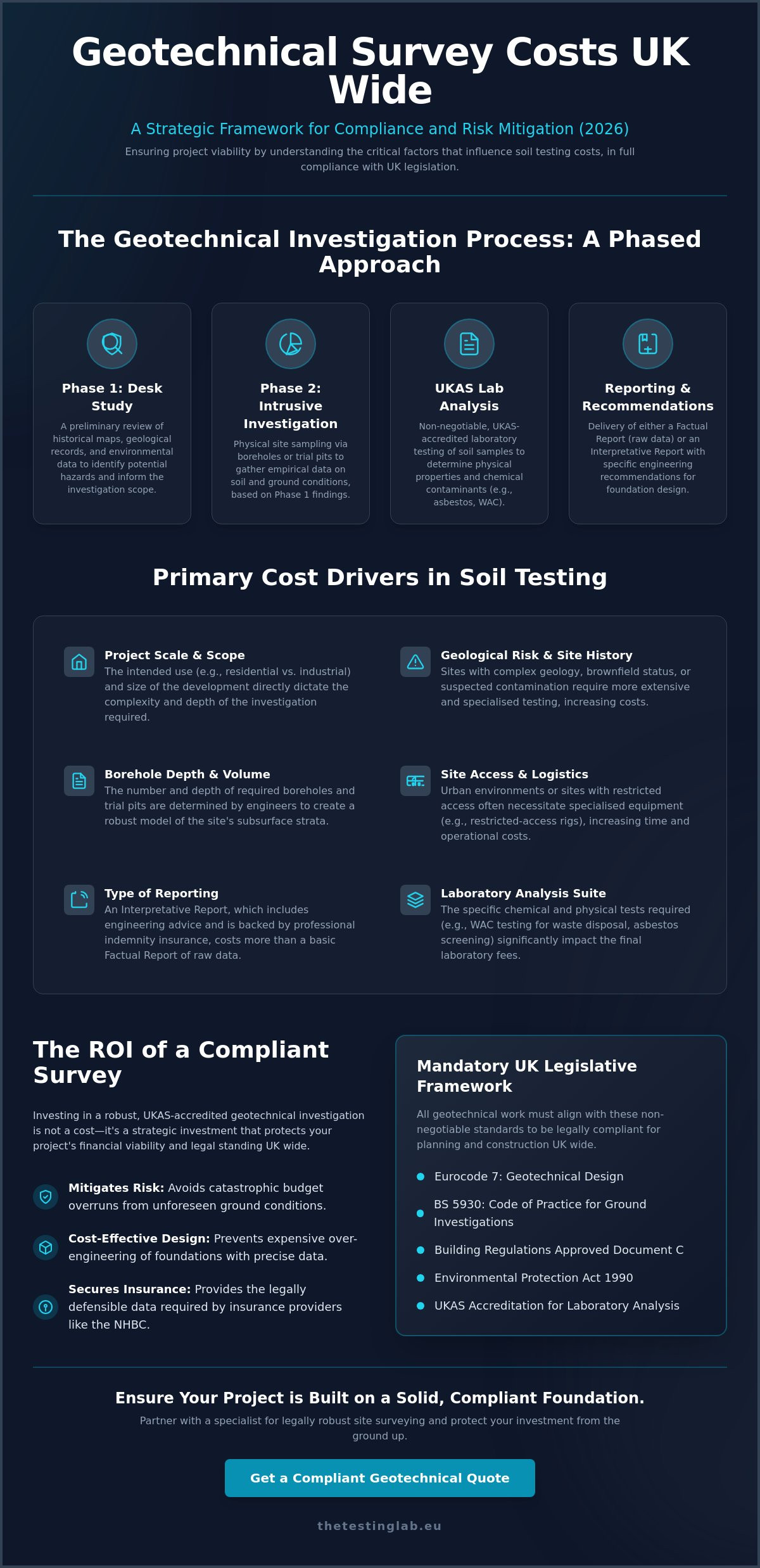
The investigation typically follows a tiered structure. A Phase 1 Desk Study involves a preliminary review of historical maps, geological records, and environmental data to identify potential hazards. If risks are flagged, a Phase 2 Intrusive Investigation follows. This involves physical sampling through boreholes or trial pits to gather empirical data. To ensure that the resulting reports are authoritative and suitable for planning submissions, all work must strictly align with BS 5930 and Eurocode 7, with laboratory analysis conducted in UKAS accredited facilities to guarantee data integrity.
The Legislative Framework and Project Scope
UK building regulations and insurance providers, such as the NHBC, mandate specific levels of testing to ensure structural safety and environmental protection. The intended use of the building significantly alters the project scope. A residential development might focus on foundation stability and garden contamination, whereas an industrial facility requires deeper analysis of load bearing capacities for heavy machinery. Eurocode 7 is the primary UK standard for geotechnical design, providing the mandatory framework for assessing ground conditions and structural safety.
Engaging with a strategic partner for specialist site surveying in London or elsewhere UK wide ensures that your data is not only technically sound but also legally robust. High quality data prevents the costly over engineering of foundations and protects against the liability of unforeseen ground conditions.
Primary Cost Drivers: From Desk Studies to Lab Analysis
The operational reality of a geotechnical survey depends heavily on site logistics. Urban environments UK wide often present access constraints that necessitate restricted-access rigs or hand-pitting, which increases the time spent on-site. The volume of data points required is another major variable. Engineers determine the number and depth of boreholes based on the industry-standard UK Specification for Ground Investigation to ensure the site model is robust and representative of the underlying strata.
Laboratory analysis forms a significant portion of the total soil testing cost UK developers must account for during the pre-construction phase. While physical testing determines engineering properties like plasticity or shear strength, chemical analysis identifies environmental liabilities. If historical site use suggests contamination, specialised testing for asbestos in soils becomes a mandatory safety and compliance requirement to protect site workers and future occupants.
Laboratory Testing and Sample Analysis Fees
UKAS accreditation is a non-negotiable requirement for any laboratory analysis. Without this, the data lacks the legal defensibility needed for planning approvals or insurance warranties. For projects involving soil removal, WAC testing is essential to classify waste and manage disposal costs effectively. Brownfield redevelopments typically require broader microbiological and chemical panels to address legacy pollutants and ensure the ground is fit for its intended purpose.
Reporting Styles: Factual vs. Interpretative
The final project cost is also influenced by the level of reporting required. A Factual Report provides raw data and borehole logs, which is useful but limited in scope. Most developers require an Interpretative Report. This document provides specific engineering recommendations for foundation design and is backed by professional indemnity insurance. If you’re managing complex urban sites, engaging with a partner for specialist site surveying in London can provide the technical clarity needed to move from raw data to actionable construction plans.
The ROI of Ground Investigations: Why Compliance Saves Money
Investing in high-quality ground data is a strategic move that pays for itself through foundation optimization. Without precise parameters, structural engineers are forced to adopt conservative, over-engineered designs to account for uncertainty. This often leads to excessive concrete and steel use, driving up construction expenses far beyond the initial soil testing cost UK developers might seek to minimize. Leaner, technically justified designs are only possible when the underlying soil mechanics are fully understood through rigorous UKAS-accredited analysis.
Mitigating the risk of unforeseen ground conditions is perhaps the most significant financial benefit. Ground-related issues remain a leading cause of project failure and budget overruns UK wide. Identifying hidden peat pockets, high water tables, or aggressive soil chemistry early allows for accurate budgeting and prevents costly mid-construction redesigns. Streamlining your project timeline is also achievable by integrating multi-disciplinary requirements, such as combining geotechnical site work with local asbestos and legionella surveying.
Long-term Structural Integrity and Liability
Securing Professional Quotes UK Wide
When comparing geotechnical quotes, look beyond the bottom line. Ensure the scope includes UKAS-accredited laboratory fees and a comprehensive interpretative report. Use this checklist for your evaluation:
- UKAS accreditation for all laboratory testing.
- Adherence to BS 5930 and Eurocode 7.
- Clear distinction between factual and interpretative reporting.
- Provision for specialized analysis like asbestos in soils if required.
To ensure your project is built on a foundation of precision and compliance, you can request a specialist quote for UKAS-accredited soil testing today.
Securing Your Project with Precision Ground Data
Navigating the technical complexities of site investigation requires a balance of engineering precision and regulatory adherence. We’ve explored how a robust geotechnical survey acts as more than a compliance hurdle; it’s a critical tool for mitigating structural risk and managing long-term liabilities. By understanding the variables that dictate the soil testing cost UK developers face, you can move away from vague estimates toward data-driven budgeting. This methodology ensures that your project remains financially viable while meeting the highest safety standards.
Our UK wide compliance consultancy ensures that every sample undergoes UKAS accredited laboratory analysis, providing the legal defensibility required for planning and insurance warranties. Whether you’re managing complex urban redevelopments or new-build residential schemes, integrating soil and construction material testing streamlines your project’s path to completion. Beyond site safety, maintaining the compliance of your operational fleet is a vital part of project logistics; for expert MOT testing in Bournemouth, you can visit Wessex Autocentres Group. Don’t leave your site’s integrity to chance or allow over-engineered foundations to drain your capital. Strategic ground data is the foundation of every successful build.
To protect your investment and ensure full alignment with Eurocode 7 standards, Get a Professional Geotechnical and Soil Testing Quote today. We’re ready to partner with you to deliver the technical clarity your project deserves.
Frequently Asked Questions
Why is UKAS accreditation important for my geotechnical survey results?
UKAS accreditation provides independent verification that a laboratory operates to the highest international standards of technical competence. For geotechnical surveys, this ensures that the data is legally robust and accepted by local planning authorities and structural warranty providers UK wide. Without this accreditation, your results may be rejected during the planning phase, leading to significant delays and additional expenditure to repeat the testing process.
How much does a standard Phase 1 Desk Study cost in the UK?
A Phase 1 Desk Study is the foundational stage of ground investigation, focusing on historical maps, geological records, and environmental data. While pricing varies based on the site’s historical complexity and the volume of data required, this phase is a strategic investment that helps define the scope of any subsequent intrusive work. It’s designed to identify potential hazards early, which can ultimately reduce the overall soil testing cost UK projects incur by preventing unnecessary borehole drilling.
Do I need a geotechnical survey for a small building extension?
Yes, a geotechnical assessment is often required for small extensions to comply with Building Regulations Approved Document C. This is particularly critical if there are nearby trees, high-plasticity clay soils, or a history of subsidence in the area. Even for smaller domestic projects, understanding the ground conditions prevents structural failure and ensures that foundation depths are correctly specified by your structural engineer, protecting the long-term integrity of the building.
How long does it take to receive a full geotechnical interpretative report?
You can typically expect to receive a full geotechnical interpretative report within two to four weeks following the completion of the physical site work. This timeframe allows for the mandatory laboratory analysis of soil samples and the subsequent engineering assessment required to provide foundation recommendations. Complex brownfield sites or those requiring specialized chemical analysis may require additional time, but this structured approach ensures the final recommendations are grounded in precise, verified data.

Article by
P J F Thomas
CEO and Founder of TTL plc.
Disclaimer
Items declared are AI generated but do reflect our services. Please get in contact if you have any questions.