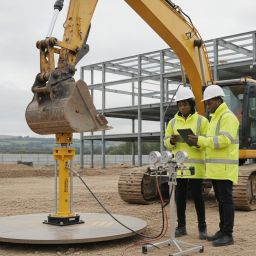
The most expensive phase 1 desk study cost UK developers face isn’t the report itself, but the price of a rejected planning application or an unforeseen contamination discovery mid-build. We recognize that navigating the technical requirements of Preliminary Risk Assessments while maintaining a lean project budget is a common hurdle for site owners UK wide. It’s often frustrating when different providers use varying terminology, leaving you unsure if a basic desktop study will satisfy your local planning authority or if a more robust assessment is mandatory.
This guide provides professional clarity on the factors driving current market rates, ensuring your site investigation aligns with the latest BS 10175:2026 standards and Environment Agency LCRM guidance. You’ll gain a transparent understanding of site risks before finalizing a purchase, allowing for more accurate budgeting of intrusive works. Whether you’re managing local asbestos and water risks or broader land contamination, our methodical approach helps you discharge planning conditions with confidence and precision.
Key Takeaways
- Understand that a Phase 1 Desk Study is the foundational step for site developments UK wide, providing a critical conceptual model before any physical works begin.
- Recognise that a typical phase 1 desk study cost UK for 2026 ranges from £800 to £1,500, with variables like site history and acreage driving the final quote.
- Ensure regulatory compliance by verifying that your assessment follows the latest LCRM framework to satisfy Local Planning Authorities and the Environment Agency.
- Discover how investing in a robust Preliminary Risk Assessment can reduce future Phase 2 expenditure by precisely targeting areas of concern for soil investigation.
The Essentials of Phase 1 Desk Study Costs in the UK
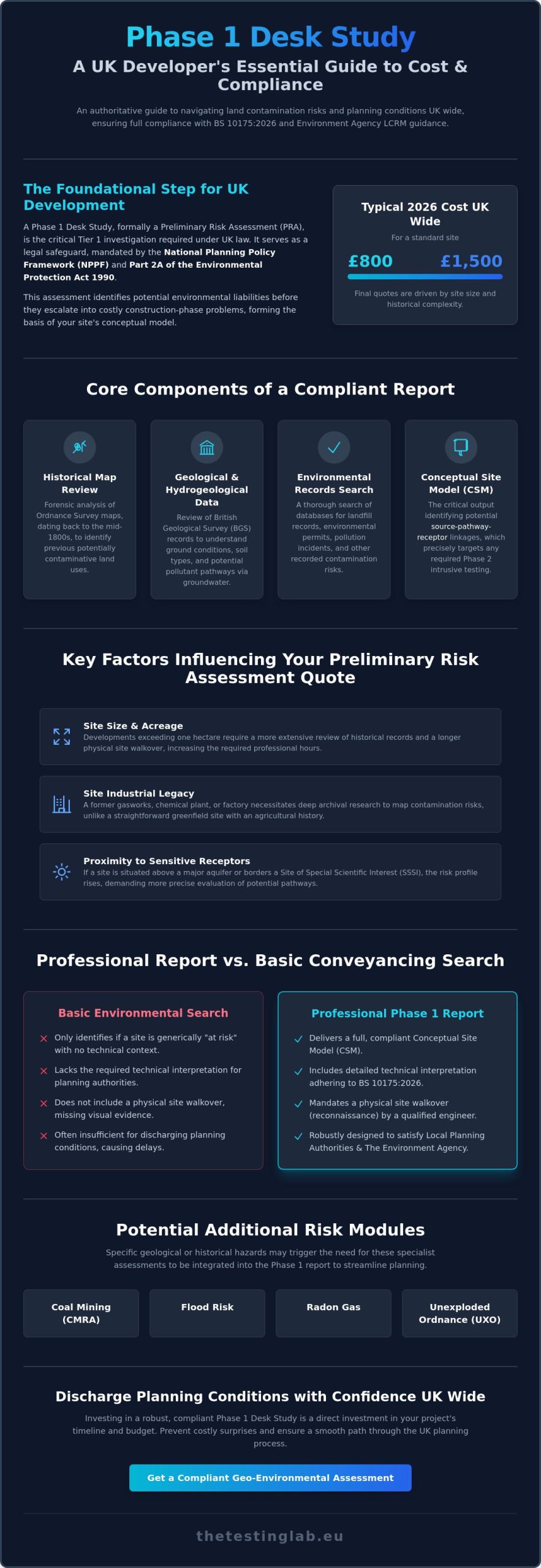
A Phase 1 Desk Study, formally known as a Preliminary Risk Assessment (PRA), represents the vital Tier 1 stage of any land contamination investigation. For developers operating UK wide, this report isn’t just a box-ticking exercise; it’s a legal safeguard required under the National Planning Policy Framework (NPPF) and Part 2A of the Environmental Protection Act 1990. When calculating your phase 1 desk study cost UK, you’re essentially investing in a forensic review of a site’s environmental history to identify potential liabilities before they become financial burdens.
Typical costs in 2026 for a standard site usually range between £800 and £1,500. This fee covers several critical components that form the backbone of a compliant report:
- Detailed review of historical Ordnance Survey maps dating back to the mid-1800s.
- Analysis of British Geological Survey (BGS) records and hydrogeological data.
- Search of environmental permits, landfill records, and pollution incidents.
- The development of a Phase I environmental site assessment, which culminates in an initial Conceptual Site Model (CSM).
Why a Professional Report Costs More Than a Standard Search
It’s easy to confuse a professional geo-environmental report with the basic environmental searches provided during property conveyancing. While a solicitor’s search identifies if a site is “at risk,” it lacks the technical interpretation required by planning authorities. Professional UK wide geo-environmental assessments include a physical site walkover, or reconnaissance. This visit allows engineers to spot visual cues like distressed vegetation, fuel staining, or undocumented tanks that automated databases often miss. This level of scrutiny ensures the report is robust enough to discharge planning conditions the first time.
Phase 1 Synonyms: Are You Paying for the Same Thing?
The industry uses several terms interchangeably, including “Desktop Study”, “Contamination Report”, and “Ground Investigation Phase 1”. Regardless of the title, the quality of the report is measured by its adherence to BS 10175:2026 and the depth of its analysis. The Conceptual Site Model (CSM) is the critical output that determines all future site costs. By identifying potential source-pathway-receptor linkages early, a precise CSM prevents unnecessary and expensive intrusive testing during Phase 2.
Key Factors Influencing Your Preliminary Risk Assessment Quote
The presence of sensitive receptors also increases the complexity of the professional hours required. If your site sits atop a major aquifer or borders a Site of Special Scientific Interest (SSSI), the risk profile rises significantly. Engineers must evaluate the potential pathways between your site and these protected environments with extreme precision. Following the official UK government guidance ensures that your Preliminary Risk Assessment is robust enough to withstand scrutiny from environmental health officers and the Environment Agency UK wide.
The Impact of Site History on Professional Fees
Urban infill sites are historically dense, often featuring layers of different industrial uses over the last 150 years. This requires a meticulous map search to identify every potential source of contamination, from old smithies to dry cleaners. In certain regions, we also evaluate the risk of unexploded ordnance (UXO). While often overlooked, a high UXO risk rating requires a specialist desktop assessment to be integrated into the final report, ensuring safety during future intrusive works.
Additional Risk Modules: Coal, Flood, and Radon
Specific geological hazards can trigger the need for additional risk modules. If a site falls within a Coal Mining Reporting Area, a Coal Mining Risk Assessment (CMRA) is often mandatory for planning. Similarly, integrating radon data and flood risk analysis at this early stage streamlines the planning process. For sites with complex building footprints, integrating local asbestos and water management data into the preliminary phase can offer significant operational efficiencies and help prevent budget overruns during the demolition or renovation phases.
Maximising Value and Ensuring Compliance for UK Developments
A high-quality Phase 1 report acts as a strategic insurance policy. By identifying potential risks early, such as asbestos in soils or heavy metal contamination, you avoid the catastrophic costs of discovering these materials during the construction phase. At The Testing Lab PLC, we act as a strategic partner, providing precise data that allows you to budget accurately for any necessary remediation. A robust preliminary assessment often reduces the overall project spend by narrowing the scope of required soil sampling in later stages.
The Role of UKAS Accredited Laboratories
When a desk study highlights a potential risk, the subsequent soil analysis must be beyond reproach. Laboratory precision is critical for accurate WM3 waste classification, which determines how excavated materials are handled and disposed of. Using an accredited facility ensures your data is accurate and legally defensible. UKAS accreditation is the gold standard for legal defensibility in UK environmental law.
Transitioning to Phase 2: Site Investigation
The Phase 1 report isn’t a standalone document; it sets the technical specification for all future intrusive works. It dictates the exact placement of boreholes and trial pits, ensuring chemical testing is targeted only at identified areas of concern. This methodical approach prevents expensive and unnecessary testing during site investigations, keeping your project on track. If you’re ready to secure a compliant, professional assessment for your site, contact our team for a specialist consultation and quote request today.
Securing Your Site with Technical Precision
Navigating the complexities of land contamination requires a partner who understands both the regulatory landscape and the technical nuances of soil chemistry. By prioritising a comprehensive Preliminary Risk Assessment, site owners aren’t just satisfying a planning condition; they’re protecting their project from the financial volatility of unforeseen environmental liabilities. Whether you’re managing urban infill sites or vast greenfield developments UK wide, a precise phase 1 desk study cost UK should be viewed as a vital investment in your site’s safety and legal defensibility. It’s the foundation upon which all successful development projects are built, especially under the rigorous BS 10175:2026 standards.
As a UKAS Accredited Testing Laboratory with specialists in asbestos, legionella, and soil analysis, we provide the methodical scrutiny needed to de-risk your investment from day one. We take the professional responsibility off your shoulders, ensuring your site investigation is robust enough to meet all current legislative requirements. Our team is ready to help you transition from preliminary data to construction with total confidence and technical precision. We look forward to supporting your next project with our expertise and operational excellence.
Request a Professional Phase 1 Desk Study Quote from Our UKAS Accredited Experts
Frequently Asked Questions
How much does a Phase 1 desk study cost in the UK for a single dwelling?
The phase 1 desk study cost UK developers pay for a single dwelling is primarily dictated by the plot’s historical land use and geological complexity. Smaller residential plots often sit at the lower end of the professional fee scale, provided there isn’t a significant industrial legacy. A site-specific quote is essential to ensure the report includes the necessary reconnaissance to satisfy local planning authorities UK wide.
How long does it take to complete a Phase 1 desk study report?
A professional Preliminary Risk Assessment is typically completed within 5 to 10 working days after the site walkover is finished. This timeframe allows our engineers to procure high-resolution historical mapping and synthesise data from various environmental databases into a robust Conceptual Site Model. Complex sites with extensive industrial histories might require additional archival research to ensure the final report is technically sound and legally defensible.
Do I need a Phase 1 desk study for a small domestic extension?
Most small domestic extensions don’t require a full Phase 1 report unless the property is situated in a known high-risk area or on land with a documented industrial past. Local authorities usually only request these assessments for “sensitive” developments where a change of use occurs. However, it’s vital to check for local asbestos and water risks during any renovation to remain compliant with health and safety legislation.
What happens if my Phase 1 desk study identifies a high risk of contamination?
If a high risk is identified, the report will recommend a Phase 2 Intrusive Investigation to physically sample the soil and groundwater. The Phase 1 assessment serves as the technical specification for this next stage, pinpointing where boreholes or trial pits are required. This methodical approach ensures that any subsequent physical testing is targeted, preventing the unnecessary costs associated with broad, non-specific site investigations.

Article by
P J F Thomas
CEO and Founder of TTL plc.
Disclaimer
Items declared are AI generated but do reflect our services. Please get in contact if you have any questions.