A low initial quote for site investigation often masks the catastrophic expense of a rejected planning application or a forced site shutdown. When you’re managing a brownfield development, understanding the asbestos in soil testing cost UK isn’t just about comparing laboratory line items; it’s about securing your project’s legal and financial viability. You’ve likely felt the frustration of budget creep or the anxiety of waiting for a regulatory report that might not pass scrutiny. We understand that environmental due diligence should be a shield for your investment, not a source of project delays.
It’s vital to ensure your sampling strategy aligns with the latest 2026 standards and the Control of Asbestos Regulations 2012. This guide provides a clear roadmap through the pricing complexities of UKAS accredited analysis and specialist soil investigations. We’ll clarify whether you truly require a full Phase 2 investigation and how to achieve fixed price certainty for your environmental reporting. By focusing on precision and compliance from the outset, you can deliver a report that passes local planning authority scrutiny the first time. For more comprehensive support, our local asbestos and legionella surveying services provide the technical depth required for complex UK wide projects.
Key Takeaways
- Understand how historical site usage, from industrial heritage to infill projects, directly scales the intensity and complexity of your investigation.
- Learn to decipher the asbestos in soil testing cost UK by breaking down professional on-site engineering time versus laboratory quantification fees.
- Discover why UKAS accredited analysis is the critical benchmark for reports intended to pass Environment Agency and local authority scrutiny without rejection.
- Identify the technical requirements for CAR 2012 compliance to ensure your environmental due diligence effectively reduces professional liability.
- Gain clarity on fixed-price certainty for soil investigations, helping you avoid budget creep during the critical Phase 2 site assessment stage.
Factors Influencing Asbestos in Soil Testing Cost UK Wide
Asbestos in soil testing is a non-negotiable step in UK environmental site investigations. Before any ground is broken on a brownfield site, developers must understand what lies beneath the surface. Understanding What is Asbestos? and how its legacy impacts modern land use is the first step in risk management. The asbestos in soil testing cost UK wide is primarily dictated by the site’s historical footprint. A former chemical plant or heavy industrial facility naturally requires a higher sampling density compared to a site with simple infill history. This isn’t just a best practice; it’s a requirement under the Control of Asbestos Regulations 2012 (CAR 2012). These regulations mandate that any potential risk to workers or the public must be identified and managed before work begins.
Legislative compliance drives every professional site sampling program. It’s about risk mitigation. A rejected report costs more than a precise one. Every sampling plan we design focuses on meeting the rigorous standards set by the Environment Agency and the Health and Safety Executive.
Phase 1 vs. Phase 2: The Cost Escalation Path
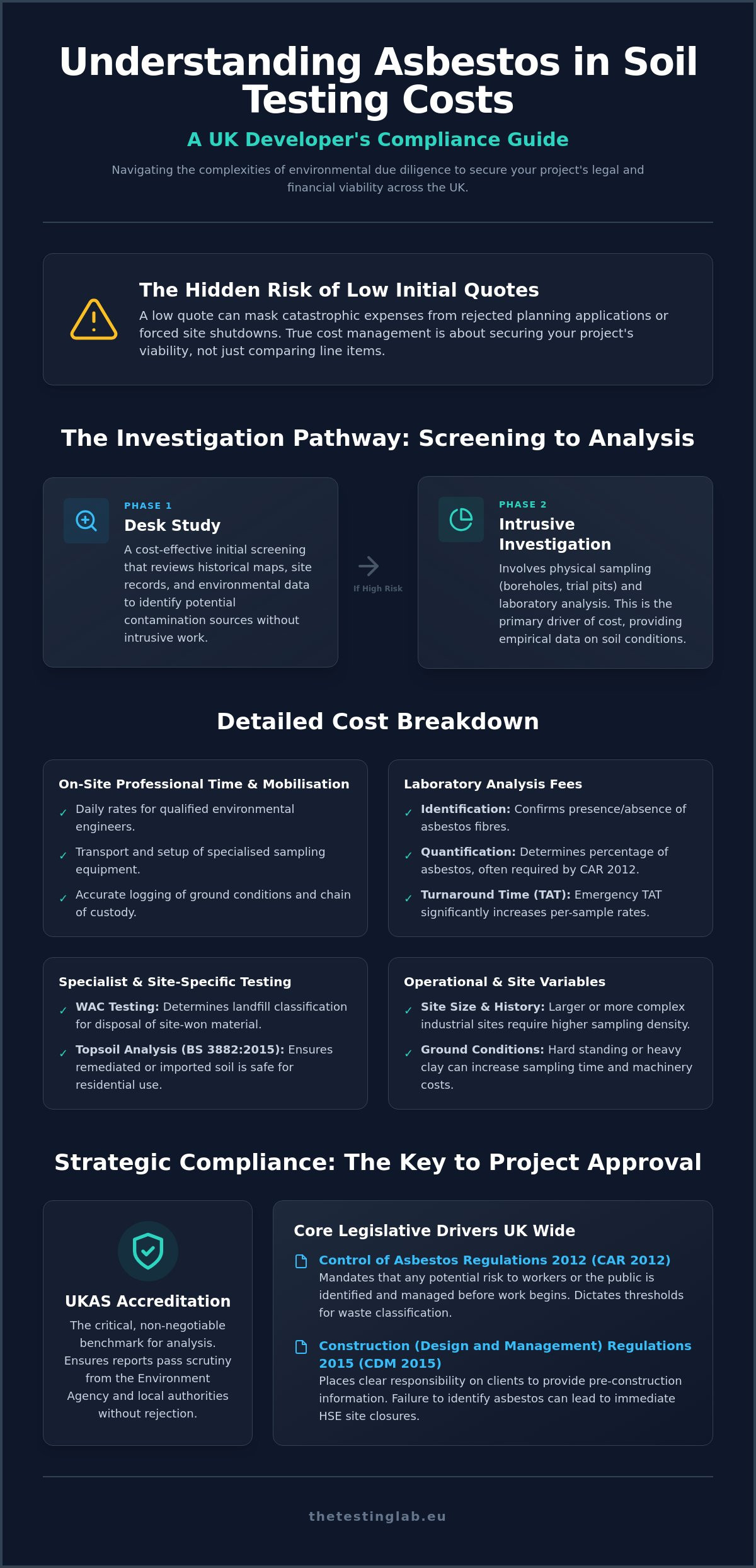
A Phase 1 Desk Study serves as the initial, cost-effective screening. It reviews historical maps and records to identify potential contamination sources. If this study flags high-risk indicators, such as previous demolition or industrial waste disposal, a Phase 2 Intrusive Investigation becomes essential. This transition involves physical sampling and laboratory analysis, which is the primary driver behind the overall asbestos in soil testing cost UK for a project. Moving to Phase 2 ensures that decisions are based on empirical data rather than assumptions.
Legislative Drivers and Regulatory Scrutiny
The Construction (Design and Management) Regulations 2015 (CDM 2015) place clear responsibilities on clients to provide pre-construction information. Failure to identify asbestos in the soil can lead to immediate site closures by the HSE. Local planning authorities also play a pivotal role, often making a compliant asbestos in soils report a pre-commencement condition for planning approval. Without a robust, legislative-grounded report, your project risks significant delays and regulatory rejection. Precision at this stage prevents budget creep later in the development cycle.
Detailed Breakdown of Soil Analysis and Laboratory Fees
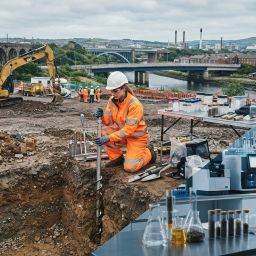
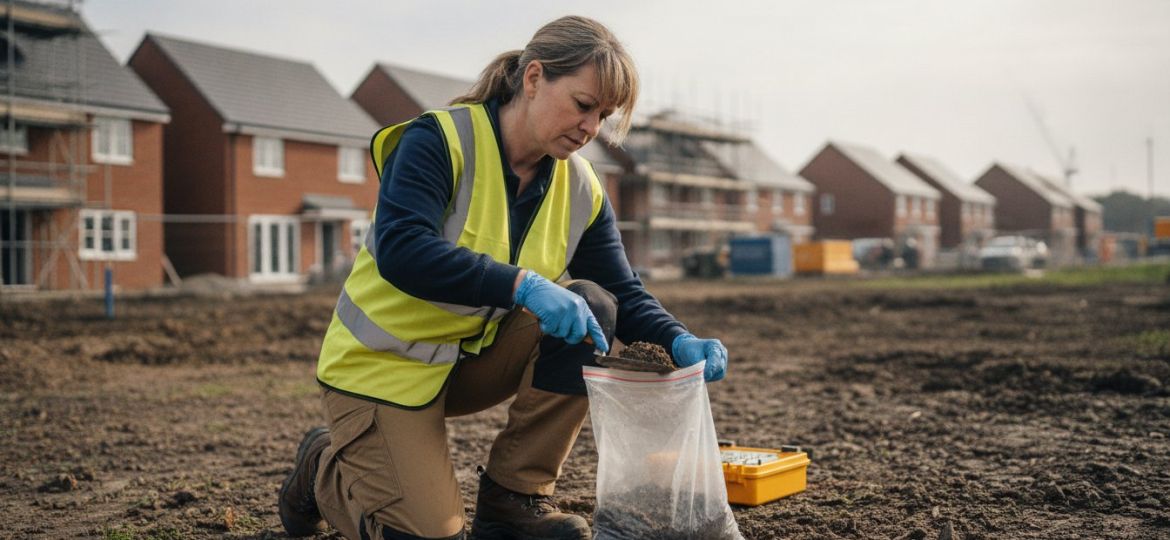
Determining the asbestos in soil testing cost UK requires a granular look at both field operations and laboratory precision. Initial expenses stem from mobilization. This covers the transport of specialized sampling equipment and the daily rate for qualified environmental engineers. Their time isn’t just for taking samples. They must log ground conditions accurately and ensure a secure chain of custody. Official UK Government Asbestos Guidance highlights that asbestos in soil presents unique management challenges, which makes professional oversight mandatory for legal compliance.
Once samples reach the laboratory, costs diverge based on the required depth of analysis. Standard identification confirms the presence of fibres. However, full quantification is often necessary to meet CAR 2012 thresholds for waste classification or risk assessment. If you’re working against tight development deadlines, emergency turnaround times (TAT) can significantly increase the per-sample rate. It’s often more cost-effective to integrate asbestos in soils testing into a broader chemical suite rather than ordering it as a standalone service.
Specialist Testing: WAC and Topsoil Analysis
When site-won material must be disposed of, WAC testing becomes a critical budgetary factor to determine landfill classification. For residential projects, topsoil testing to BS 3882:2015 ensures that imported or remediated soil is safe for future residents. Per-sample fees are calculated based on the complexity of the contaminant suite, ranging from basic screening to comprehensive heavy metal and hydrocarbon analysis.
Operational Variables: Boring and Sampling
Site size dictates the number of boreholes or trial pits required to achieve a statistically representative sample set. Larger sites naturally incur higher operational costs due to the extended time needed for intrusive works. Ground conditions, such as hard standing or heavy clay, also impact the speed of sampling and the type of machinery required. If you’re unsure about the sampling density required for your project, you can request a tailored technical quote to establish baseline costs early.
Strategic Compliance: Minimising Risk with UKAS Accredited Analysis
Selecting a laboratory isn’t just a procurement task; it’s a risk management decision. While some providers offer lower rates, the real asbestos in soil testing cost UK includes the potential for regulatory rejection if the analysis lacks UKAS accreditation. The Environment Agency and local planning authorities demand data that meets the highest technical standards. By following the Industry Guidance for Asbestos in Soil, developers ensure their site investigation reports are legally robust and scientifically defensible. Precision at this stage is the only way to avoid the exponentially higher costs of re-sampling and project delays.
Working with an independent, UKAS accredited lab removes the burden of professional liability from the developer’s shoulders. When you treat testing as a strategic partnership rather than a commodity, you gain access to precision data that informs your entire remediation strategy. This methodological accuracy prevents the catastrophic costs of over-engineering a solution for contamination that may not exist at hazardous levels. We provide this level of expertise UK wide, ensuring consistent quality and a unified asbestos in soil testing cost UK strategy across your entire property portfolio.
The Value of Technical Competence and MCERTS
Regulators specifically look for MCERTS accreditation when reviewing chemical soil analysis. This standard confirms that the laboratory operates with the specific technical competence required for environmental monitoring. Precise quantification of asbestos fibres allows for accurate waste classification. This prevents projects from over-spending on hazardous waste disposal fees by potentially reclassifying material as non-hazardous where the data supports it. It’s a clear example of how technical excellence directly protects your project’s bottom line.
Securing Your Environmental Compliance
Achieving first-time approval from planning authorities requires a proactive approach to site investigation. You can request a specialist environmental survey quote to align your project with current legislative requirements. For developers managing assets in the capital, our guide on local asbestos and legionella surveying offers deeper insights into navigating the specific regulatory landscape of high-density urban environments. Securing accurate data today ensures your development remains on track and within budget tomorrow.
Securing Your Project Through Precise Environmental Analysis
Managing environmental risks on brownfield sites requires more than just a box-ticking exercise; it’s about protecting your investment from the ground up. By understanding how site history and sampling density influence the asbestos in soil testing cost UK, you can budget with confidence and avoid the catastrophic delays that stem from non-compliant reporting. Precision in your initial investigation is the most effective way to prevent budget creep and ensure your project satisfies planning conditions without the need for expensive re-testing.
Technical excellence is your best defense against regulatory scrutiny. Choosing a partner that provides UKAS accredited laboratory analysis and independent professional consultancy ensures your project meets the rigorous standards of CAR 2012. Our UK-wide service coverage provides consistent, high-quality data that scales with your project’s needs, whether you’re managing a single site or a large portfolio. Strategic compliance doesn’t just manage risk; it streamlines your path to site commencement.
Ready to secure your site’s future with data you can trust? Request a Quote for UKAS Accredited Soil Testing today. We’re here to take the technical burden off your shoulders and keep your development moving forward safely.
Frequently Asked Questions
How much does a Phase 1 asbestos in soil report cost in the UK?
A Phase 1 desk study is the initial risk assessment stage, primarily involving historical research and site walkovers. While costs vary based on site size and the volume of historical data to review, this stage is significantly more affordable than intrusive sampling. It serves as the foundation for determining if further, more expensive investigations are required UK wide under the Control of Asbestos Regulations 2012.
What factors cause Phase 2 soil testing costs to increase?
Several operational variables directly impact the asbestos in soil testing cost UK during a Phase 2 investigation. The primary drivers include the required sampling density, the depth of boreholes or trial pits, and the complexity of the ground conditions. The need for rapid laboratory turnaround times or full quantification of fibres instead of simple identification will also add a premium to the standard testing quote.
Is asbestos soil testing mandatory for all UK brownfield sites?
While not every single brownfield site requires intrusive testing, UK legislation makes a formal risk assessment mandatory. Under the Control of Asbestos Regulations 2012 and CDM 2015, developers have a legal duty to identify and manage asbestos risks. Local planning authorities typically mandate a compliant soil contamination report as a pre-commencement condition for any site with an industrial or infill history.
Does a standard soil contamination report include asbestos quantification?
No, a standard screening report usually only identifies the presence or absence of asbestos fibres. Full quantification, which measures the exact percentage of asbestos by mass, is a more complex laboratory process and often requires a separate request. This higher level of detail is essential for accurate waste classification and for designing a precise remediation strategy that avoids unnecessary hazardous waste disposal costs.

Article by
P J F Thomas
CEO and Founder of TTL plc.
Disclaimer
Items declared are AI generated but do reflect our services. Please get in contact if you have any questions.