
Did you know that the systematic reuse of ground investigation data is estimated to contribute approximately £1.2 billion per year to the UK economy? With the introduction of the Geotechnical Data Bill in March 2026, understanding how to interpret a geotechnical report for foundations has never been more critical for project efficiency. If you’re currently staring at a stack of borehole logs, you’re likely feeling the pressure of this complexity. It’s common to feel overwhelmed by technical terminology, especially when a single misunderstood value could lead to an over-engineered foundation or a missed soil risk like sulphates.
This guide provides a professional framework to help you master the technical jargon and critical data points required for UK wide projects. We’ll show you how to identify the safe bearing capacity of the soil and determine required foundation depths while adhering to BS EN 1997 (Eurocode 7) standards. By understanding these metrics, you’ll be able to decide if specialist solutions like piles are necessary or if traditional footings will suffice. For broader site safety, including ground contamination and hazardous materials, our pillar page on local asbestos and legionella surveying offers additional strategic insights for your development.
Key Takeaways
- Understand how these reports align with UK Building Regulations Part A to ensure structural integrity and legal compliance UK wide.
- Learn how to interpret a geotechnical report for foundations by identifying critical soil strata and locating the ‘Allowable Bearing Capacity’ within complex borehole logs.
- Discover the specific data thresholds that dictate the choice between cost-effective shallow strip foundations and more robust raft foundations.
- Identify subsurface risks early, such as high water tables or variable peat layers, to prevent over-engineering and unnecessary project costs.
- Gain the confidence to collaborate with UKAS accredited labs for soil investigation testing, ensuring your data is precise and defensible.
What is a Geotechnical Report and Why is it Critical for UK Foundation Design?
A geotechnical report acts as the technical blueprint for any construction project. It provides the empirical data required to bridge the gap between architectural vision and geological reality. For developers operating UK wide, learning how to interpret a geotechnical report for foundations is both a legal and structural necessity. These documents don’t just describe the ground; they quantify the risks associated with soil, rock, and groundwater conditions to ensure full compliance with Building Regulations Part A (Structure).
The investigation process typically moves from a Phase 1 Desk Study to a Phase 2 Geotechnical investigation. While the desk study reviews historical records and maps, the site investigation involves physical drilling, sampling, and in-situ testing. Prioritising UKAS accredited laboratory testing for these samples is vital for data integrity. Without this level of precision, your foundation design rests on guesswork rather than verified science, which can lead to costly delays or structural failure.
The Regulatory Framework: BS EN 1997 and Eurocode 7
Geotechnical design in the UK is standardised by BS EN 1997, or Eurocode 7. This framework ensures a unified approach to limit state design, focusing on how soil reacts under specific loads. A ‘Competent Person’, typically a chartered engineer, must oversee the interpretation of this site data. This expertise is critical during early project stages, where UKAS accredited asbestos testing and asbestos in soils analysis protect both the site workers and the project’s legal standing. You can find more about site safety and environmental compliance at our pillar page for local asbestos and legionella surveying.
Key Components of the Report Structure
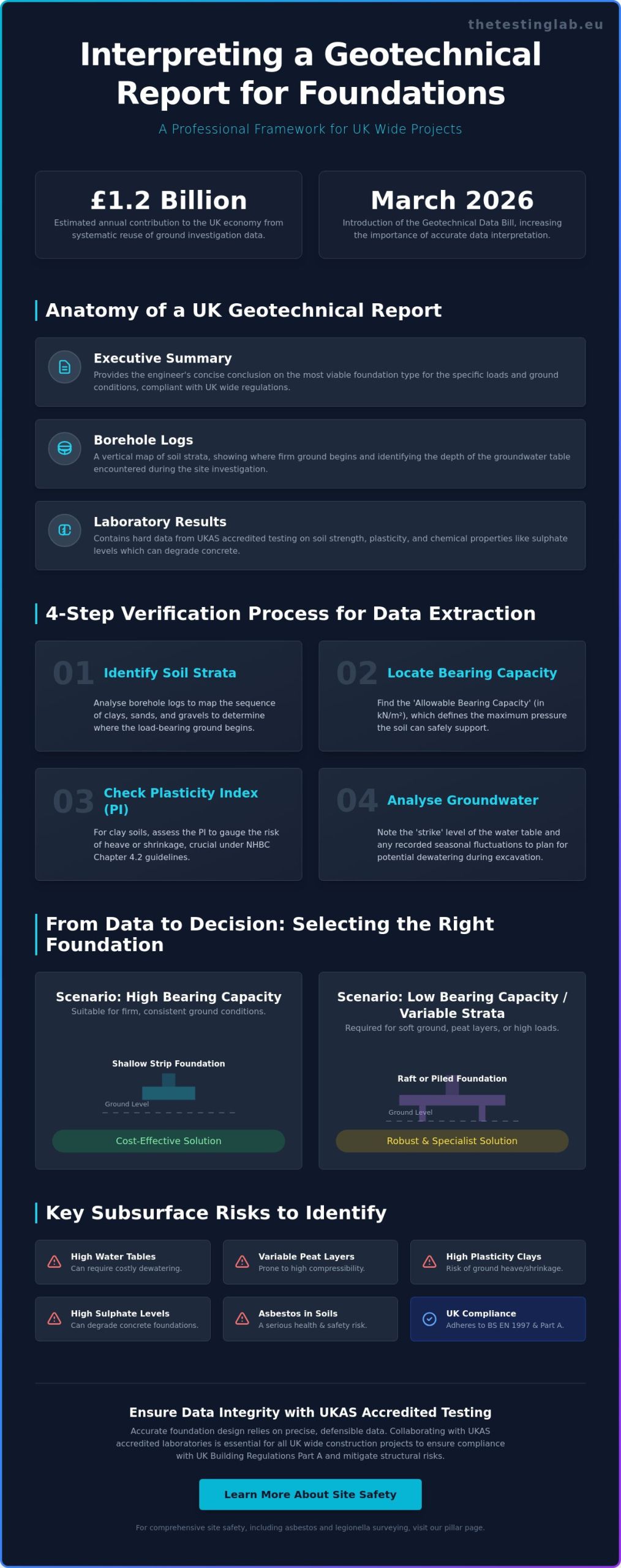
A well-structured report allows you to extract critical information quickly. To understand how to interpret a geotechnical report for foundations effectively, you should focus on these three pillars:
- Executive Summary: This section contains the engineer’s concise conclusion regarding the most viable foundation type for your specific loads and ground conditions.
- Borehole Logs: These provide a vertical map of the soil strata. It shows you exactly where firm ground starts and identifies the depth where groundwater was encountered.
- Laboratory Results: These offer the hard data on soil strength, plasticity, and chemical properties, such as sulphate levels, that might degrade concrete over time.
Deciphering Technical Data: Soil Strata, Bearing Capacity, and Water Tables
Once you understand the report structure, the next challenge is extracting the specific metrics that dictate foundation design. Learning how to interpret a geotechnical report for foundations requires a systematic approach to the data sheets. Engineers across the UK wide construction sector use a four step verification process to translate raw data into design parameters.
- Step 1: Identify the soil strata via borehole logs. You’re looking for the sequence of clays, sands, gravels, or peat to determine where the load bearing ground begins.
- Step 2: Locate the ‘Allowable Bearing Capacity’. This value, typically expressed in kN/m², defines the maximum pressure the soil can safely support without excessive settlement.
- Step 3: Check the Plasticity Index (PI) in clay sections. This is vital for assessing the risk of heave or shrinkage, especially if trees are nearby.
- Step 4: Analyse the groundwater table. Look for the ‘strike’ level and any notes on seasonal fluctuations that might require dewatering during excavation.
Understanding Soil Classification and Plasticity
In the UK, clay soils are categorized by their plasticity. High plasticity clays are prone to significant volume changes, which directly impacts foundation depth under NHBC Chapter 4.2 guidelines. The Plasticity Index is a numerical measure of a soil’s potential to change volume in response to varying water content. Designers also rely on Standard Penetration Test (SPT) ‘N’ values to gauge soil density and consistency. A low ‘N’ value in granular soil suggests loose packing, potentially necessitating ground improvement or deeper footings. For a broader look at site risk management, visit our pillar page on local asbestos and legionella surveying.
Chemical Risks: Sulphates and Concrete Specification
Soil chemistry is just as important as physical strength. You must check the water soluble sulphate levels and pH to prevent concrete degradation. This data is translated into ACEC (Aggressive Chemical Environment for Concrete) classifications, which dictate the type of cement required. For projects on brownfield land or sites with complex mineralogy, we offer specialist services like XRD analysis to identify exact mineral compositions. Ensuring your concrete specification matches these chemical risks is a non negotiable step for long term structural health. If you need precise data for your next project, our UKAS accredited soil investigation testing provides the professional accuracy your design team requires.
From Data to Action: Selecting the Right Foundation Type
The transition from raw data to structural implementation is the most critical phase of any development project. Mastering how to interpret a geotechnical report for foundations allows you to select a design that balances safety with cost efficiency. For UK wide projects, the choice usually falls into three categories based on the soil’s allowable bearing capacity and strata consistency.
- Shallow Foundations: Strip or trench fill foundations are the standard for sites with firm clay or dense sand layers near the surface. These are cost effective but rely on the ground’s ability to support loads without significant settlement.
- Raft Foundations: If the report indicates weaker or variable ground, a raft foundation spreads the building’s load over a larger area. This is often the preferred solution for sites with minor subsidence risks.
- Deep Foundations: When the borehole logs reveal low bearing capacity at shallow depths, piles become necessary. These transfer the load to more competent strata deep underground.
Before any excavation begins, you must verify the presence of asbestos in soils. Overlooking this environmental risk can lead to immediate site closures and significant legal liabilities under UK health and safety legislation.
Interpreting Professional Recommendations
The ‘Recommendations’ section of your report provides the engineer’s definitive stance on foundation depth and type. Pay close attention to mentions of ‘Made Ground’. This refers to soil that has been previously disturbed or filled; it rarely provides reliable support and usually necessitates deeper foundations or piling. Consulting with specialists for structural surveys ensures that your geotechnical data aligns perfectly with your building’s structural integrity requirements.
Risk Mitigation and Final Compliance
Geotechnical contracts often include ‘unexpected conditions’ clauses. These protect parties if the ground differs from initial samples. To maintain insurance validity, ensure all laboratory testing follows UK wide quality standards through UKAS accredited facilities. Your final checklist should confirm that the foundation design matches every constraint listed in the report, from sulphate levels to the plasticity index. Precision at this stage prevents over-spending on over-engineered solutions while guaranteeing compliance with Building Regulations Part A.
Securing Your Groundwork with Technical Precision
Translating geological data into a stable foundation requires more than just a cursory glance at borehole logs; it demands a rigorous understanding of soil mechanics, chemical classifications, and UK legislation. By mastering how to interpret a geotechnical report for foundations, you ensure that every design choice is defensible, cost effective, and compliant. Whether you’re navigating high plasticity clays or the complexities of made ground, your ability to apply these data points directly impacts the structural integrity of your build.
Accurate ground data is the foundation of project success. At The Testing Lab PLC, we act as your strategic partner to remove the burden of technical risk. Our UKAS Accredited Laboratory provides the precision you need, supported by professional engineering oversight and UK wide service coverage. We’re ready to help you turn complex site investigations into actionable design parameters.
Request a professional soil and material testing quote for your UK project today. Your project’s longevity begins with the precision of your initial ground data.
Frequently Asked Questions
What is the most important number in a geotechnical report for foundations?
The allowable bearing capacity, measured in kilonewtons per square metre (kN/m²), is the most critical figure for foundation design. It defines the maximum pressure the ground can support without structural failure or excessive settlement. Understanding how to interpret a geotechnical report for foundations requires focusing on this value to ensure the soil can safely carry the building’s specific loads under BS EN 1997 standards.
How deep should foundations be based on a soil report in the UK?
Foundation depth depends on the soil strata and plasticity index identified during the site investigation. For UK wide residential projects, NHBC Chapter 4.2 dictates depths based on clay volume change potential and proximity to trees. While standard strip foundations often sit at 1 metre deep, high plasticity clays or tree influence can push this depth to 2.5 metres or necessitate pilled solutions.
What does ‘made ground’ mean in a geotechnical investigation?
Made ground refers to anthropogenic soil layers that have been placed or disturbed by human activity rather than natural geological processes. This often includes demolition rubble, reworked soil, or imported fill material. Because made ground is unpredictable and prone to settlement, it’s rarely suitable for shallow footings and often requires deeper excavations or specialized testing for contaminants. For sites with complex histories, our local asbestos and legionella surveying services provide essential environmental risk data.
Can I design my own foundations using a geotechnical report?
You shouldn’t design your own foundations because UK Building Regulations Part A requires a ‘Competent Person’ to sign off on structural designs. While learning how to interpret a geotechnical report for foundations helps you understand site risks and budget requirements, a Chartered Structural or Civil Engineer must perform the final calculations. Professional oversight ensures your design is safe, insured, and legally compliant across all UK wide jurisdictions.

Article by
P J F Thomas
CEO and Founder of TTL plc.
Disclaimer
Items declared are AI generated but do reflect our services. Please get in contact if you have any questions.