
In 2026, a laboratory report isn’t just a technical document; it’s your primary defense against a regulatory rejection or a project-halting stop notice. You’re likely aware that inaccurate data leads to the high costs of misclassified waste and critical delays in construction. Choosing a contaminated land soil testing laboratory UK that operates with technical precision is a strategic risk management decision that impacts your entire project lifecycle. We recognize the pressure of meeting the Environment Agency’s latest standards while aiming to save on landfill tax through accurate waste classification.
This guide provides the framework you need to master the criteria for selecting a UKAS-accredited laboratory, ensuring full legal compliance with UK environmental law. You’ll learn how to navigate the April 2026 MCERTS standards for rapid measurement and the Street Works UK Material Classification Protocol, which requires classification before any material moves. We’ll also examine how reliable data for risk assessments, including specialized asbestos and legionella surveying, provides the foundation for safe, UK-wide site development.
Key Takeaways
- Identify why ISO 17025 and MCERTS accreditations are the essential benchmarks for technical competence and regulatory acceptance in the UK.
- Learn how accurate WM3 waste classification protects your budget by ensuring correct disposal routes and minimizing landfill tax liabilities.
- Master the logistical criteria for choosing a contaminated land soil testing laboratory UK that offers secure chain of custody and rapid turnaround times UK wide.
- Explore the necessity of integrated asbestos and legionella surveying to mitigate long-term environmental and health risks on complex development sites.
Essential Accreditations: Why UKAS and MCERTS are Non-Negotiable
Selecting a partner for site investigation isn’t just a procurement checkbox; it’s a critical risk management step. When choosing a contaminated land soil testing laboratory UK, you’re essentially buying insurance for your planning application and legal standing. Without the correct credentials, your site investigation data is effectively worthless in the eyes of regulators. The UK Contaminated Land Framework demands rigorous evidence that soil has been analyzed under controlled, repeatable conditions to protect human health and the environment.
The Legal Weight of ISO 17025 in the UK
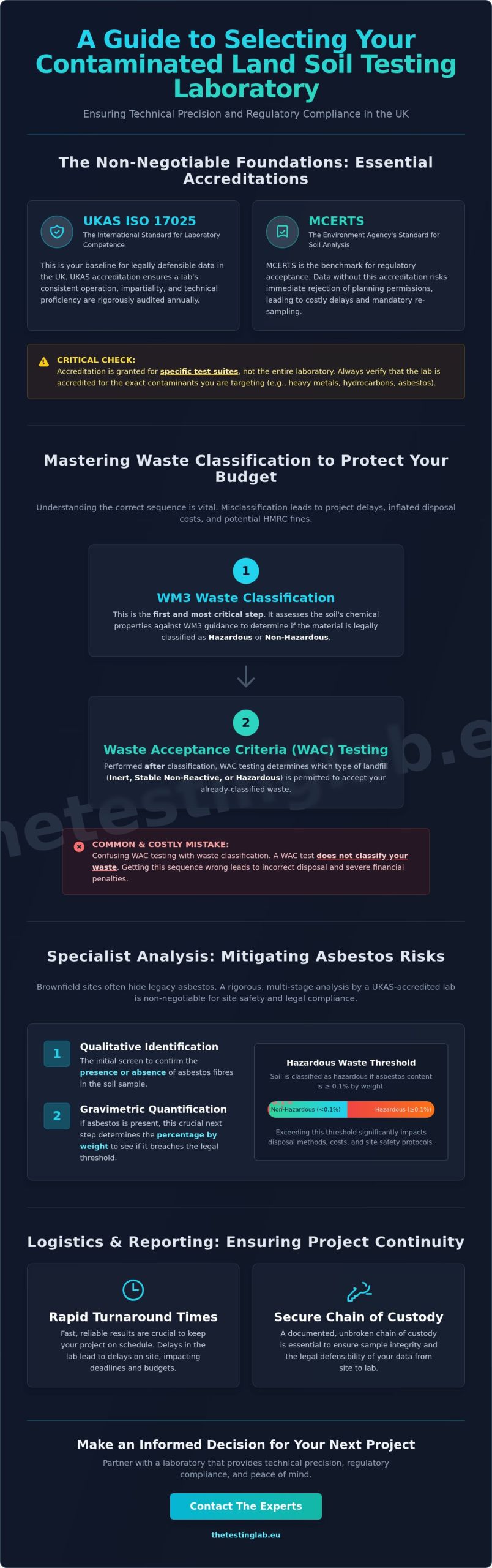
ISO 17025 is the international standard that specifies the general requirements for the competence, impartiality, and consistent operation of laboratories. In the UK, the United Kingdom Accreditation Service (UKAS) performs rigorous annual audits to verify that a facility doesn’t just own the right equipment, but possesses the technical proficiency to use it accurately. This accreditation provides the baseline for any professional environmental assessment UK wide, ensuring that data is both reliable and legally defensible.
MCERTS: The Standard for Regulatory Acceptance
The Environment Agency established the Monitoring Certification Scheme (MCERTS) to provide a framework for high-quality environmental measurements. For soil analysis, MCERTS is the specialized extension of ISO 17025 that planning authorities and environmental regulators prioritize during the review process. If your laboratory results aren’t MCERTS accredited, you risk immediate rejection of planning permissions or environmental permits. This often leads to catastrophic project delays and forced re-sampling costs.
It’s a common misconception that a lab is “accredited” for everything once they pass a general audit. In reality, accreditation is granted for specific test “suites.” You must verify that your chosen partner is specifically accredited for the contaminants you’re targeting, such as heavy metals, hydrocarbons, or asbestos in soils. Relying on non-accredited data can double your investigation budget instantly if a regulator demands a complete site re-test.
Evaluating Laboratory Specialisms: WAC, WM3, and Asbestos in Soils
Choosing a contaminated land soil testing laboratory UK requires more than just checking for a UKAS logo. It’s about matching the lab’s technical specialism to your project’s specific risks. While many facilities offer basic chemical suites, the financial difference between a project’s success and a budget blowout often lies in specialist waste classification and mineralogical analysis. Relying on a generalist lab for complex brownfield sites can lead to data gaps that stall development for months.
Waste Acceptance Criteria (WAC) and Waste Classification
It’s vital to distinguish between hazardous waste assessments and WAC testing. Many developers mistakenly believe a WAC test classifies waste; it doesn’t. Classification happens first via WM3 testing to determine if the material is hazardous or non-hazardous. WAC testing only determines which type of landfill can accept that waste once it’s already been classified. Getting this sequence wrong leads to misclassification, which can trigger heavy HMRC Loss on Ignition (LOI) fines and inflated disposal costs. Following Official UK Government Guidance ensures your classification process remains compliant and cost-effective UK wide.
The Risks of Asbestos in Contaminated Land
Brownfield sites frequently contain legacy asbestos from demolished structures or historic fill. Identifying these fibres requires a rigorous, multi-stage approach. First, the lab performs qualitative identification to confirm the presence of asbestos. If found, they must proceed to gravimetric quantification to determine if the concentration exceeds the 0.1% hazardous waste threshold. Using a facility with UKAS accredited asbestos in soils testing is non-negotiable for site safety and legal protection.
For complex industrial sites, standard chemical analysis might not provide the full picture. Specialized techniques like XRD analysis and XRF analysis allow for precise mineral identification and elemental profiling. These tools are essential when dealing with slag, ash, or unusual industrial by-products. If you’re managing a complex redevelopment, integrated surveying and testing can significantly streamline your compliance strategy and reduce the risk of unexpected site discoveries.
Logistics and Reporting: Ensuring Project Continuity UK Wide
Analytical precision is meaningless if the physical sample loses its integrity before reaching the bench. When choosing a contaminated land soil testing laboratory UK, you must evaluate their logistical infrastructure as rigorously as their UKAS schedule. A laboratory should act as a strategic partner, helping you fulfill your obligations under the Health and Safety at Work Act 1974 by providing defensible data that protects both your workforce and the public. This partnership ensures that your site investigation remains a robust defense against future litigation.
Sample Integrity and Chain of Custody
Data Delivery and Regulatory Liaison
Modern construction schedules don’t have room for slow turnaround times. Efficient laboratories provide digital portals for real-time tracking, allowing you to view preliminary results as they’re validated. This transparency is crucial when adhering to official UK guidance on contaminated land. Beyond raw data, a laboratory’s ability to provide interpretive reporting adds significant value. When the Environment Agency or a local planning authority raises technical queries about a specific contaminant suite, having a laboratory partner that can provide technical justification can save weeks of back-and-forth negotiations. Providing reliable, UK-wide logistics ensures that whether your site is in London or the Highlands, your project continuity remains uninterrupted.
Future-Proofing Your Site Through Technical Precision
Managing the 2026 regulatory landscape requires more than just a service provider; it demands a partnership grounded in technical competence and legal accuracy. We’ve explored how UKAS and MCERTS accreditations form the bedrock of regulatory acceptance, while specialist suites like WM3 and WAC testing prevent the financial pitfalls of waste misclassification and regulatory rejection.
Ultimately, choosing a contaminated land soil testing laboratory UK is a decision about project resilience. By prioritizing laboratories that offer robust chain of custody protocols and UK-wide logistical support, you ensure your data remains defensible against the strictest environmental scrutiny. This approach protects your timelines and your bottom line from the risks of construction delays and landfill tax errors.
The Testing Lab PLC provides the professional oversight needed to manage these complex variables. With our UKAS accredited laboratory analysis and deep expertise in WAC and WM3 compliance, we provide UK-wide technical support and consultancy to streamline your site assessments. Request a UK-wide contaminated land testing quote from The Testing Lab PLC today. We’re ready to help you achieve full compliance and operational excellence on your next project.
Frequently Asked Questions
What is the difference between UKAS and MCERTS accreditation?
UKAS accreditation to ISO 17025 confirms a laboratory’s general technical competence and impartiality; whereas MCERTS is the Environment Agency’s performance standard specifically for environmental monitoring. For soil analysis, MCERTS provides the regulatory framework that ensures data is acceptable for planning and permitting. Most UK regulators require both to ensure results are technically sound and legally compliant across the project lifecycle.
How long does a standard contaminated land soil analysis take in the UK?
Standard turnaround times for soil analysis typically range from five to ten working days; however, express services can deliver results in as little as 48 hours. The complexity of the suite, such as detailed asbestos quantification or heavy metal leaching, influences the duration. When choosing a contaminated land soil testing laboratory UK, you should align these timelines with your construction schedule to prevent costly site delays.
Is asbestos testing mandatory for all UK brownfield developments?
Asbestos testing is required under the Control of Asbestos Regulations 2012 (CAR 2012) whenever there is a reasonable likelihood of asbestos fibres being present. Given the industrial history of UK brownfield sites, most local authorities and the Environment Agency mandate identification and quantification as part of the initial site investigation. Failure to test can lead to significant health risks, legal prosecution, and immediate site closure.
Can I use a soil testing kit for regulatory planning applications?
Off-the-shelf soil testing kits are not acceptable for regulatory planning applications or environmental permits. UK planning authorities require data produced by a UKAS-accredited facility to ensure the results are accurate and reproducible. While kits might provide indicative data for private use, they lack the technical rigor and chain of custody required for professional contaminated land assessments and legal compliance.
What are the consequences of incorrect soil waste classification?
Incorrect waste classification often results in significant financial penalties, including HMRC Loss on Ignition (LOI) fines and inflated landfill tax liabilities. Beyond the monetary impact, misclassifying hazardous waste as non-hazardous can lead to criminal prosecution under the Environmental Protection Act 1990. It also causes logistical failures UK wide, as waste disposal sites will reject material that doesn’t match its accompanying documentation.
How do I check if a laboratory is currently UKAS accredited?
You can verify a laboratory’s status by searching the United Kingdom Accreditation Service (UKAS) online database. It’s essential to download the laboratory’s “Schedule of Accreditation” to confirm they’re accredited for the specific tests you require. Simply being an accredited facility isn’t enough; the individual methods for soil, water, or asbestos must be explicitly listed on their current schedule to ensure data validity UK wide.

Article by
P J F Thomas
CEO and Founder of TTL plc.
Disclaimer
Items declared are AI generated but do reflect our services. Please get in contact if you have any questions.